


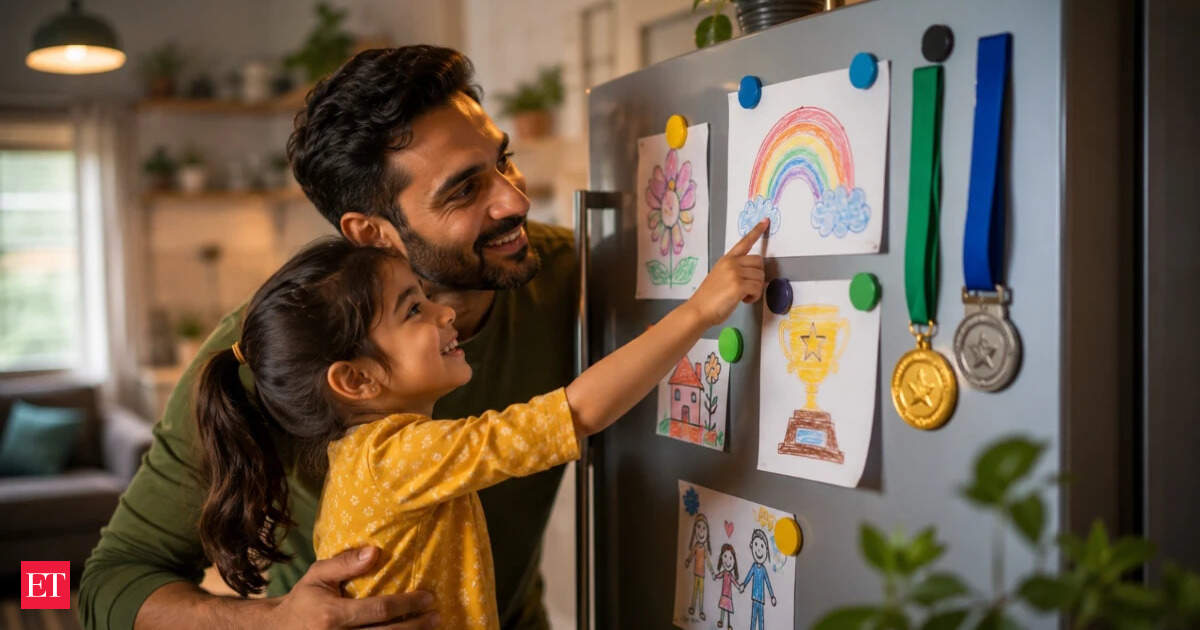
A refrigerator covered with children’s drawings, school certificates, photographs and medals can look like an ordinary feature of family life. But psychologically, the habit may communicate something much deeper. When parents prominently display a child’s artwork or achievement, they are making the child’s effort visible, memorable and socially meaningful. The behavior can be connected with parental pride, positive reinforcement, children’s need for competence and the development of motivational beliefs. It does not automatically mean parents are overly competitive or trying to show their children off. In many families, the refrigerator becomes a small public stage where parents communicate, “What you did matters to us.”
Psychology Says Displaying a Child’s Work Can Communicate Recognition
Children do not develop their understanding of their abilities entirely on their own. Feedback from important adults can influence how they interpret success, effort and competence.Research by psychologist Elizabeth Gunderson, Carol Dweck and colleagues found that parents’ process praise during early childhood was associated with children’s later incremental motivational frameworks, beliefs that abilities can develop through effort and learning. The longitudinal study followed children into elementary school and found that early process praise predicted later academic achievement through these motivational beliefs.Displaying a child’s painting is not the same thing as verbally praising effort, and researchers have not established that putting artwork on a refrigerator directly creates a growth mindset.But the behavior can serve as another form of positive social feedback. The child sees that their creation has been considered important enough to occupy a visible place in the home.You Might Also Like:

Psychology says if you cannot put a book down mid-chapter, your brain may hate leaving stories unfinished
Psychology Says Children Have a Basic Need to Feel Competent
Self-Determination Theory, developed by psychologists Edward Deci and Richard Ryan, identifies competence, autonomy and relatedness as fundamental psychological needs.Competence involves feeling capable and effective. Relatedness involves feeling connected and valued by others.When a parent proudly places a child’s painting on the refrigerator, the action can potentially support both. The message is not necessarily, “You are the best artist.”It may simply be: “We noticed what you created, and we value it.”Research examining parental praise similarly suggests that positive feedback can be associated with children’s motivation, particularly when it emphasizes effort, strategies and actions rather than fixed personal qualities.
Psychology Says the Refrigerator Can Become a Symbol of Family Identity
Family objects often carry emotional meaning beyond their practical purpose. A child’s first painting, football medal or school certificate may represent a particular moment in the family’s history. Keeping it visible can transform an ordinary object into a shared family memory.Psychologically, this can contribute to a sense of family identity and belonging. The refrigerator is especially interesting because it occupies a highly visible location. Family members repeatedly encounter it while eating, cooking or passing through the kitchen.The artwork therefore becomes part of the everyday environment rather than something hidden away in a drawer. For parents, seeing it repeatedly can also reinforce their own memory of the child’s development: This was when she first started drawing. This was his first medal.
Psychology Says Parents May Be Reinforcing Effort Without Realizing It
Imagine a child comes home with a drawing that is far from technically perfect. The parent puts it on the refrigerator anyway. That action can communicate something different from simply saying, “You’re talented.”It can signal that participation, creativity and effort are worth recognizing. This distinction matters because research on process praise has repeatedly found different motivational associations compared with praise focused on fixed traits.In a longitudinal study, children who received relatively more process praise from parents in their early years were more likely to develop incremental motivational frameworks and later showed stronger academic achievement through those beliefs.Other research has similarly found that process praise can be associated with learning goals and adaptive responses to challenges.
Psychology Says A Medal on the Fridge Can Become a
Operant conditioning, associated with psychologist B.F. Skinner, provides another useful perspective. Behavior that receives positive consequences can become more likely to be repeated.A child who practices piano, enters an art competition or trains for a race may receive encouragement, attention and recognition from parents. Displaying the resulting achievement can become another rewarding social consequence.However, this does not mean every child whose medal is displayed will become motivated solely by external rewards. The effect depends on the broader parenting environment.If the message is “We love you because you win,” the child may begin associating worth with performance. If the message is “We are proud of the work and commitment you put into this,” the experience may support a more mastery-oriented interpretation.Research on praise shows why that distinction matters. Children praised for fixed ability can respond differently to setbacks than children whose effort and strategies are recognized.
Psychology Says Parents May Also Be Celebrating Their Own Emotional Experience
There is another side to the behavior. Parents are not emotionally neutral observers of their children’s accomplishments. A child’s achievement can produce parental pride, joy and a sense of shared accomplishment.A refrigerator covered in children’s achievements can therefore represent the parent’s emotional attachment to their child’s development.The display may communicate something about the parent too: I was there when this happened. I remember this moment. This is part of our family story.That does not necessarily make the behavior narcissistic or competitive. For many parents, it is simply an everyday expression of affection.
Psychology Says The Meaning Depends on What Parents Emphasize
The same medal can send very different psychological messages. A parent who says, “You worked incredibly hard for this,” emphasizes effort and persistence.A parent who repeatedly says, “You’re naturally the smartest child,” emphasizes a fixed characteristic.Research by Dweck and colleagues suggests these different forms of feedback can shape how children interpret ability, challenge and failure. So the psychology is not really about the refrigerator.It is about what the display represents within the parent-child relationship. For one family, the refrigerator is a gallery of trophies. For another, it is a gallery of memories. And for many parents, it is simply a very visible way of telling their child: “We see you. We are proud of you. What you create matters.”
Why do parents put their children’s drawings on the refrigerator?Displaying children’s artwork can be a simple way of showing attention, affection and recognition. It may also make the child’s creative efforts part of the family’s everyday environment.Does displaying a child’s medals make them more confident?There is not enough evidence to say that refrigerator displays directly increase confidence. However, research on parental feedback shows that how parents recognize children’s effort and abilities can be associated with motivational beliefs, persistence and learning.Add 
as a Reliable and Trusted News Source

Add Now!
(You can now subscribe to our Economic Times WhatsApp channel)
Read More News on
children’s achievements displaychild developmentmotivation in childrenparenting tipsimportance of children’s artworkpsychology of praise
(Catch all the US News, UK News, Canada News, International Breaking News Events, and Latest News Updates on The Economic Times.)
Download The Economic Times News App to get Daily International News Updates
…moreless
(You can now subscribe to our Economic Times WhatsApp channel)
Read More News on
children’s achievements displaychild developmentmotivation in childrenparenting tipsimportance of children’s artworkpsychology of praise
(Catch all the US News, UK News, Canada News, International Breaking News Events, and Latest News Updates on The Economic Times.)
Download The Economic Times News App to get Daily International News Updates
…moreless
