


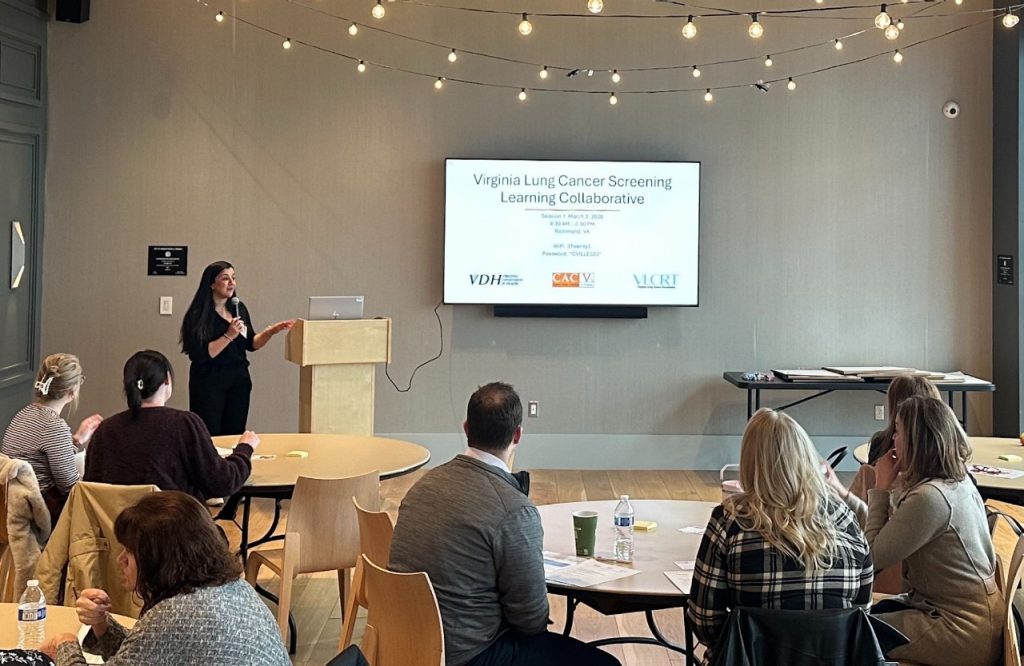
Nine years ago, Amanda Qadado ’14, MPH ’17 was a Virginia Tech public health graduate student helping compile data for the 2018-22 Virginia Cancer Plan
Today, she is the comprehensive cancer control coordinator for the Virginia Department of Health, overseeing development and implementation of the state cancer plan, two iterations later
“It truly is a full circle moment of having worked with the process at Virginia Tech, and now being able to work with Sophie in this collaborative way,” Qadado said. “That we can continue this partnership between the VDH and Virginia Tech, and the fact that it’s lasted multiple iterations, is just a beautiful thing.”
“Sophie” refers to Sophie Wenzel, associate director of the Center for Public Health Practice and Research and an associate professor of practice in the Department of Population Health Sciences, within the Virginia-Maryland College of Veterinary Medicine
The center has received a $33,000 grant from the Virginia Department of Health for facilitation of developing the new cancer plan over a 14-month period.
The plan is a partnership between the health department and the Cancer Action Coalition of Virginia, a nonprofit that drives its development with federal funding support.
“It’s a road map to help Virginia residents address the burden of cancer,” Wenzel said. “It’s setting the strategy for Virginia to address cancer in the state, and it’s multi-pronged, so it really focuses on all the different aspects of cancer.”
The cancer plan is organized around five focus areas:
- prevention;
- early detection,
- diagnosis and cancer-directed therapy;
- survivorship and palliative care; and
- cancers specific to children and young adults.
Each section draws on roughly 10 to 15 subject-matter experts from across the state, and the coalition runs seven roundtables — including groups focused on breast, lung, colorectal, and pediatric cancers, along with patient navigation and HPV immunization — that turn the plan’s goals into action on the ground
Jan Eberth, department head of Population Health Sciences at the veterinary college and a rural health and cancer prevention researcher as a professor of epidemiology and health services research and policy at Virginia Tech, has been tapped to be one of the subject matter experts in the study
Development of the new edition kicks off with a September meeting to review current progress and data needs, before Virginia Tech students spend the fall gathering updated data. A larger meeting in February will bring the groups together to set new objectives and benchmarks, with final content due by next July. The 2028-2032 plan will finalize next fall and take effect on Jan. 1, 2028
Progress is tracked on a dashboard maintained by the health department’s epidemiology team, which measures how the current plan is performing against its targets
For example, the present plan expiring next year set a goal of reducing adult cigarette smoking to 12 percent statewide. As of 2024, Virginia had already reached 11 percent, down from a starting 13.6 percent in 2020
Wenzel said the plan does not claim direct credit for such outcomes, but rather signals that an issue is a shared statewide priority
“The fact that it’s in the plan shows that the subject matter experts have deemed that it’s a priority for the state,” Wenzel said
For Qadado, the work is deeply familiar.
As a master’s student in Virginia Tech’s public health program, she spent months in 2016 gathering screening and prevention data for what became the 2018-22 edition of the plan — research that earned her a line in the plan’s acknowledgments.
Qadado graduated in 2017 and worked at the Richmond City Health District until early 2019 before moving to the state level, eventually transitioning into her current role in August 2024
Now her daily work uses the plan she once helped research. She draws on partnerships across Virginia’s cancer centers, nonprofits, and the coalition’s roundtables to identify where policy or program changes could reduce cancer’s impact, from local screening access to statewide prevention campaigns
“It really allows you to see what the cancer data looks like, to identify down to a locality level what it looks like in your region,” Qadado said of the document, which typically runs more than 60 pages
“If you have cancer survivors in your family, if you are a cancer survivor, the plan also provides an opportunity to know what’s happening in the state, to find your communities, to find causes that really align with your personal and professional interests,” Qadado said. “It provides any lay person the opportunity to learn more about a comprehensive picture of what cancer looks like in Virginia.”
Wenzel said she plans to hire several graduate students from Virginia Tech’s Master of Public Health program to help collect data and draft narrative sections of the new plan — the same kind of work that first brought Qadado into the project a decade ago
Contact:
540-231-9005
