August 12, 2026
Rare Ventures, a First-of-its-kind Platform for Accelerating Rare Disease Therapies, Launches in Pittsburgh
Carnegie Mellon will serve as the technology core, applying its strengths in AI, life sciences and automated science to help accelerate treatments for rare diseases
Media Inquiries
Name
University Communications and Marketing, Media RelationsEmail
Developing treatments for rare diseases presents many challenges: small patient populations, fragmented data and long, complex paths to new therapies. But rare doesn’t mean few. More than 400 million people worldwide live with a rare disease, yet about 95% of the 10,000+ rare diseases don’t have an approved treatment
To help change that, Carnegie Mellon University is a founding partner in a Pittsburgh-based partnership that brings together leaders in medicine, biotechnology and artificial intelligence to speed the development of treatments for rare diseases.
The Richard King Mellon Foundation has committed up to $25 million to launch Rare Ventures™, a first-of-its-kind venture philanthropy platform designed to accelerate the development of therapies for rare diseases and to create a new model for medical innovation
The initiative unites the EB Research Partnership (EBRP), founded by Jill Vedder and Eddie Vedder of Pearl Jam, with Carnegie Mellon, the University of Pittsburgh Health Sciences, UPMC Children’s Hospital of Pittsburgh, UPMC Vision Institute, Stanford Medicine and ElevateBio. By combining AI, clinical research, therapeutic development, manufacturing and commercialization, Rare Ventures aims to create a faster, more coordinated path to treatments and cures. The EBRP is dedicated to funding research aimed at treating and ultimately curing epidermolysis bullosa (EB), a rare genetic condition that causes fragile, blistering skin.
While scientific advances in genomics, gene editing, AI and biotechnology have transformed what’s possible in medicine, turning discoveries into approved therapies remains a slow and difficult process, especially for rare diseases. Rare Ventures aims to close that gap. Carnegie Mellon’s interdisciplinary strengths in AI, life sciences and automated science will be applied to support each stage of the therapeutic process, accelerating the path from initial scientific discovery to meaningful patient impact.
“By bringing together artificial intelligence, venture philanthropy, therapeutic development and world-class institutions, we are building a new model designed to accelerate therapies and create hope for millions of families around the world,” said Michael Hund, CEO of EBRP and co-founder of Rare Ventures.
Carnegie Mellon’s role
Finding a treatment for any disease is a complex challenge. Scientists must first understand the biological cause of a disease, identify the right therapeutic target, design a promising therapy and then find a way to deliver it to the right cells in the body. As the technology core of Rare Ventures, Carnegie Mellon researchers will work across every stage of that process, helping accelerate the path from scientific discovery to patient impact
“The convergence of artificial intelligence, automated chemistry, computational biology, genomics and medicine is creating entirely new possibilities for understanding and treating human disease,” said Barbara Shinn-Cunningham(opens in new window), Glen de Vries Dean of CMU’s Mellon College of Science. “Rare Ventures represents an exciting opportunity to bring together expertise across disciplines to tackle some of the most difficult challenges in healthcare.”
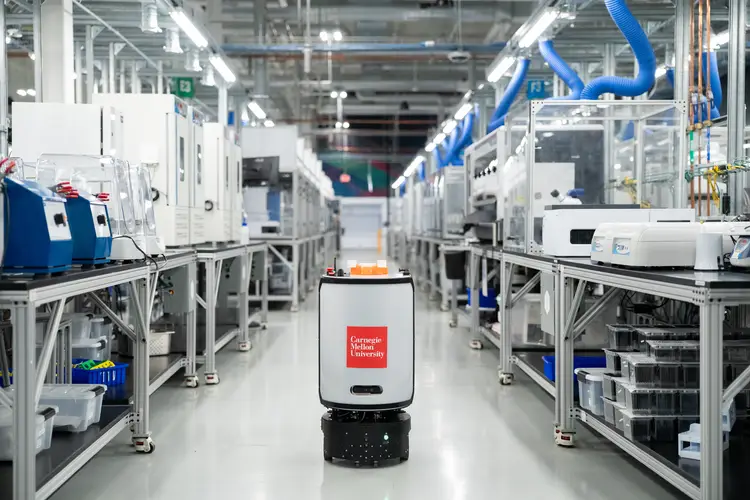
University infrastructure such as the AI Science Foundry(opens in new window) and the new Richard King Mellon Hall of Sciences(opens in new window)will bring together researchers in life sciences and AI, the combination of which will speed breakthroughs. Work in these spaces and with Rare Ventures also will inform another Carnegie Mellon project: the Helix Foundry, which will use automated chemistry to synthesize libraries of nucleic acid molecules for testing as potential therapeutics.
“If you want to push the frontiers of medicine, you need to do it through computational and experimental innovations. As the technology core, we’re positioned to address immediate clinical needs, improve existing technologies and spark new innovations that could dramatically expand the number of diseases that can be treated,” said Bruce Armitage(opens in new window), professor and head of the Department of Chemistry(opens in new window)and co-director of the Center for Nucleic Acids Science and Technology(opens in new window).
Across fields including biological sciences, chemistry, chemical engineering, mechanical engineering and computational biology, CMU researchers are increasingly combining computational, theoretical and experimental approaches. Using automation and AI, they are already accelerating scientific discovery by:
- Developing a new deep learning method(opens in new window), KGWAS, that improves the detection of genetic variants and associated traits for rare diseases, potentially enabling the discovery of new drugs or treatments.
- Using AI to computationally screen thousands of possible chemical structures(opens in new window)to identify potential drug candidates for treating rare diseases.
- Studying pyruvate dehydrogenase complex (PDC) disease, a rare disorder that makes it difficult for the body to turn food into energy. By identifying the genetic mutations that cause the disease, they hope to develop molecules that restore normal protein function.
- Working on diverse methods for delivering therapeutic nucleic acids (opens in new window)to specific tissues and cells. Having options increases the likelihood of finding an effective treatment.
- Developing at home testsfor cancer screening.
Carnegie Mellon researchers will work closely with clinicians at UPMC, UPMC Children’s Hospital and Stanford Medicine, providing technologies ready for clinical testing while developing the next generation of therapies and delivery systems
Interdisciplinary strength in the Steel City
Pittsburgh was chosen as the home of Rare Ventures because of its unique concentration of strengths across AI, life sciences, clinical research, advanced manufacturing and translational medicine.
“Rare diseases represent one of the greatest unmet challenges in medicine, affecting millions of families while receiving only a fraction of the attention and resources devoted to more common conditions,” said Sam Reiman, director and trustee of the Richard King Mellon Foundation. “Rare Ventures brings together an exceptional group of partners around a bold vision: creating the infrastructure, partnerships and innovation ecosystem needed to accelerate therapies for patients. We believe Pittsburgh possesses the talent, institutions and collaborative spirit necessary to lead this effort, and we are proud to support its launch.”
The goal is to create a coordinated, efficient system that streamlines the translation of scientific breakthroughs into approved therapies, bringing new treatments to patients more quickly
“Throughout our work with the EB community, we’ve seen what can happen when patients, researchers, physicians, philanthropists and industry leaders unite around a common purpose,” said Jill and Eddie Vedder, co-founders of EBRP. “Rare Ventures represents the next chapter of that journey. We’re taking lessons learned from one disease and building something that can help families facing thousands of rare diseases. Every patient deserves hope, and every breakthrough deserves the chance to reach the people who need it most.”
Building on a legacy
Rare Ventures builds upon EBRP’s model that has demonstrated success with EB. Over the past 14 years, EBRP has helped fund more than 180 research projects in 22 countries, contributed to the expansion of the EB clinical trial landscape from two active trials to more than 50, and accelerated the development of three FDA-approved therapies in the last three years. Through its pioneering venture philanthropy approach, EBRP has also demonstrated that financial returns generated from successful therapies can be reinvested into future research, creating a sustainable cycle of innovation and impact.
Rare Ventures expands that model beyond a single disease. In addition to epidermolysis bullosa, partners at UPMC have identified six additional rare diseases that will be a focus of the initiative over the next three years.
Rare Ventures is designed to grow into a platform capable of supporting hundreds of disease communities over time. It aims to create a self-sustaining model in which philanthropic capital, venture philanthropy returns, industry partnerships and platform-based infrastructure continuously generate resources that can be reinvested into future therapeutic development. The long-term vision is to create a scalable engine capable of accelerating therapies across hundreds of rare diseases and serving as a blueprint for the future of medical innovation.
“Ultimately, our success will not be measured by the model we build, the capital we deploy, or the partnerships we unite,” Hund said. “It will be measured by the therapies we help bring to patients and the lives we help change. That is the mission that unites everyone behind Rare Ventures and we thank the Richard King Mellon Foundation for making it possible.”
How AI is Advancing Gene Therapy
CMU’s Andreas Pfenning explains how AI is helping researchers develop more targeted gene therapies and identify genetic causes of rare diseases
— Related Content —
Carnegie Mellon’s AI Science Foundry Selected by NSF To Help Build National Infrastructure for AI-Enabled Scientific Discovery
Finding Answers Faster: AI Method Brings Hope to Rare Disease Research