


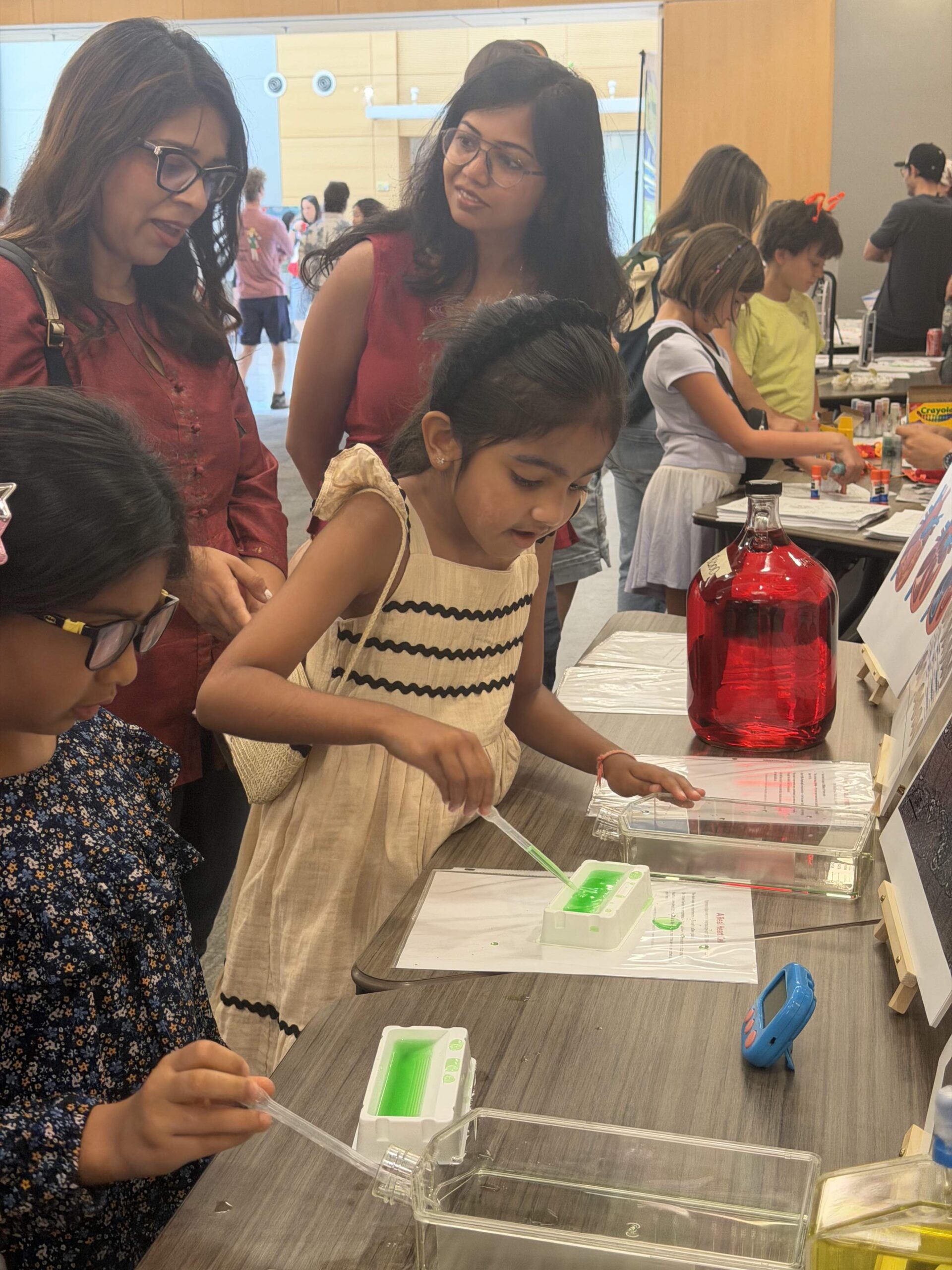
Researchers connect with the public at Summer Science Day
Jul 31, 2026
There’s a different energy in the Eccles Health Science Education Building on Summer Science Day
In the Alumni Hall, parents and children alike grimace as they touch pig lungs with gloved hands. One corner is filled with the music and sounds of computer games, but it’s not Minecraft—it’s perhaps a game about antibiotic resistance, or maybe about using genetic tools in agriculture. As groups, including teens, gaggle through the atrium in disposable lab coats on their way to a lab tour, an enthusiastic Ph.D. student holds up a sign – “Ask me about worms!”— and giggling kids exit the art and craft room with fungal cell coloring pages and bedazzled bead bracelets.
This is Summer Science Day, a free, all-ages event from the U’s Stark Science Learning Center, now in its second year. On Saturday, July 11, 2026, 700 people engaged with 70 science learning opportunities presented by researchers from across the University of Utah. The encounter changed both presenters and attendees for the better
Visitors filled the Alumni Hall, which featured 15 different activity and demo tables. A microscope connected to the room’s projector displayed live imagery of zebrafish embryos on the wall. Children and their parents assembled licorice and marshmallow DNA strands at “DNA Damage Repair: A Delicious Demonstration” and learned about how glitter behaves at the boundary between oil and water at “The Great Glitter Mystery: Where Will the Glitter Go?”
“I was surprised to see how many people were there from many different age groups,” said Ray Heffley, also a SURE undergraduate in the Franklin lab, “and was glad to see a lot of people curious about research and the scientific process.”
Down the hallway, visitors explored presentations, including talks on current research projects like “How cancer tricks the immune system and how immunotherapy fights back” and helpful sessions for prospective or current students, like “What to do to Prepare for Medical School” and “Doing Undergraduate Research at the U.”
“This was such a wonderful opportunity for my kids to explore things that might interest them for college,” one parent wrote. “I love the exposure.”
Further down the hallway, kids and adults in the craft room scribbled with colored pencils on coloring pages exploring biology at scales from proteins to organs to whales. In the science story time room, they learned about firefly research and waved glow sticks to crowd
“I liked that the activities were great for a variety of age ranges, including 8, 5, and 3,” another parent wrote
Researchers opened their labs to public tours, and Summer Science Day attendees jumped at the chance. More than 200 people participated in 19 tours, with most tours at or near capacity. Where required, lab tourists wore white disposable lab coats and safety glassed, provided by ARUP Laboratories.
“These events offer a rare chance to step inside the world of scientific research,” said Marta Szulik, PhD, associate instructor in the Franklin lab who led four tours titled “The Science of the Heart: From Research to Real Life (examine a heart up close!)”
“Visitors can see what researchers do every day, ask questions, and learn how new discoveries are translated into real-world solutions,” Szulik said. “For children, it can spark a lifelong interest in science, and for adults, it provides a better understanding of the research happening in their own community and why it matters.”
“The broader impact of science comes not only from making discoveries, but also from being able to communicate those discoveries effectively,” said Sapp, who led two lab tours and gave two presentations about her work with the model organismC. eleganstitled “The Tiny Worms That Help Us Understand the Brain.”
“Summer Science Day gives researchers an opportunity to practice explaining their work to the general public, making science feel more accessible and helping build trust between scientists and the communities they serve.”
Sapp said Summer Science Day had a “profoundly impactful effect” on her, showing her the importance of communication between researchers and the public
“I was surprised by how many people were genuinely interested in learning about what scientists do,” she said. “From young children to older adults, everyone seemed excited to ask questions and learn something new, even if they hadn’t expected to.”
Summer Science Day was sponsored by University of Utah Health Research,Baxter Aerospace,ARUP Laboratories, and BioHive
Interested in presenting at or sponsoring next year’s Summer Science Day? Contact us at sslc@utah.edu
