


News
Ripples of impact
2026 White Coat Ceremony sets incoming medical students on path to serve, heal and discover
August 24, 2026
Mary Ellen Gabriel
Education
Share
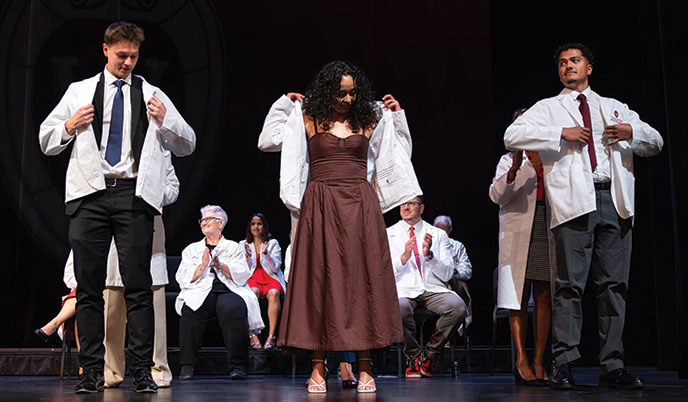
Like pebbles dropped in a pond, incoming medical students create ripples that widen far beyond the University of Wisconsin School of Medicine and Public Health
That was Dean Nita Ahuja’s message to the new class at the annual White Coat Ceremony at Shannon Hall on Friday, August 21
“Throughout your journey here, you will be surrounded by others who have made ripples of impact,” she said. “From today forward. . .imagine yourself as a pebble, ready to make the best ripple the world has ever seen.”
Of the 171 incoming students, 26 will train for rural practice with the Wisconsin Academy for Rural Medicine (WARM). A small percentage will join the Medical Science Training program, a rigorous MD-PhD program that averages eight years to complete and prepares them for careers as physician-scientists
Though their backgrounds and goals are unique, students’ journeys will soon intersect, combine and expand outward through the learning environment, the Madison community and beyond
Reid Goble
Reid Goble brings a professional athlete’s mindset to medical school
Goble grew up on the cross-country ski trails of Petoskey, Michigan and raced on the NCAA circuit for Michigan Tech. After graduation, Goble moved to Bozeman, Montana to train with the Bridger Ski Foundation Pro Team and met his goal of competing in World Cup finals this year
“The best skiers in the world train upwards of 1000 hours a year, so you have to say no to other things,” Goble said. “It’s like medical school — it’s very time consuming and you have to keep your head in it and keep grinding if you want success.”
The best reward for Goble was serving as a sighted guide for visually impaired skier Jake Adicoff in the 2026 Milano-Cortina Paralympic Games in Italy, where they won gold medals in two events: the 10-kilometer distance race and the 4×2.5-kilometer mixed relay. As a guide, Goble’s role was to stay just ahead of Adicoff, an elite Paralympic athlete
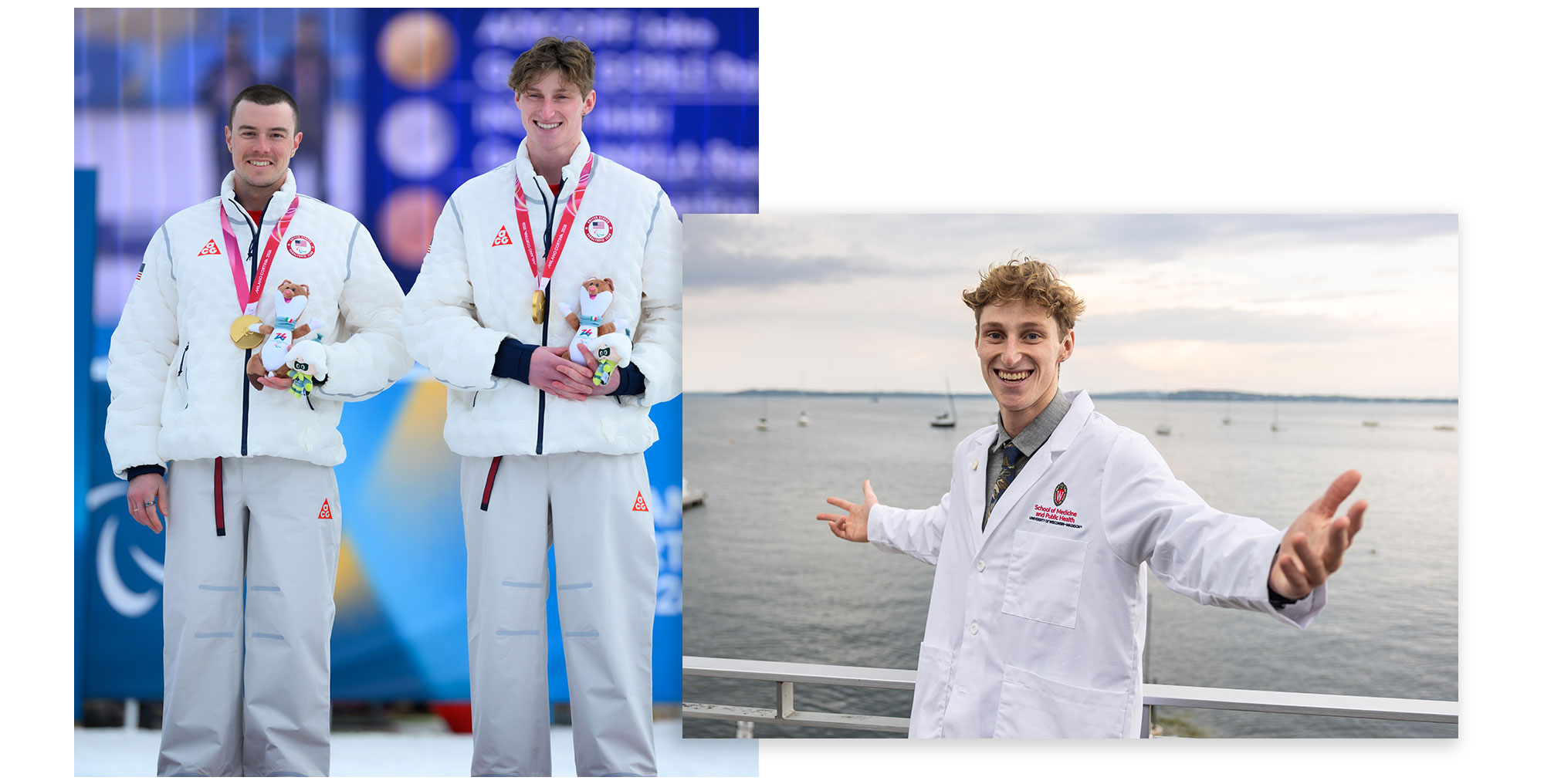
“Along with speed, communication between us is key,” Goble said. “The main thing is just to ski really smoothly and predictably.”
Those same qualities of mental focus and teamwork, combined with a desire to serve rural communities, will help power him through the next four years of medical school. Goble will be training for rural practice with the Wisconsin Academy for Rural Medicine. He is drawn to the small size of the WARM cohort and the chance for hands-on experience during rotations
“I have always lived in rural communities, and a few family friends are rural physicians,” he said. “They seem to love what they do.”
Athena Borca
Growing up in Cedarburg, Wisconsin, Athena Borca was curious about, well, everything. She followed her mom around the garden toting field guides to the birds and flowers of Wisconsin. In first grade, she developed an all-consuming interest in sharks
“I really like to go down a rabbit hole of information,” she laughed
When Borca was ten, her grandfather, an engineer, died of Parkinson’s disease. Borca couldn’t stop thinking about ways to tackle intractable diseases. At Cornell University, in Ithaca, New York, she majored in biomedical engineering
“I loved learning about the human body, but also about physics and electrical engineering and mechanical engineering,” she said. “These cool math and physics concepts could be applied to the body and result in new solutions.”
Senior year, she worked with a group of peers to design a device to stop postpartum hemorrhaging, or severe bleeding after childbirth, which is the leading cause of maternal mortality worldwide. At the same time, she served as the director of Cornell’s on-campus emergency medical technician (EMT) program
At a certain point, it all became too much
“I was working close to 80 hours a week with EMT, taking 20 credits in biomedical engineering, studying for the MCAT,” she recalled. “What I learned is that I had to prioritize the things that really mattered to me.”
Borca loved engineering, but working with patients as an EMT led her to medicine. She continues to be fascinated by the potential for biomedical solutions to improve health and is excited to explore research opportunities at UW–Madison
Vivek Sivan
One Monday morning in mid-September, near the start of his junior year at UW–Madison, Vivek Sivan woke up in his childhood room, unaware that his life was about to change drastically. Down the hall, his parents were getting ready for work. Suddenly, his father collapsed
“He had had a hemorrhagic stroke and was paralyzed on one side,” Sivan recalled. “We immediately called 911 and followed the ambulance to the emergency room.”
When the family arrived at University Hospital, a medical team of experts provided immediate, lifesaving care
“I witnessed firsthand how early intervention can save a stroke victim’s life,” Sivan said. “Over the next months, as UW Health doctors, nurses and rehabilitation therapists helped my father recover, I came to understand what interdisciplinary care truly means.”
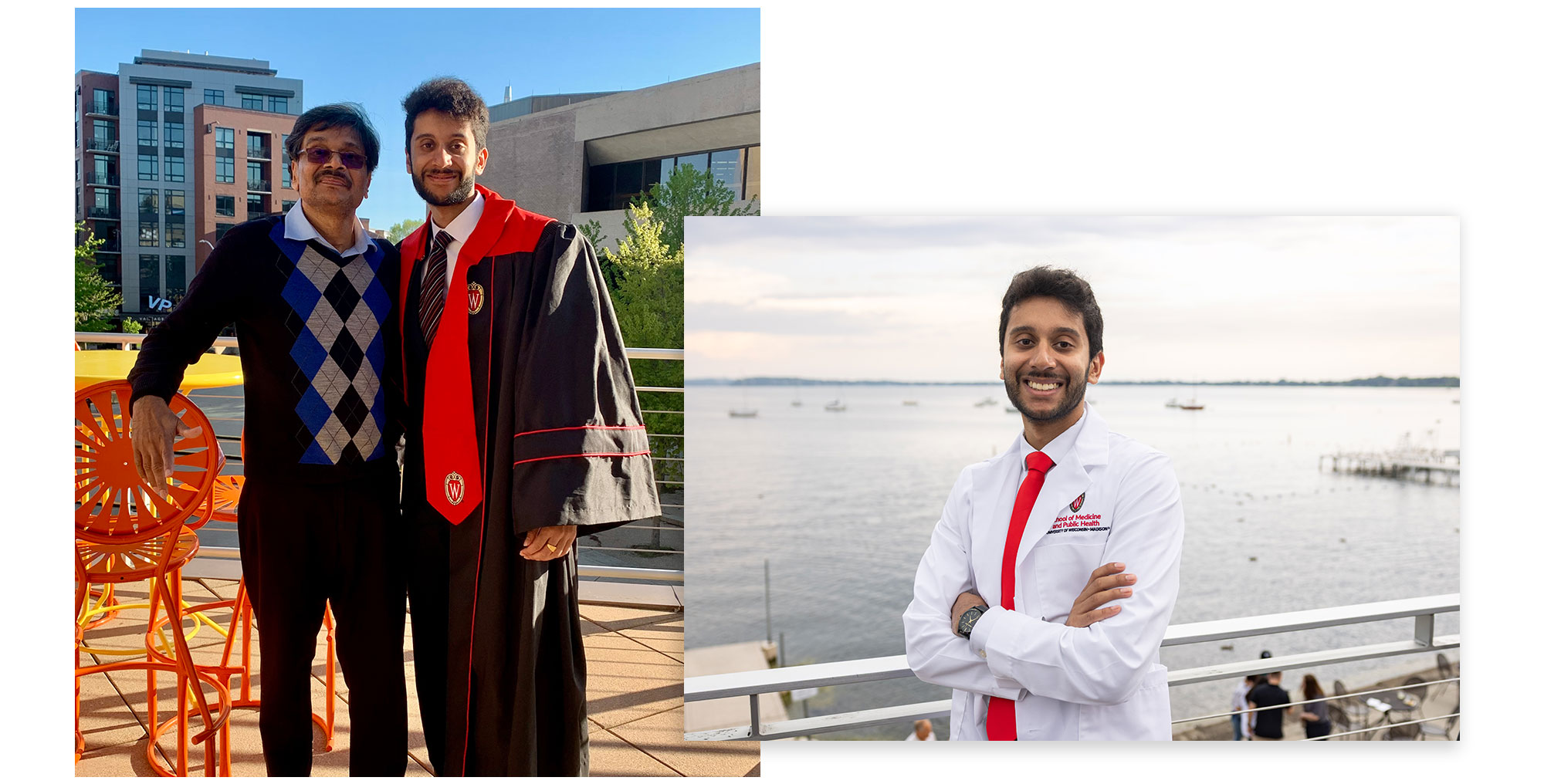
Sivan’s parents, scientific researchers, raised him to be curious and ask questions. His father studied Alzheimer’s disease, and as a kid, Sivan was fascinated by the centrifuges in his father’s lab — and by posters showing intricate diagrams of the brain
“Tagging along with him sparked my interest in science,” he said
Since freshman year, Sivan has worked in the lab of Dr. Bermans Iskandar, a professor in the Department of Neurological Surgery, exploring ways to improve cerebrospinal fluid shunts to better treat children with hydrocephalus, an abnormal buildup of fluid in the hollow spaces deep within the brain. That research experience helped transform a love for science into a growing passion for medicine
His father’s stroke turned that passion into a deeper calling.“Sitting at my father’s bedside throughout his recovery journey, I learned the power of compassionate care in uplifting patients,” he said. “I love the thought of integrating scientific insight with human connection to deliver empathetic care.”
White Coat Ceremony photos by Sirtaj Grewel/Media Solutions
Tags
White Coat Ceremony
More News
Science & Technology
July 30, 2026
Dr. Brigitte Smith received a $1.1 million precision education grant from AMA to build a platform that will help vascular surgery training programs analyze residents’ and recent graduates’ performance data
Science & Technology
July 29, 2026
No cure exists — yet — for Alzheimer’s disease, the brain disorder that slowly destroys memory and thinking skills, along with the ability to complete daily tasks. But dozens of researchers at the University of Wisconsin–Madison, many of them within the UW School of Medicine and Public Health, are working on ways to prevent, slow and cure the disease
