


||
Samsung Biologics (207940.KS) has made the largest investment in the history of Korean pharmaceutical and biotech mergers and acquisitions (M&A) to enter the peptide contract development and manufacturing organization (CDMO) business, aiming to secure a competitive edge in the global obesity treatment market, which is expected to grow to 200 trillion won over the next decade. Analysts view the move as a strategy to strengthen the company’s leadership in the global CDMO market by fully launching its “three-pillar expansion strategy,” spanning production capacity (CAPA), business portfolio, and global sites, while also securing production bases in Europe and India.
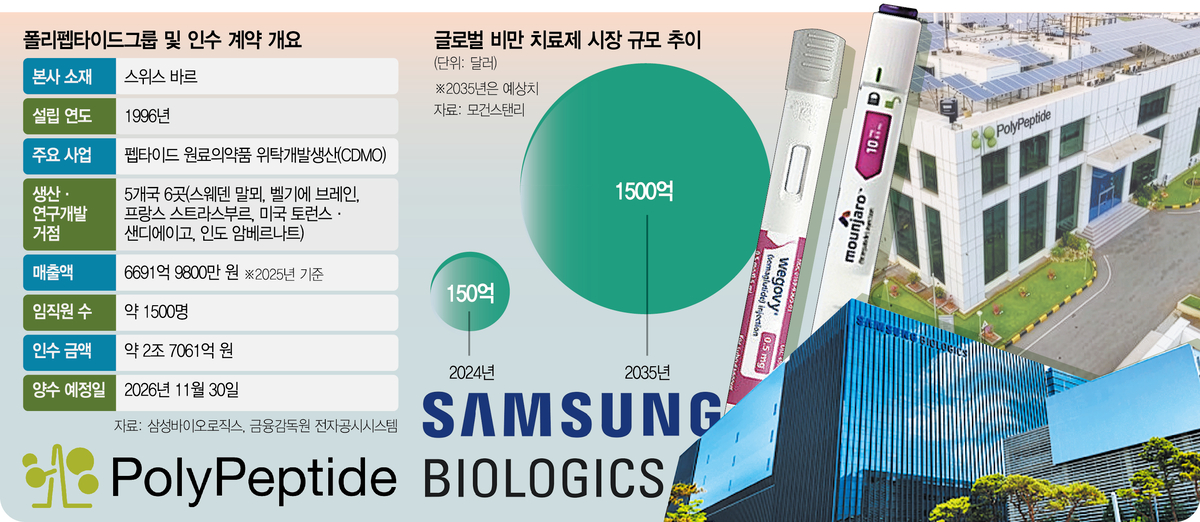
According to Samsung Biologics on the 20th, the company will conduct a tender offer for up to 33,016,411 shares of PolyPeptide, excluding treasury stock, from September to November. The tender offer price is 44.31 Swiss francs (CHF) per share, about 40% higher than the closing price of 31.65 Swiss francs on April 10. The total acquisition amount is about 2.7 trillion won, the largest among Korean pharmaceutical and biotech M&A deals. This exceeds Samsung Biologics’ operating profit last year of 2.0692 trillion won. A Samsung Biologics official explained, “The company plans to fund the deal using its cash holdings and external borrowing.” The expected completion date for the acquisition is late December, when business combination approvals from competition authorities in each country, including the European Union (EU), Australia, and Brazil, are completed.
Samsung Biologics’ decision to make the large-scale investment is interpreted as a response to the rapidly growing obesity and diabetes treatment market. Peptides are the core raw material for glucagon-like peptide (GLP)-1 class obesity and diabetes treatments. As their synthesis process is complex and requires advanced process control and strict quality management, about 62% to 64% of peptide developers are known to use specialized CDMOs. Competitors Lonza of Switzerland and WuXi of China also provide peptide CDMO services in addition to biopharmaceuticals. According to Morgan Stanley, the global obesity treatment market is forecast to grow to a maximum of $150 billion (about 200 trillion won) by 2035. In addition, the development scope of peptides has recently been expanding into treatments for cancer, immune and rare diseases, and brain diseases.
PolyPeptide has also expanded its production capacity in preparation for market growth, investing more than 20% of its revenue in capital expenditure (CAPEX) each year while enduring losses for three consecutive years. Its end-to-end peptide development capabilities, workforce of some 1,500 specialists, and global customer base are also assessed as strengths. Peter Wilden, chairman of the board of PolyPeptide Group, forecast, “When combined with Samsung Biologics’ overwhelming production capabilities and operational know-how, we will secure a firm competitive advantage in the global peptide CDMO market.” A Samsung Biologics official also explained, “Taking into account the operational and commercial synergies expected after the acquisition, along with strategic value and the effect of preempting market leadership, we judged it to be a reasonable level.”
Samsung Biologics plans to further strengthen its global CDMO competitiveness based on its “three-pillar expansion strategy” (portfolio, global sites, production capacity). By adding peptides, a high-growth field, to its CDMO business centered on existing antibody drugs, messenger ribonucleic acid (mRNA), and antibody-drug conjugates (ADC), the company has broadened its portfolio. In particular, the company expects its cooperative relationship with existing customer Eli Lilly to be further strengthened. Samsung Biologics’ board explained, “We judged that there is strategic fit in securing major customers and pipelines, including Lilly.”
Lilly is a major customer of Samsung Biologics that sells “Mounjaro,” the world’s No. 1 obesity and diabetes treatment. However, until now, the company has been unable to win orders for obesity and diabetes treatment raw materials due to the lack of peptide production facilities. PolyPeptide, whose CDMO contracts Samsung Biologics will assume, has produced the raw material for Novo Nordisk’s “Wegovy.” Last year, the global sales of Lilly’s Mounjaro and Novo’s Wegovy reached $39.1 billion and $18.6 billion, respectively. In addition, the company is reviewing the construction of production facilities for high-value new modalities such as cell and gene therapy (CGT) and next-generation vaccines at the Third Bio Campus site.
Furthermore, by securing production bases in Europe and India through the PolyPeptide acquisition, the company expects to respond more flexibly to changes in global supply chains. PolyPeptide operates six production and development sites across five countries, including Malmo in Sweden, Braine in Belgium, Torrance and San Diego in the United States, Strasbourg in France, and Ambernath in India. A Samsung Biologics official assessed, “In connection with our existing production facility in Rockville, U.S., we have enhanced accessibility to multinational pharmaceutical companies and can respond effectively to changes in regional supply chains.” Earlier, Samsung Biologics acquired GSK’s production facility in Rockville, Maryland, U.S., in April. Following New Jersey and Boston in the U.S. and Tokyo in Japan, the company plans to newly open a sales office in the Netherlands in the third quarter of this year.
Meanwhile, Samsung Biologics holds a total antibody drug production capacity of 845,000 liters, combining its Songdo Plants 1 through 5 (785,000 liters) and the U.S. Rockville plant (60,000 liters). The company plans to build additional Plants 6, 7, and 8 at its Second Bio Campus by 2032 to expand its total production capacity to 1,385,000 liters. PolyPeptide’s specific production capacity has not been disclosed, but the company’s position is that it is also considering facility expansion in step with market growth.
A Samsung Biologics official added, “We plan to combine PolyPeptide’s peptide technology capabilities with our good manufacturing practice (GMP) system that supports large-scale commercial production, global supply chain operations, and regulatory response capabilities,” adding, “If market demand increases, we will use our accumulated experience in plant construction and production capacity expansion to rapidly expand production facilities and respond to mass production demand.”
#SamsungBiologics#PolyPeptide#CDMO#ObesityDrugs#GLP1#BioMA#Peptide
Companies in this story
Samsung Biologics
207940.KS · BioAI KEY Company Analysis →
Original reporting by Han Min-koo for Seoul Economic Daily
AI-translated from Korean. Quotes from foreignxact original wording
View Korean originalTranslation Policy
More →
Most Read This Week
1-5
- 1Which Country Will Buy KF-21 First? Indonesia, UAE, Philippines, Malaysia
- 2Airport Store Clerks Dismantle Shelf to Retrieve Japanese Tourist’s Earbuds, Win Award
- 3Prosecutors Raid Three Global Chip Suppliers Over Price-Fixing
- 4People Power Party Expels Cheongju Councilor Over Minor Prostitution Charges
- 5Airport Staff Injured as Chinese Tourists Cut Ahead in Incheon Queue
← Back to Home
