


Advertisement
In family videos, Sasha Lipworth beams, open-mouthed and elated as she zooms past on her aquamarine scooter. She giggles as she ambles along a footpath hand-in-hand with her pint-sized friend, and trills “I’m calling mummy” as she presses a comically large telephone receiver to her tiny ear
There’s footage of Sasha sitting on her father’s lap, and singing Happy Birthday before blowing out the four candles on her cake
Within a few months, an unknown quirk in Sasha’s genetic coding would begin to rob her of the ability to speak, hold a spoon, use a toilet or play with the most basic of baby toys
Advertisement
Now nine, Sasha has been nonverbal longer than she was able to speak. For her past five birthdays, she couldn’t blow out a single candle
“That is crazy when you express it like that,” Sasha’s father, David Lipworth, says. “It’s taking too long to get this done.”
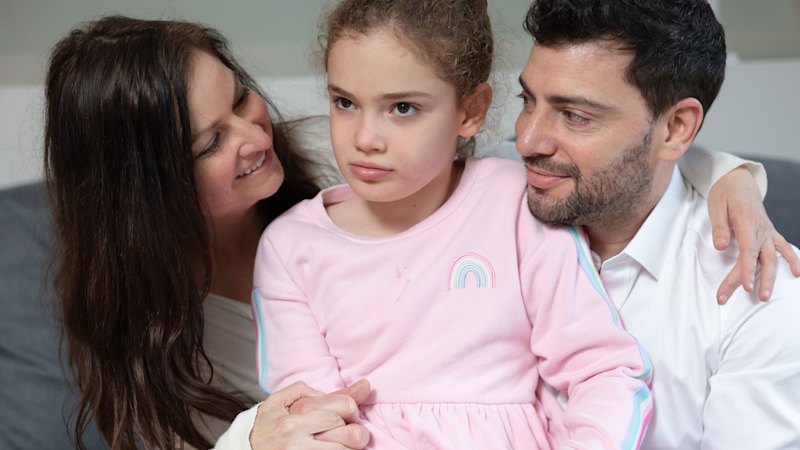
David and Sasha’s mother, Nadine Lipworth, have devoted their lives to Sasha – who needs 24-hour care – and to finding a way to restore her abilities and give her the chance to gain new skills
“We were told that there was no treatment and no cure. That wasn’t going to be an option,” Nadine says. “We knew Sasha before she lost everything, and we wanted to give her her future back.”
Advertisement
With no financial backing from any institution, the Lipworths have assembled a crack team of scientists from Australia and the United States to undertake the painstaking work of developing a Sasha-specific genetic therapy
They are months away from confirming that they have got it: bespoke gene patches called Antisense Oligonucleotides (ASO), the latest frontier in experimental precision therapies for rare genetic disorders that were, until recently, considered “undruggable”
Mini lab-grown Sasha brains are key to the final stages of testing three potential treatment candidates. The team then plans to send the best performer to the US for mandatory safety testing. If all goes well, Sasha could receive her first dose by her 10th birthday, in March
“To be so close to the finish line is amazing,” David says. “This disease has stolen so much from her, but that spark she has had since she was a baby gives us hope that we can get her back.”
Among the regulatory, logistical and clinical obstacles sits a $1 million hurdle: securing philanthropic donations to cover the cost of toxicology testing in a US laboratory, then, hopefully, manufacturing a new medicine
Advertisement
If the Lipworths succeed, they hope to blaze a trail for other children whose rare genetic diseases could be treated with RNA-targeting precision medicines
“I cannot leave this world until my daughter can tell someone if she is in pain or being harmed,” Nadine says
‘It’s up to us’
Nadine and David Lipworth quit their jobs to care for Sasha and support their mission. David has become a citizen scientist in RNA therapeutics, impressing with his nous internationally renowned molecular biologist and antisense pioneer Professor Emerita Sue Fletcher
Advertisement
Nadine is spearheading crucial fundraising for the expensive endeavour through a GoFundMe page, raffles and tax-deductible donations
“It has all been up to us,” Nadine says
Loading
Cut-and-paste
In March 2024, the University of Sydney’s RNA for Rare Diseases teamidentified a spontaneous mutation in Sasha’s SLC6A1 gene, which encodes a protein called GAT-1 that recycles the brain’s main calming neurotransmitter, affecting how messages move through the brain. Only one other person in the world is known to have this variant
Advertisement
In every human cell, there are more than 3 billion base pairs of DNA, each pair a combination of the letters A, T, C and G
“In Sasha’s case, just one letter has been changed, and this is causing her disorder,” Fletcher says
The single-letter change does not alter the protein code in Sasha’s DNA. It alters how the code is edited, cut and pasted together
When a cell needs to make a protein, it copies the gene containing that protein’s assembly instructions from the master blueprint, DNA, to make a temporary, portable transcription called messenger RNA (mRNA). This transcription needs to be edited before it reaches the cell’s protein-building factory
Advertisement
The initial unedited message (pre-mRNA) is made up of exons – sequences of the protein-making code – which are separated by non-coding filler sequences called introns. This is where Sasha’s mutation wreaks havoc
The cell’s machinery – cellular scissors and glue – needs to “splice out” the non-coding introns and paste the exon coding sequences together
Sasha’s single-letter change signals the cellular scissors to splice in the middle of an exon, severing crucial information, rendering it impossible to correctly assemble the protein from the incorrectly edited instructions
“Everything downstream [from the errant splice] is garbled,” Fletcher says
If Sasha’s splicing error was a TV murder mystery
Think of mRNA as a whodunit on commercial television, where the exons are the movie and the introns the ad breaks
To watch the movie without ad breaks, you need to edit out the introns and stitch the exon sequences together
Sasha’s movie is being spliced in the middle of an exon at the climactic plot twist – excising the moment that the true murderer is unmasked, and their fiendish motive revealed – rendering the rest of the movie incomprehensible
Advertisement
“If we can overcome that one small glitch, Sasha’s cells will make a perfectly normal protein from the gene that carries this one damaging ‘letter’ change,” Fletcher says
To fix the glitch, Sasha’s research teams turned to ASOs: short, synthetic strands of RNA modified with such precision that they can bind to a specific mRNA sequence
The genetic masking tape
In a laboratory at the Queensland University of Technology, Dr Laura Croft has been tending to dishes of miniature Sasha brains. For 140 days, Croft has raised them on a steady diet of nutrient-rich media
Advertisement
These brain organoids – 3D brain tissue derived from Sasha’s blood cells reprogrammed into stem cells – are a critical component to testing treatment candidates designed with painstaking specificity for Sasha and her ultra-rare mutation
“It’s so emotional seeing them,” Nadine says after a recent visit to Croft’s lab and seeing her daughter’s mini brains. “I feel like crying now thinking about it.”
Croft specialises in advancing rare disease therapies for “n-of-1” cases, like Sasha: a patient whose condition is so rare that she represents the entire patient cohort
“It is so exciting,” Croft says. “It’s possible that Sasha will be the first child in Australia to be treated with an Australian-developed n-of-1 ASO.”
Advertisement
Croft screened about 20 ASOs engineered by her team, Fletcher and US researchers. David thinks of them as masking tape that covers the errant splice site, shielding it from the cellular scissors
“ASOs are the ultimate precision medicines,” Fletcher says. “They can be targeted very specifically to certain types of gene mutations.”
But not every genetic disorder could be targeted by this bespoke approach. “It very much depends on the gene and the specific mutation,” Fletcher says
The ASO Nusinersen was the first-ever disease-modifying treatment forspinal muscular atrophy – the biggest genetic killer of children under two years of age
Advertisement
The world’s first person to be treated with an ASO made just for them was a seven-year-old girl named Mila Makovec at Boston Children’s Hospital in 2018 – within a year of her diagnosis. Tragically, Mila, who had the rare and fatal neurodegenerative disorder Batten disease, died in 2021. But her experimental drug, dubbed Milasen, was shown to reduce her seizures and provided a blueprint for the rapid development of highly customised therapeutics
An estimated 15 to 30 per cent of all genetic diseases are caused by mutations affecting RNA splicing, suggesting they may be amenable to ASOs, Croft says
In Croft’s lab, three ASOs corrected the errant splicing at the RNA level in Sasha’s lab-made brain cells
“We have to repeat these studies at least three or four times for all three ASOs,” says Croft, a task she expects to take three months
Advertisement
“[Then] we need to make sure that this translates into functional protein, [and] which one is the best at restoring the GAT-1 protein function in Sasha’s cells,” she adds
Preliminary evidence shows at least one ASO does just that, Croft says. It will cost $75,000 to confirm a top candidate
Simultaneously, Sasha’s team have been working to select a laboratory to conduct toxicology testing as soon as a lead candidate is identified. This, plus manufacturing a clinical-grade drug, will cost $900,000, which is why the Lipworths’ focus is now on finding new philanthropic donors, fast
“We are progressing the program as quickly as possible because we know that the earlier the intervention occurs, the better the outcome for Sasha is likely to be,” Croft says
The Lipworths hope to have Sasha treated at the Sydney Children’s Hospital Network (SCHN)
Advertisement
A network spokesperson said that administering experimental therapy is governed by rigorous ethical, regulatory and legal requirements, and that the network was developing pathways that enable children with rare diseases to access highly personalised therapies
Sasha’s parents dream of Sasha regaining all the skills she has lost and more, attending a mainstream school and, in adulthood, having a productive, fulfilling job
A trial of an experimental ASO to treat Dravet syndrome – a neurodevelopmental disorder triggered similarly to Sasha’s – found that children regained skills they had lost and developed some new abilities, including communication, language and gross and fine motor skills
“If we can get Sasha treated soon, while her brain is still developing, then who knows what the future holds for her,” David says
Advertisement
Professor Zornitza Stark, clinical geneticist at Murdoch Children’s Research Institute, says: “The explosion in precision treatments over the last 10 years has been hugely exciting.”
Stark says that even when an ASO is developed for a single child, the principles learnt can help advance the entire field of new-generation therapies
One day, David hopes this will be as routine as surgery: “You go to the doctor, the doctor finds your mutation and develops a personalised genetic treatment that targets [it].”
But infrastructure must be built for these personalised therapies to be developed faster and more cheaply
There is no doubt, Fletcher says, that Sasha is at the forefront of her parents’ minds. “But they have been very clear that … whatever the outcome for Sasha, we are working on a pipeline and creating opportunities to help the next child, and the next and the next.”
Advertisement
“We must get this done,” Nadine says. “The impact is bigger than one child.”
Start the day with a summary of the day’s most important and interesting stories, analysis and insights. Sign up for our Morning Edition newsletter
More:
Kate Aubusson is Health Editor of The Sydney Morning Herald.Connect via Xoremail.
Advertisement
Advertisement
