


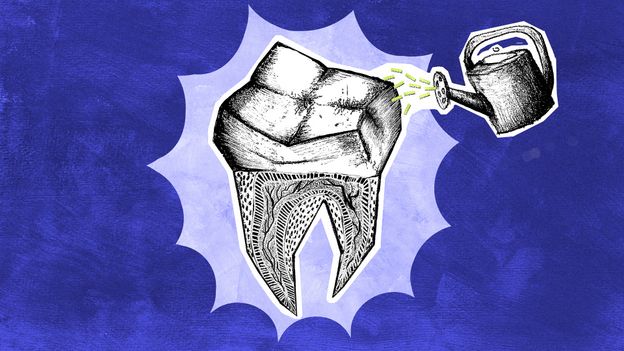
Scientists are regrowing human teeth
2 hours ago

BBC/ Serenity Strull
While teeth play a greater role in health than many realise, current dental solutions for tooth loss are temporary and subpar. What if we could regrow our teeth instead?
Some surveys suggest upwards of 70% of adults fear going to the dentist. Their anxieties and distrust of fillings and drillings lead them to skip routine cleaning and care
Yet, nearly every day, biochemist Hannele Ruohola-Baker gets an email from someone begging to undergo bizarre dentistry experiments that go beyond the routine pains of most dentist visits – they want her to help them regrow their teeth
That’s because Ruohola-Baker is part of a growing number of scientists worldwide harnessing the power of regenerative medicine to replace traditional dental procedures for the millions of people who are missing teeth and managing tooth pain
Dental issues, like bacteria from gum disease, can increase the risk of heart disease and respiratory infections
If their vision becomes reality, a visit to the dentist could one day involve regrowing damaged teeth tissue or even an entire tooth, rather than repairing it with synthetic materials or yanking it out – an appealing prospect not only because of its novelty, but also because teeth play a greater role in health and well-being than many may realise
“When we first began, one thing became very clear to me,” says Ruohola-Baker, who is the associate director of the University of Washington Institute for Stem Cell and Regenerative Medicine in the US. “People are ready for something new in dentistry.”
Open wide
Teeth are “your window to the world,” says Pamela Yelick, a professor at the Tufts School of Dental Medicine in the US. “If you’re afraid to open your mouth or can’t eat properly, it’s a very downward spiral.”
Historically, it was underappreciated that “oral health is key to good systemic health,” says Yelick. Now, it’s increasingly understood that dental issues, like bacteria from gum disease, can increase the risk of heart disease and respiratory infections. They have even been linked to Alzheimer’s disease. Tooth loss, meanwhile, is associated with more illness and earlier death. It affects the ability to eat, chew, and smile, and can harm social and emotional well-being – an insidious cycle that can begin in childhood.
Dentists have many tools to help counteract this. They can repair cavities by removing what’s damaged and filling the space with a man-made material, such as a resin composite. And they can use fillings to fix minor chips and cracks
But these are imperfect solutions. For instance, there’s a lot of variability in the durability of fillings, which can last anywhere from about five to 20 years. It’s also not uncommon for people to have to go through “repeated interventions” with procedures like these, says Anne George, a professor of oral biology at the University of Illinois, Chicago, in the US
That’s because these fixes primarily focus on “repairing damage, rather than restoring biological function,” says George. Instead, “regenerative dentistry can be a paradigm shift,” says George. “It emphasises healing.”
BBC/ Serenity Strull
Self-filling cavities
Cavities, for one, are “the most common thing that destroys the tooth,” says George.
Teeth have four main layers: enamel, dentine, cementum, and tooth pulp. Cavities develop when dental plaque bacteria feed on sugars and produce acids that gradually dissolve that first layer of tooth enamel. Dentine is beneath enamel and is softer and less resistant to decay, and when enamel is lost and dentine becomes exposed, cavity risk further increases
George researches the proteins that help dentine grow, mineralise, and repair itself. She was also part of a team that cloned one of the genes that helps build dentine, understanding more about the inner workings of how teeth create and maintain this tissue in the first place. This knowledge could lead to new treatments that stimulate damaged teeth to repair cavity damage with new dentine on their own, says George, ending the need for traditional fillings to plug the holes instead
Ruhola-Baker and her team are also working on “living fillings” – but ones rooted more in enamel, rather than in dentine. After researching donated wisdom teeth, the scientist found that the special cells that make enamel, called ameloblasts, die after a human tooth erupts so they cannot be stimulated once the tooth breaks through
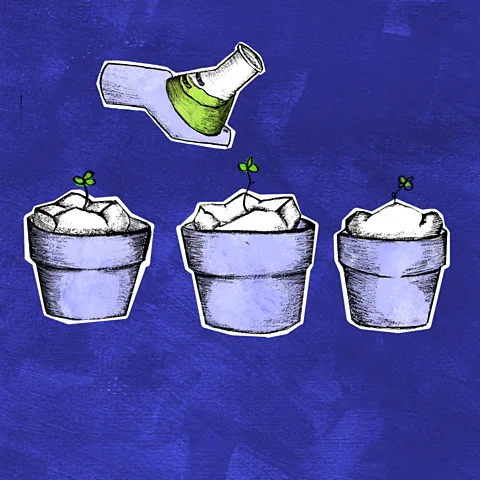
Instead, the team used chemical signals to coax some stem cells into ameloblasts, and induced other stem cells to become odontoblasts, which are cells that make dentine. Combined in a dish, these ingredients produced a tooth organoid that secretes enamel proteins on its own
Ruohla-Baker can see a future in which these enamel proteins are used to make fillings or painted onto cracked teeth. But her long-term goal is a whole lab-grown tooth: eventually, she wants to embed the engineered cells necessary to build a tooth in a patient’s mouth and let “nature take care of the rest,” she says
How to farm a tooth
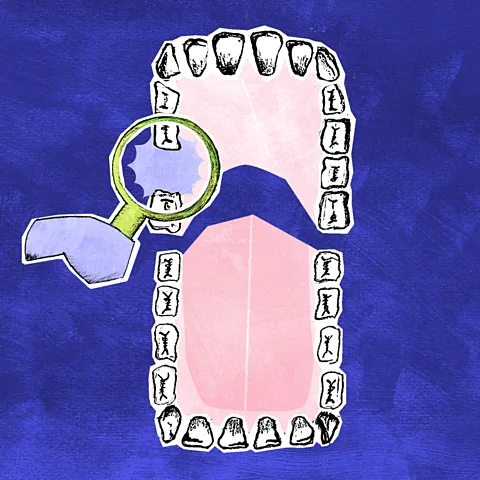
If a tooth has many cavities and decay, the best and easiest treatment may be to pull it out and place an implant – a combination of a screw-like post, an artificial crown, and a connector of the two.
But implants don’t contain nerves that help you feel while you chew, so it’s possible to unintentionally bite down too hard and crack the implant. Bacteria can attach to the implant, leading to a condition that can affect the remaining healthy teeth. Artificial crowns need replacement after about 15 years and can cost thousands of dollars, depending on your insurance
BBC/ Serenity Strull
Entirely lab-grown teeth, instead, could be a more durable solution than implants, says Ana Angelova Volponi, director of regenerative dentistry at King’s College London, in the UK
“Rather than just trying to patch what has been damaged, we could use a biological replacement,” says Volponi, who is also creating an organoid capable of developing into a replacement tooth.
Even if a pig is harvested for food, there are tooth buds that are in the jaw getting ready to form another tooth – Pamela Yelick
Volponi’s team found that cells taken from adult human gum tissue, combined with tooth-forming cells from mice, could produce a hybrid human-mouse “tooth structure” with the instructions that guide such tooth formation, along with engineered biomaterials that might help those cells assemble into a structured, functional tooth
Unfortunately, this does not happen naturally
Unlike some other animals, humans can’t continuously grow new teeth once something happens to their adult set. Sharks, instead, have an endless supply of teeth, regenerating them in a continuous conveyor-belt-like manner. Kangaroos get multiple sets of molars, as do elephants
Pigs also have a biological quirk: their jaws contain multiple sets of unerupted adult tooth buds. It’s because of this eccentricity that Yelick was able to grow human-like teeth in adult Yucatan minipigs using a combination of human and pig tooth cells
The team collected cells capable of forming dentine from human teeth and cells that form enamel from unerupted teeth in discarded pig jaws from a butcher. “Even if a pig is harvested for food, there are tooth buds that are in the jaw getting ready to form another tooth,” says Yelick
After growing the cells in a laboratory, the researchers combined them on a bioengineered scaffold designed to mimic the environment of a developing tooth. After three months, tooth-like structures developed at a rate close to that of natural pig teeth
• How chewing more boosts your brain
• How to future-proof your knees
• How to properly brush your teeth
“It was a proof of principle that this could really work… many, many people reached out who were desperate to fix their own tooth problems,” says Yelick, who is now looking to do the experiment over a longer period of time, and directly inside a pig jaw. Eventually, Yelick and her team want to prompt cells to grow teeth in a person’s mouth without any pig cells involved
From the lab to the dentist’s chair
Despite the demand, we’re still years away from the first person to get self-filling cavities or a lab-grown tooth replacement. Before “we can begin to talk about” studying humans, experiments with non-human primates have to happen first, says Ruohola-Baker. That will take more research, time, and money. Plus, to get lab-grown teeth into human mouths, researchers need to create improved environments for tooth development
In the meantime, the lessons learned in regenerative dentistry could help broader efforts to reproduce various parts of the body, such as organs and bones. Because teeth are “highly sophisticated living organs,” says Yelick, efforts to replicate them in labs are teaching scientists how hard and soft tissues work together on a very basic level
While it may not happen soon, Volponi is confident that safe, sustainable regenerative dental solutions will eventually be available to the public. “That’s where I see the future,” she says. “It’s not very clear, but it’s hopeful.”
—
For trusted insights on health and wellbeing, sign up to theLive Well For LongerandSix Steps to Calmcourses
For more science, technology, environment and health stories from the BBC, follow us onFacebookandInstagram
Health
Human body
Ageing
Science
Features
