


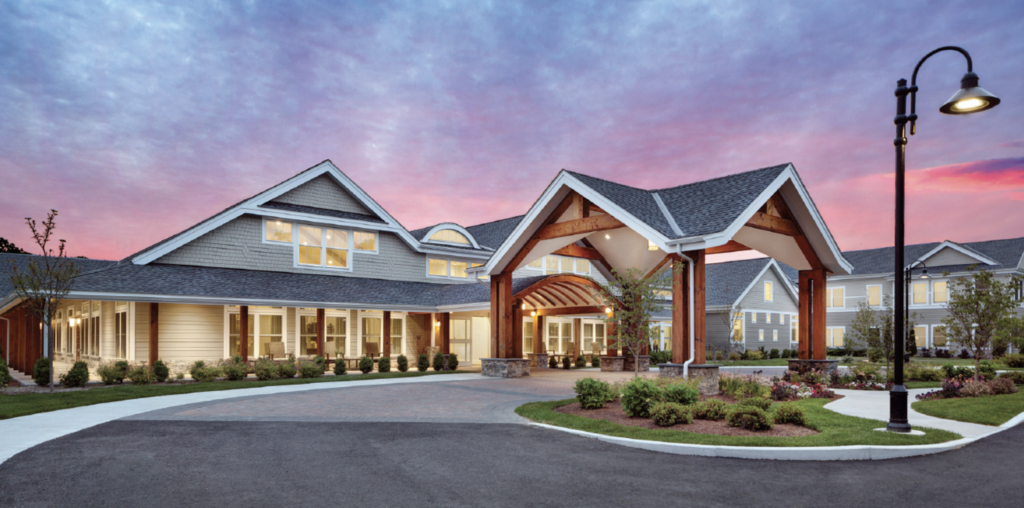
Maplewood at Brewster / Maplewood Senior Living
This story is part of your SHN+ subscription
Senior living providers are incorporating more mental and behavioral <a href="https://healthylife7.com/health-hub-helps-farmers-prioritise-their-wellbeing/” title=”Health Hub helps farmers prioritise their wellbeing”>health services into their operational models to help their residents manage depression, anxiety and post-traumatic stress disorders
According to the World Health Organization, almost 15% of all people 70 and older worldwide live with a mental health condition, the most common being anxiety or depression. Mental health conditions for older adults “often go underrecognized and undertreated” due to the stigma around seeking mental health support
Leaders of senior living providers like Erickson Senior Living have seen “a notable increase” in behavioral health needs among older adults in senior living communities, according to Vice President and Regional Medical Director Ashley Kinder
While it can be hard to determine the cause of the rising prevalence of depression and anxiety, Kinder said multiple factors include emotional challenges associated with living longer with chronic illness, social isolation and an increased diagnosis of depression and anxiety
Baltimore-based Erickson Senior Living relies on mental health services that play a “critical role” in supporting older adults’ quality of life, independence and “ability to thrive,” Kinder told Senior Housing News. Effectively reaching older adults struggling with anxiety, depression or post-traumatic stress disorder (PTSD) starts at screening and diagnosis. On-site medical centers include mental health assessments as part of primary care services, and this has helped “normalize” conversations around mental health and reduce the perceived stigma of seeking mental health treatment.
“An encouraging trend is that mental health is becoming a more visible and accepted component of overall wellness,” Kinder told SHN. “Residents are increasingly open to seeking support for mental health concerns, which allows providers to identify needs earlier and intervene more effectively.”
St. Louis-based EverTrue has also seen a “significant increase” in behavioral health needs among residents since the pandemic, according to Rachel Little, vice president of clinical services. In addition to higher rates of diagnosed major depressive disorder, anxiety and PTSD, EverTrue’s staff are seeing more residents arrive with a history or current pattern of substance use. That has prompted the organization’s leaders to rethink how clinical and lifestyle teams work together to support residents’ mental health needs.
“We’re looking at a much more holistic approach,” Little said during an interview with SHN. “It’s not just about a medical response or a medication, it’s about what other supports and experiences we can build around residents so they can feel and function at their best.”
This shift is underway as many older adults were raised in social settings where mental health and behavioral health services “weren’t talked about,” noting that senior living providers are on the “leading edge” of people starting to feel comfortable to discuss mental health struggles
Other senior living providers, including Maplewood Senior Living, Viva Senior Living and Chelsea Senior Living, are taking steps to integrate more behavioral and mental health services into operations to improve the quality of life for older adults staying in senior living communities today
‘Meaningful increase’ in behavioral health needs prompts shift in strategy
Leaders with Westport, Connecticut-based Maplewood Senior Living have seen a “meaningful increase” in the number of older adults moving into communities with ongoing and current mental health services as part of their primary care
Today, many residents “require more active clinical support” for conditions like anxiety and depression, rather than routine monitoring as in the past, according to Maplewood Senior Living Chief Clinical Officer Tino Popescu. At the same time, Popescu said older adults were showing a “growing interest” in alternatives to antipsychotic medications due to some of their risks and side effects
“Our role is to coordinate care carefully, evaluate outcomes, and ensure any treatment approach is integrated safely and appropriately into each resident’s individualized care plan,” Popescu said
Maplewood Senior Living’s new approach to adapting clinical services to better support residents with anxiety, depression, PTSD or other mental health conditions is a combination of strong partnerships with medical providers, investment in behavioral health training for staff and a focus on employee retention so that older adults become familiar with those helping to care for them. The provider also added talk therapy through licensed psychotherapists so residents can access behavioral health support.
Critical to all of this are the close partnerships with medical providers, Popescu said. What makes these partnerships work is continuity as clinical partners know resident medical histories and staff, making care transitions smoother and unmet mental health needs get identified sooner
“The clearest challenge industry-wide is access to psychiatric expertise; psychiatrists are in short supply,” Popescu said
Maplewood’s leaders are expanding the company’s clinical care model to include psychiatric-certified nurse practitioners and talk therapy
Assessment is a critical period for senior living providers to connect with older adults. EverTrue relies on the Brief Interview for Mental Status (BIMS) cognitive screening and depression screening tool, alongside a trauma assessment. This helps EverTrue’s clinical teams to identify needs a resident may struggle to articulate and trigger personalized interventions that could range from counseling and one-on-one visits to aromatherapy, music therapy or horticultural therapy sessions
“We try to understand where anxiety, depression or loneliness is coming from and then match residents with the right mix of support,” Little said. “That may be clinical care, but it may also be a chaplain visit, a music therapist, a walk in the garden or time with a social worker who knows their story.”
As an industry, access to geriatric behavioral health specialists is also a challenge, according to Viva Senior Living Chief Medical Officer Afrika Parks. Workforce shortages continue to impact the availability of psychiatrists, psychologists, licensed therapists, hospice organizations and pharmacy consultants
Hospitality and lifestyle elements like connection, compelling life engagement, daily routines, and providing residents with care with dignity are critical parts to supporting the company’s clinical model. This has led Maplewood to “integrate behavioral health support in a way that feels natural rather than institutional.”
For example, Maplewood launched the “Early Riser” and “Night Owl” programs to help meet residents’ needs during the early morning and evening hours, providing “intentional routines” in a supportive environment
“These programs address behavioral health needs while preserving the hospitality-focused experience of living in a community,” Popescu said
Behavioral health ‘no longer a specialty service’ in senior living
The prevalence of social isolation, anxiety and depression spurred by the early days of the Covid-19 pandemic has led providers to adapt clinical models to include greater behavioral health services for residents
“Behavioral health is no longer a specialty service in senior living—it has become a fundamental component of quality care,” Parks said. “As resident acuity continues to increase, operators must evolve from managing medical conditions alone to providing truly integrated, whole-person care.”
Memory care is an area of the continuum where operators have had to adapt clinical support with broader behavioral health services. Within Viva Senior Living’s Thrive Memory Care Program, practitioners and staff are trained to identify adverse resident behavior as direct communication, rather than asking what is wrong with a resident exhibiting those disruptive behaviors. Identifying the “underlying cause of distress” is critical in memory care, and teams work collaboratively to understand a resident’s history, preferences, routines and potential triggers when crafting support plans.
Relying on passive monitoring technology in resident rooms has helped communities identify subtle changes in a resident’s health before a crisis occurs, Parks said, tracking sleep pattern changes, activity, vital signs and cognition that give “early indicators” of depression, anxiety, delirium or other behavioral health concerns
Viva Senior Living partners with psychiatrists, psychologists, licensed therapists, primary care providers, hospice organizations, pharmacy consultants and other behavioral health specialists to give residents access to “comprehensive care” while living in a community
Behavioral, mental health services reshape clinical workforce in senior living
Growing behavioral health needs have “reshaped” how providers approach clinical workforce strategy. EverTrue increased social worker support and relied more heavily on external behavioral health partners while expanding training on de-escalation, trauma-informed care and psychotropic medication management
“Psychotropic medications can be one tool, but they should never be the only answer,” Little said
Offering new training was a central part to operators expanding their behavioral and mental health services. Chelsea Senior Living also expanded education on de-escalation, stigma reduction and trauma-informed care, according to Chelsea Senior Living Regional Director of Health Services Pat Banta
Chelsea Senior Living has moved away from a one‑size‑fits‑all model to individualized behavioral tolerance plans in memory care and assisted living, asking staff to tailor activities, environments and daily routines to each resident’s mental health needs and risk profile, Banta said
“There’s always that stigma attached to people with mental health conditions and retraining them was necessary to give them the tools they need to deal with exacerbations of resident behavior,” Banta said
In the future, Parks said behavioral health will become “one of the defining components of senior living” over the next decade, as providers integrate more closely with primary care physicians, behavioral health specialists and pharmacy services
“Ultimately, I believe our industry is moving away from reactive care models and toward predictive, relationship-centered care,” Parks added
Kinder also sees the need for behavioral health services continuing to grow in senior living as resident needs become more complex
“I think the industry is recognizing that healthy aging requires equal attention to physical, emotional and social well-being,” Kinder said. “Senior living is uniquely positioned to deliver that integrated approach, bringing the care where it is needed to support earlier access, and hopefully, engaging residents more effectively.”
Companies featured in this article:
Chelsea Senior Living, Erickson Senior Living, EverTrue, Maplewood Senior Living, Viva Senior Living
