


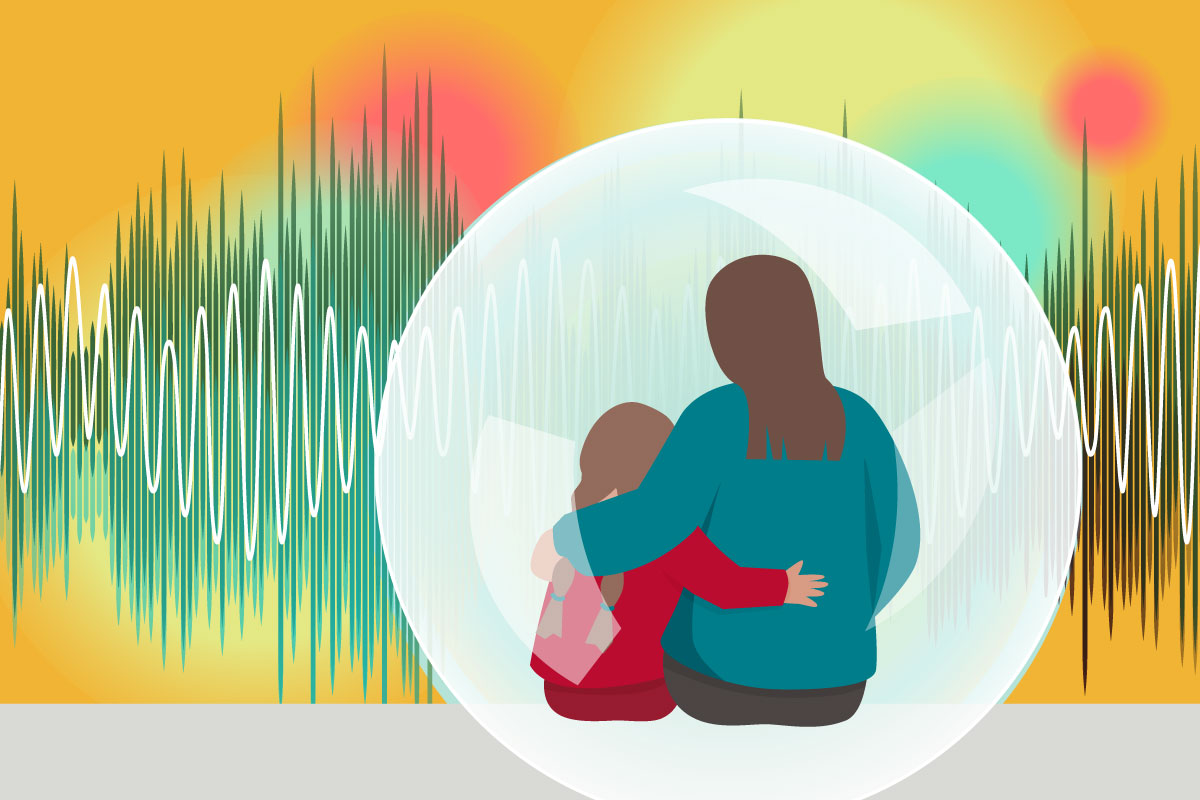
Overreactions to ordinary sensory stimuli — a scratchy shirt tag, a roaring vacuum cleaner, an unfamiliar smell — are commonly associated with autism. But in fact, an estimated 15% to 20% of children experience such reactions, known as sensory over-responsivity or sensory distress, and they show up across a range of psychiatric conditions
Now, research from Washington University School of Medicine in St. Louis is shedding light on what sensory overload indicates about a child’s mental health. Analyzing data from more than 15,000 children ages 6 to 18, the researchers found that sensory over-responsivity is connected not just to autistic traits but also to anxiety in both children with autism and those without. Contrary to longstanding assumptions, sensory over-responsivity was not directly related to ADHD
Examining brain scans from a subset of the children, the team also found that even mild sensory issues are linked to differences in specific patterns of brain connectivity
The findings are published Aug. 13 in the Journal of the American Academy of Child and Adolescent Psychiatry
“These sensory challenges are not kids just ‘being difficult,’ but are behaviors rooted in specific neurological differences,” said senior author Rebecca Schwarzlose, PhD, an assistant professor of psychiatry at WashU Medicine. “We also show kids without autism can struggle with the sensory environment. Because services like occupational therapy can help children cope with these challenges, it is important to properly identify sensory over-responsivity and get kids the right support.”
Sensory sensitivity linked to anxiety and autism, not ADHD
Sensory over-responsivity has long been considered a symptom of autism, and it was added to the diagnostic criteria for autism spectrum disorder in 2013. But it turns up in many other psychiatric conditions, appearing among children with anxiety, ADHD, obsessive-compulsive disorder and other conditions. That overlap has left clinicians without a clear consensus on what it means for diagnosis and treatment when a child is overwhelmed by everyday sights, sounds and textures
“What all parents want is for their child to be able to do the things they want to do. The more we can help them live in this world with targeted modifications, while avoiding undue distress, the better.” Rebecca Schwarzlose, PhD, WashU Medicine
To better understand how sensory over-responsivity is involved in these conditions, Schwarzlose and her colleagues pooled data from 15,728 children across five separate studies, which collectively included both children diagnosed with autism and kids in the general population who may or may not have neurodevelopmental or other psychiatric conditions. All the studies included standard parent or caregiver questionnaires assessing symptoms of conditions such as anxiety, depression and ADHD, as well as a standard scale measuring autism-related traits, which includes an item used to gauge a child’s sensory sensitivity.
The researchers applied a statistical approach that accounts for the fact that psychiatric conditions frequently overlap to pin down which conditions are independently associated with sensory over-responsivity, as opposed to piggybacking on an overlapping condition
They found that most associations vanished. What remained was a specific, consistent signal: children with sensory over-responsivity had elevated symptoms of both anxiety and autism, but not of ADHD. The pattern held whether the children were from a general community sample or had an autism diagnosis, and across every age group
Signs of sensory over-responsivity in the brain
Schwarzlose and colleagues also analyzed brain imaging data from a subset of 9,197 children who underwent resting-state functional MRI, a brain scan taken while the child lies still and rests. Those scans let the researchers measure functional connectivity, an indicator of the extent to which brain regions communicate and coordinate activity with each other
The analysis linked sensory over-responsivity to reduced connectivity between a small brain network involved in memory and a deep-brain structure that helps translate sensory information into action
“When the connection between them is weak, sensory information may not get integrated with the child’s sense of context,” said first author Christina Luo, who conducted the work as a master’s student in Schwarzlose’s lab. “So an innocuous sound triggers a raw defensive response instead of being filtered through a sense that ‘this is normal and safe.’”
Schwarzlose’s team is now looking earlier into childhood and infancy to trace when sensory over-responsivity first emerges in the brain and which neural circuits drive it, information that could point to ways to help children earlier
“What all parents want is for their child to be able to do the things they want to do,” Schwarzlose said. “The more we can help them live in this world with targeted modifications, while avoiding undue distress, the better.”
