



Routines
The Complete Guide To Strength Training For Women, From The Experts
Author:Ava DurginJuly 18, 2026
Assistant Health Editor
By Ava Durgin
What is it?Biggest mythsHow to hard to trainHow oftenHow much weightProgressive overload 101More reps or more weight?Where to startWhy creatine is essential
July 18, 2026
Many women were introduced to strength training through a version of fitness that felt more punishing than empowering—grueling workouts, endless exhaustion, and the belief that harder always equals better. Lifting weights became associated with soreness, intimidation, and pushing yourself to the point of burnout
But real strength training looks very different. At its core, it’s one of the most evidence-backed, accessible, and life-changing things you can do for your body at any age. It’s about your metabolic health, your bone density, your hormones, your mood, your capacity to carry groceries, chase your kids, recover from illness, and feel like you
And yet, despite how important it is, a lot of strength training advice still falls into two extremes. It’s either overly complicated bro-science, or it’s so vague that people leave without understanding how to actually start
So for this guide, we spoke with four experts who approach strength from very different perspectives: a physical therapist turned fitness founder, a behavior analyst who’s also a nutritionist and trainer, a yoga and Pilates instructor, and a celebrity trainer known for helping women build strength sustainably
Whether you’ve never lifted a weight in your life or you’ve been training for years and feel stuck, this is your foundation
Meet your experts:
Ashley Damaj, BCBA, MSW, CN, CPT
Ashley Damaj, BCBA, MSW, CN, CPT, board-certified behavior analyst, nutritionist, therapist, trainer, and founder of Mothership Wellness
Shannon Ritchey, P.T., DPT
Shannon Ritchey, P.T., DPT, former physical therapist, fitness trainer, and founder of Evlo Fitness
Kristin McGee
Kristin McGee, nationally recognized yoga and Pilates teacher, founder of Kristin McGee Movement, and pioneer of Peloton’s yoga and Pilates program, with over 30 years in the industry
Senada Greca
Senada Greca, fitness entrepreneur, coach, and founder of the WeRise App
Why strength training matters more than you think
Before we get into sets and reps, let’s talk about why this is worth your time, beyond the obvious
You are losing muscle. If you’re not actively training to maintain it, you are losing it. Muscle mass naturally declines with age, beginning as early as your 30s and accelerating after menopause. Alongside muscle, you’re also losing bone density, metabolic efficiency, and the neuromuscular coordination that keeps you stable on your feet. None of this is inevitable, but it does require intentional effort
Shannon Ritchey, physical therapist and founder of Evlo Fitness and past guest on the mindbodygreen podcast, is direct about this, “I wish more women saw it as non-optional, like brushing your teeth. We are losing strength, power, and muscle as we age. So, at least trying to maintain it should be a non-negotiable.”
Beyond muscle preservation, the benefits of consistent strength trainingstack up across virtually every system in your body. Research consistently links resistance training to:
- Improved bone density, which reduces fracture risk as you age
- Better metabolic health, including improved insulin sensitivity and blood sugar regulation
- Hormonal support, which is crucial for all ages, but particularly important for women in perimenopause and beyond
- Improved mood and a healthy stress response
- Enhanced cardiovascular health
- Greater functional independence across decades of life
Senada Greca, fitness entrepreneur and founder of the WeRise App, emphasizes this importance, “Beyond changing your physique, it improves bone density, metabolic and hormonal health, longevity, resilience, and overall quality of life. Research also shows it can boost confidence, mood, and mental well-being.”
And there’s a psychological dimension that often goes unacknowledged. Strength trainingchanges how women relate to their bodies, not just how those bodies look, but how they feel from the inside.
“Instead of constantly asking, ‘How do I look?’ she starts asking, ‘What am I capable of?'” Greca says. “That psychological shift is powerful.”
I wish more women saw it as non-optional, like brushing your teeth
What counts as strength training
One of the most persistent myths about strength training is that it requires barbells, a gym membership, and a certain kind of body. But this is far from the case.
Strength training is, at its core, about resistance and adaptation. You’re asking your muscles, bones, connective tissue, and nervous system to work against a challenge, and over time, they respond by getting stronger. The method matters far less than whether the stimulus is there
Kristin McGee, nationally recognized yoga and Pilates teacher and founder of Kristin McGee Movement, has spent more than three decades watching people arbitrarily exclude whole categories of movement from the “strength training” column.
“When I think about strength training, I think about resistance and adaptation,” she says. “Body weight absolutely counts. Yoga counts. Pilates counts. The key is whether you’re creating enough challenge to build stability, control, endurance, or power.”
That said, there are real limits to bodyweight training over the long term. Ritchey explains, “Bodyweight training can absolutely work for some exercises and for beginners, especially. But if you can easily do more than about 30 reps, it’s probably no longer enough resistance to continue building meaningful muscle and strength. At that point, most people benefit from adding external load.”
So bodyweight is a valid starting point and can remain part of a sustainable program, but if your goal is continued progress inmuscle and strength, you’ll eventually want to introduce resistance in some form. That could be dumbbells, barbells, resistance bands, kettlebells, cable machines, or weight machines

Image by Eli Ritter / mindbodygreen
The biggest myths holding women back
Strength training has a mythology problem. Despite decades of research debunking the most persistent fears, misinformation continues to steer women away from the weights section
Myth 1: Lifting weights will make you bulky
This needs to be shouted from the rooftops. Lifting weights will not make you “bulky.”
“Building large amounts of muscle is incredibly difficult, especially for women due to lower testosterone levels compared to men,” Greca explains. “What strength training actually does for most women is improve body composition, increase metabolic health, strengthen bones, support hormone health, and create a more athletic physique.”
The women you’ve seen who appear very muscular have typically trained with extreme specificity and volume for years, often alongside nutritional protocols designed to maximize muscle gain. That doesn’t happen by accident, or by showing up for three strength sessions a week
Myth 2: Light weights & high reps are the right approach for women
Social media promises “Pilates legs” and “toned arms” with only (emphasis on only) light or no weights. But the research doesn’t support “light weights, high reps” as a uniquely female approach to training
Muscle growth (hypertrophy) is driven by training close to failure, not by specific rep counts or load amounts. You can build strength and muscle with both lighter and heavier weights, as long as the muscle is being challenged. More on this shortly
Myth 3: More is better
More workouts, more volume, more soreness must equal more results. Right??
Ritchey has built her entire methodology around dismantling this belief. “Exercise is stress,” she says. “It’s good stress when it’s dosed appropriately, but too much stress can lead to joint pain, excessive soreness, low energy, and delayed recovery. And delayed recovery compounds over time. You show up to your next workout with less effort and lower performance, which ultimately means worse results and a body that feels worse over time.”
Myth 4: Soreness is the measure of a good workout
I used to love feeling sore after a workout. I felt like it was a sign that my workout “worked.” It feels like proof that something happened. But soreness is more closely related to novelty and eccentric muscle stress than to muscle growth itself
“Neither soreness nor exhaustion is a requirement for results,” Ritchey says. “If your goal is building muscle consistently, excessive soreness can actually interfere with performance and training frequency. Being only mildly sore—or not sore at all—can actually be beneficial because it allows you to train consistently and recover well.”
Myth 5: You need to love it
You don’t have to love squats. You don’t have to love deadlifts, or pushups, or overhead presses. “There are so many effective ways to train,” Ritchey says. “You do not have to force yourself to do exercises you hate.”
The best exercise is the one you’ll actually do consistently. When selecting movements, start from what feels good and build from there
The science of how muscles grow
To train effectively, it helps to understand the basic mechanism behind muscle growth, so you can make smarter decisions rather than following rules you don’t understand
When you train a muscle close to its maximum capacity (aka failure), you recruit high-threshold motor units, the muscle fibers responsible for strength and size. This mechanical tension and metabolic stress signals your body that adaptation is needed. In the recovery window that follows, muscle protein synthesis ramps up, and (provided adequate protein and rest), your muscles come back slightly stronger
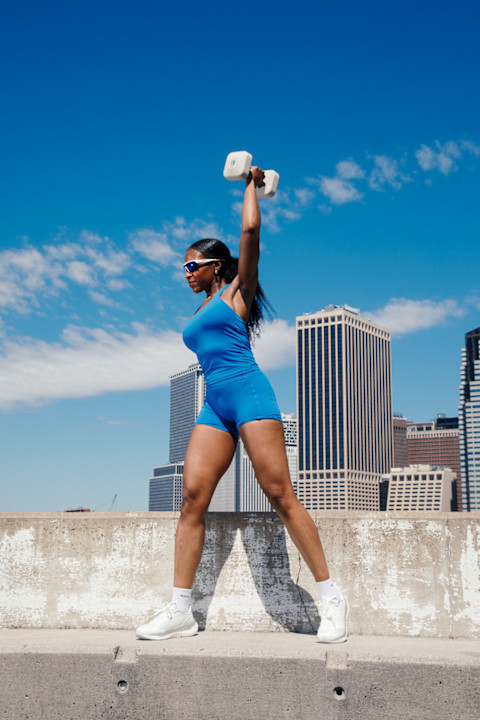
Image by Eli Ritter / mindbodygreen
This is why training near failure is the non-negotiable variable. “Muscle growth is driven by recruiting high-threshold muscle fibers, which happens when you train sufficiently close to failure,” Ritchey explains. “Feeling shaky, sweaty, out of breath, or experiencing muscle burndoes not necessarily mean you’re stimulating muscle growth.”
Many women are working much harder than they need to, in terms of perceived effort and sweat, while not working hard enough in terms of actual muscular challenge. You can be breathless and exhausted from a circuit class and still not have given your muscles a strong enough reason to adapt
Ashley Damaj, board-certified behavior analyst, nutritionist, past guest on the mindbodygreen podcast, and founder of Mothership Wellness, adds important scientific context. She describes the role of mTOR (mechanistic target of rapamycin), the molecular signaling pathway that turns on muscle protein synthesis. Getting enough leucine per meal (~2.5 grams) is one of the key triggers for this pathway, which is why protein quality and distribution across the day matter as much as total intake
On the training side, progressive overload is the mechanism that keeps adaptation happening over time. “The stimulus has to be sufficient and consistently increasing or the muscle has no reason to adapt,” Damaj says. “This is non-negotiable. Period.“
RELATED READ:This Is The Best Tasting Clear Whey Protein (& I’ve Tried Dozens)
The REPS framework: A simple blueprint for effective training
Ritchey developed a framework at Evlo that distills the most important variables into an actionable structure. I’ll touch on each of these in more detail, but here is the basic breakdown
- R: Repetitions:Train to failure or 1–3 reps shy of failure in each set. Anywhere from 4 to 30 reps per set can be effective, as long as the final rep is at or near failure. This gives you enormous flexibility. You can use a lighter weight for higher reps, or a heavier weight for lower reps—both work.
- E: Exercise selection:Choose exercises that target one muscle group at a time, that limit discomfort, and that you enjoy. No single exercise is required. If a particular movement causes pain or you dread it, there is always an alternative.
- P: Protein:Eat 0.7 to 1 gram of protein per pound of body weight per day. This is a consistent recommendation across all four experts and is supported by substantial research. Protein provides the raw material for muscle protein synthesis. Without it, the training stimulus cannot translate into actual muscle.
- S: Structure:Work each muscle group roughly twice per week on non-consecutive days. Strength train 3 to 5 times per week in total.
What’s helpful about this framework is that it’s quite simple, while still covering the fundamentals your body needs to get stronger
How hard should you train?
One of the most common training errors, especially among women, is not training hard enough. Not in terms of volume or duration, but in terms of proximity to muscular failure
creatine with taurine+ drink mixes
★ ★ ★ ★ ★
★ ★ ★ ★ ★
“Many women do ‘3 sets of 10,’ but realistically could have done 15 or more reps with that weight,” Ritchey says. “If the muscle isn’t being challenged enough, you’re probably not giving your body a strong enough reason to adapt beyond those initial beginner gains.”
That doesn’t mean every workout should leave you completely wiped out or crawling out of the gym. One of the most important skills in strength training is learning the difference between muscular challenge and pain
In the beginning, that distinction can feel hard to recognize. A simple rule of thumb from Greca: “If you can complete all your reps with solid form and still feel like you have several reps left in the tank, it’s probably time to progress.” There are a few different ways to “progress,” which I’ll cover shortly.
RELATED READ:If You Exercise 5+ Times A Week — These Supplements Should Be In Your Stack
Many women do ‘3 sets of 10,’ but realistically could have done 15 or more reps with that weight
Building your program: Frequency, volume, & structure
How often to train
The research-backed sweet spot1 for most people is training each muscle grouptwice per week2, with at least 48 hours between sessions targeting the same muscles. This gives the muscle enough frequency to signal adaptation while allowing adequate recovery
For the overall weekly structure, most women do well with 3 to 5 strength sessions per week. “A balanced week in my world usually includes a mix of strength, mobility, recovery, and restorative movement,” McGee says.
“For many women, especially in midlife, more is not always better. I love two to four strength-focused days depending on the person, combined with walking, mobility work, Pilates, yoga, and at least one true recovery day.”
How much volume
One of the biggest misconceptions around strength training is that you need long, grueling gym sessions or daily workouts to see results. In reality, muscle growth is driven more by the quality and consistency of your training than the sheer amount of time you spend exercising
When researchers talk about “volume,” they’re referring to the total amount of work you do for a muscle group across the week, usually measured in working sets. For most women focused on building muscle, research tends to land around 10 to 20 challenging sets per muscle group per week as an effective range, especially for more experienced lifters
Beginners usually need far less to see progress because their bodies respond quickly to a new training stimulus. And importantly, those sets don’t need to happen all at once
Damaj notes that “spreading that volume across the week outperforms cramming it into fewer sessions. Frequency drives adaptation.” So doing a few quality sets multiple times throughout the week is often more effective and more recoverable than destroying one muscle group in a single workout and staying sore for days afterward
At the same time, the minimum effective dose for progress is probably lower than most people think. Ritchey points out that research suggests you can build muscle with around four hard sets per muscle group per week, especially if those sets are performed close to muscular failure. Maintaining muscle may require even less
That’s important because a lot of people abandon strength training entirely when life gets busy, assuming short workouts “don’t count.” But consistency matters far more than perfection. A focused 15- to 20-minute session where you challenge your muscles with intention can absolutely move the needle, especially when repeated week after week
A balanced week in my world usually includes a mix of strength, mobility, recovery, and restorative movement
The movement patterns that matter most
What we want to avoid for any newcomer is an injury that puts you on the couch for six weeks. Strength training should make your body feel more capable, not more beat up
Greca explains that these movements “recruit multiple muscle groups at once and give you the biggest return on your time.” Here’s a basic breakdown of each move:
- Squat: Lowering and lifting your body by bending through the hips and knees together. Think sitting down into a chair, standing back up, or picking up a child.
- Hinge: Bending from the hips while keeping your spine stable and long. This is the movement behind deadlifts, but also everyday things like picking something up off the floor or unloading the dishwasher.
- Push: Moving weight away from your body, or pushing your body away from a surface. This includes exercises like push-ups, chest presses, and overhead presses.
- Pull: Bringing weight toward your body. Rows, pull-ups, and lat pulldowns all fall into this category, and it’s one of the movement patterns many people don’t train enough.
- Carry: Holding weight while walking and staying stable through your core and posture. Think farmer’s carries or carrying heavy grocery bags from the car into the house.
Beyond these foundational patterns, McGee emphasizes single-leg balance and core stability as particularly important as we age, both for injury prevention and for functional independence
RELATED READ:Ditch the Crunches — Here’s What Actually Builds Core Strength
Progressive overload: How to keep getting stronger
Your body adapts to the demands you place on it. Once it has adapted, the same stimulus no longer produces the same results. This is why progressive overload (gradually increasing the challenge over time) is essential for continued progress
Ritchey describes the full range of options: “Progression can also look like doing more reps, improving form, increasing control, or moving through a greater range of motion.”
“I think people put too much pressure on themselves to increase weight every single week,” she adds. “Your body is adapting even when the changes are more subtle.”
Greca uses a slowed tempo as one of her favorite progression tools. Slowing the eccentric (lowering) phase of a movement increases the mechanical tension on the muscle without requiring more weight, and can make a seemingly easy exercise much more challenging
The key is that some form of progression is happening. If you’ve been doing the same workout at the same weight with the same effort for months, you’ve likely stopped making gains. The stimulus has to keep evolving
Progression can also look like doing more reps, improving form, increasing control, or moving through a greater range of motion
The role of reps & sets: Hypertrophy vs. strength
For most people, there’s no sharp line between “hypertrophy training” and “strength training.” They exist on a continuum, and both produce benefits. But understanding the distinction helps you design smarter programs
Hypertrophy training typically uses moderate loads (around 8 to 15 reps per set) with higher volume and moderate rest periods. It creates the metabolic stress and mechanical tension that drives muscle growth
Strength-focused training uses heavier loads (typically 3 to 6 reps per set) with lower volume and longer rest periods. It builds neuromuscular efficiency, training your nervous system to recruit more motor units and fire them faster
Damaj explains why both matter for body recomposition: “A stronger muscle is a bigger muscle with more capacity to grow. Heavy strength work trains the nervous system to recruit more motor units and fire them faster. That neural adaptation does not show up on a DEXA scan, but it shows up in every single subsequent session.”
This neuromuscular foundation also pays dividends across decades. “Women who build a foundation of heavy strength work carry that neuromuscular efficiency forward even through periods of reduced training, injury, postpartum recovery, or aging. The muscle may shrink temporarily. The nervous system remembers how to use what is there.”
For most general-fitness goals, a program that rotates between hypertrophy and strength emphasis, either within sessions or across weeks, will outperform one that stays rigidly in one rep range
RELATED READ:Want More Confidence At The Gym? Here’s Your Guide To Success
Fueling for strength
You can have the perfect workout program on paper, but if you’re consistently under-eating, skimping on protein, or avoiding carbohydrates altogether, you’re likely leaving results on the table. Nutrition plays a major role in muscle growth, recovery, performance, and body composition. For a deeper look at how to fuel your training, check out the re
- Holistic vs. Fitness Nutrition: What Women Need to Know About Macros
- A Simple Guide On What To Eat To Support Muscle HealthWant To Build Muscle?
- Most Women Are Missing This Nutrient (It’s Not Protein)
How to measure progress beyond the scale
The scale measures one thing. Your weight (and only your weight) on a given morning. It doesn’t tell you how much muscle you’ve built, how much fat you’ve lost, how your hormones are functioning, or how capable you’ve become
Damaj recommends a BIA (bioelectrical impedance analysis) scale for home use. While not as precise as a DEXA scan, a BIA scale tracks body fat percentage, skeletal muscle mass, and sometimes visceral fat, giving you a much richer picture than body weight alone. “Look for trends—don’t mind absolute body weight as much,” she says
Other meaningful metrics include:
- Waist-to-hip ratio, which Damaj describes as her favorite measure for female clients, because it reflects changes in body composition and metabolic risk more accurately than scale weight.
- Performance markers: Are you lifting more weight? Completing more reps? Moving through a greater range of motion? Recovering faster between sets?
- Subjective measures: Energy levels, quality of sleep, mood, confidence, and what Damaj calls “feelings of badassery.” These often shift before the mirror or the scale reflects change. And, in my opinion, matter much more.
McGee echoes this, “Often the first shifts are better energy, improved posture, more confidence, deeper sleep, less pain, and feeling more capable in daily life. Those are huge wins.”
Greca notes the psychological dimension, “Women begin to trust their bodies more. They feel more grounded, more resilient, and more connected to themselves.”
Women begin to trust their bodies more. They feel more grounded, more resilient, and more connected to themselves
Where to start
If you’re starting from zero, or restarting after time away, the goal is to build the skill of training, not to exhaust yourself
Ritchey recommends beginning with exercises you feel confident doing, using machines if needed, and focusing on learning what muscular challenge feels like. “Learning how to train near failure is a skill that will continue to give back to you throughout your life.”
Here are a few ways to get started:
- 2 to 3full-body strength sessionsper week, on non-consecutive days. Each session should cover the major movement patterns: a squat or hinge, a push, a pull, and a core movement.
- 2 to 4 sets per exercise, working to 1 to 3 reps shy of failure. Rest for at least a minute between sets.
- Choose weight or resistance that makes the last few reps hard, not uncomfortable in a painful way, but in a “I’m not sure I can do one more” way.
- Track something. Even simple notes on your phone about the weight used or reps completed give you a benchmark and make progressive overload possible.
- Prioritize protein. Aim for 0.7 to 1 gram per pound of body weight, spread across meals.
- Don’t undervalue recovery. If you’re sleeping poorly, managing significant stress, or feeling consistently run-down, adding more training is rarely the answer.
As Greca explains it, “Effective strength training is the consistent practice of progressively challenging your muscles, nervous system, and mindset in a way that builds strength, resilience, longevity, and confidence over time.”
Consistent. Progressive. Sustainable. Those three words, more than any specific exercise or rep scheme, are the foundation
RELATED READ:New To Strength Training? Avoid These 4 Progress-Killing Mistakes
Train it like you mean it. Show up however you actually are
Build even more muscle & strength with creatine
That’s right. Creatine is the most researched supplement on the market, and decades of research show that it helps people of all ages and fitness levels build more muscle and strength from their routines than exercise alone.*
That’s because creatine helps replenish yourmuscles’ quick energy stores (ATP), allowing you to perform at a higher intensity and recover between sets. Over time, those small performance gains add up to greater improvements in strength, power, lean muscle, and overall training results. Plus, research continues to show that creatine supportsbrain health, mental energy, and memory.*
mindbodygreen’s creatine with taurine+ is a smart choice for a daily supplement. It provides the optimal 5-gram dose of creatine monohydrate along with 2 grams of the amino acid taurine, which further supports exercise recovery, muscular fatigue, and strength gains in addition to heart health.*
The takeaway

Image by Eli Ritter / mindbodygreen
Over time, strength training moves away from appearance and toward capability. You notice how much steadier you feel carrying groceries, climbing stairs, getting up off the floor, moving through stressful seasons, or simply existing in your body with more energy and confidence. The wins become less about chasing a certain look and more about building a body that supports you back
McGee put it beautifully when she said that “real strength is being able to move through life with confidence, stability, energy, and trust in your body. It’s feeling capable in your own skin.” (Speaking of McGee, don’t miss her incredible 20-minute at-home strength workout on our YouTube channel.)
Greca described a similar shift in her own life: “Strength became less about shrinking myself and more about building myself. Now, I see strength as one of the most important pillars of overall health—not just physically, but mentally and emotionally as well.”
As Damaj says, “Bodies are not entirely an aesthetic project. They are a strong, resilient, wildly intelligent organism. Train it like you mean it. Show up however you actually are.”
And everything else will follow
If you are pregnant, breastfeeding, or taking medications, consult with your doctor before starting a supplement routine. It is always optimal to consult with a health care provider when considering what supplements are right for you.
