


This article was featured in New York’s One Great Story newsletter. Sign up here
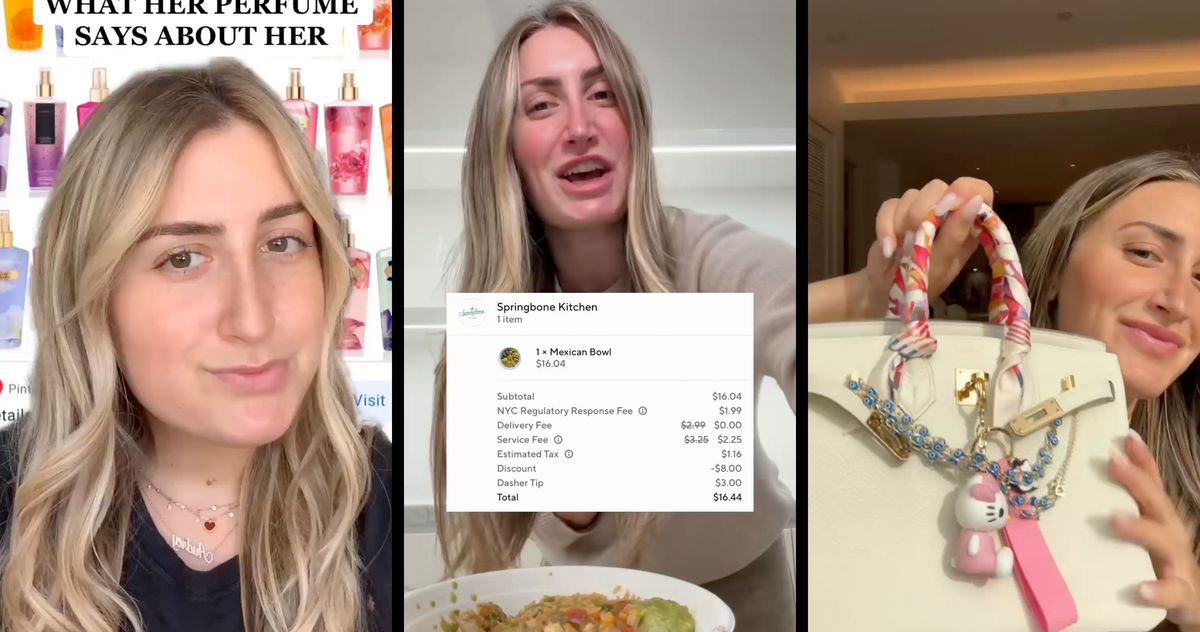
In a comically spotless white kitchen on a Tuesday in June, Audrey Peters is filming her latest hit TikTok series: a compilation of all the food delivery she orders in a day. “I deliver almost every single meal, almost every single day, because I hate to cook and I’m incredibly lazy,” she says with a practiced, self-deprecating laugh to her camera, propped against the wall as a portable LED light bathes her in a warm glow. “It is 10:15 a.m., and my first delivery just arrived, and it is my Starbucks coffee.” The coffee, an almond-milk iced latte with cold foam, two pumps of vanilla, and a pinch of cinnamon, costs $25.18.
“When I really want to rage-bait, I’ll order coffee. People get so mad at me,” she tells me. The Starbucks, after all, is only three blocks from her apartment, and most of the time she grabs it while walking her dog, an English cream miniature dachshund named Linguine. But, she explains, it’s been a while since she’s made a DoorDash video, and “I just really want to ensure good performance.” After reshooting the opening a few times, she’s finished with the segment. “I don’t need the coffee anymore,” she announces. “Would you like it?”
The career of Audrey Peters, 29-year-old lifestyle influencer, has been a series of eras. When she was in boarding school in the 2010s, she launched a blog about fashion and travel called According to Audrey. Living online had come naturally to her. As a child, she was always told she was too loud; back then, her dream was to be a singer “even though I can’t really sing.” But growing up with wealthy and stylish parents between Miami and Manhattan gave her access to a lifestyle ripe for voyeurism. Though she abandoned the blog shortly after college graduation, her second era began when she, like a lot of people at the start of the pandemic, joined TikTok and made front-facing comedy videos like “what your New York City neighborhood (or favorite designer, or brunch spot) says about you.” After two years, the jokes started to feel overdone (“I just genuinely couldn’t make one more joke about Murray Hill”). “That’s when I realized,” she says, “I’m going to have to constantly adapt and rebrand.”
Since then, Peters has found a niche posting about luxury: Her worldwide search for a specific color of Chanel sandals went viral in 2022, and she’ll often share “come along with me” videos while securing Hermès appointments in Paris and browsing Pucci in St.-Tropez. But like clockwork, after two years something shifted. She used to get millions of views for her shopping videos, these days, she says, “maybe on a good day I’ll get like 300k.” Luxury got stale, people got bored, or perhaps they felt resentful watching influencers show off free PR and designer hauls when they couldn’t afford groceries.
Enter the DoorDash series. Its success is not a mystery: When she published her first video in April, in which she ordered four separate meals for breakfast, lunch, dinner, and dessert, the 760 comments were a mix of shock and despair, calling her wasteful and out of touch. “People were calling my manager and being like, ‘Oh my God, so many people are making videos about it, do you care?’ And I’m like, ‘No, this is exactly what I wanted.’” What she’d created was greater than a one-off viral hit, it was an easily repeatable gimmick that she could serialize for guaranteed views, even if most of the views weren’t necessarily her fans. “It was completely strategic,” she says. “Your goal is to always hit a new ‘For You’ page.”
Once upon a time, influencers could post beautiful photos of their lives — their outfits, their coffee, their vacations, their children — and, with enough consistency, amass an audience of followers who looked to them for inspiration or escape. The rise of TikTok and Instagram’s prioritization of video forced them to get comfortable not just posing but speaking to a camera; those without compelling personae were left behind, stuck in an eternal 2019. Now, halfway through the TikTok decade, another evolution is taking place, one on an ever-nicheifying, hypercompetitive internet devoid of any real monoculture and obscured by fake or bought metrics. The only reliable way to reach mainstream or even moderate recognition against all the noise is to either carpet-bomb social media with clips or to enrage wide swaths of the public. Showing off a cute outfit, an ab routine, or a gorgeous home can’t possibly compete with the army of people doing the exact same thing, nor the stealth marketing campaigns designed to cut through the noise. In an era of oversaturation and slop, audiences want one of two things: to be sucked into the endless scroll by titillation and rage-bait or to be lured away from it by a fresh filming style, a gripping series, access to an exclusive community, a spot-on cultural analysis, or an outlandish personality.
Where does this bifurcation leave lifestyle influencers who have built businesses by being aspirational and brand-safe? They’re in sort of a tricky place. Much like every aspect of the entry-level economy, it’s much harder for new people to break in than it was even a few years ago. Though advertisers are shelling out more money than ever to work with influencers — an expected $43.9 billion this year, compared to $37.1 billion in 2025, according to the Interactive Advertising Bureau — those without a strong niche, point of view, or expertise are often left hanging. This spring, several lifestyle influencers were dropped from brand-sponsored trips to Coachella just days before they were scheduled to leave. One brand manager on X wasn’t surprised: “With budgets tighter, no one is paying $20-$40K+ for a few posts that have little impact,” he wrote.
Brands are now significantly more selective about which influencers they work with and are demanding far more control over how their products are positioned, and briefs are now lengthy, specific, and covered with contingency plans if a post doesn’t perform. Only influencers with pristine engagement rates are considered for campaigns, the standard formula being a creator’s combined likes, comments, shares, and saves divided by their number of followers. “Before, if their content was incredible, they would let it slide,” says Amanda Acevedo, director of talent at G&B Digital Management. “But brands have been super-strict with engagement rates, wanting to see them at a minimum of around 3 percent. In the past, it was 2.”
Attention, like everything, is a supply-and-demand business. “There are a decent amount of lifestyle creators who five years ago were part of quite a small pool and could throw a big number at the wall and very often it would stick,” explains Grace Murray Vazquez, executive vice-president of strategy at Fohr, an influencer marketing firm. Many of those creators can no longer command the same fees from brands, and more often than not their followers are tired of the same old content. Last year, the longtime beauty influencer Jaclyn Hill complained that TikTok wasn’t promoting her videos like it used to. “I just feel like I’m talking to myself,” she said. Hill’s commenters saw something different. Instead, her plummeting viewership was, in their words, “because your era is over and that’s ok.” “We’re tired of watching influencers rub their wealth in our faces,” said one. “Teach me something. Educate me. That is what I want,” wrote another.
“There’s less of a desire to just watch someone else live out their life,” adds Murray Vazquez. “It’s like, ‘How does this impact me? Am I learning from this? Am I getting some kind of feeling that I like?’” Or, as Peters puts it, “You can’t just be showing matcha-Pilates-Alo.” The boring, dime-a-dozen influencer is dead, and nobody’s mourning it. But what happens if its replacement is even worse?
One task Peters has to do today that she really does not want to do is post links to her Instagram Story. “I hate linking,” she says, curled on her white couch, but she must because a brand that is considering paying her to promote its product wants to see her link-click metrics. It wants to verify, in other words, how good of a saleswoman she is
The answer is “very.” There are a few ways, according to Peters, to get lots of people to click on an Instagram link. One is to post a screenshot of a DM of someone asking for a recommendation, which, for whatever reason, makes people desperate to find out what it is. Another is to include a long paragraph about why a product is great, which she does next to a bottle of tanning drops even though she’s anti fake tan. But the most reliable way is to hint that the product you’re about to recommend is expensive, and then crop out the price. “If you want to be sneaky about it, a lot of times I use click-bait, where I’m like, ‘This is pretty pricey!’” she says, linking to a dress she recently wore to a wedding. Within seven minutes, 7,000 people have viewed the story, and 2,000 of them have clicked on the link to the dress. “I do have great conversion,” she says.
Peters’s bread and butter is still luxury fashion, even if the category isn’t as hot as it was two years ago. “I used to get 5 million views to be like, ‘Come with me to Chanel!’” she recalls. Now even she’s a little bored by watching yet another influencer unbox a Birkin. “Every hoe now has an Hermès. Thrilled for you, but I actually don’t need to see an Hermès bag anymore.” When the yoga brand Alo chartered a yacht during Cannes and stuffed it with influencer-celebrities like Kylie Jenner and Alix Earle, Peters wasn’t surprised that much of the feedback was negative. “If it was 2022, everyone would have been like, ‘Show us a day in the life on the yacht!’ And everyone was like, ‘This is disgusting.’ I knew in advance they were doing it and I was like, That’s not gonna do well.”
While her income from deals with brands like Starbucks and Wella have been consistent over the past several years — in March, she had 14 partnerships, in April she had six — she’s had to keep pivoting. Hence the baiting game. The art of the viral-but-still-brand-safe rage-bait is a delicate balance between provoking viewers into commenting and sharing the post while still maintaining a wink-wink posture that nods, at least to your core audience, that you’re in on the joke. (Showing off one’s collection of multi-thousand-dollar designer bags? That’s just run-of-the-mill bragging, not the kind of “what’s actually going on here?” rage-bait the algorithm loves. Paying $25 for Starbucks delivery? Perfect.) Acevedo of G&B Digital Management points to the tradwife-adjacent influencer Alexia Delarosa, who went viral in 2024 for making snacks from scratch while wearing cottagecore dresses and a plastered-on smile. Though her videos started out as earnest documentations of the meals she made her children, similar to influencers like Nara Smith and Hannah Neeleman of Ballerina Farm, over time she exaggerated each aspect of her videos to maximize engagement. “It’s all about being strategic and not pushing it too far,” says Acevedo. Steffy Degreff, a DIY influencer known for her seasonal home décor, leans into this with her projects. When she transformed her front porch into an Italian picnic by painting her door gingham and cutting out giant tomatoes and pasta shapes, commenters either praised her whimsicality or hated the result. “If people have a reaction, whether it’s a really good or bad reaction, that means that I’m doing well at what I do. So it doesn’t bother me at all,” she says.
What does get frustrating is the flood of copycats she’s either directly or indirectly inspired. Degreff started her career in the days when Instagram was mostly photos, and content could be expected to reach your core audience. Now, she says, you need to reach everyone, because there’s no guarantee your followers will see it, which means that when one post breaks containment, it usually begets a trend. Years ago, Degreff started making jokes about how as soon as the Fourth of July hits, she starts celebrating fall. “It used to be a good joke!” she says. “And now I literally cringe hitting publish on it because I’ve seen 50 of those videos.” Over the course of her career, she’s seen brands become choosier about who they work with and more particular about how their products are positioned. “I had to reshoot a Christmas ad because I was filming it in October and my nails were orange,” she says. “I had to refilm another because it was supposed to be ‘Christmas but nondenominational vibes’ and I had Santa earrings on.”
Creators now lament the fact that unposed photos overlaid with butter-yellow text are performing better than videos they spent hours editing, perhaps a result of the ever-changing algorithm, perhaps because they evoke an aura of artistry or depth, or perhaps just because it looks cute, no one really knows. Another change: “Follower counts are becoming less and less important every year,” says Murray Vazquez. To keep viewers engaged, creators are turning to serialized franchises that can be seamlessly monetized, like Peters’s DoorDash series. In her first video, she was careful not to mention a specific app in case one of them wanted to offer her a brand deal. “I wanted to keep it open to the highest bidder,” she says; DoorDash reached out almost immediately. But, she points out, “I can’t just be the DoorDash girl, so I can’t do it every day. I don’t want to lose relationships because I’m now known as the DoorDash girl.” Despite pressure among lifestyle influencers to “niche down,” that is, find a specific topic they can “own,” Murray Vazquez warns that “a niche is a great place to start and a dangerous place to stay. It can quietly close off how you earn because it’s great to be known for something, but it’s not good to be limited by it.”
The next hurdle for lifestyle influencers will be to make content that’s both useful and, crucially, distinguishable from what AI can do. Taylor Lorenz, author of Extremely Online: The Untold Story of Fame, Influence, and Power on the Internet, argues that as more people turn to AI for everything, aspirational lifestyle influencers may become obsolete. “You’re looking for skin-care recs and basic lifestyle improvements that now AI is directly telling you the answers to,” she says. “Like, ‘What should I have for breakfast if I want to slim down?’ ‘How do I make a raspberry tart?’ It already gives you inspiration and advice and it’s tailored to you.”
That afternoon, Peters has a call with her manager, Shana Davis-Ross, the founder of Ponte Firm. She’s known for representing a gaggle of well-known West Village girls and was called in one TikTok “the Kris Jenner of the NYC influencer scene.” “Hi, princess!” greets Peters with characteristic enthusiasm, after which they discuss which brands are casting for upcoming campaigns and what their budgets might be. (Of a trendy body-care brand: “I don’t know what happened to their budget, but it doesn’t exist anymore”; of a mid-priced mall brand: “Respectfully, if they want to elevate, they need girls that maybe wouldn’t wear it.”)
But mostly, what Davis-Ross wants to talk about is her newsletter. “I think you should really step up your Substack a little bit,” she says. Though she hasn’t posted since December, Davis-Ross stresses that even less well-known Substackers are being cast for brand campaigns and trips just because of their conversion rates, i.e., how many people click one of their links and buy the products they recommend. “It helps with the fashion crowd,” she says. “No, you’re absolutely right,” Peters says with a sigh, though she’s about to leave for Europe for a few weeks and knows she likely won’t have time. “You called it ages ago.”
Many in the industry are echoing the sentiment: In an age of the endless scroll, people want to feel like the hours spent on their phones are not, in fact, a waste of time, rather a means of gaining access to smart and cool people who lead interesting lives off-camera. In a recent interview, Lena Dunham said she’d heard that a single Substack follower was equal to many more followers on Instagram, because people who subscribed to a Substack were more likely to actually purchase a book. “You can’t just be pretty and share pretty clothes,” says Acevedo. “People want more educational content. And also content that is not AI and could never be AI.”
It’s an ironic turn at this precise stage of the internet for influencers to be encouraged to go back to where it all began: blogging. Mommy bloggers invented the influencer economy as we know it by building huge personal brands off of diaristic entries on Blogspot and LiveJournal; now creators of all stripes are doing the same on Substack. Stephanie Liu Hjelmeseth, a longtime lifestyle creator in Los Angeles who started her blog Honey and Silk in 2012 but since pivoted to Instagram, says she’s excited to focus on writing again. “With Instagram and TikTok and our attention spans being shortened, no one’s reading,” she says. “I felt like I lost that art because no one wanted it. But now that Substack came around, it just shows there’s a cycle.” Even if fewer people overall are reading, the ones who do are seeking out distinct, often paywalled spaces for it, making them an attractive demographic to brands hoping to reach educated and stylish consumers. Video content is getting more intellectual, at least aesthetically (one creator called the rash of cultural commentary videos with aesthetic lighting, serif fonts, and sound effects as “intellectual content slop”), as celebrities and influencers are capitalizing on the idea that, as manyatrendpiece has pointed out, being smart and having taste is hot again. How long that may be the case is another question, of course — it’s possible that the golden age of Substack is already over, that the audience of people willing to pay to read yet another newsletter has already been tapped out and is simply too niche for the kind of growth that brands like to see.
Peters is, in all likelihood, safe from the many ways other influencers could flame out over the next influencer vibe shift. She has a hefty stable of brands that continue to work with her; she will continue being able to shop at Chanel and Hermès even during years when the rest of the world is fatigued by it because advertisers will, for the most part, always want to associate themselves with luxury. When I meet her in June, she has just returned from work trips to Amsterdam, Paris, and Ravello; next week she will leave for London and St.-Tropez. She will continue to adapt to algorithms, to post on TikTok and Instagram and now her Substack, which she sees as a reinvention of According to Audrey, the blog she began in boarding school. With her DoorDash series and her Substack, she’s capitalizing on both the shift toward attention-getting rage-bait and more serious, thoughtful content for a smaller niche of extra-engaged readers. Influencing was made for people like Peters, people who will find a way to win the game of attention even when the work is a little less easy and effortless than it used to be. “Everything I do,” she says, “is strategy.”
The Influencer Recession
