


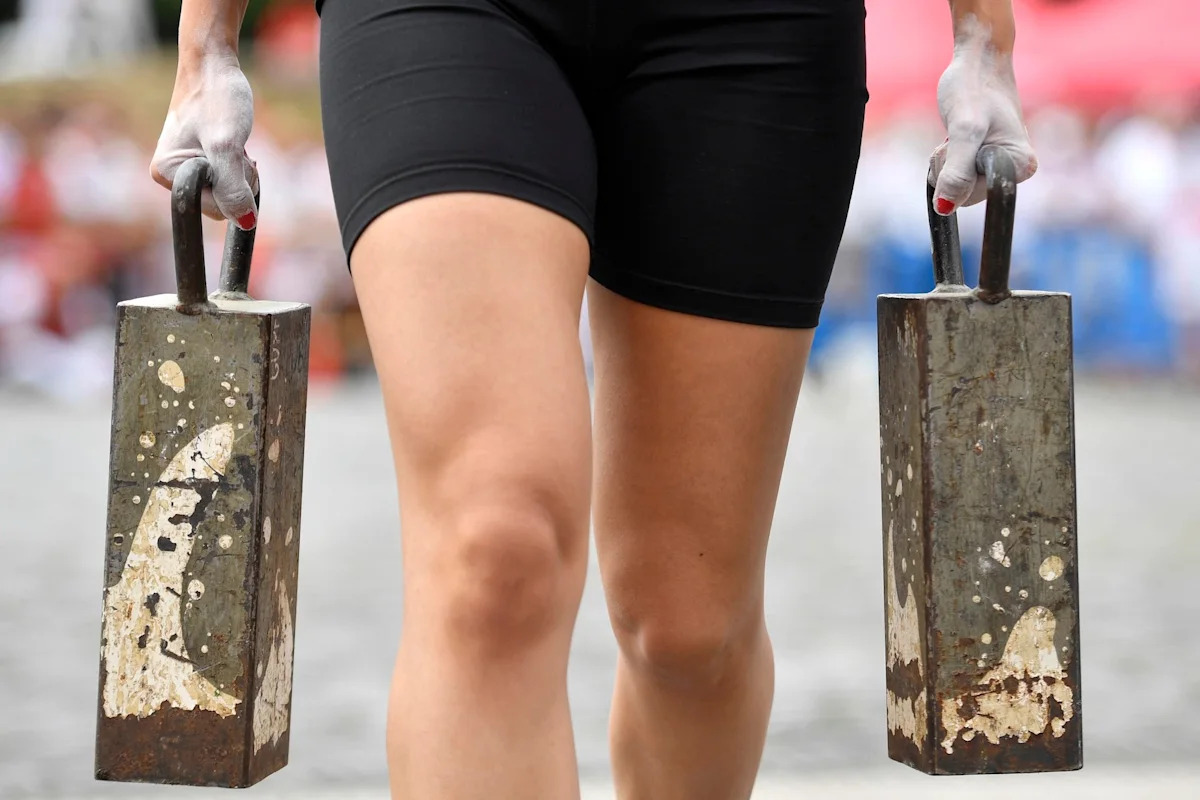
- The farmer’s walk, a full-body exercise involving picking up heavy weights and walking with them, is gaining popularity among trainers and researchers for its efficiency in improving posture and core stability.
- The resurgence of the farmer’s walk is being driven by a broader shift towards functional fitness, accumulating research on posture and pain, and its accessibility with minimal equipment required.
- Expect the farmer’s walk to become a standard in general fitness routines, with loaded carries becoming a common programming block and posture-focused training gaining more attention in addressing pain and discomfort.
A once-obscure strength move borrowed from pre-mechanized farm work is quietly moving to the center of the functional fitness conversation. The farmer’s walk, picking up heavy weights and walking with them, is being framed by trainers and researchers as one of the most efficient full-body exercises available, with particular payoff for posture and core stability. What’s driving the resurgence, and where the trend goes next, points to a broader shift in how everyday exercisers are choosing to train.
What is the farmer’s walk?
Personal trainers and strength coaches are increasingly recommending the farmer’s walk (also called the farmer’s carry) as a foundational strength exercise. Matthew Meyer, a certified personal trainer and run coach in Denver, described it to Runner’s World as “an extremely simple, but effective exercise. All you need are [one or] two weights and some space to walk back and forth.”
The Best Tech Neck Exercises to Relieve Neck Pain, Improve Your Posture and Reduce Screen-Time Strain
Advertisement
The exercise traces back to farmers hauling heavy buckets, equipment or seed before modern machinery. Its comeback is being propelled by both practitioner endorsement and research support. A 2015 electromyography study in the Journal of Human Kinetics concluded that “the farmers’ walk exercise should be used as an exercise to strengthen the [gluteus medius], especially in groups with a [hip abductor muscle] weakness.”
Matt Kasee, MS, CSCS, founder of Trilogy Fitness Systems, told Parade it’s the best functional exercise around
Why the farmer’s walk is making a comeback
Three forces are driving the resurgence, and none of them are accidental
The first is a broader consumer pivot toward functional fitness — training that transfers directly to daily life rather than isolating muscles for aesthetics. Meyer told Runner’s World the farmer’s walk “not only does this improve sports-specific areas, but also helps address weaknesses in your everyday life.” That framing — strength you actually use — has become a selling point across the industry
Advertisement
The second is the accumulating research on posture and pain. A 2018 study in BMC Musculoskeletal Disorders found that “improvements in postural awareness are longitudinally associated with reduced pain in patients.” Because the farmer’s walk requires an upright, braced position under load, it targets exactly the postural mechanics that research is now linking to fewer aches and injuries
The third is accessibility. There’s no equipment barrier and no gym membership required. Dumbbells, kettlebells or even a pair of evenly filled gallon jugs will do the job. A suitcase loaded with books works too. In a market where at-home training has become the default for millions, an exercise that scales from a hallway to a driveway has structural advantages
“By focusing on the legs and deep stabilizing muscles of the core, farmer’s walks can help runners stay healthy and prevent injuries.”— Jason Fitzgerald, USA Track & Field certified coach and head coach, Strength Running
What Could Be Next
Expect the farmer’s walk to keep migrating from strength-specialist circles into general fitness routines over the next 12 to 18 months — and expect the framing to shift from “unusual” to “essential.” Three near-term developments are worth planning around
Loaded carries become a standard programming block, not a novelty. Fitzgerald told Runner’s World the exercise is “fantastic for general strength before more sport-specific or explosive exercises as it strengthens nearly the entire body. And because it’s done while walking, it’s a very functional exercise that can improve postural stability and core strength.” That’s the kind of endorsement that pushes a move from niche to default. Reader action: Add the farmer’s walk to your existing strength routine now, before it becomes a group-class staple. Fitzgerald recommends 2-4 sets of 10-20 steps whenever you’re lifting weights, aiming for roughly twice per week. Track the weight carried and the distance walked, so each session is measurable.
Advertisement
Posture-focused training gets a research tailwind. With the 2018 BMC Musculoskeletal Disorders finding connecting postural awareness to reduced pain, expect more clinicians and coaches to prescribe loaded carries for desk-bound clients dealing with neck, shoulder or lower-back discomfort. Reader action: If you’re chronically hunched at a keyboard, start with moderately heavy weights you can hold and walk with for up to a minute. Pull your shoulders back and together, keep your palms facing your body and engage your core through the entire walk. Kasee told Parade that once a week is enough to start seeing results.
The at-home fitness market absorbs the move. Because the barrier to entry is a pair of weights and open floor space, the farmer’s walk fits neatly into the home-workout economy that expanded during the pandemic and hasn’t contracted. Reader action: Don’t wait for equipment you don’t own. Two gallon jugs of water weigh roughly 16 pounds combined — a legitimate starting load for most beginners. Progress by adding distance before you add weight
The clear takeaway: this is a low-cost, high-return exercise with research behind it and coaches converging on the same recommendation. Start light, start now and track your reps. The people who benefit most from a trend are the ones already doing it when it goes mainstream
THREE SIGNALS TO WATCH1. New peer-reviewed research linking loaded-carry exercises to postural awareness or injury prevention outcomes2. Group fitness classes and training apps adding dedicated “loaded carry” or “farmer’s walk” programming blocks3. Your own logged progression — weight carried and distance walked — over a four-to-six-week window
How Evening Workouts Boost Sleep Quality in Ways Most People Never Expect, According to New Findings
The Best Stretches for Pain in Your Lower Back, Hips, Shoulders and Neck
Save Thousands With Joint-Strengthening Workout Equipment At Home (Workouts Included!)
