


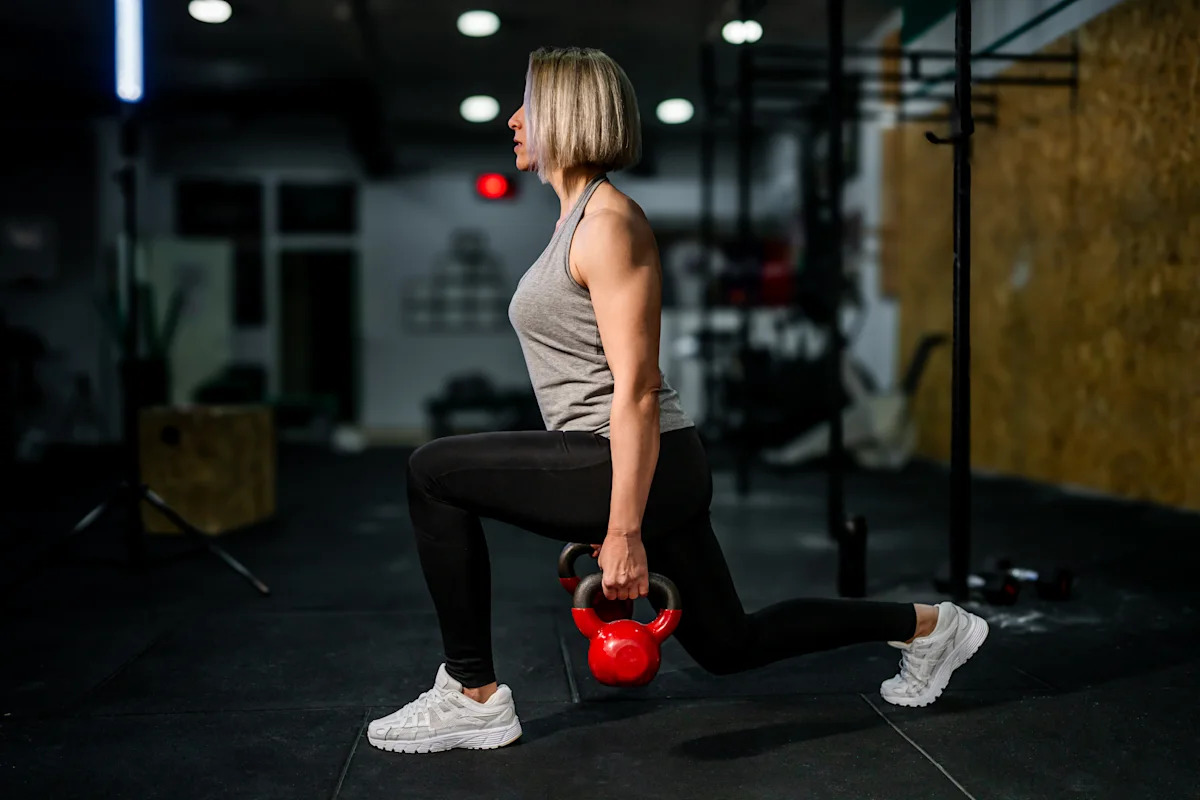
For most of our 20s and 30s, the fitness message aimed at women was remarkably consistent: burn it off, shrink it down, fit into something smaller. All we thought about was cardio and pilates, and heavy weights were for WWE wrestlers and people who wanted to bulk up. It’s hard for many of us in our 30’s, 40’s, 50’s and beyond to see muscle building as critical to our health
But it is
Somewhere along the way, an entire generation of women was pointed toward the treadmill and away from the one thing that would have actually protected their health for decades to come: muscle
Advertisement
That’s the message Chief Science Officer of The Exercise Coach “I think we’ve unintentionally sold women the wrong reason to exercise,” he says. “For years the message has been about shrinking—losing weight, fitting into smaller clothes, burning calories. But biology tells a completely different story.”
The real story is this: 40, muscle isn’t about being “bikini ready”, it becomes, in Fisher’s words, “one of your body’s most valuable organs.” It regulates blood sugar, stores amino acids your body pulls from during illness, sends out signaling molecules that support your heart and brain, protects your bones, and eventually decides how independently you’ll be able to live in your 60s, 70s, and 80s
So essentially, if you want to be able to lift luggage on your way to a fabulous vacation abroad in your 70’s and meet your great grandkids in your 80’s and 90’s, you need to start thinking about weight lifting
What’s actually happening in your body
If you’re in your 40s or 50s and nothing on the scale has changed, that can feel like reassurance, but it may not be. As estrogen declines through perimenopause, Fisher explains, “women become less responsive to the normal signals that maintain muscle. Protein synthesis becomes less efficient, recovery slows, body fat tends to increase, particularly around the abdomen, and muscle quality gradually declines.”
Advertisement
The scale can hold steady while the composition underneath shifts—less muscle, more fat—and the first place that shows up isn’t the mirror. It’s function. “Standing from a chair, climbing stairs, carrying shopping, preventing falls—these all become progressively more difficult,” Fisher says
The good news, and it’s real good news: muscle doesn’t stop responding to training just because you’re past 40. “Muscle remains remarkably adaptable,” Fisher says. “Even women in their 70s, 80s and beyond can gain significant strength with appropriate resistance training. It’s never too late to start, but earlier is certainly easier.”
It’s not just about your body—it’s about your brain
One of the more surprising threads in Fisher’s research is the link between lifting and cognitive health. When a muscle contracts, it releases chemical messengers called myokines, some of which influence inflammation, blood flow, and the production of a protein that supports neuron growth and maintenance. At the same time, he notes, strength training is “a neurological activity. Every repetition requires your brain to recruit motor units, coordinate movement, maintain balance and produce force.”
Advertisement
The research bears it out: “people with greater muscular strength tend to have lower risks of cognitive decline, and resistance training has been associated with improvements in executive function, memory and processing speed.”
Where this leaves cardio—and GLP-1s
None of this means cardio is worthless. But if Fisher had to pick one form of exercise for women after 40, it wouldn’t be it. “Cardiovascular fitness is important for all people, but not at the expense of muscle. If I had to choose or recommend only one form of exercise after 40, I’d choose strength training,” he says—pointing to its effects on bone density, insulin sensitivity, balance, and metabolic health. “Cardio certainly improves heart and lung health, but it doesn’t provide the same stimulus for maintaining muscle or protecting bone.”
It also matters for the millions of women now using GLP-1 medications to lose weight. Fisher is blunt about the stakes: without resistance training, “somewhere between 20 and 40 percent of the weight lost can come from lean tissue, including muscle.” His prescription is simple—”progressive resistance training two times per week for 20 minutes”—paired with adequate protein and hydration. “The ideal outcome isn’t simply weight loss. It’s fat loss while preserving—or even increasing—muscle mass.”
Ask Fisher what this all adds up to, and he doesn’t talk about aesthetics at all. He talks about healthspan—”not just living longer, but living longer in good health… the number of years you remain capable, independent and fully engaged with life.”
Advertisement
He’s seen it play out at The Exercise Coach: a 75-year-old client who, after a year of consistent strength training, is stronger than the average woman in her 30s. “That means travelling and walking through airports, not being wheeled, AND then lifting your suitcase into the overhead locker,” he says. “It’s kneeling down to plant flowers and getting back up without assistance. It’s picking up grandkids, recovering from illness, avoiding falls and continuing to do the hobbies you love.”
None of that happens by accident, and none of it disappears overnight, either—it erodes slowly, in the absence of investment. “Every strength training session is like making a deposit into your future independence account,” Fisher says. “You’re not just training for next week. You’re training for the woman you’ll be twenty or thirty years from now.”
The barrier to entry is lower than you think
If the whole idea still feels intimidating—unfamiliar equipment, loud gyms, feeling like you don’t belong—Fisher’s actual prescription might come as a relief. “Strength training twice per week for 20 minutes each time will produce substantial improvements in strength, muscle mass and metabolic health,” he says. “You SHOULDN’T spend hours in the gym. You don’t need to become a bodybuilder.”
Advertisement
What matters, he says, is working the major muscle groups with real effort, then letting the body recover and adapt. It’s a far smaller ask than the decades of cardio we were sold—and, according to the science, a far better trade
Creators are not employed by Yahoo. Views expressed by creators do not reflect the opinions and position of Yahoo.Learn how to become a creator.
