


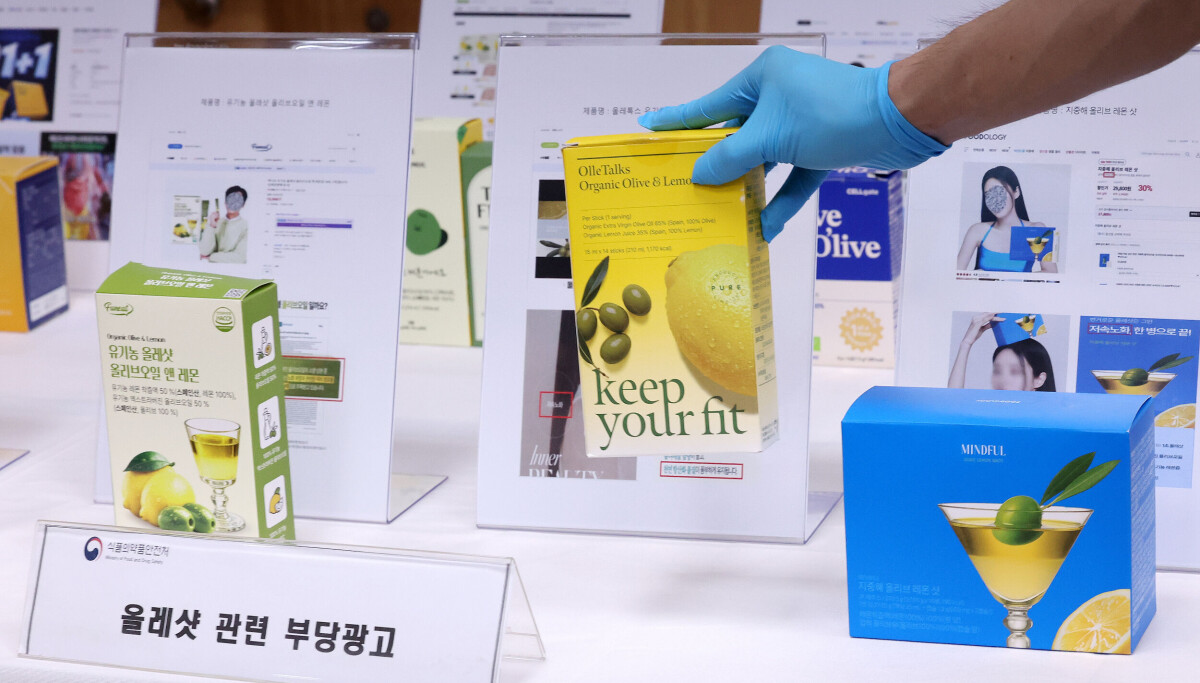
Last year, singer Jang Won-young of girl group IVE revealed a new beauty tip that quickly exploded into an online wellness craze: drinking a spoonful portion of olive oil with lemon juice on an empty stomach in the morning
Dubbed the “Ole Shot,” a portmanteau of the two ingredients, the trend was embraced by celebrities and health-conscious consumers as a slow-aging routine,giving rise to a range of related products that have since come under scrutiny. The Ministry of Food and Drug Safety recently flagged dozens of businesses for making false or misleading advertisements tied to similar claims.
In the crackdown, 26 businesses were found to have violated Korea’s food advertisement laws through the sales of 600,000 products worth 11.5 billion won ($8 million) in total. The Food Ministry has ordered their ads to be revised accordingly
Most of the Ole Shot-related products were promoted as having effects such as “slow aging,” “detoxification,” “antioxidant” and “anti-inflammatory” benefits, despite a lack of scientific evidence to support such claims. Although classified as conventional foods, the products were advertised in a way that gave consumers the impression that they had medicinal properties, according to the Food Ministry
Ole Shot isn’t the only type of product accused of being a health scam. Other non-medicinal products, sold in forms of pills, injections or stick packs, propagated unsubstantiated benefits including appetite suppression, blood sugar control, reduced body fat and improved blood circulation.
Some were blatantly promoted under slogans like “edible Wegovy,” referring to the prescription-only obesity drug, or mentioned “GLP-1,” the natural gut hormone used in such medications to treat Type 2 Diabetes and help with weight loss
In a separate inspection, cosmetics and personal wellness devices were also found to have been advertised deceptively. A calf massager advertised by comedian Hong Hyun-hee came under fire for being promoted as helping to “improve blood circulation and reduce swelling in the body.” However, the Food Ministry found it to be a violation because the product was not a medical device and therefore could not be advertised as being capable of treating specific symptoms or diseases
Healthcare products promising dramatic results have long relied on exaggerated claims and the allure of celebrity endorsements. But as AI becomes more accessible, some businesses are turning to generating fabricated experts and reviewers to wrongfully gain consumers’ trust — and their money
Regulators are working to tackle such scams, but questions remain over whether they can be completely eliminated
Related Article
With the abortion pill unavailable, Korean women resort to cancer drug to end pregnancies
Chronic regional doctor shortage <a href="https://healthylife7.com/drug-resistant-superbug-fungus-spreads-to-23-states-what-you-should-know/” title=”Drug-resistant ‘superbug’ fungus spreads to 23 states. What you should know”>spreads as national firefighter hospital remains understaffed
One in 20 Korean adults likely has borderline intellectual functioning
No promises allowed
The 26 businesses flagged by the Food Ministry are still allowed to sell their products. The issue lies not with the products themselves but with the way they were advertised.
In Korea, products consumed for health purposes are generally classified into three categories: conventional foods, health functional foods and medicine, and they each have different regulations when it comes to advertising.
“Conventional foods are not allowed to explicitly state what their intended benefits are,” a Food Ministry official told the Korea JoongAng Daily. “Health functional foods, on the other hand, may only advertise the specific functions they have been approved for, but they are still distinct from actual medicines.”
According to Article 8 of the Act on Labeling and Advertising of Foods, conventional food items are prohibited from being labeled or advertised to mislead consumers into believing that they are effective in preventing, treating or curing any disease. It also forbids product promotion in a “false, exaggerated, deceptive or slanderous manner.”
The type and severity of the violation determine the level of punishment, ranging from corrective orders and fines to business suspensions and criminal penalties
Health functional foods, similar to supplements, are defined by Korean law as being manufactured and processed using ingredients deemed to have beneficial functions for the human body. However, they are not proven to directly treat or prevent diseases.
Businesses are required to undergo evaluation and obtain official certification from the Food Ministry for their products to be recognized as health functional foods.
“Simply put, medicine can advertise explicitly what conditions they treat,” the official continued. “For health functional foods, manufacturers may only claim that their products ‘help contribute to’ a specific health benefit.”
Using star power and AI
One similarity found by the ministry among the flagged companies was that their main method of advertising was repeated exposure of short-form content on social media platforms like YouTube or TikTok
Consumers, when clicking on the videos in curiosity, would be automatically directed to the products’ own sales websites in an attempt to encourage purchases.
The companies would commonly utilize AI-generated before-and-after images to make it appear like their products provide miraculous results. An example is a facial cream that went viral on social media for purportedly “erasing” freckles and blemishes with a simple application — results that would normally require laser treatment by a licensed dermatologist
Hiring celebrities or social media influencers to endorse their products continues to be a staple marketing tactic as well
“I bought weight-loss supplements after seeing ads that said I didn’t need to exercise or change my diet,” said Choi Min-seong from Goyang, Gyeonggi, adding that he was “easily fooled” after seeing famed figures claim that they achieved the same results.
“But the pills just made me vomit and feel nauseous all the time — that’s when I knew I was scammed.”
The short-form ads tend to use striking phrases such as “rapid weight loss in a short period,” “flushes out body fat” and “lets you eat without gaining weight,” only to tone down such egregious claims on the products’ actual online stores to evade scrutiny, the Food Ministry found.
Businesses would also repeatedly delete and repost their advertisements to make it difficult to identify the
False advertising claims can also damage the image of celebrity endorsers. Choi, who bought a supplement promoted by singer Soyou, known as a member of the now-disbanded girl group Sistar, said he now views her “negatively.”
Separately, another health functional supplement advertised by Soyou was also one of the flagged products for promoting drastic weight loss in the Food Ministry’s recent crackdown
Actor Ahn Sun-young recently apologized for giving consumers the impression that a gray hair-covering product she endorsed could actually dye their hair
“People told me that they bought the product because they trusted my recommendation, only to find that it didn’t cover their gray hair,” Ahn said in a YouTube video on July 28. “I should have been more careful in explaining exactly what this product does.”
“Only business operators found to be in violation by the Food Ministry face administrative penalties; celebrities hired to promote their products do not,” the ministry official said.
The struggles to keep up
“I successfully lost weight from 75 kilograms [165 pounds] to 54 kilograms by just getting 10 hours of sleep — this sleep diet gave me the same results as running on a treadmill for 10 hours.”
This is what a woman said in a short-form advertisement for a diet supplement while flaunting her mind-blowing transformation. But she does not exist — she is an AI-generated character. Even the supplement in reality is classified as a processed sugar product.
The Food Ministry has taken steps to tackle the growing use of AI in deceptive advertising. In April, five amendment bills concerning laws under the ministry’s jurisdiction were passed by the National Assembly.
One of them now prohibits advertisements that use AI to create fake experts, such as doctors, to recommend food, cosmetics and medicine, a measure aimed at preemptively preventing misleading content from causing consumer harm
While the relevant law is set to take effect later this year, enforcement remains a challenge. With legacy media, there are fewer loopholes thanks to airtight regulations. But social media is a completely different story — the overwhelming amount of content makes it nearly impossible to monitor every detail, according to Lee Young-ae, a professor of consumer science at Incheon National University.
“Short-form content can lure consumers in more easily. It tends to be more provocative and provide consumers all the information they want in a very short amount of time, especially toward heavy users of social media,” Prof. Lee told the Korea JoongAng Daily.
“Consumers need to remember: If a product promises fast results without requiring much effort on the consumer’s part, it’s probably a lie.”
