


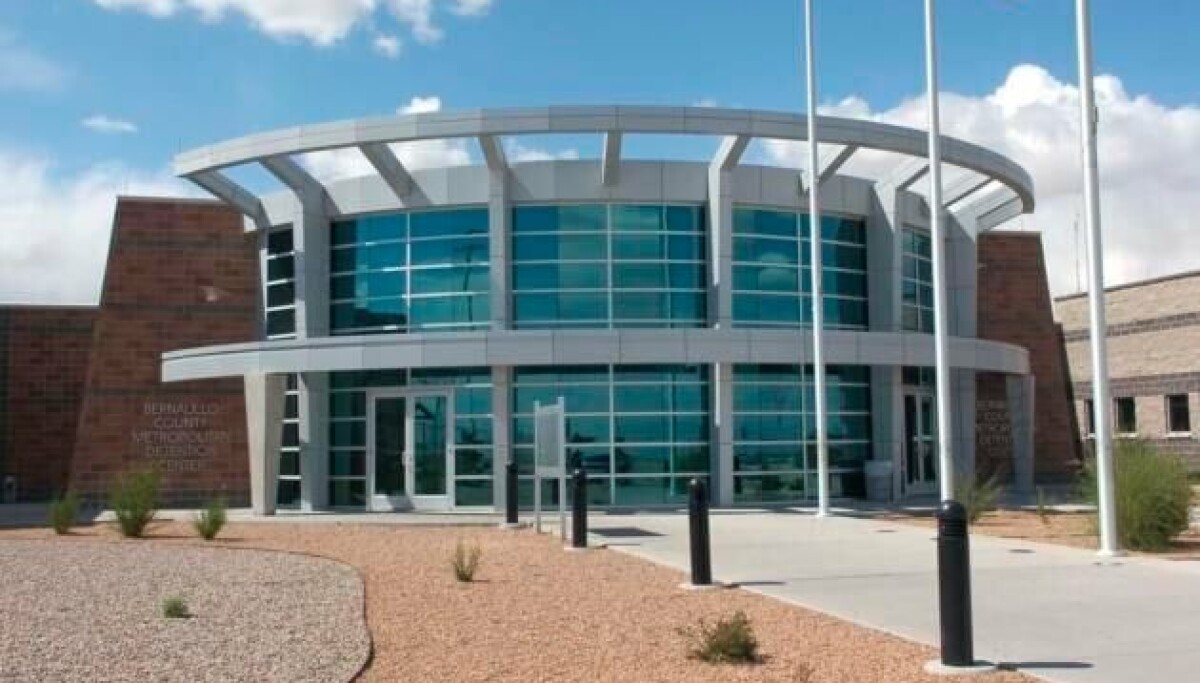
With less than a year remaining in its contract, the University of New Mexico Hospital is set to become the latest healthcare provider to leave the embattled Metropolitan Detention Center
Bernalillo County and UNMH announced Wednesday that they “mutually agreed that UNM Hospital will conclude medical, dental and behavioral health services at MDC, at the end of the current agreement.”
That means UNMH will not renew its contract with the jail in July 2027, four years after the provider took over following two for-profit providers leaving amid rising inmate deaths and substandard care — issues that remain
Since 2020, 49 people have died at the jail or died after falling ill at the jail. Of those, 24 deaths occurred after UNMH took over in July 2023
Many of the inmates who died were detoxing at the time, and in recent audits, federal monitors found UNMH was not adhering to constitutional healthcare standards outlined in a 2017 settlement agreement
“Over the coming months, Bernalillo County and UNM Hospital will work together to ensure continuity of care for patients while evaluating options for the next phase of healthcare services at the detention center,” according to a release from the county
Bernalillo County Manager Cindy Chavez said there “wasn’t really a single pinpoint reason” for the split, which she repeatedly emphasized was mutual. She said discussions on future providers and how to move forward have not occurred.
Chavez said the county was grateful UNMH jumped in to help when the county “was in dire straits and absolutely needed a medical care provider.” She said no discussions ever occurred about renewing UNMH’s contract another four years
“I think we have learned a lot, and they have learned a lot. And I think it was just a really good time for us to take all that we learned, so that we can improve opportunities in the future,” Chavez said
She said the entities “formally” agreed to forego further healthcare provisions Friday and UNMH gave them a year “to make this transition in a collaborative fashion.”
UNMH spokesperson Christopher Ramirez also did not elaborate on any reasoning for the move. He said, “Corrections medicine is complex and it has been particularly so over the past three years at MDC, as the patient population has increased.”
Ramirez added there was a mutual agreement “that conclusion of the UNM Hospital professional services agreement at MDC is the best next step.”
The decision came after commissioners approved millions in budget reconciliations to account for UNMH healthcare costs rising — something the county attributed to the outsized use of travel nurses at the jail. Chavez said the choice to move forward without UNMH was not about money, and UNMH has been paid $89 million “to date” for providing healthcare at MDC
She said, however, “costs are certainly a consideration” when it comes to MDC, as the county spends up to $120 million – out of its half-billion dollar budget – on “incarcerating people.”
Chavez emphasized the challenges with treating the population at MDC, noting that “almost half” of inmates are homeless and, at any given time, they have over 500 people in custody with mental health issues, along with many addicted to fentanyl and other drugs
More recently, encampment sweeps undertaken by the city of Albuquerque have repeatedly led to the unhoused being cited for code violations, like blocking the sidewalk, and later jailed for missing hearings. Homeless people now make up the largest population cycling through MDC
“People who come into our care — are very ill — if half of the people that we have in custody, on average, are homeless, that means they don’t have good nutrition, they have chronic healthcare issues, potential addiction issues, and mental health issues,” Chavez said. “So, providing good, strong, quality care is absolutely our highest aspiration in terms of providing services. And to be candid with you, we know we have to learn from our mistakes and do better and better for the public every day.”
Ramirez said “staffing to meet those needs is challenging,” particularly amid a healthcare workforce shortage. He added that the “workforce that chooses to work in correction medicine is a relatively small group.” Ramirez said, at the end of the four years, UNMH “will be proud to have advanced healthcare at MDC and provided high quality care in a facility that houses some of New Mexico’s most vulnerable populations.”
Kate Loewe, an attorney representing those incarcerated at the Bernalillo County jail under the class-action settlement, said she is concerned UNMH will leave “without remedying the problems and our community members in jail will continue to suffer.”
“We were so optimistic about this community partnership. And now we have another transition of providers that will, at least in the short term, deepen the crisis at the jail,” Loewe said in a statement. “Transition in medical vendors is historically a period of increased risk to our clients. Medications can be disrupted, needed equipment can be lost, critical patient information difficult to access. I pray they can make good on this promise of a seamless transition and continuity of care.”
In the county’s news release, County Commissioners Barbara Baca and Adriann Barboa lauded the work UNMH had done for the facility, with Baca stating she appreciated UNMH’s commitment “to helping ensure that the next chapter is even stronger.”
The county release states that the transition process “will evaluate operational lessons learned under the current agreement, identify priorities for the County’s future healthcare delivery model and develop recommendations to support high-quality, sustainable healthcare services at MDC.”
Over the next several months, local and national experts will work alongside the county, UNMH and the state Legislature “to develop a roadmap for the future of healthcare at MDC,” according to the release
Chavez said the task ahead “is a serious one.”
“I’m very very optimistic that we’re going to continue to dramatically improve care. Not just because we know it’s a moral obligation, but because we have the talent in our community to do it,” she said
