


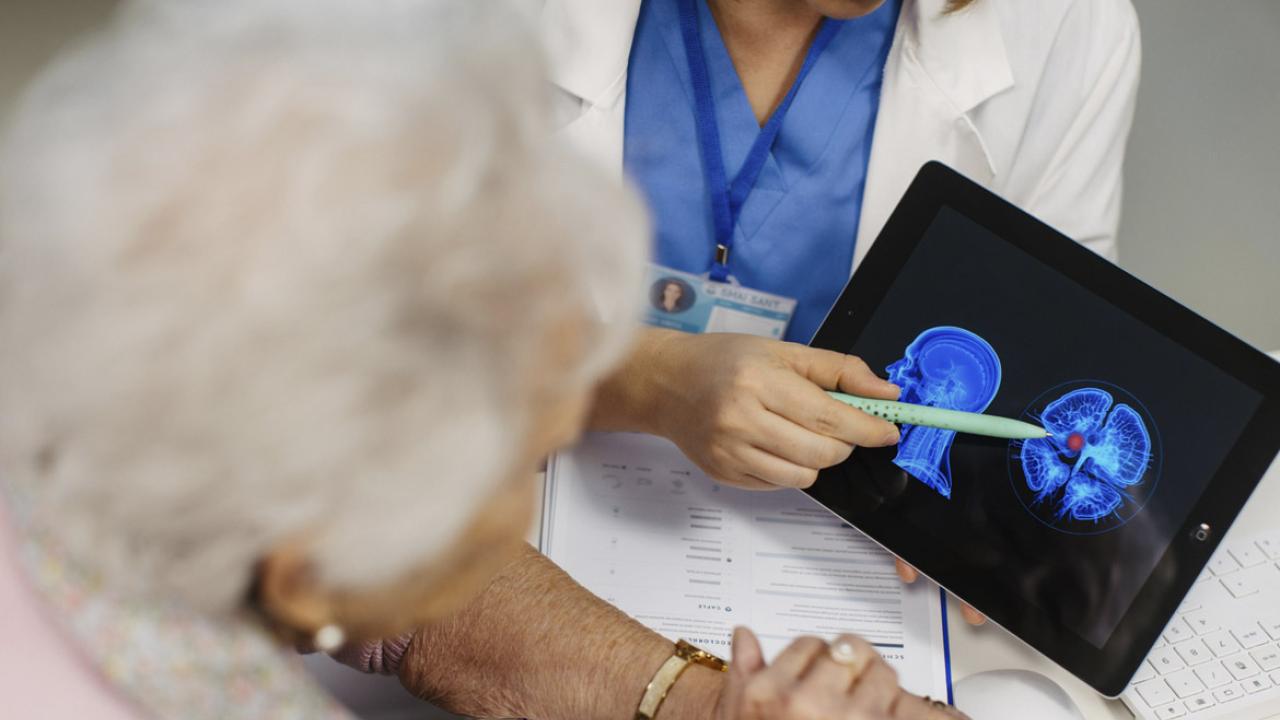
AT A GLANCE: A brain aneurysm can be silent for years or rupture without warning. Here are four things you will learn about brain aneurysms from Yazan Alderazi, MD, a neuroendovascular surgeon, vascular neurologist and neurointensivist at HCA Healthcare, in this article:
- Most brain aneurysms are found incidentally in patients who have no symptoms at all. Knowing the warning signs—such as a sudden, severe “thunderclap” headache, a drooping eyelid or double vision—can help you know when to seek immediate emergency care.
- Smoking and high blood pressure are the two primary risk factors for developing brain aneurysms.
- Many unruptured aneurysms are safely monitored over time, while those that require treatment are addressed with minimally invasive endovascular procedures.
- AI tools can now help clinicians detect possible aneurysms on scans obtained for unrelated reasons that may go undetected otherwise, but expert physician review remains essential to diagnosis and treatment decisions.
Health vs. Hype Podcast
The loudest wellness trends on the internet—answered with science.
Listen Now
A brain aneurysm may silently be present for years without producing a single noticeable symptom. If an aneurysm leaks or ruptures, however, the consequences can be sudden and devastating, ranging from severe neurological damage to death. Yet advances in imaging technology, monitoring and minimally invasive treatment provide promising options for patients today
Many aneurysms are often discovered incidentally, such as when imaging is ordered for an entirely different reason, rather than in response to symptoms. A patient brought in after a car accident, or evaluated for dizziness or memory concerns, may leave with an aneurysm finding alongside the condition that first prompted their visit. That means many patients encounter a diagnosis they were unprepared for, sometimes while facing another acute condition
Closing that gap has required both protocol innovation and technology. Health systems have increasingly begun using artificial intelligence (AI) to analyze CT angiography images and flag potential areas that may represent an aneurysm, including scans originally obtained for another clinical reason. These flagged findings are then reviewed by clinical experts, keeping a human in the loop to ensure that care delivered remains safe and personalized to the patient’s needs.
The AMA’s What Doctors Want Patients to Know™ series gives physicians a platform to share what they want patients to understand about today’s healthcare headlines
In this installment, Yazan Alderazi, MD, a neuroendovascular surgeon, vascular neurologist and neurointensivist who serves as the medical director of cerebrovascular disease and neurointerventional surgery with HCA Healthcare’s Gulf Coast Division, discussed what patients should know about brain aneurysms—from recognizing the warning signs that demand emergency care, to understanding how AI is responsibly reshaping detection and follow-up
HCA Healthcare is part of the AMA Health System Member Program, which provides enterprise solutions to equip leadership, physicians and care teams with re
An aneurysm is a bubble in the brain
Understanding what a brain aneurysm actually is can help patients make sense of the risks and the range of decisions that follow
“An aneurysm is an outpouching of the artery. The arteries are vessel tubes that take the blood from the heart to different organs. In this discussion, taking the blood to the brain,” said Dr. Alderazi. “These tubes go up and they branch the same way that a tree trunk branches into different branches.”

Yazan Alderazi, MD
“Sometimes a point of weakness can develop in the artery and that weakness can bulge over time, forming an aneurysm,” he added, noting “you can think of it as a bubble—if you have a tube, a bubble forms on that tube.”
“The two most important aneurysm locations are aneurysms that form in the brain and aneurysms that form in the aorta, the big main artery in the body,” Dr. Alderazi said. “Albert Einstein is thought to have died from an aortic aneurysm that ruptured, and many people die and suffer from aneurysms in the brain that rupture, which is why this is such an important condition.”
Brain aneurysms are often found when patients are asymptomatic
“Most aneurysms nowadays are detected in patients who are asymptomatic—they don’t have symptoms—because we do imaging for other conditions,” Dr. Alderazi said. “For example, if they’re in a car accident, or if they have dizziness, memory problems, or other neurological symptoms or vascular disease.
“We detect aneurysms that way,” he added. “That poses different challenges because the aneurysms are subtle and may be missed because the radiologists and clinical teams are looking for other conditions.”
Also, if the patient has just been in a car accident and is focused on potential injuries in different parts of the body, and the imaging just happens to detect an aneurysm, sometimes that aneurysm is not prioritized in the care of patients
“We noticed that was happening for years in multiple healthcare systems,” Dr. Alderazi said. “So, we’ve implemented processes and different technologies to help make sure patients don’t get missed.”
“One of those technologies is machine learning and artificial intelligence that can assist physicians and the radiologists by flagging imaging findings that may warrant further evaluation, automatically alerting them to areas of potential concern,” he explained. “Using technology, we’re also able to communicate much faster and transmit that information in a privacy-protected way so that the neurointerventionalist can be alerted
“Then we can connect with the team taking care of the patient to coordinate care so that their aneurysm is being addressed alongside the main conditions that brought the patient in,” Dr. Alderazi added. Each year, hospitals across the broader HCA Healthcare network care for about 12,000 patients with aneurysms and provide more than 3,000 aneurysm procedures—supported by advanced diagnostic and treatment tools that help care teams deliver evidence-based, high-quality care.
Advancing public health
AMA membership offers unique access to savings and resources tailored to enrich the personal and professional lives of physicians, residents and medical students.
Join the AMA
Don’t ignore these warning signs of an aneurysm
When an aneurysm does cause symptoms, it tends to announce itself in ways that should never be dismissed or waited out
“Aneurysms can cause symptoms in two main ways. The aneurysm can leak, and when it leaks, blood goes around the surface of the brain,” said Dr. Alderazi. One way is “a sudden severe headache. We call it a ‘thunderclap headache.’ It’s a headache that goes from zero to the worst pain of your life in a matter of seconds or a minute or two.”
“This isn’t the gradual headache that develops over a few hours. It’s a really sudden severe headache. Some people describe it as being hit with a bat on the head,” he added. “That’s a serious headache that should prompt emergent medical attention, not something you should take medications for and see if it goes away or sleep it off.”
“Those are usually the warning-sign leaks—the aneurysm first leaked and could rupture again, and the next rupture could be catastrophic,” Dr. Alderazi said. “The second way ruptured aneurysms present is with coma. Many patients with catastrophic aneurysm die before reaching the hospital. And some present with stroke symptoms, such as difficulty speaking and difficulty moving one side of the body.”
“The other way an aneurysm presents with symptoms without rupturing is when it becomes big enough that it’s close to nerves and presses on them, particularly the nerves of the eye,” he explained. “If patients develop a droopy eyelid, double vision or difficulty seeing from one eye, that’s a serious medical symptom that needs attention, and aneurysms can be one possible cause. These are aneurysms we would treat sooner.
“And those causing symptoms by leaking—such as a severe headache or neurological symptoms—are medical emergencies,” Dr. Alderazi added
When uncertain, seeking care is always the right instinct.
“We do err on the side of caution,” he said, “and thankfully the testing to detect bleeding from an aneurysm is very good.”
Smoking and high blood pressure are major risk factors
“The two major risk factors for aneurysms are smoking and high blood pressure,” Dr. Alderazi said, noting that “a minority of patients have a family history of aneurysms. If you have two first-degree relatives—such as a parent, sibling or child—with a history of aneurysms, you should discuss with your physician whether screening may be appropriate for you.”
“Patients who have certain medical conditions such as adult polycystic kidney disease or certain connective tissue disorders can also be predisposed to getting aneurysms and may require more monitoring,” he said. “But for the majority of the population, the two biggest risk factors are smoking and high blood pressure.
“It’s important to quit smoking if you do smoke—for the aneurysm’s sake and other reasons—and not to start if you haven’t,” Dr. Alderazi added. “All of us should know what our blood pressure is and take measures to control it and monitor it over time, because many of us will develop high blood pressure as the years go by.”

What doctors want patients to know™
Subscribe for the answers to the latest questions patients are bringing to the exam room.
Brain aneurysm diagnosis starts with brain imaging
“The initial diagnosis is usually a scan of the blood vessels in the brain,” said Dr. Alderazi. “Typically, it is an MRA—a type of MRI called MR angiography—where the patient goes into the scanner and it takes images of the blood vessels in the brain.
“It does not require any IV medication or any procedure into the body. It’s just a very strong magnet and radio waves,” he added. “In the emergency room, we usually use a faster test called a CT angiogram, where it’s a CT scan of the brain that takes a few minutes. That one does require an IV line where we inject some contrast into the IV, and it’s a very accurate way of detecting aneurysms.”
“We also now have AI tools that can analyze these images alongside our radiologists to help flag possible aneurysms for further clinical evaluation, including on scans obtained for other clinical reasons, or flag concerning areas for the radiologist and neurointerventionalist to determine whether it really is an aneurysm and what next steps may be appropriate,” Dr. Alderazi explained
Treatment for brain aneurysms varies
“The first question about an aneurysm is whether it needs to be treated at this moment or not,” said Dr. Alderazi. “Many aneurysms can be and should be monitored.
“We perform scans on a yearly or so basis, and as long as the aneurysm stays stable and we control the risk factors, nothing needs to be done,” he added. “Many patients could live their whole life that way.”
“There are some patients where the aneurysm is large enough, an irregular shape, it changes in size, or if the patient has certain risk factors, where we would recommend treatment before it ruptures,” Dr. Alderazi said. “Most aneurysms nowadays we treat endovascularly. We take small, long tubes called catheters, inserted through the artery in the wrist or the artery in the leg in front of the hip, and from inside the blood vessel, we can go into the arteries in the brain and block the aneurysms without having to cut into the skull or the brain.”
“We do have some patients who still need open surgery, where the neurosurgeon will go directly through the skull and find the aneurysm and block it off by a procedure called clipping,” he explained. “That’s reserved for a minority of patients. Ruptured aneurysms generally require urgent evaluation and treatment. Symptomatic aneurysms also warrant specialist evaluation, with treatment decisions based on the patient’s condition and aneurysm’s characteristics.”
The progress over recent decades is significant.
“Whereas 30 years ago, the options were open surgery or be very worried about your aneurysm,” Dr. Alderazi noted. “Nowadays we can manage this in a much better way, but we’re never satisfied and we always want to make our care for our patients better.”
Related Coverage
What doctors want patients to know about the deadly risk of stroke
AI can help identify brain aneurysms
“AI in the medical field is very different from the AI that we may use for searching for information online or for entertainment,” said Dr. Alderazi. “We have a very rigorous process before implementing any AI—we need to make sure the science behind it works.”
“The second principle we have is that we must maintain human oversight over the AI at all points in time, and we prioritize the safety of the patient and the quality of the results,” he said. “Having a human in the loop for aneurysm detection, all suspected aneurysms flagged by the AI are flagged for review by a human expert—both the radiologist and the neurointerventionalist.”
“Communication with the patient about their aneurysm happens from the clinical team,” Dr. Alderazi said, noting that “some patients are very worried when you talk to them about having an aneurysm.
“On the other hand, some patients may not understand that this is something that needs to be monitored and can’t be brushed off,” he added. “That needs to be delivered in a way the patient can accept and that matches the way they want to be communicated with. We want to prioritize safety, quality, and privacy—and usually a human interface.”
Know when to contact your doctor
“The main preventive steps, thankfully, also have other health benefits: smoking cessation, knowing your blood pressure, and controlling it,” said Dr. Alderazi. “If you have specific risk factors—a significant family history of aneurysms, adult polycystic kidney disease, or certain connective tissue disorders that put you at risk—then you should seek an opinion from a neurointerventionalist or neurovascular specialist on whether screening for aneurysms is appropriate for you.”
“But for the majority of us, an ounce of prevention is worth a pound of cure,” he said. “If you have a sudden severe headache, don’t brush it off. Seek medical care. If you have double vision or droopy eyelids, that’s also an emergency.”
“There are new technologies and new ways of helping people, but the key principles remain: understanding what’s scientifically validated, maintaining human oversight, keeping the patient’s safety and quality in our focus, and delivering healthcare in a way that the patient wants to be communicated with are key,” said Dr. Alderazi. “It’s amazing how far we’ve come. And we’re always excited to go further.”

4 huge Medicare pay reforms are part of new bipartisan House bill
Aug 11, 2026
|
AMA takes fight to Wisconsin optometrists performing eye surgeries
Aug 10, 2026
|

Measles is spreading. Vaccination remains our best defense
Aug 10, 2026
|

How to know it is time to apply for AMA Joy in Medicine recognition
Aug 6, 2026
|
