


It’s often said that the healthcare system is broken, from the outdated use of fax machines to perverse incentives
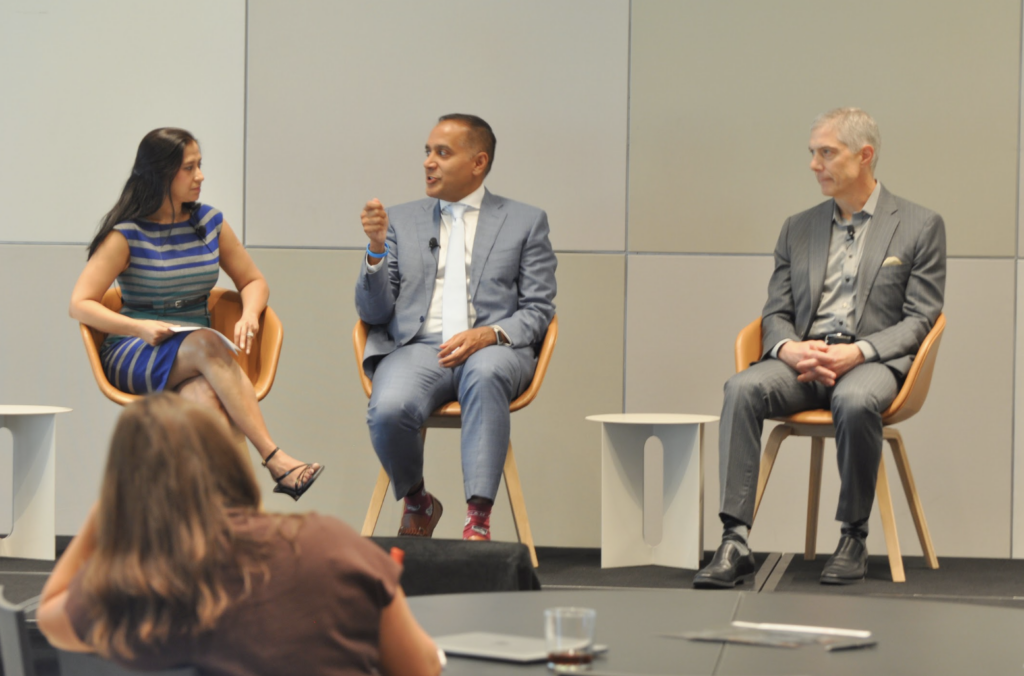
But who broke the healthcare system? At MedCity News’ Bullseye event in Chicago, Editor-in-Chief Arundhati Parmar posed this question to two health insurance CEOs
The response? “We did,” replied Sachin Jain, CEO of SCAN Health Plan, referring to all of those who work inside of healthcare. He added that healthcare stakeholders have normalized the abnormal
presented by

Sponsored Post

New Webinar: The Payer AI Readiness Gap: Why Better Data Will Define the Next Era of Health Plan Performance
We’ll explore why the next era of payer performance will depend on building a trusted data foundation that connects people, providers, and relationships across the enterprise
By Verato and MedCity News
“I think we’ve come to accept things that we would not want for our loved ones. When they apply to other people, we’re kind of okay with it because all of us have access to a back door,” he said. “When any one of us has a challenge or a problem with the healthcare system, we pick up the phone, we call the person that we know might be able to make it work, and then we’re like, ‘Okay, thank god I know the CEO of this or the president of that.’ But the reality is, most people who are SCAN members are actually subject to a system that is far from optimal, and I think we have to do some serious work to try to fix it.”
The CEO of Ascendiun, Paul Markovich, echoed this. Ascendiun is a nonprofit and parent company of Blue Shield of California, Blue Shield Promise Health Plan, Altais and Stellarus
“It’s our own damn fault collectively, and I think that’s why we’re trying to focus a lot of our energy on the system. … One of the reasons I work at a health plan and a nonprofit health plan is because I think what the health plans can do is create a better system,” he said. “We tend to control the rules of how people get paid, what are the administrative burdens? Are we using a fax machine, or are we figuring out another way to connect digitally? We have the biggest influence, I think, in trying to shift the system to getting much better results from people day to day than what we’re seeing now.”
However, while nonprofit organizations like SCAN and Ascendiun say they’re on board to make changes to the healthcare system, they don’t have the same scale as the major for-profit insurance companies like UnitedHealthcare, which may not have the same interest in fixing the system. Parmar questioned whether insurance companies should even be for-profit entities.
presented by

Sponsored Post

Inside an Automated Healthcare Practice: Redesigning Care Around People, Not Paperwork
By Michael Blackman, MD, MBA Chief Medical Officer, Greenway Health®
Markovich responded that he’s torn, noting that it’s possible the system would be better off if there were more nonprofit insurers. However, he stated that there are some for-profit organizations that are very mission-driven, pointing to insurance company Devoted Health. It’s also worth noting that some nonprofit plans have received scrutiny: Kaiser Permanente recently reached a big settlement on risk adjustment, he stated
Jain argued that leadership matters when it comes to for-profit healthcare organizations. He gave the example of when CVS Health made the decision to remove cigarettes from its stores in 2014, which decreased the number of smokers in the U.S. because cigarettes became less accessible
“We used to talk about corporations as potentially moral entities, and I think we’ve become slaves to the idea that corporations have to just be slaves to their incentives or quarterly earnings,” Jain said. “Corporations can be good or bad; they don’t just have to serve shareholders. And I think that’s the conversation we need to be having: how do we actually ensure that an industry that treats human life every single day operates in a moral way?”
Jain and Markovich added that even though SCAN and Ascendiun don’t have the scale of companies like UnitedHealthcare, it’s still possible to make a difference. Markovich noted Blue Shield of California recently changed its pharmacy benefitsnsibilities of a traditional PBM among several different companies.
“We went out with a model, the first major health plan, to say this doesn’t make sense. We’re not going to do a traditional model. It got a lot of attention, and others started to follow. … And then I think it also got traction in the public and with Congress,” he said. “So my point is that I think there are things that we can do to lead that can help change, but at the end of the day, I think we also need help.”
Ultimately, change isn’t going to come until healthcare stakeholders acknowledge there is a problem, Jain said. In other words, healthcare executives need to admit that they are “hypocrites.”
“Every one of us in this industry works for what I would describe as a fundamentally hypocritical organization, because you say one thing and you do another, and I think it’s not going to get better until we actually say that out loud,” Jain declared. “We are hypocrites. I am a hypocrite. I don’t want to be a hypocrite anymore. That’s the journey that we have to take the industry on.”
Photo: Walter Lim
