


Download PDF
Abstract
Difficulties of sharing information about genetic risks, for medical purposes, with family members are well known to patients with rare genetic diseases and healthcare professionals. To understand the mechanisms underlying the difficulties associated with the family disclosure of genetic risk (FDGR) process, an online questionnaire survey was designed in collaboration with French patient associations, healthcare professionals and academics. 595 patients with various rare diseases, or their relatives, who had an experience of FDGR, reported 685 FDGR events. Using hierarchical clustering on the principal components (HCPC) of a multiple correspondence analysis (MCA), these 685 experiences were divided into three clusters, representing 347 (Cluster 1 50.7%), 175 (Cluster 2 25.5%) and 163 (Cluster 3 23.8%) FDGR events, respectively. In cluster 1, the FDGR events described were considered generally satisfactory. In cluster 2 and cluster 3 (approximately 50% of FDGR), the FDGR events described were considered unsatisfactory, both in terms of information transmission and psychosocial damage, mainly due to a poor understanding of the information to be conveyed and/or low motivation, particularly in families experiencing relationship difficulties. However, other factors, such as certain characteristics of the disease or the type of healthcare professional involved in the process, do not appear to differ significantly between the three clusters. Our results, obtained through a collaborative approach, provide a basis for the collective development of tools (i) aimed at improving patients’ understanding of genetic information and their motivation to disclose it to family members, but if this proves impossible or too difficult, (ii) to delegate disclosure to healthcare professionals.
Subjects
- Ethics
- Genetic counselling
- Patient education
Introduction
Among the 5000–8000 known rare diseases [1], roughly 72% are genetic [2, 3] and 80% of these are inherited. Advances in genetic sequencing have allowed genetic tests to be offered to growing numbers of patients, providing definite genetic diagnosis for many rare disease patients. The results of these tests are often relevant for other family members. The family members who could benefit from further genetic testing need to be identified based several criteria including the degree of relatedness with the proband, the mode of transmission as well as the penetrance and expressivity of the disease.
Family disclosure of genetic risk (FDGR) procedures differ between diseases and countries depending on the availability and quality of genetic testing, cultural and legal frameworks, and the structure of healthcare systems [4,5,6]. Under French law [7], before any genetic test is carried out, patients must be informed that, if “a genetic anomaly is diagnosed that can cause serious symptoms justifying preventive measures, including genetic counselling or treatment”, potentially-affected family members must be informed of these results. This information may be provided by the patients themselves or by a health care professional (HCP) who prescribed of the test, at patients’ request. In this article, procedures for informing relatives and this HCP-led notification refers to the procedure as set out in French law [8].
As highlighted in the literature, FDGR is often difficult to implement due to ‘emotional’ distance [9, 10], family-related barriers [11] and comprehension issues [12, 13]. Several approaches have been proposed to identify and evaluate practices that help patients carry out FDGR [14,15,16,17]
These interventions, initiated by HCPs, are mostly based on theoretical models [18,19,20], thus only address some of the identified obstacles, and focused on particular diseases (for instance, genetically determined cancers, cardiological diseases, Huntington’s disease). Several studies have suggested that these practice modifications have a limited impact on the FDGR outcomes [21]
In order to identify the parameters of patients’ experiences of FDGR, to explore the diversity of FDGR pathways and to pinpoint levers for improvement, we initiated an interdisciplinary study entitled IGPrare (Information Génétique de la Parentèle dans les maladies rares)
This study involved HCPs, humanities and social science researchers, and patient representatives. The aim was to identify common or specific factors influencing outcomes in real-life cases of FDGR by developing a detailed questionnaire and analysing the results using an original statistical methodology. The study also sought to equip these various stakeholders with evidence-based tools to optimise FDGR in future
Materials and methods
Study design
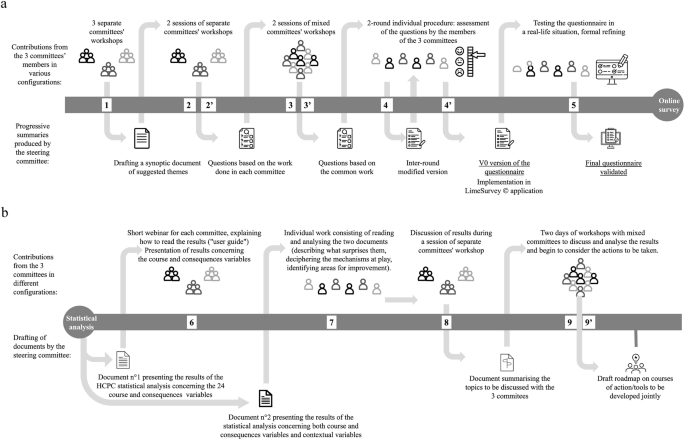
The project was coordinated by a multidisciplinary steering committee of eight members (the “main authors”). The entire research process—from questionnaire design to results discussion—was conducted in collaboration with three expert committees, each with equal authority and comprising around ten members: HCPs (geneticists, genetic counsellors, psychologists), patient representatives from 11 rare disease associations, and academics in the humanities and social sciences (statistician, sociologists, lawyers, psychiatrists, researchers in medical ethics, philosophers). These committees, combining practical experiences with knowledge from the literature, are listed as the ‘IGPrare Group’ in the list of authors. The respective roles of the steering committee and the three expert committees are shown in Fig. 1.
Schematic outlines of the questionnaire design process (a) and of the process for results analysis and discussion (b)
Among the different stakeholders of the FDGR, including HCPs, informants, and informed relatives, the informant was selected as theuestionnaire was therefore designed for probands or family members who have performed one or more FDGR procedures for a rare disease
It was developed through iterative discussions within and between the three committees and then tested in real-life conditions (Fig. 1a). The final version (see supplementary data) contained 85 questions exploring the FDGR process, its consequences, the family relationships, the initial announcement of the genetic disease, the proposal of FDGR and whether FDGR was accomplished or not. It was subsequently used to gather study data
The questionnaire was administered online via the LimeSurvey© application and was open from 18 January 2022 to 7 September 2022. Questionnaire data were collected on a secure Aix-Marseille University server. Patients were invited to participate through announcements by patient associations, the “Alliance maladies rares” (Federation of patient associations) several rare disease networks, and the “Tous Chercheurs” collaborative network. Disease names were entered by respondents in a free-text field and then translated into 107 standard disease names using OrphanetFootnote1 nomenclature. Next, based on the literature, seven characteristic variables (Table 1) were identified for each disease mentioned, so that these could be included in the statistical analysis of all FDGRs
The discussion and interpretation of the results were organised in the same collaborative way (Fig. 1b)
Statistical analysis
The wide variety of situations previously discussed with patients and healthcare professionals led us to adopt a typological analysis strategy called Hierarchical Clustering on Principal Components (HCPC) [22]. This type of statistical analysis is based on very few initial assumptions, except distinguishing variables that describe the nature of the unit of interest (in this case, the course and consequences of FDGR) and variables that characterize its context (e.g. in this case, the disease concerned, the status or gender of the respondent, the pre-existing family climate, etc.). Based on collected responses concerning course and consequences of FDGR, this analysis divides the set of FDGR events into clusters that are as homogeneous as possible and distinct from each other (here, three clusters). Then this typology can be refined by qualifying each cluster by its context. Beyond the division into clusters, the significance of the role played by each variable in their identification and characterisation provides valuable insight into the mechanisms at work.
For descriptive analysis, categorical variables were summarized as numbers and percentages (n, %)
In the first step of HCPC analysis, we performed a Multiple Correspondence Analysis (MCA) on the FDGR events using the 24 categorical variables about the course and consequences of FDGR as active ones. In the second step, we applied an Ascendant Hierarchical Clustering (with Ward’s criterion and a k-means consolidation) on the 43 first principal components of the MCA (accounting for 80.75% of the variance in the data). The clusters were identified and described using the active variables and characterized with supplementary variables (i.e. regarding the context of the FDGR procedures). Chi-squared tests were used to identify the most determining variables of the partition and v-test values to identify the most characterizing categories of each cluster (categories with an absolute v-test greater than 1.96 were retained highlighting a significant over- or under- representation of the category in a cluster in relation to the total population).
Variables recoding and descriptive analyses were performed using SAS 9.4 Software and the HCPC analysis was performed using the HCPC function in the FactoMiner package for R version 4.2.2. The results are presented in two parts in the following section: first, those that identified the clusters describing the event (course and consequences), and second, those describing its context
Results
The collaborative approach, described earlier in the ‘Methods’ section, was a key stage of the project, particularly during the development of the questionnaire, enabling us to gather a wide range of experiences relating to the FDGR
Respondent characteristics
595 respondents provided complete descriptions of 685 FDGR events. 71.5% of respondents were female and 60.8% were the probands in the FDGR procedure
62.0% of respondents were university-educated while 38.0% had secondary education only. 66.7% of respondents were employees, 19.0% were unemployed or retired, 8.2% were self-employed and 6.1% were students
Disease characteristics
The 10 most commonly reported diseases among the 107 mentioned by respondents were Charcot-Marie-Tooth disease (133/685 reports, 19.4%), cystic fibrosis (97/685, 14.2%), haemochromatosis (65/685, 9.5%), cerebellar ataxia (40/685, 5.8/%), Steinert’s myotonic dystrophy (33/685, 4.8%), hereditary spastic paraplegia (31/685, 4.5%), fragile X syndrome (17/685, 2.5%), Friedreich’s ataxia (16/685, 2.5%), Noonan’s syndrome (11/685, 1.6%), and facioscapulohumeral dystrophy (10/685, 1.5%). A breakdown of the number of reported FDGR events in terms of disease characteristics [23] is presented in Table 1.
FDGR course and consequences, overall data
The overall results describing the course and consequences of FDGR are reported in the “All” column of Table 2, as percentages of answers to a given question. The variables are presented in three groups of questions: those which factually describe the “FDGR course”, those that report the “Respondent’s state of mind before and after the FDGR” and those that focus on the “Consequences perceived by the respondent on his family”
For the majority of FDGR (70.8%), respondents informed collectively their family members, involving on average five relatives, as soon as possible after the diagnosis (58.8%). The information provided often included both genetic information and advice on measures to be taken (76.2%). In only 12.4% of FDGR, respondents know which relatives are at risk. Their approach was mainly guided by altruism (89.3%)
The experience of FDGR appears to be mixed. In a majority of FDGR, respondents expressed satisfaction at having passed on the information (65.7%). However, in around a quarter of FDGR, respondents feared having been the bearer of bad news (23.9%) or providing incorrect information (26.7%). In our study, in which all FDGR events were carried out by the respondents, 40.5% of FDGRs resulted in regret not having used an HCP-led notification
Thus, the reality reported by respondents seems far removed from the scenario envisaged by French legislation and more broadly, by best-practice guidelines, according to which HCPs are required to identify at-risk relatives and offer them the option of HCP-led notification
In most cases, respondents knew whether their relative contacted a medical service (60.8%) or did nothing (28.5%). Despite sometimes difficult immediate reactions, FDGRs more often improved (23.1%) than worsened (8.9%) intra-family relationships and resulted in gratitude (26.3%) or empathy (35.8%) from the informed relatives
FDGR course and consequences, clusters identification
As described in the ‘Methods’ section, the HCPC analysis identified three clusters accounting for 347 (cluster 1, 50.7%), 175 (cluster 2, 25.5%) and 163 (cluster 3, 23.8%) FDGR events. To facilitate upcoming discussions between the committees, the three clusters were collectively named (Fig. 1b, phases 9 and 9’), using the following designations: Effective (cluster 1), Detached (cluster 2) and Forced (cluster 3). Thus, the results are also presented by cluster (columns Effective, Detached, Forced clusters in Table 2). For each variable, the contrast between clusters, expressed by the chi-square test, reflects its contribution to the partition. The analysis of the results by cluster allows us to identify different FDGR profiles, creating a contrasting typology.
The most contributory variables concern the “respondents’ state of mind after the FDGR” (p values reaching 10–84 for ‘Feelings with respect to informed relatives’): FDGR in Effective cluster were more often reported by respondents expressing greater satisfaction at having been able to help and pass on information. Also highly contributory are the variables concerning the perception of the effects of the information on relatives, with respondents in Forced cluster reporting more avoidance, refusal to listen, misunderstanding or lack of reaction from their relatives. As for respondents in Detached cluster, they often differ from the other two clusters in that they were less invested in the FDGR process.
It should be noted that, apart from the information provided during the FDGR (p = 2.7 × 10⁻³⁹), data relating to the FDGR course contributed little to the partition; participants in the Detached cluster were more likely than others to simply pass on genetic information
FDGR context, overall data and characterization of the 3 clusters
To avoid overloading Table 3 and for the sake of clarity, only the variables showing significant differences between the clusters are presented in it. However, we considered the absence of differences in certain cases to be a noteworthy finding in itself. These cases were:
i) the medical specialism of the HCP who announced the initial diagnosis (overall: specialist physician or paediatrician 57.7%, genetic specialist or genetic counsellor: 30.7%, general practitioner 8.9%);
ii) the context of this announcement (overall: specific consultation: 63.2%; routine follow-up consultation: 18.0%; other: 18.8%);
iii) the HCP’s awareness of the HCP-led notification option (overall: aware: 11.7%; unaware: 77.2%; no opinion: 11.1%);
iv) three of the seven disease characteristics taken into account (prevalence; risk of intellectual disability; and risk of functional dependence) showed a similar distribution across the three clusters (overall values presented in Table 1)
Apart from age at the onset, with more adult cases reported among the Effective cluster, the other characteristics of the disease—which were only weakly (Table 3) or not at all associated with the outcome—appeared to be of little relevance to understanding and optimising the FDGR
Among the most influential areas, respondent’s state of mind regarding FDGR was a variable that differed between clusters, both in terms of awareness of the importance of FDGR and in terms of feelings of legitimacy or competence in communicating this information. Thus, Effective cluster scored highest on these three characteristics
The quality of pre-existing family relationships also showed a very significant gradient between clusters, with interactions, characterized in terms of communication and family gatherings, being easier in Effective cluster than in the two other clusters
Finally, there are differences between clusters in how the initial diagnosis and information about the FDGR process were perceived. For the initial diagnosis (in terms of tone, comprehension and duration), there was greater satisfaction expressed for Effective cluster than for Forced cluster and (to a lesser extent) for Detached cluster. The presentation of the FDGR process was also perceived as more satisfactory for Effective cluster, with Detached cluster appearing to be less informed and Forced cluster being the least informed.
The three brief descriptions of the clusters presented below are based on both statistical results and collaborative discussions (phases 8, 9-9’ on Fig. 1b)
Effective cluster
the largest cluster, (50.7% of reported FDGR events) consists of FDGR procedures, with generally favourable outcomes, reported in families with frequent contact and easy communication. The initial genetic diagnosis was announced with sufficient time and was well understood. The need for FDGR was presented by a HCP, again with sufficient time. FDGR was carried out, often collectively, without reluctance, shortly after the announcement. The informant provided a broad range of information combining scientific concepts and practical information. The FDGR, which aroused interest among relatives and very rarely denial or aggression, was well understood and followed. At the end of the FDGR, the informant felt satisfied that they had passed on useful information that has often strengthened family ties and did not regret not having used the HCP-led notification. These FDGR procedures provide a realistic point of comparison with those of the other two identified clusters.
Detached cluster
(25.5% of reported FDGR events) is characterized by FDGR in families with limited relationships and poor communication. Initially, the respondents described their own diagnosis as too quick and not always intelligible, and they had only a vague recollection of its atmosphere. Informants rarely remember that FDGR was suggested to them by an HCP and rarely received information about which relatives to inform. They often seemed detached from the process and did not feel very legitimate or competent, so they only informed a limited number of their relatives. The transmission of information was very limited, or even non-existent, often only genetic, leading to poor understanding among relatives. It left neither the satisfaction of having acted usefully nor the regret of not having resorted to HCP-led notification, and had little impact on family relationships.
The high frequency of ‘I don’t know / I can’t remember’ as a response to various questions stood out to the expert committees of HCPs and patient representatives—as a notable finding, suggesting a lack of engagement in Detached cluster
Forced cluster
(23.8% of reported FDGR events) concerned FDGR procedures performed more often individually, in families where communication was difficult. Respondents described these procedures as poorly understood on both sides. The circumstances of these procedures, with (i) a poor understanding and negative experience of both the initial diagnosis and the presentation of FDGR by HCPs and (ii) relatively infrequent family contact, contributed to a very difficult situation. Despite this unfavourable context, respondents seemed nevertheless aware of the importance of FDGR and were motivated to inform many relatives, although they felt they lacked the legitimacy and competence to do so and feared causing harm to their relatives, in connection with the little success. The information passed on tended to be sparse and often inappropriate, leading to misunderstanding on the part of relatives and adverse effects on family relationships (reactions more often characterised by avoidance than interest, denial or even aggression expressed by relatives). Respondents in this group often reported negative perceptions of themselves and expressed regret at having been bearers of bad news, which had a detrimental effect on family relationships. Unsurprisingly, this cluster is the one with the highest proportion of respondents expressing regret at not having used HCP-led notification.
Discussion
Methodological innovations and limitations of this study
A major strength of this study lies in its participatory methodology, integrating the complementary perspectives of healthcare professionals (HCPs), patients, and academics. This approach enabled a patient-centred analysis enriched by the insights of clinicians and researchers. For instance, patient associations highlighted issues related to disclosure of the initial diagnosis, HCPs emphasised difficulties in understanding genetics, and social science researchers focused on completion or renouncement of planned FDGR, all identified as explanatory factors of FDGR outcomes. Differences in stakeholders’ reactions to the results also generated productive discussions and interpretations. In addition, verbatim comments collected alongside categorical questions provided valuable contextual information for interpreting the statistical findings.
Questionnaire dissemination mainly through patient associations may have introduced opposing biases, including overrepresentation of highly informed or engaged respondents and a greater emphasis on difficult experiences. However, collaboration with associations likely fostered trust and contributed to a satisfactory level of participation with diverse experiences
Finally, the data were self-reported and therefore subject to respondent subjectivity. However, the objective was not to describe the overall course of FDGR, but rather to explore the diversity of experiences and practices associated with this process
In line with our objective of understanding the FDGR, our study is based on HCPC analysis, which is a powerful approach for uncovering meaningful and relevant patterns within complex [22, 24], heterogeneous social and psychological data without requiring any prior assumptions
While the associative origin and declarative format remain possible uncontrolled biases, the influence of other causes of variability (gender and status of the respondent, length of time since FDGR, characteristics of the disease) were incorporated in the analysis as contextual variables. As this is a voluntary survey, it is hardly surprising that more women than men took part [25]. Moreover, this difference is significantly greater for FDGR reported by a relative, with eight times more women than men, highlighting their strong family involvement and the family dimension associated with this process. Our findings suggest that FDGR outcomes depend less on these variables and more on interpersonal or family dynamics and how the initial diagnosis was experienced as described in the results section. The size of the population (685 FDGR) and the number and variety of non-cancer rare genetic diseases represented (107 diseases – see Table 1) ensure the diversity of the population. The results should therefore be applicable to most situations in rare diseases.
The collaborative approach and the HCPC analysis proved to be complementary: the collaborative approach made it possible to broaden the scope of the areas explored by incorporating and combining different perspectives. The HCPC analysis, for its part, enabled us to capitalise on this comprehensive approach, both in terms of understanding the FDGRs and the applicability of the results
Perspective based on the literature and original contributions of the study to current knowledge
Our study revealed some unexpected facts about FDGR. Informing relatives about genetic risk is far from being a standard process, firstly because the information to pass on varies from case to case, and secondly because the causes of these difficulties are multifaceted, which may explain the limited results of interventions focused on a specific aspect of FDGR
Patients’ lack of knowledge about which relatives to inform has been reported previously [26,27,28] and in keeping with these results, our respondents generally had limited knowledge of the inheritance pattern of their disease, as reported previously [16] and in only 12.4% of FDGR procedures, at-risk relatives were individually designated. This study also highlights the discrepancy between the limited extent of the FDGR information intended to be communicated by legislators and HCPs, and the more wide-ranging disclosure reported in practice. While FDGR in France should only include the existence of a familial medical issue and an invitation to consult a geneticist, patients tended not only to disclose the hereditary nature of their disease and the fact that other relatives may be affected, but also medical details, as has been reported previously [29, 30]. Patients may be inclined to discuss the symptoms of their disease in response to questions from relatives or to justify their approach [31]. In most cases also, patients suggested to their relative that they should consider seeking medical advice and/or undergoing a genetic test. The FDGR events with the most comprehensive content, reported in Effective cluster, including non-essential medical information, were also the best received.
Another important finding is that most respondents were unaware that FDGR could be delegated to HCPs, although French law requires HCPs to inform patients of this option before and after genetic testing. This is probably because HCPs are reluctant to fulfil their duty [8, 32, 33]. The roles of HCPs and patients in FDGR have been widely debated in the literature. While it is generally accepted that FDGR by HCPs is more effective [11, 34,35,36], it creates a moral dilemma for professionals, between a duty to inform at risk relatives and medical confidentiality. The contrast between the intensity of debates on this subject among HCPs, and the attitudes of patients, who view the professional (HCP-led notification) versus familial procedures as complementary rather than mutually exclusive [37, 38] is also striking.
Nevertheless, the patient’s commitment is required to perform FDGR. Our study shows that these levels of commitment varied widely between clusters. Commitment is the balance of altruistic motivation on the one hand, and the urge to avoid the difficulties and potential drama of the announcement, often mentioned in workshops. Furthermore, feelings of legitimacy and competence are offset by a fear that the task might exceed the respondents’ capabilities [26] and could therefore, in some cases, lead them to abandon the FDGR.
The fact that FDGR is a legal requirement in France should have taken precedence over individual motivation, but our findings and other reports [39] suggest that this is far from true in practice. Individual motivation also appears to be compromised by the poor quality of information received from HCP
The FDGRs described here, all carried out by the patient, have sometimes weakened and sometimes strengthened family ties. A discussion to assess the pre-existing family ‘atmosphere’ could help identify situations where HCP-led notification would be entirely appropriate
According to our findings, the FDGR approach appears to be primarily family-based, with little focus on the genetic risks of a given parent, as mentioned in the legal text: this is reflected in the frequent use of collective procedures at the family level [40], particularly in Effective cluster, involving both at-risk and not-at-risk relatives, extending the scope of confidentiality from a person at risk to the family [41] It can also be explained by a wish to avoid a face-to-face setting, reminiscent of their own initial diagnosis and to rely on other family members for moderation [39, 42].
The contrast between an emotionally charged family-centred approach [40, 41] and an approach guided by an objective medical issue [39] – an area in which most respondents lack expertise [16] – has already been described in the literature [13, 37, 42, 43]. Our study nevertheless helps to clarify the extent and determinants of this process
The closer family relationships in Effective cluster support previous findings that FDGR works best in close-knit families with good communication [41, 44, 45]
Conclusions
The experience gained in carrying out this study points to the value of involving the various stakeholders in the design of all aspects of any new measures, from the content and the methods used to the individuals put in charge of implementing them [26, 46]
Implementing family disclosure of genetic risk (FDGR) involves assessing the patient’s motivation and abilities, evaluating the consequences of a family that may be supportive or hostile, discussing the choice between HCP-led notification and FDGR done by the patient himself or herself, and then, if necessary, supporting the patient in this process
The results of the IGPrare study suggest various areas for improvement: (i) improving patients’ assimilation of the information provided to them at the time of diagnosis, (ii) strengthening patients’ altruistic motivation with well-founded arguments [27], (iii) warning patients of the risk of family conflict inherent in FDGR, and (iv) encouraging HCP-led notification when the assessment of individual and family situations shows that the patient-led FDGR is unlikely to succeed and may have serious psychosocial consequences. We suggest that these improvements be achieved through the creation of tools developed in a cross-disciplinary manner (healthcare professionals, patients, social and health sciences).
Data availability
Currently, the data is stored on a secure server at Aix-Marseille University and is only accessible to the main investigators (BSS and MM). Access to the data may be granted upon request to the investigators (BSS and MM)
Notes
References
Rare diseases and European Reference Networks – European Commission [Internet]. [cited 2025 Feb 11]. Available from: https://health.ec.europa.eu/rare-diseases-and-european-reference-networks_en 2024
eClinicalMedicine. Raising the voice for rare diseases: under the spotlight for equity. eClinicalMedicine. 2023;57:101941. https://doi.org/10.1016/j.eclinm.2023.101941
Orphadata—Orphanet datasets [Internet]. [cited]. Available from: https://www.orphadata.com/ (2024)
Dheensa S, Lucassen A, Fenwick A. Limitations and pitfalls of using family letters to communicate genetic risk: a qualitative study with patients and healthcare professionals. J Genet Counsel. 2018;27:689–701. https://doi.org/10.1007/s10897-017-0164-x
Phillips A, Borry P, Van Hoyweghen I, Vears DF. Disclosure of genetic information to family members: a systematic review of normative documents. Genet Med. 2021;23:11 https://doi.org/10.1038/s41436-021-01248-0
Lee DSC, Meiser B, Mariapun S, Hassan T, Yip CH, Mohd Taib NA, et al. Communication about positive BRCA1 and BRCA2 genetic test results and uptake of testing in relatives in a diverse Asian setting. J Genet Couns. 2021;30:720–9. https://doi.org/10.1002/jgc4.1360
Code de la santé publique [Internet]. French Government. Available from: https://www.legifrance.gouv.fr/codes/article_lc/LEGIARTI000043895837
d’Audiffret Van Haecke D, de Montgolfier S. Genetic diseases and information to relatives: practical and ethical issues for professionals after introduction of a legal framework in France. Eur J Hum Genet. 2018;26:6 https://doi.org/10.1038/s41431-018-0103-9
Srinivasan S, Won NY, Dotson WD, Wright ST, Roberts MC. Barriers and facilitators for cascade testing in genetic conditions: a systematic review. Eur J Hum Genet. 2020;28:1631–44. https://doi.org/10.1038/s41431-020-00725-5
Lautenbach DM, Christensen KD, Sparks JA, Green RC. Communicating genetic risk information for common disorders in the era of genomic medicine. Annu Rev Genomics Hum Genet. 2013;14:491–513. https://doi.org/10.1146/annurev-genom-092010-110722
Suthers GK, Armstrong J, McCormack J, Trott D. Letting the family know: balancing ethics and effectiveness when notifying relatives about genetic testing for a familial disorder. J Med Genet. 2006;43:665–70. https://doi.org/10.1136/jmg.2005.039172
Lea DH, Kaphingst KA, Bowen D, Lipkus I, Hadley DW. Communicating genetic and genomic information: health literacy and numeracy considerations. Public Health Genomics. 2011;14:279–89. https://doi.org/10.1159/000294191
Farmer GD, Gray H, Chandratillake G, Raymond FL, Freeman ALJ. Recommendations for designing genetic test reports to be understood by patients and non-specialists. Eur J Hum Genet. 2020;28:885–95. https://doi.org/10.1038/s41431-020-0579-y
Lobb E, Butow P, Meiser B, Barratt A, Kirk J, Gattas M, et al. The use of audiotapes in consultations with women from high risk breast cancer families: a randomised trial. J Med Genet. 2002;39:697–703. https://doi.org/10.1136/jmg.39.9.697
Loader S, Shields C, Levenkron JC, Fishel R, Rowley PT. Patient vs. physician as the target of educational outreach about screening for an inherited susceptibility to colorectal cancer. Genet Test. 2002;6:281–90. https://doi.org/10.1089/10906570260471813
Eijzenga W, de Geus E, Aalfs CM, Menko FH, Sijmons RH, de Haes HCJM, et al. How to support cancer genetics counselees in informing at-risk relatives? Lessons from a randomized controlled trial. Patient Educ Couns. 2018;101:1611–9. https://doi.org/10.1016/j.pec.2018.05.009
Garcia C, Sullivan MW, Lothamer H, Harrison KM, Chatfield L, Thomas MH, et al. Mechanisms to increase cascade testing in hereditary breast and ovarian cancer: Impact of introducing standardized communication aids into genetic counseling. J Obstet Gynaecol Res. 2020;46:1835–41. https://doi.org/10.1111/jog.14366
Baile WF, Buckman R, Lenzi R, Glober G, Beale EA, Kudelka AP. SPIKES-A six-step protocol for delivering bad news: application to the patient with cancer. Oncologist. 2000;5:302–11. https://doi.org/10.1634/theoncologist.5-4-302
Daly MB, Barsevick A, Miller SM, Buckman R, Costalas J, Montgomery S, et al. Communicating genetic test results to the family: a six-step, skills-building strategy. Fam Community Health. 2001;24:13–26. https://doi.org/10.1097/00003727-200110000-00004
Gaff CL, Clarke AJ, Atkinson P, Sivell S, Elwyn G, Iredale R, et al. Process and outcome in communication of genetic information within families: a systematic review. Eur J Hum Genet. 2007;15:999–1011. https://doi.org/10.1038/sj.ejhg.5201883
Young AL, Imran A, Spoelma MJ, Williams R, Tucker KM, Halliday J, et al. Proband-mediated interventions to increase disclosure of genetic risk in families with a BRCA or Lynch syndrome condition: a systematic review. Eur J Hum Genet. 2023;31:18–34. https://doi.org/10.1038/s41431-022-01200-z
Husson F, Josse J, Pages J Technical Report of the Applied Mathematics Department (Agrocampus) [Internet]. [cited 2026 May 28]. Principal component methods – hierarchical clustering – partitional clustering: why would we need to choose for visualizing data? Available from: http://www.agrocampus-ouest.fr/math/ (2010)
Orphanet [Internet]. Available from: https://www.orpha.net
Soyer J, Gabet ACDS, Grave CCDS, Piffaretti C, Verdot C, Salanave B, et al. Need for improvement of cardiovascular health: a clustering method to identify cardiovascular health profiles. Eur J Public Health. 2023;33:732–7. https://doi.org/10.1093/eurpub/ckad048
Becker R. Gender and survey participation: an event history analysis of the gender effects of survey participation in a probability-based multi-wave panel study with a sequential mixed-mode design. Methods Data Analyses. 2022;16:3–32. 10.12758/mda.2021.08
Ballard LM, Band R, Lucassen AM. Interventions to support patients with sharing genetic test results with at-risk relatives: a synthesis without meta-analysis (SWiM). Eur J Hum Genet. 2023;31:988–1002. https://doi.org/10.1038/s41431-023-01400-1
Forrest LE, Delatycki MB, Skene L, Aitken M. Communicating genetic information in families – a review of guidelines and position papers. Eur J Hum Genet. 2007;15:6 https://doi.org/10.1038/sj.ejhg.5201822
Mazzella JM, Adham S, Frank M, Legrand A, Lahlou-Laforêt K, Jeunemaitre X. Communication of genetic information to at-risk relatives during the multidisciplinary monitoring of vascular Ehlers-Danlos syndrome in a French referral clinic. J Genet Couns. 2020;29:828–37. https://doi.org/10.1002/jgc4.1211
Studwell CM, Glanton E, Undiagnosed DN, Sinsheimer JS, Palmer CGS, LeBlanc K. Family genetic result communication in rare and undiagnosed disease communities: Understanding the practice. J Genet Couns. 2021;30:439–47. https://doi.org/10.1002/jgc4.1329
Mendes Á, Metcalfe A, Paneque M, Sousa L, Clarke AJ, Sequeiros J. Communication of information about genetic risks: putting families at the center. Fam Process. 2018;57:836–46. https://doi.org/10.1111/famp.12306
Forrest LE, Curnow L, Delatycki MB, Skene L, Aitken M. Health first, genetics second: exploring families’ experiences of communicating genetic information. Eur J Hum Genet. 2008;16:11 https://doi.org/10.1038/ejhg.2008.104
Derbez B, de Pauw A, Stoppa-Lyonnet D, Galactéros F, de Montgolfier S. Familial disclosure by genetic healthcare professionals: a useful but sparingly used legal provision in France. J Med Ethics. 2019;45:811–6. https://doi.org/10.1136/medethics-2018-105212
Phillips A, Vears DF, Van Hoyweghen I, Borry P. Clinician perspectives on policy approaches to genetic risk disclosure in families. Fam Cancer. 2024;23:177–86. https://doi.org/10.1007/s10689-024-00375-2
Henrikson NB, Blasi P, Figueroa Gray M, Tiffany BT, Scrol A, Ralston JD, et al. Patient and family preferences on health system-led direct contact for cascade screening. J Pers Med. 2021;11:538 https://doi.org/10.3390/jpm11060538
Rosén A, Ivarsson A, Nordyke K, Karlsson E, Carlsson A, Danielsson L, et al. Balancing health benefits and social sacrifices: a qualitative study of how screening-detected celiac disease impacts adolescents’ quality of life. BMC Pediatr. 2011;11:32 https://doi.org/10.1186/1471-2431-11-32
Tiller JM, Stott A, Finlay K, Boughtwood T, Madelli EO, Horton A, et al. Direct notification by health professionals of relatives at-risk of genetic conditions (with patient consent): views of the Australian public. Eur J Hum Genet. 2024;32:98–108. https://doi.org/10.1038/s41431-023-01395-9
Dove ES, Chico V, Fay M, Laurie G, Lucassen AM, Postan E. Familial genetic risks: how can we better navigate patient confidentiality and appropriate risk disclosure to relatives?. J Med Ethics. 2019;45:504–7. https://doi.org/10.1136/medethics-2018-105229
Sermijn E, Delesie L, Deschepper E, Pauwels I, Bonduelle M, Teugels E, et al. The impact of an interventional counselling procedure in families with a BRCA1/2 gene mutation: efficacy and safety. Fam Cancer. 2016;15:155–62. https://doi.org/10.1007/s10689-015-9854-4
Forrest K, Simpson S, Wilson B, Van Teijlingen E, McKee L, Haites N, et al. To tell or not to tell: barriers and facilitators in family communication about genetic risk. Clin Genet. 2003;64:317–26. https://doi.org/10.1034/j.1399-0004.2003.00142.x
Dimond R, Doheny S, Ballard L, Clarke A. Genetic testing and family entanglements. Soc Sci Med. 2022;298:114857. https://doi.org/10.1016/j.socscimed.2022.114857
Gilbar R. Communicating genetic information in the family: the familial relationship as the forgotten factor. J Med Ethics. 2007;33:390–3. https://doi.org/10.1136/jme.2006.017467
McClellan KA, Kleiderman E, Black L, Bouchard K, Dorval M, Simard J, et al. Exploring re still need to talk. Eur J Hum Genet. 2013;21:9 https://doi.org/10.1038/ejhg.2012.286
Chivers Seymour K, Addington-Hall J, Lucassen AM, Foster CL. What facilitates or impedes family communication following genetic testing for cancer risk? A systematic review and meta-synthesis of primary qualitative research. J Genet Counsel. 2010;19:330–42. https://doi.org/10.1007/s10897-010-9296-y
Aktan-Collan KI, Kääriäinen HA, Kolttola EM, Pylvänäinen K, Järvinen HJ, Haukkala AH, et al. Sharing genetic risk with next generation: mutation-positive parents’ communication with their offspring in Lynch Syndrome. Fam Cancer. 2011;10:43–50. https://doi.org/10.1007/s10689-010-9386-x
Shah LL, Daack-Hirsch S, Ersig AL, Paik A, Ahmad F, Williams J. Family relationships associated with communication and testing for inherited cardiac conditions. West J Nurs Res. 2019;41:1576–601. https://doi.org/10.1177/0193945918817039
Ho A, Leach E, Virani A, Arbour L, Bartels K, Wong EK. Cascade testing for inherited arrhythmia conditions: experiences and attitudes of family communication approaches for a Canadian cohort. J Genet Couns. 2022;31:815–28. https://doi.org/10.1002/jgc4.1550
Acknowledgements
The authors are grateful to Svetlana Gorokhova for the critical review of the manuscript and for valuable suggestions that helped improve it and to Jean Thimonier for proofreading the article and providing technical assistance
Funding
This project was funded by the French Agence de la Biomédecine “Appel d’offres Recherche 2020” (convention 20AMP014)
Author information
Author notes
These authors contributed equally: Marion Mathieu, Bérengère Saliba-Serre
Authors and Affiliations
Association Tous Chercheurs, Marseille, France
Marion Mathieu & François Faurisson
Aix Marseille Univ, CNRS, EFS, ADES, Marseille, France
Marion Mathieu, Bérengère Saliba-Serre, Sandrine de Montgolfier & Pierre Le Coz
Aix Marseille Univ, INSERM, IRD, SESSTIM, Marseille, France
Sandrine de Montgolfier
CMT-France Association (Charcot-Marie Tooth disease Organization), Angers, France
Martine Libany
Espace de réflexion éthique PACA-Corse, AP-HM, Marseille, France
Annagrazia Altavilla, Perrine Malzac & Pierre Le Coz
Plateforme de médecine moléculaire et génomique, AP-HM, Marseille, France
Perrine Malzac
Association Française contre l’ataxie de Friedreich (Friedreich Ataxia Organization), Saint-Avé, France
Claudie Baleydier
AFM-Téléthon Association (myopathies), Evry, France
Michel Bonnaire & Alain Geille
CHU, Nice, France
Amandine Boureau-Wirth
Association Vaincre la mucoviscidose (Cystic fibrosis Organization), Paris, France
Paola de Carli
Lyon 3 Jean Moulin University, Lyon, France
Catherine Dekeuwer
Laboratoire IRDA, Law faculty of the University Sorbonne Paris Nord, Paris, France
Valérie Depadt
CRESPPA-CSU, Paris, France
Benjamin Derbez
Association Française des Hémophiles (Hemophilias Organization), Paris, France
Maryse Dien & Jean-Marc Tassain
Valentin association des porteurs d’anomalies chromosomiques (Chromosomal abnormalities Organization), Eragny, France
Véronique Dujardin & Isabelle Marchetti
Medical Genetics Department, AP-HM, Marseille, France
Brigitte Jarret, Audrey Mallet & Karine Nguyen
Medical Genetics Department, Purpan Hospital, Toulouse/UMR1295, Bioethics, Inserm—Toulouse University, Toulouse, France
Sophie Julia
Association du Syndrome de Gilbert (Gilbert syndrome Organization), Clermont-Ferrand, France
Julien Klein
Unité de psychologie et psychiatrie de liaison, Hôpital Européen Georges-Pompidou, Paris, France
Khadija Lahlou-Laforêt
Connaître les syndromes cérébelleux (Cerebellar syndromes Organization), Portet-sur-Garonne, France
Sylvain Leveille & Raymond Souqui
Faculté de médecine et centre atlantique de philosophie, Rennes University, Rennes, France
Laetitia Marcucci
Clinical Genetics Department, FHU GenOMedS, CRDI, ERN ITHACA, CHU, Rennes, France
Laurent Pasquier
CARGO, CHU Strasbourg, Strasbourg, France
Valérie Pelletier
Denis Picard Fundation (Huntington disease Organization), Brugheas, France
Roger Picard
Association France Fer Hémochromatose (Hemochromatosis Organization), Paris, France
Brigitte Pineau
Medical Genetics Department, CHU Nice; CRMM, Univeristy Côte-d’Azur, CNRS, Inserm, IRCAN, Nice, France
Cécile Rouzier
Medical Genetics Department, CHU Bordeaux, Bordeaux, France
Eva Toussaint & Cécile Zordan
Amis-FSH (Facioscapulohumeral diseases Organization), Tours, France
Vincent Tronel
Authors
- Marion MathieuView author publications
Search author on:PubMed Google Scholar
- Bérengère Saliba-SerreView author publications
Search author on:PubMed Google Scholar
- Sandrine de MontgolfierView author publications
Search author on:PubMed Google Scholar
- Martine LibanyView author publications
Search author on:PubMed Google Scholar
- Annagrazia AltavillaView author publications
Search author on:PubMed Google Scholar
- François FaurissonView author publications
Search author on:PubMed Google Scholar
- Perrine MalzacView author publications
Search author on:PubMed Google Scholar
Consortia
IGPrare group
- Claudie Baleydier
- , Michel Bonnaire
- , Amandine Boureau-Wirth
- , Paola de Carli
- , Catherine Dekeuwer
- , Valérie Depadt
- , Benjamin Derbez
- , Maryse Dien
- , Véronique Dujardin
- , Alain Geille
- , Brigitte Jarret
- , Sophie Julia
- , Julien Klein
- , Pierre Le Coz
- , Khadija Lahlou-Laforêt
- , Sylvain Leveille
- , Audrey Mallet
- , Isabelle Marchetti
- , Laetitia Marcucci
- , Karine Nguyen
- , Laurent Pasquier
- , Valérie Pelletier
- , Roger Picard
- , Brigitte Pineau
- , Cécile Rouzier
- , Raymond Souqui
- , Jean-Marc Tassain
- , Eva Toussaint
- , Vincent Tronel
- & Cécile Zordan
Contributions
MM, FF, PM designed this study and secured the funding. MM, BSS, SdM, ML, AA, PdC, FF, PM coordinated the project. MM, BSS, SdM, ML, AA, FF, PM, CB, MB, ABW, PdC, CD, VD, BD, MD, VD, AG, BJ, SJ, JK, PLC, KLL, SL, AM, IM, LM, KN, LP, VP, RP, BP, CR, RS, JMT, ET, VT, CZ created the questionnaire, and discussed the statistical results. BSS, FF performed statistical analyses. MM, PM, FF, BSS drafted the manuscript. MM, PM, FF, BSS, SdM critically revised the manuscript. MM, BSS, SdM, ML, AA, FF, PM, CB, MB, ABW, PdC, CD, VD, BD, MD, VD, AG, BJ, SJ, JK, PLC, KLL, SL, AM, IM, LM, KN, LP, VP, RP, BP, CR, RS, JMT, ET, VT, CZ have reviewed and approved the final version of the manuscript.
Ethics declarations
Competing interests
The authors declare no competing interests
Ethical approval
This study involves human participants and was strictly anonymous, excluding any potentially identifying information (geographical location, age, digital or computer identifiers). Patients provided informed consent for publication before completing the questionnaire. The study was approved by the Aix-Marseille University ethics committee (approval n°2021-07-08-09, July 8th 2021)
Additional information
Publisher’s note Springer Nature remains neutral with regard to jurisdictional claims in published maps and institutional affiliations
Supplementary information
IGPrare Questionnary (download DOCX )
Rights and permissions
Open Access This article is licensed under a Creative Commons Attribution-NonCommercial-NoDerivatives 4.0 International License, which permits any non-commercial use, sharing, distribution and reproduction in any medium or format, as long as you give appropriate credit to the original author(s) and the source, provide a link to the Creative Commons licence, and indicate if you modified the licensed material. You do not have permission under this licence to share adapted material derived from this article or parts of it. The images or other third party material in this article are included in the article’s Creative Commons licence, unless indicated otherwise in a credit line to the material. If material is not included in the article’s Creative Commons licence and your intended use is not permitted by statutory regulation or exceeds the permitted use, you will need to obtain permission directly from the copyright holder. To view a copy of this licence, visit http://creativecommons.org/licenses/by-nc-nd/4.0/.
About this article
Cite this article
Mathieu, M., Saliba-Serre, B., de Montgolfier, S. et al. Why is family disclosure of genetic risk so difficult? A collaborative analysis of 685 rare-disease patient experiences.
Eur J Hum Genet (2026). https://doi.org/10.1038/s41431-026-02205-8
Received:14 January 2026
Revised:09 June 2026
Accepted:17 July 2026
Published:21 August 2026
Version of record:21 August 2026
DOI
:https://doi.org/10.1038/s41431-026-02205-8
