


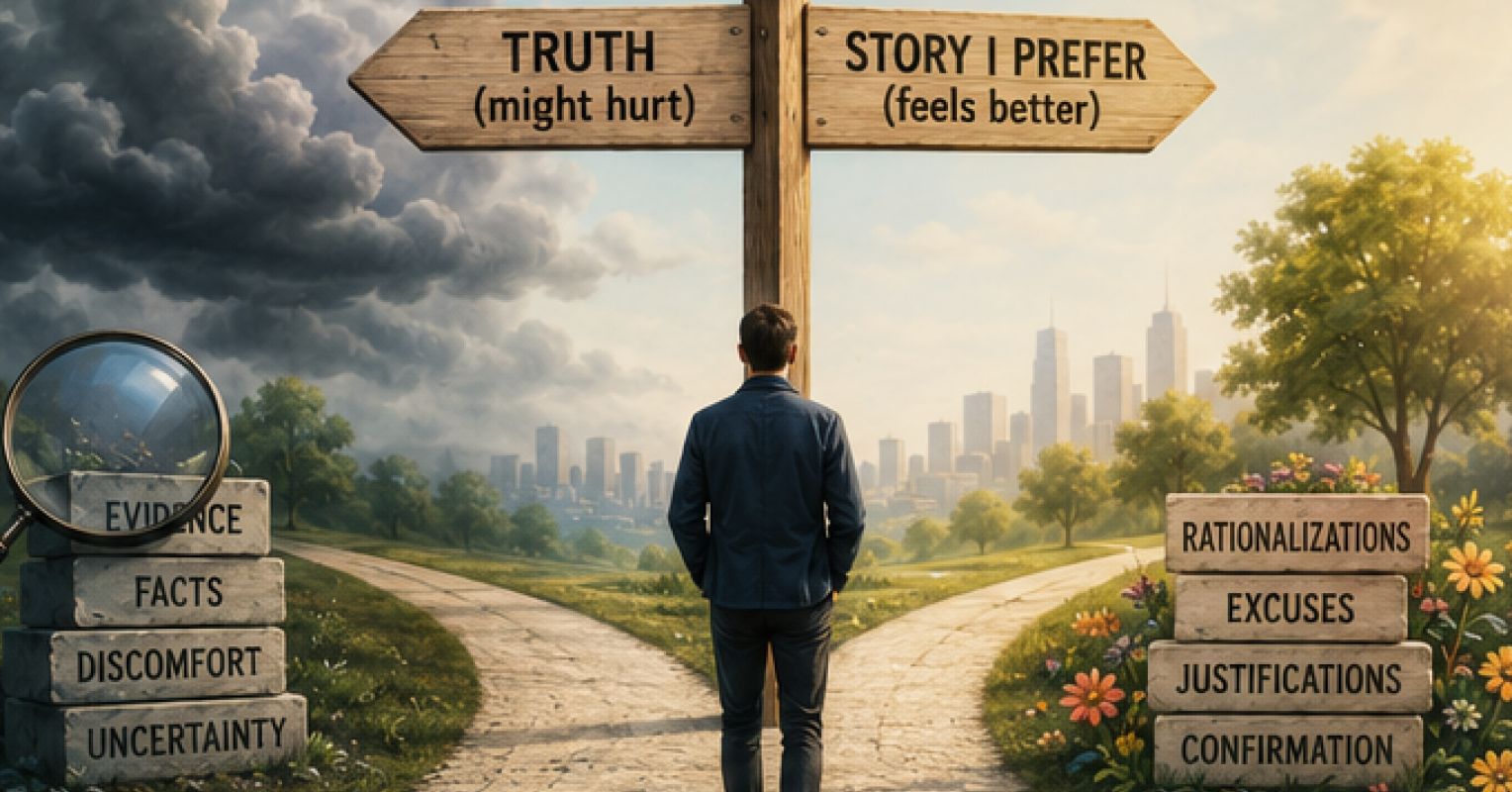
Key points
- Motivated reasoning can lead us to scrutinize unwanted evidence while accepting preferred evidence.
- Greater intelligence may provide more sophisticated tools for rationalizing preferred conclusions.
- Self-deception often preserves a coherent sense of identity.
- Intellectual humility requires examining what we may emotionally gain from reaching them.
I was a solid debater in high school. In college, I studied philosophy (with an emphasis on logic and argument) and neuropsychology (to better understand the human mind and persuasion). I then went to law school, followed by 17 years of high-stakes litigation (that means I got paid a good amount of money to win arguments). When I retired, I wanted to specialize in persuasion, connection, and negotiation, combining ancient philosophy with modern neuroscience
I’m really good at navigating an argument and evaluating research data, evidence, and precedent. But I still fall for lies every once in a while
Sure, we’d like to imagine intelligence and sophisticated reasoning as a kind of cognitive armor. The smarter we are, the better we can evaluate the situation and various arguments; the better we should be at spotting bad arguments, resisting manipulation, and separating what’s true from what we wish were true. And sure, with intelligence we can better distinguish fact from fiction. But plenty of times, it just makes us better lawyers for what we want to believe. Alas. The human mind can be profoundly disappointing sometimes.
Psychology has a name for our uncanny ability to talk ourselves into the version of reality we prefer: motivated reasoning, which results from the cognitive dissonance between the truth and what we need to be true. We scrutinize evidence that threatens our beliefs, asking ourselves, Must I accept this? We also become surprisingly generous toward evidence that supports it, asking instead, Can I accept this?
Intelligence Isn’t the Same as Intellectual Honesty
Imagine two people receive information suggesting that a political candidate they support behaved unethically. Now imagine the not-so-farfetched notion that, while one of the two people is wildly disappointed in their candidate and reconsidering their support, the other immediately identifies problems with the source, generates three alternative explanations, recalls examples of similar behavior by the opposing candidate, questions the methodology behind the reporting, and constructs a sophisticated argument for why the allegation doesn’t mean what everyone thinks it means.
Who is reasoning better? While the second person might seem so at first blush, perhaps they’re just superior at rationalizing
That’s the uncomfortable distinction. Intelligence gives us greater capacity to analyze evidence, but analysis itself is neutral. We can use that capacity to test our beliefs, or to protect them. Thus, a powerful intellect can interrogate an idea, break it down, and reduce it to a tearful confession!
But why would anyone want to believe something that isn’t true, especially when the stakes are highest? Because sometimes a particular version of reality gives us something we need: confirmation, belonging, vindication, hope, status, or simply protection from something we aren’t ready to face. In this way, rather than believing with our brains and logic-powers, we tend to believe with our identities
My partner would never betray me
My child couldn’t have done that
My political side is the far more reasonable one
This bet is going to pay off
Our needs and motivations give us an assignment, and we make the case just as an experienced lawyer would in a court of law. We do this even when the lie is about ourselves; in fact, those are the most believable lies, regardless of how brutal our inner narrator might be. The voice in my head can be merciless, denying me a flattering self-image while still insisting that the story I tell about myself remains coherent
I was an idiot in this situation, but I’m a good and moral person
Maybe people do leave me, but that’s because I refuse to become someone I’m not just to make them stay
That’s what makes self-deception so difficult to recognize: from the inside, it doesn’t feel like lying. It feels like reasoning
Intelligence Needs Humility
The antidote isn’t becoming less intelligent, but rather learning to turn intelligence against our certainty. The Stoics understood something remarkably modern about the mind: Our first interpretation of an event is not necessarily reality. For example, many (including my oft-quoted favorite, Epictetus) distinguished between what happens and the judgments we form about what happens
Intelligence Essential Reads

On the Origin of the Healthy Mind

A Kind of Intelligence That Matters More Than IQ
Don’t believe everything your mind tells you just because it said so convincingly. That means asking questions our brains would rather avoid:
What evidence would actually change my mind?
If someone I disliked made this argument, would I find it persuasive?
What do I emotionally gain from believing this?
Am I trying to discover the truth, or win an argument with reality?
Intelligence is an extraordinary tool. It lets us detect patterns, solve problems, imagine alternatives, and question assumptions. A tool, however, doesn’t determine its own purposes. A sharp mind can dismantle a falsehood, but it also brilliantly builds one
Wisdom begins when we stop treating intelligence as evidence that we’re right and start treating it as a responsibility to question why we think we’re right. Indeed, sometimes the easiest person for a smart person to fool is the one whose arguments they trust most: Themselves
Thaler, M. (2024). The Fake News Effect: Experimentally Identifying Motivated Reasoning Using Trust in News. American Economic Journal: Microeconomics, 16(2), 1–38
Cusimano, C., & Lombrozo, T. (2023). People Recognize and Condone Their Own Morally Motivated Reasoning. Cognition. 234, 105379
Mei, D., et al. (2022). Self-deception: Distorted metacognitive process in ambiguous contexts. Human Brain Mapping, 44(3), 948–969
