


US–Iran Tensions Ignite Fresh Travel Anxiety Across the Middle East as Airlines, Gulf Transit Hubs and Millions of International Travellers Brace for Potential Disruptions – What Every Global Traveller Must Know – Travel And Tour World
Iran Tensions Ignite Fresh Travel Anxiety Across the Middle East as Airlines, Gulf Transit Hubs and Millions of International Travellers Brace for Potential Disruptions – What Every Global Traveller Must Know
By: Ankita Neogi Khan
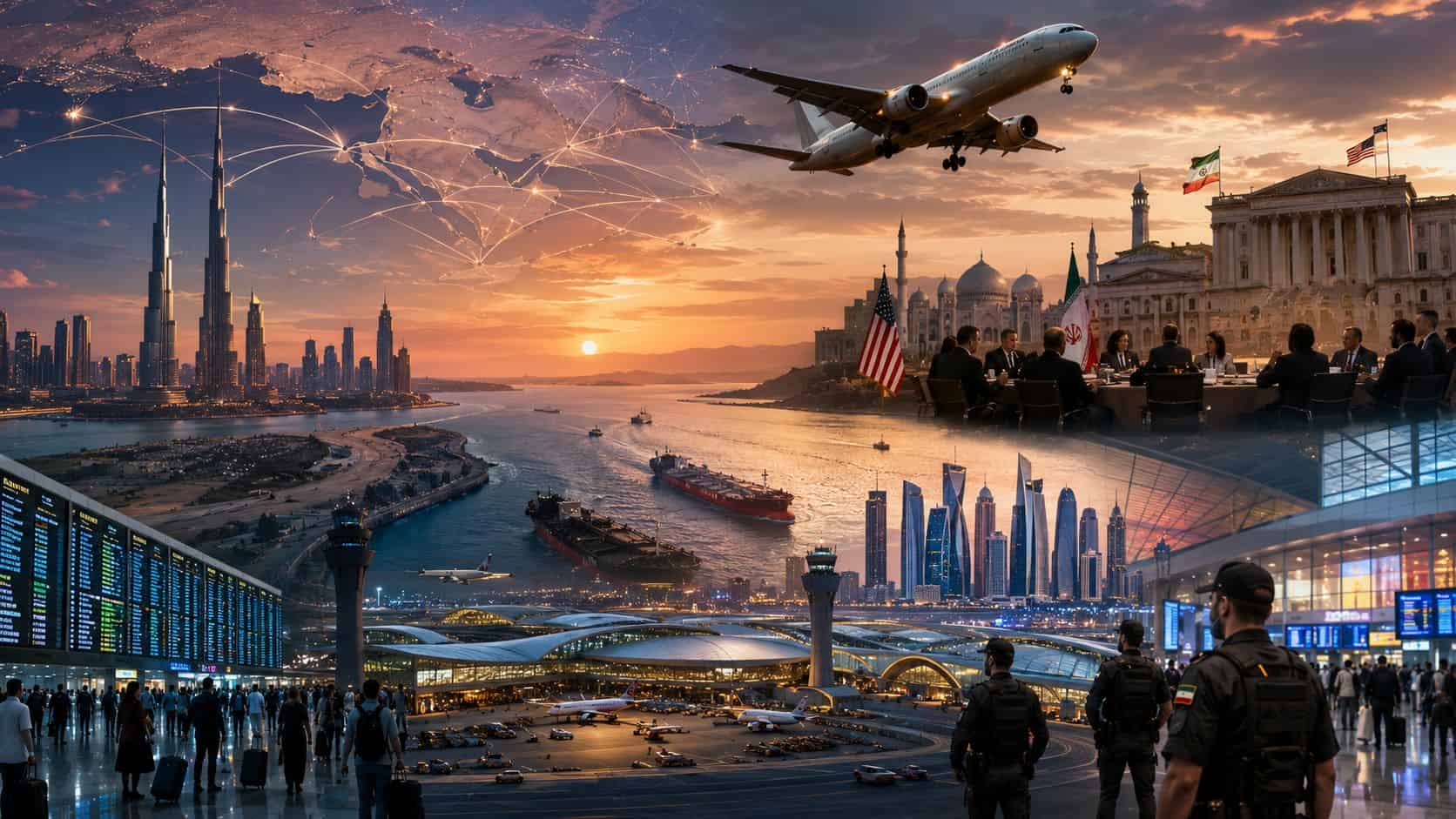
Image generated with Ai
As renewed diplomatic friction between the United States and Iran unfolds alongside fresh political statements and mediation efforts, the consequences are extending well beyond geopolitics. International airlines, travel companies, cargo operators, cruise lines, insurers and millions of travellers are once again monitoring developments across the Middle East, where aviation corridors, maritime routes and tourism flows remain closely connected to regional stability. Although commercial aviation continues operating across much of the Gulf, industry experts note that even limited security incidents or heightened military alert levels can rapidly alter airline routing decisions, insurance premiums and traveller confidence.
The latest developments also arrive during one of the busiest periods for international travel across Europe, Asia and the Middle East. Major Gulf hubs—including Doha, Dubai, Abu Dhabi, Riyadh and Muscat—serve as critical transit gateways linking Europe with South Asia, Southeast Asia, Africa and Australasia. Consequently, any escalation in regional tensions carries implications that extend far beyond the countries directly involved. Travellers are increasingly reviewing government travel advisories, airlines are maintaining contingency operating plans, and travel insurers are closely evaluating geopolitical risk, even as diplomatic channels remain active. For the global tourism industry, the priority is balancing operational resilience with passenger confidence while avoiding unnecessary disruption.
Why US–Iran Travel Impact Matters Far Beyond the Middle East
For the international travel industry, geopolitical developments rarely remain confined within national borders. Ae tourism relies on secure shipping lanes, and global tourism thrives when travellers perceive destinations as safe and accessible
The renewed attention surrounding US–Iran relations highlights how interconnected the travel economy has become. Modern airline networks operate through highly integrated hub systems where disruptions in one region can ripple across multiple continents within hours
Advertisement
Several Gulf airports rank among the world’s busiest international transit hubs, connecting thousands of long-haul passengers every day. Flights linking London, Paris, Frankfurt, New York, Singapore, Sydney, Delhi and Johannesburg frequently depend on efficient routing across Middle Eastern airspace
Should operational conditions change, airlines may be required to implement longer routings, increasing flight times, operational costs and fuel consumption
Advertisement
Advertisement
Global Travel Sectors Closely Monitoring Developments
| Travel Sector | Potential Implications |
|---|---|
| International Airlines | Possible route adjustments, higher operating costs, contingency planning |
| Airports | Operational coordination with airlines and air navigation authorities |
| Travel Insurance | Increased monitoring of policy coverage relating to geopolitical events |
| Tour Operators | Flexible booking policies if travel advisories change |
| Business Travel | Additional corporate risk assessments for regional travel |
| Cruise Industry | Monitoring maritime security across regional waterways |
| Cargo & Logistics | Possible shipping route adjustments and insurance considerations |
Ae Scenarios
The international acy planning capabilities over the past decade. Lessons learned from conflicts, pandemics, volcanic ash disruptions and regional airspace closures have encouraged airlines to diversify operational strategies
Rather than reacting only after major developments occur, carriers now continuously monitor security intelligence, Notices to Air Missions (NOTAMs), meteorological conditions and government advisories
This allows airlines to modify routes when necessary while maintaining service continuity wherever possible
Network carriers operating through the Gulf have also invested heavily in operational resilience. Advanced flight planning software enables dispatch teams to evaluate alternative routings based on fuel efficiency, airspace availability and passenger connections
Consequently, even when regional security concerns emerge, widespread flight cancellations are not always the immediate outcome
Gulf Arks
The Middle East occupies a unique geographical position within global a
Advertisement
Advertisement
Flights connecting Europe with South Asia, Southeast Asia, Australia and East Africa frequently traverse Gulf airspace or utilise regional hub airports
According to recent international af millions of international passengers annually through their extensive long-haul networks
Major hubs facilitate seamless transfers while supporting tourism, business travel, religious travel and cargo logistics
Major International Transit Gateways
| Airport Hub | Strategic Importance for International Travel |
|---|---|
| Dubai | One of the world’s largest international connecting hubs |
| Doha | Key transit point linking Europe, Asia and Africa |
| Abu Dhabi | Growing intercontinental aviation gateway |
| Riyadh | Expanding international aviation and tourism market |
| Muscat | Important regional connector within Gulf aviation |
The resilience of these hubs has become increasingly important as airlines continue rebuilding international passenger demand following several years of global disruption
Tourism Confidence Depends on Perception as Much as Reality
One of the travel industry’s greatest challenges during geopolitical uncertainty is managing public perception
Traveller behaviour often changes before any operational disruption occurs. Holidaymakers may postpone bookings, corporations may delay executive travel and conference organisers may reassess event schedules even when flights continue operating normally
Advertisement
Advertisement
Industry analysts consistently observe that confidence plays a decisive role in tourism demand
When governments maintain existing travel advice and airlines continue operating published schedules, markets generally stabilise quickly
Conversely, rapidly changing security assessments can influence booking trends across multiple destinations simultaneously
For destinations throughout the Gulf Cooperation Council, maintaining transparent communication with travellers has become an essential component of destination management
Tourism authorities increasingly collaborate with airlines, airports, hotels and emergency management agencies to provide timely operational updates while minimising uncertainty for visitors
Maritime Trade Routes Also Influence the Travel Economy
Although ay remains equally significant for international tourism
Advertisement
Advertisement
The Gulf region borders several strategically important waterways that facilitate global trade, cruise operations and energy transportation
Any increase in regional security concerns may influence shipping schedules, marine insurance costs and cruise itinerary planning
While commercial shipping generally continues under enhanced security arrangements, cruise operators routinely assess regional conditions before finalising itineraries
This proactive planning helps minimise disruption while protecting passenger safety
Strategic Areas Closely Watched by the Travel Industry
| Area | Importance for Tourism and Transport |
|---|---|
| Arabian Gulf | International aviation and maritime connectivity |
| Strait of Hormuz | Critical global shipping corridor influencing energy markets |
| Gulf of Oman | Commercial shipping and regional tourism |
| Arabian Sea | International cruise and cargo operations |
| Eastern Mediterranean Connections | Alternative logistics and travel routing considerations |
Travellers Increasingly Seek Reliable Information Before Departure
Modern travellers have become significantly more informed than in previous decades
Rather than relying solely on news headlines, many passengers now consult airline notifications, embassy travel advice, airport updates and travel insurance providers before departing
Advertisement
Advertisement
This shift has encouraged the travel industry to improve communication channels considerably
Mobile applications, real-time flight tracking systems and automated airline alerts now enable passengers to receive timely operational information, reducing uncertainty during periods of heightened geopolitical attention
For business travellers in particular, flexibility has become a central element of travel planning. Many multinational organisations now incorporate dynamic risk assessments into corporate travel policies, allowing itineraries to be adjusted rapidly if regional conditions evolve
Airline Contingency Planning Shapes the Future of US–Iran Travel Impact
Commercial acades. Airlines now maintain sophisticated operational control centres capable of assessing geopolitical developments, weather systems, airport congestion, technical disruptions and airspace restrictions simultaneously. This layered approach allows carriers to adapt schedules with minimal disruption whenever possible
For international airlines serving the Middle East, contingency planning extends far beyond aircraft operations. Dispatch teams continuously review approved flight corridors, alternate airports, fuel requirements, crew duty limitations and passenger connection times. If one air corridor becomes temporarily unavailable, airlines can often reroute flights using neighbouring Flight Information Regions (FIRs), although this may increase flight duration and operating costs
For travellers, these operational adjustments are usually less visible than outright cancellations. Instead, passengers may experience slightly longer flying times, revised departure schedules or altered connection windows. Such measures help airlines maintain network integrity while prioritising passenger safety
Advertisement
Advertisement
Another important consideration is airport coordination. Major Gulf hubs process thousands of international transfer passengers every hour. Maintaining smooth operations during periods of geopolitical uncertainty requires close cooperation between airport authorities, airlines, air navigation service providers, security agencies and emergency management teams
How Airlines Typically Respond to Heightened Regional Risk
| Operational Area | Possible Airline Response | Potential Effect on Travellers |
|---|---|---|
| Flight Routing | Alternative air corridors | Longer journey times |
| Fuel Planning | Additional contingency fuel | Increased operating costs |
| Crew Scheduling | Revised duty allocations | Minor timetable adjustments |
| Passenger Connections | Rebooking flexibility | More protected connections |
| Customer Communication | Real-time notifications | Improved travel certainty |
| Airport Operations | Enhanced coordination | Reduced operational disruption |
These preparations illustrate why modern airlines maintain several operational scenarios that can be activated as conditions evolve
Tourism Businesses Balance Caution With Continued Growth
Despite periodic geopolitical uncertainty, tourism across much of the Middle East has expanded significantly over the past decade. Governments have invested billions in airports, hotels, convention centres, entertainment districts and heritage attractions, reflecting long-term strategies to diversify their economies
Large-scale tourism initiatives continue across several Gulf countries, supported by expanding international airline networks and increasingly liberal visa policies. Consequently, tourism authorities remain focused on preserving visitor confidence while ensuring robust emergency preparedness
Hospitality operators are similarly experienced in managing changing market conditions. International hotel brands typically maintain comprehensive business continuity plans covering guest communication, staff safety, supply chains and operational flexibility
Travel management companies also continue strengthening flexible booking arrangements. Many now offer itinerary modifications, date changes or destination substitutions where operational circumstances warrant additional flexibility
Advertisement
Advertisement
Business Travel Faces New Risk Assessment Requirements
Corporate travel represents one of the most economically significant segments affected by geopolitical developments
Multinational companies increasingly require comprehensive travel risk assessments before approving employee travel to regions experiencing heightened political attention
Risk management now extends beyond destination safety alone. Companies evaluate airport connectivity, medical infrastructure, insurance coverage, communications resilience and evacuation procedures where appropriate
Consequently, travel management companies have expanded their advisory services considerably
Rather than discouraging travel outright, most corporate programmes now emphasise informed decision-making supported by continuously updated intelligence
Corporate Travel Considerations
| Consideration | Why It Matters |
|---|---|
| Government Travel Advisories | Official assessment of destination conditions |
| Airline Operational Updates | Flight schedule reliability |
| Travel Insurance | Coverage during geopolitical events |
| Medical Facilities | Emergency healthcare access |
| Embassy Registration | Assistance during emergencies |
| Communication Access | Reliable contact with employers and family |
These practices have become increasingly common across international business travel, particularly for organisations with operations spanning multiple continents
Advertisement
Advertisement
Government Travel Advisories Continue Playing a Central Role
One of the most important reernment travel advice
Foreign ministries regularly review evolving security conditions, local laws, transport infrastructure and emergency response capabilities before updating travel guidance
Importantly, governments do not always advise against travel during periods of heightened political tension. Instead, advisories frequently recommend increased awareness, avoidance of specific locations or enhanced preparation before departure
Travellers should therefore distinguish between precautionary advice and formal restrictions
Checking official travel guidance shortly before departure remains one of the simplest ways to remain informed
Practical Checklist Before Travelling
| Before Departure | Why It Is Important |
|---|---|
| Review official travel advice | Understand current conditions |
| Monitor airline notifications | Stay updated on schedule changes |
| Confirm travel insurance | Verify policy coverage |
| Register with embassy where available | Improve emergency contact options |
| Keep digital copies of documents | Faster recovery if documents are lost |
| Allow additional airport time | Operational procedures may require more time |
These straightforward precautions can significantly improve travel preparedness without discouraging international journeys
Advertisement
Advertisement
Insurance Providers Closely Monitor Geopolitical Developments
Travel insurance remains another essential element of international travel planning
Most comprehensive policies include medical emergencies, trip interruption and baggage protection. However, coverage relating to conflict or government travel advisories varies considerably between providers
For this reason, travellers should review policy wording carefully before departure rather than assuming identical protection across all insurers
Business travellers often benefit from specialised corporate policies offering broader emergency assistance, medical evacuation and security support
The insurance sector also monitors geopolitical developments because changing regional risk can influence underwriting decisions and premium calculations over time
Regional Tourism Has Demonstrated Strong Resilience
Historical experience suggests that tourism demand frequently rebounds once diplomatic conditions stabilise
Advertisement
Advertisement
Several destinations across the Middle East have recovered rapidly following previous periods of regional uncertainty through coordinated government communication, a
International events, sporting competitions and cultural festivals have further demonstrated the region’s capacity to restore visitor confidence after temporary disruptions
This resilience reflects significant investment in tourism infrastructure alongside improved crisis management capabilities
Comparison With Previous Regional Disruptions
| Period | Tourism Response | Industry Outcome |
|---|---|---|
| Earlier Regional Airspace Disruptions | Temporary route adjustments | Networks adapted through alternative routing |
| Pandemic Recovery | Extensive operational reforms | Passenger demand gradually returned |
| Isolated Security Incidents | Enhanced traveller communication | Confidence recovered over time |
| Current Diplomatic Tensions | Continuous monitoring and contingency planning | Operations largely continue while preparedness increases |
These experiences indicate that the travel industry has become considerably better equipped to manage uncertainty than in previous decades
Aviation Connectivity Remains Fundamental to Global Tourism
The significance of Middle Eastern a
Airlines based in the Gulf connect hundreds of destinations across Europe, Asia, Africa, Oceania and the Americas. Their strategic geographic location allows passengers to complete long-haul journeys efficiently through single-stop connections
Advertisement
Advertisement
Consequently, maintaining reliable operations benefits not only regional tourism but also global business travel, international education, medical tourism and cargo logistics
For many destinations, Gulf carriers represent essential gateways supporting inbound visitor arrivals and international trade simultaneously
As diplomatic engagement continues alongside heightened political rhetoric, the al remain an important indicator of broader travel market confidence
A Measured Outlook for Global Tourism
While geopolitical developments inevitably attract worldwide attention, the international travel industry has repeatedly demonstrated its ability to adapt to periods of uncertainty. Enhanced coordination between governments, anal resilience, helping preserve connectivity across key international markets
For travellers, informed preparation remains the most effective strategy. Relying on verified information, maintaining flexible travel arrangements and following official guidance can help minimise inconvenience should operational conditions change. As diplomatic efforts continue, the sector will closely monitor developments while working to sustain passenger confidence and uninterrupted international mobility
For the global tourism economy, the coming weeks will be watched carefully. Any improvement in regional stability would reinforce confidence across ad uncertainty could encourage airlines and travel businesses to maintain enhanced contingency measures. Regardless of the political outcome, the travel industry’s focus will remain on ensuring safe, reliable and resilient journeys for millions of passengers worldwide
Advertisement
Advertisement
Frequently Asked Questions (FAQs)
1. Why are the latest US–Iran tensions important for international travellers?The renewed diplomatic tensions have increased attention on security across the Middle East. While commercial flights continue to operate, airlines, governments and travel companies are closely monitoring the situation for any developments that could affect air routes, travel advisories or regional stability
2. Are flights to and through the Middle East operating normally?Yes. Most international airlines continue to operate scheduled services through major Gulf hubs such as Dubai, Doha, Abu Dhabi and Riyadh. However, carriers may adjust flight paths or schedules if operational or security assessments change
3. Should travellers cancel trips to the Middle East?There is no universal recommendation to cancel travel. Travellers should review the latest official travel advisories issued by their government, follow airline updates and ensure they have suitable travel insurance before departure
4. Can US–Iran tensions lead to longer flight times?Potentially. If airlines decide to avoid certain airspace for operational or security reasons, flights may follow alternative routes, resulting in slightly longer journey times and possible schedule adjustments
5. How could the situation affect travel insurance?Travel insurance policies differ by provider. Travellers should carefully check whether their policy covers trip disruptions, cancellations or changes related to geopolitical events and government travel advisories
6. Which travellers are most likely to be affected?Passengers transiting through Gulf airports, business travellers visiting the region, cruise passengers sailing nearby waters and travellers with flexible itineraries may notice the greatest impact if operational conditions change
Advertisement
Advertisement
7. What should travellers do before flying to the Middle East?Monitor airline notifications, check official government travel advice, confirm travel insurance coverage, keep digital copies of travel documents and allow extra time at the airport if advised by the airline
8. Which parts of the travel industry are closely monitoring the situation?International airlines, airports, travel management companies, tour operators, cruise lines, cargo operators, travel insurers and hospitality businesses are all closely watching developments and maintaining contingency plans
9. Could the tensions affect global ational a Any significant disruption could influence flight routing, aircraft operating costs and passenger connections on long-haul international services
10. Where can travellers find reliable travel updates?Travellers should rely on official government travel advisory websites, their airline’s official communication channels, airport websites and recognised international a
Advertisement
Tags: airline routes, aviation security, Geopolitical Risk, Gulf Aviation, international airlines
Advertisement
Advertisement
This content is protected under the Copyright Act. Unauthorized scraping, AI extraction, reproduction, or republication is strictly prohibited. Read ourCopyright Policy.
Follow Travel And Tour World in Google News

PARTNERS






REGIONAL NEWS
Europe
Cornwall Links With Rame Peninsula, Cawsand and Kingsand as Hidden UK Beach Dest
Saturday, July 11, 2026

Slovakia Outpaces Malta, Estonia, Slovenia, Bulgaria and More Countries With an
Saturday, July 11, 2026
America

NOW Canada, United States, Mexico, and Australia Unite as Cross-Border Family Vi
Saturday, July 11, 2026
US–Iran Tensions Ignite Fresh Travel Anxiety Across the Middle East as Airline
Saturday, July 11, 2026
Middle East
US–Iran Tensions Ignite Fresh Travel Anxiety Across the Middle East as Airline
Saturday, July 11, 2026
Georgia Ignites a Bold Tourism Gateway as OneClick Airways Unleashes Direct Tel
Saturday, July 11, 2026
Asia

Thailand Teams Up With Japan, China, Singapore, and Malaysia as High-Speed Airpo
Saturday, July 11, 2026

Bangladesh’s Bandarban Extends Tourist Spot Closures Until 15 July as Heavy Ra
Saturday, July 11, 2026
© 2026 Travel And Tour World. All Rights Reserved.
Copyright Policy
We use cookies on our website to give you the most relevant experience by remembering your preferences and repeat visits. By clicking “Accept”, you consent to the use of ALL the cookies.Do not sell my personal information.
Settings
Manage consent
X
