


In low-frequency medical scenarios, can high-frequency operations retain users?
Edited by Hai Ruojing
Major internet corporations are increasingly favoring the “weight management” scenario when developing medical AI applications
Recently, Ant Group announced its investment in Bohee Health, acquiring a stake of over 28% and becoming its largest external shareholder. Founded in 2008, this internet healthcare company has gathered more than 200 million users by providing services such as diet tracking and scientific weight loss plans, and has compiled a food database containing 1.6 million entries
In 2021, Bohee Health completed its Series D financing with a valuation of 2 billion RMB. According tonvestment, with Ant’s total investment amount reaching hundreds of millions of RMB at a relatively reasonable valuation. Ant Group has not yet commented on the specific consideration details
As learned by 36Kr, Bohee Health’s main revenue sources include e-commerce sales of food and functional products, as well as membership subscriptions. In the past two years, its partnerships with innovative weight-loss pharmaceutical companies and CROs in the clinical medical scenario have also shown strong growth momentum. Multiple AI healthcare practitioners believe that the ability to deepen services in a single health management scenario while building strong user stickiness and commercial conversion is one of the key factors that makes Bohee Health a valuable asset in Ant’s eyes.
In the broader health industry, medical services are relatively low-frequency scenarios. To improve user retention and engagement for medical AI applications, major tech giants are all targeting the “weight management” scenario, which features high frequency, strong user demand, and vast downstream product expansion potential
Prior to investing in Bohee Health, Ant Health had already distributed 9.9-yuan budget-friendly body fat scales to encourage users to participate in the “100 Million Jin Scientific Weight Loss Challenge” on the “Afu” app
In mid-July, JD Health also launched a “Weight Loss Challenge”, attracting continuous user participation through cash prizes and free blood glucose meters; Tencent Health chose to partner with Pfizer, leveraging AI to provide users with personalized services covering different stages of weight management
A Trial Focused on User Retention
In Ant Group’s strategic planning, healthcare is positioned as the “third leg of the stool” alongside payments and financial services, and “Afu” is the core product of its healthcare business segment
During the extensive marketing campaign at the end of 2025, the “Afu” app became widely known to the public. In addition, AI healthcare practitioners noted that Ant has been continuously strengthening cooperation with local health authorities, aiming to promote its products to more grassroots users through medical professionals
The core goal is to quickly secure a spot as a national-level AI health entry point. According to official disclosures, “Afu” currently has 100 million users, with over 10 million daily consultation sessions
This practitioner believes that with such a goal, the real competitors of “Afu” are not vertical healthcare AI products, but general large language models such as Doubao and Deepseek. “Therefore, to retain users and encourage them to use the product frequently, Afu needs to tie itself to specific scenarios and focus on enhancing functional depth.”
In other words, without high-frequency, long-cycle, highly interactive scenarios to support user engagement, the user base attracted by marketing campaigns, advertising, and word-of-mouth referrals could be lost. At this stage, this may be a greater challenge than acquiring new users
When it comes to general user health management scenarios, available options are relatively concentrated, including blood sugar control and weight loss, chronic disease management, sleep health, and maternity care. Among these, weight management is “a scenario that can effectively arouse widespread public enthusiasm”, supporting a wide range of services and products covering daily health monitoring, medical consultation, pharmacy access, and diet management. This naturally makes it the first choice for internet giants exploring AI healthcare implementation.
The next question is: how to excel in the weight management scenario?
Zhang Ming, an investor from Jinyumaowu, also participated in this round of financing for Bohee Health. He mentioned that with current AI capabilities, individuals or startup teams can develop and launch a weight loss product, and even create distinctive features and gather users in a short period of time. The real difficulty lies in forming a closed loop, integrating both lifestyle services and clinical medical services
“In China’s weight management industry, Bohee Health is one of the few targets that has long-term accumulated user bases, the ability to integrate with clinical medicine, and has found a
In this context, rapidly supplementing capabilities through investment or acquisitions aligns with Ant’s consistent strategy. To integrate medical repharmaceutical retail qualifications and channels, it acquired Orca Pharmacy in the second half of 2025
After nearly 20 years of development, Bohee Health has mastered a self-sustaining operational model that does not rely on external traffic, generating revenue through user services and partnerships with pharmaceutical companies and smart hardware manufacturers. Furthermore, the two companies already have a deep relationship: before the launch of “Afu”, Bohee Health had settled in Alipay’s medical and health channel, providing users with services such as food data analysis, laying a foundation of mutual trust.
Ant Group stated that after the two sides initiated cooperation discussions, they “reached an equity investment intention within several months”
Why Bohee Health:
Riding the GLP-1 Trend and Embracing AI Opportunities
For a long time, the public’s impression of Bohee Health was limited to the “food calorie scanning and recognition” function in its app, and its meal replacement e-commerce business. In the early years, its self-owned food brand “Supermodel 25” series was once very popular
Zhang Ming introduced that Jinyumaowu began to contact Bohee Health in the second half of last year. Before that, he also thought it was an e-commerce-dominated internet product, but with in-depth communication, he found that in the past few years, the company’s “service capabilities and business boundaries have been greatly expanded, and user-centric content has been continuously generating value”
The most critical advantage lies in data value, which includes two core dimensions: user behavior data accumulated over many years and its food database. The former reflects the real diet records and weight loss plans of 200 million people in China’s weight loss population; as for the latter, “considering the complexity of Chinese food varieties and cooking processes, maintaining and updating such a database is extremely difficult, creating a high competitive barrier”
The weight management process inherently involves a large amount of data collection, integration, and personalized customization, which naturally fits with AI capabilities. At the same time, Bohee Health has been leveraging its data advantages in the past two years to consciously build AI capabilities and integrate them into the weight management scenario
This is not only reflected in the embedded “AI Weight Management Specialist” function in its app; another detail is that Bohee Health, which previously focused on C-end services, officially launched its B-end AI platform, Bohee Science.AI this year. Through API and SDK integration or customized solutions, it provides its food database capabilities to smart hardware companies, health internet products, and medical institutions

Bohee Science.AI, the AI platform under Bohee Health
This is also the first collaborative feature between “Afu” and Bohee Health. According to Ant’s information, currently, when users scan food to record calorie intake in “Afu”, the system will call Bohee Health’s database for support
In addition, from the external environment, the launch and popularity of GLP-1 weight loss drugs in China have created huge market opportunities for companies developing weight management products, and Bohee Health “has not missed this opportunity”
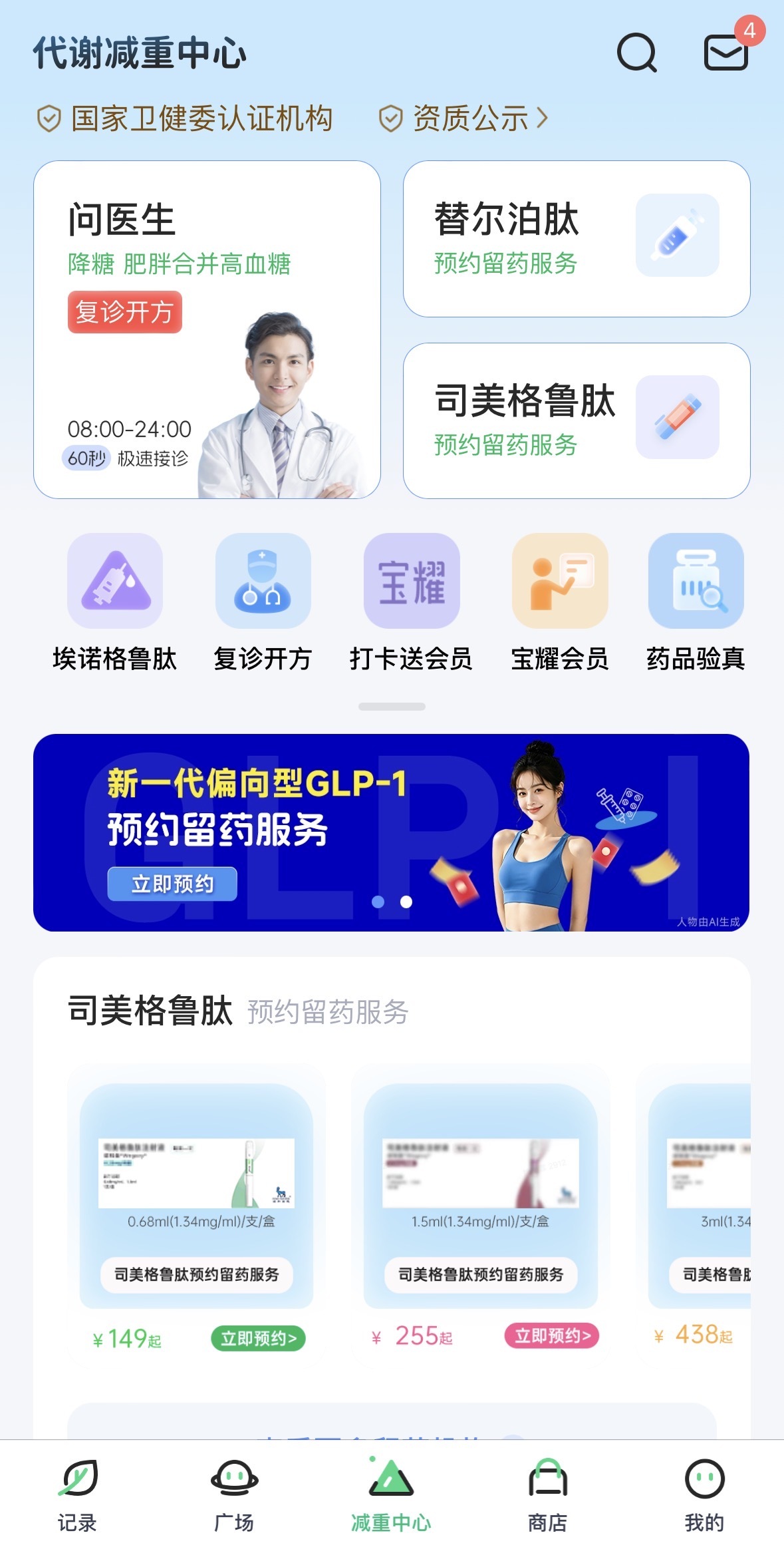
Weight management services within Bohee Health
From Bohee Health’s developments in recent years, it can be seen that the company has been continuously deploying clinical medical-related businesses. For example, in its self-operated business, Bohee Health obtained an internet hospital license in 2022, gaining prescription qualification; at the same time, the company is also cooperating with various private medical institutions and public hospital endocrinology departments to provide software services or assist in building weight management centers.
These early deployments have laid a foundation for it to develop weight loss services around GLP-1 products. According to Bohee Health’s data, from the end of 2024 to the end of February this year, more than 400,000 people have consulted or used GLP-1 and other related drugs on its platform; 35,000 users have subscribed to the GLP-1 medication + lifestyle intervention weight loss plan. As reported by 36Kr, in 2025, the company’s weight management-related revenue reached 1.8 billion RMB, 60% of which came from paid members.
When asked whether the operational experience in the weight management scenario can be replicated to other health management scenarios, Zhang Ming believes that weight management is already a prominent scenario in lifestyle health management, and further expansion would be a positive development. However, “each scenario in the lifestyle health management field has its own unique characteristics, and directly copying a mature model may bring uncertainties. It is better to evaluate each scenario individually and combine AI capabilities with specific use cases.”
