


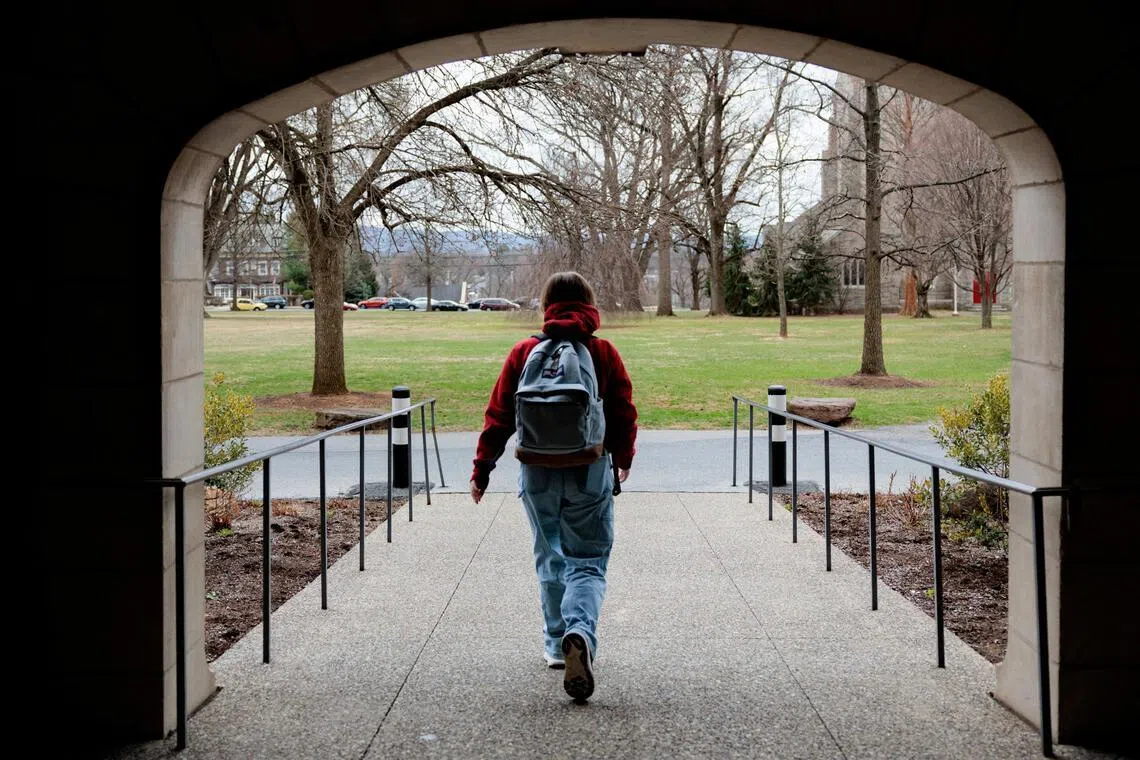
‘Four years isn’t enough’: South Korean students shaken by new US stay policy
Anxiety has spread rapidly among South Korean foreign student communities across the US
PHOTO: REUTERS
- The US Department of Homeland Security set a four-year limit on stays for international students on F and J visas, ending indefinite stays previously allowed.
- South Korean students express anxiety over the new rule, fearing it disrupts their studies and work plans, especially those needing more time for exams.
- The rule also affects foreign journalists with fixed stay limits, with Chinese journalists facing even shorter durations for stays in the US.
AI generated
SEOUL – A new US policy capping foreign students’ stay at four years has sent shock waves through South Korean student communities across the country
The US Department of Homeland Security (DHS) announced on July 16 that it had finalised a rule setting a four-year limit on the stay of international students on F visas and exchange visitors on J visas
Set to take effect in September, the rule is part of the Trump administration’s immigration crackdown and an end to the longstanding system that allowed F and J visa holders to remain in the United States as long as they maintain their student or exchange status
“For decades, foreign students have been admitted into the US indefinitely, allowing thousands to abuse our immigration system by perpetually enrolling in courses to avoid having to leave the US,” Homeland Security Secretary Markwayne Mullin said in a statement. “This final rule ensures that foreign students remain focused on their primary purpose: completing their studies and returning home.”
Reuters reported that the number of US student visa holders topped 1.8 million in 2024, up 11 per cent from 2023
Under the new rule, students who have already entered the US on student visas would also automatically become subject to the four-year limit
Those who need to remain beyond that period would have to apply to the DHS for an extension, which would be granted only after “rigorous scrutiny”
Anxiety has spread rapidly among South Korean student communities across the US, particularly among those currently on or preparing to apply for Optional Practical Training (OPT), a temporary work authorisation that allows F-1 students to take jobs related to their field of study after graduation
The programme allows most graduates to work in the US for one year, or up to three years in science, technology, engineering and mathematics fields, often serving as a bridge to employer-sponsored visas and permanent residency
Kim Se-hee, a 24-year-old who transferred to a nursing school in Chicago last autumn and has three to four years of study ahead before she seeks a nursing position at a hospital through OPT, fears she could be sent back home before getting a chance to launch her nursing career
“I can’t graduate early by cramming my coursework, there’s no guarantee I’ll pass the NCLEX-RN (US licensing exam for registered nurses) on my first attempt, and I’ve been told the OPT application process also takes time. Four years really isn’t much time,” Kim told The Korea Herald
“I’ve been working towards building a life in the US, so if I have to go back to Korea right after getting my US nursing licence, it would all be for nothing.”
The uncertainty is also weighing on South Koreans pursuing education in the US, with some saying the proposed four-year limit could leave little room for unexpected changes, such as switching majors after discovering another field that better suits their interests
“I’m starting to wonder whether studying in the US is worth the risk if the rules can change after I get there,” one user wrote on Mijunmo, a popular Naver community for South Koreans keen on studying in or immigrating to the US
According to the South Korean embassy in Washington, 11,861 Korean students were in the US on F-1 visas in 2025, along with 1,347 family members on F-2 visas. Another 7,985 Koreans were in the country as exchange visitors on J-1 visas, accompanied by 3,180 dependants
The proposal would also impose fixed periods of stay on foreign national journalists
Journalists working for overseas media outlets who enter the US on I visas would be allowed to stay for up to 240 days at a time and would have to apply to extend their stay every 240 days. Chinese journalists would face a shorter limit of 90 days per stay. THE KOREA HERALD/ASIA NEWS NETWORK
South Korea
United States
Students
Universities – overseas
Education and schools
