


National
The White House pushes healthy eating. It cut a landmark nutrition education program
July 23, 20265:00 AM ET
Joe Hernandez
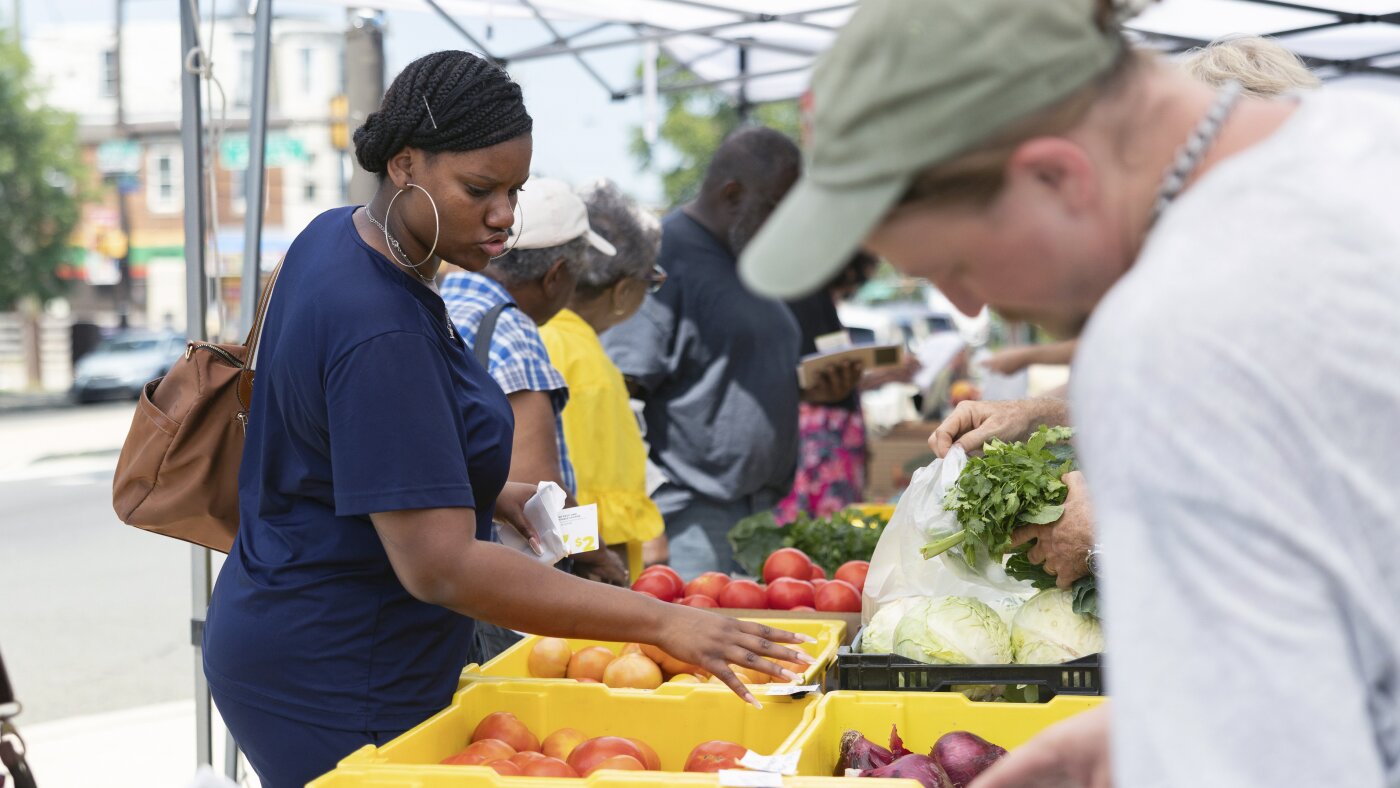
Kate Feurtado, a medical assistant at Spectrum Health, browses for produce at a farmers market in Philadelphia on July 15. The Food Trust, a Philadelphia-based nonprofit, uses SNAP-Ed funding to support its farmers markets.
Rachel Wisniewski for NPRhide caption
toggle caption
Rachel Wisniewski for NPR
Wholesome eating is a central part of the Trump administration’s efforts to Make America Healthy Again. But a landmark nutrition education program for recipients of federal food assistance and other low-income people will cease to exist within weeks after President Trump eliminated it last summer when he signed a massive Republican spending and tax bill
For decades, the Supplemental Nutrition Assistance Program Nutrition Education and Obesity Prevention Grant Program, known as SNAP-Ed, has funded programs such as community cooking classes, farmers markets in low-income neighborhoods, school nutrition lessons and more in every U.S. state. The program is a “pillar of the public health infrastructure in the US,” according to a report published in the Journal of Nutrition Education and Behavior
The decision to end SNAP-Ed at a time of rising food prices and the Trump administration’s push for healthy eating has mystified nutrition advocates and public health experts alike
“It doesn’t make sense when we have an administration [promoting] the Make America Healthy Again efforts that are focused on decreasing consumption of ultraprocessed foods and wanting to encourage people to eat more fruits and vegetables,” said Tashara Leak, a professor of nutritional sciences at Cornell University, “to then get rid of the largest federally-funded nutrition education program that helps to achieve those goals.”
What’s Eating America
The MAHA movement is coming to school cafeterias. Here’s what that means for kids
The White House did not provide specifics to NPR about how or whether eliminating this program aligned with the goals of the MAHA agenda, but said the law signed by President Trump had strengthened SNAP for future generations and provided tax cuts that improved all Americans’ financial situations
Some recent SNAP-Ed projects include a series of cooking workshops led by indigenous chefs and traditional food experts in Southwest Colorado, classes on meal planning and budgeting in Kansas and a social marketing campaign in Michigan that urged parents and caregivers to model healthy behaviors for children. One North Carolina church built a fitness center that’s free to use
Federal funding for SNAP-Ed stopped at the end of September 2025, but states with leftover money have until the end of this September to spend it
‘I gotta change my bread’
On a recent July morning inside Ray Food Market, a small corner store in West Philadelphia, Elines Olivares stood behind a table offering shoppers small plastic cups of Quaker Oats oatmeal and fruit
Health
The MAHA movement is mad about the weedkiller glyphosate and Trump’s EPA
“So we teach people about fiber, what they can eat, what they should eat, and let them have a little taste test of our oatmeal today,” said Olivares, a nutrition educator with The Food Trust, a Philadelphia-based nonprofit organization
Olivares was there as part of the organization’s Healthy Corner Store Initiative. It aims to increase the amount of healthy food carried by convenience stores in lower-income neighborhoods, where residents often lack access to full-service grocery stores. It has largely been funded with SNAP-Ed dollars. The Food Trust trains store owners and staff and provides stores with items like refrigerators, shelving and signage to promote healthy products
That morning, Sherron Dudley stopped into Ray Food Market and began chatting with Olivares. Dudley, who lives across the street, said she recently lost 100 pounds using the GLP-1 weight loss drug Ozempic combined with dietary changes. But she was wondering if the honey wheat bread she enjoys is a nutritious option
Elines Olivares (left), a nutrition educator with The Food Trust, gives a healthy food demonstration at Ray Food Market in Philadelphia. The Food Trust’s Healthy Corner Store Initiative is funded in part by SNAP-Ed.
Rachel Wisniewski for NPRhide caption
toggle caption
Rachel Wisniewski for NPR
Ray Food Market in Philadelphia.
Rachel Wisniewski for NPRhide caption
toggle caption
Rachel Wisniewski for NPR
“I thought honey wheat was like, ‘OK they might not say nothing about the honey, but at least it’s got wheat in it,” Dudley said, “but she said it wasn’t real healthy.” Olivares told her it was, in fact, flavored white bread
Consider This from NPR
Is MAHA influencing health policy?
After hearing that, Dudley said she planned to switch to whole wheat. “I gotta change my bread.”
The role of SNAP-Ed
SNAP-Ed traces its origins back to the Food Stamp Act of 1977, which called for the establishment of a national nutrition education program that would “enable low-income individuals and families to engage in nutritionally sound food purchasing and preparation practices.”
It wasn’t until 1992 that funding for the nutrition education program began in seven states, and the Healthy, Hunger-Free Kids Act of 2010 expanded SNAP-Ed even further, broadening its mission and audience and adding a focus on obesity prevention. By 2013, it was operating in every state. By 2018, USDA said it was the “most robust federal nutrition education program.”
SNAP-Ed’s reach extends beyond SNAP recipients – those eligible also include low-income people who qualify for means-tested federal assistance programs and residents in communities where half or more of the population is low-income
Jules Koehl, community nutrition coordinator for The Food Trust, shows community members how to prepare a black-eyed pea and corn salad at Spectrum Health in Philadelphia. The cooking demonstration was supported by SNAP-Ed funding.
Rachel Wisniewski for NPRhide caption
toggle caption
Rachel Wisniewski for NPR
According to the USDA, SNAP-Ed educational programming reached 1.8 million Americans in 2022
National
Have you lost or are worried about losing SNAP benefits? NPR wants to hear your story
The program has even played a role in emergencies. Leak, the Cornell professor, said that during the Flint, Michigan water crisis over a decade ago, the local SNAP-Ed agency helped teach residents with lead-contaminated waterto prepare food safely
Targeted for cuts
When Trump signed H.R.1 into law last July, it made sweeping changes to SNAP itself, including shifting more costs to states, tightening eligibility rules for immigrants and expanding those subject to work requirements to include older people and parents of teenagers. The left-leaning Center on Budget and Policy Priorities estimated that enrollment in SNAP dropped by more than 4 million people between then and March of this year
That law also wiped out all funding for SNAP-Ed, which had a $536 million budget last fiscal year. (For comparison, the federal government spent $99.8 billion on SNAP in the previous fiscal year.)
The Supplemental Nutrition Assistance Program Nutrition Education and Obesity Prevention Grant Program, known as SNAP-Ed, has funded programs such as community cooking classes, farmers markets in low-income neighborhoods, school nutrition lessons and more in every U.S. state.
Rachel Wisniewski for NPRhide caption
toggle caption
Rachel Wisniewski for NPR
White House spokesperson Anna Kelly said in a statement that Trump was “strengthening SNAP for the Americans who need it by ensuring these programs are sustainable for future generations.” Kelly said the law “restores basic work requirements, prioritizes American citizens, and implements reasonable cost-sharing measures with states to crack down on waste, fraud, and abuse.” She did not specifically respond to a question about the decision to eliminate SNAP-Ed
2025 government shutdown
Supreme Court temporarily blocks full SNAP benefits even as they’d started to go out
The USDA said in a statement that it would still maintain some nutrition education programming in the absence of SNAP-Ed
“While Congress chose to eliminate SNAP-Ed, the Department continues to provide nutrition education through initiatives like the Expanded Food and Nutrition Education Program and FoodSafety.gov,” a USDA spokesperson said
At least one Republican lawmaker has made a more pointed critique of SNAP-Ed. Rep. Glenn “GT” Thompson, R-Pa., who chairs the House Agriculture Committee, toldTheWashington Post last year that “data shows it hasn’t moved the dial in making America healthy again.” Thompson’s office did not respond to an interview request from NPR
Thompson and others have argued that SNAP-Ed failed to improve nutrition and reduce obesity rates among participants. Critics point to a 2019 report from the Government Accountability Office that said the USDA did not effectively track the success of its nutrition programs, including SNAP-Ed
But when that report was released, the USDA was already in the process of adopting a new system to do just that
Was SNAP-Ed seeing results?
The USDA launched a new national reporting system for SNAP-Ed in 2023 to achieve “an improved understanding of program effectiveness and accountability.”
Gina Crist, a community health specialist with the University of Delaware’s cooperative extension who oversaw the state’s SNAP-Ed program, said agencies across the U.S. had been reporting their results to the USDA
“We had a very robust reporting mechanism. All of us who implemented SNAP programming had to deliver surveys. We had to gather the data, and then it was actually reported nationally,” she said
A customer purchases produce at a farmers market in Philadelphia on July 15.
Rachel Wisniewski for NPRhide caption
toggle caption
Rachel Wisniewski for NPR
Crist said there were never any long-term research studies done on the health improvements of SNAP-Ed participants over time, because such a study would not have been allowed under the program’s funding rules. Yet operators like Crist did survey participants about whether they changed their behaviors over the course of SNAP-Ed programs
“We tracked if an individual in our program said from class one to class six that they increased their fruit and vegetable consumption,” said Crist, who also leads the Association of SNAP Nutrition Education Administrators, or ASNNA. “But I can’t tell you that that same person had a decrease in [body mass index] five years down the road, because that’s not what we were set up to measure.”
Crist and other operators said they saw positive results from SNAP-Ed programs, a conclusion that was backed up by the survey results. In a 2025 report, ASNNA found that 40% of SNAP-Ed participants said they increased their fruit intake and 34% increased their vegetable consumption. Twenty-three percent of participants upped their physical activity
Changes like this can save society money in future health care savings, advocates say. A 2023 report by the Illinois SNAP-Ed program concluded that for every $1 it spent, the program would return between $5.36-$9.54 in future savings due to lower rates of obesity and food insecurity
How groups are moving forward
For organizations like Leah’s Pantry, a California-based nonprofit that works on trauma-informed nutrition initiatives, the loss of SNAP-Ed has dealt a crushing blow to its work
Adrienne Markworth, the founder and executive director of Leah’s Pantry, said SNAP-Ed funding accounted for 90% of its budget. The organization has already had to reduce staff and will do so again after the September funding cutoff, Markworth said, which will mean a dramatic rethinking of its programming at a time when nutrition education is sorely needed
Hank Whittenberg (left), owner of Hayday Farms, helps Kenny Waddington shop for produce at a farmers market in West Philadelphia.
Rachel Wisniewski for NPRhide caption
toggle caption
Rachel Wisniewski for NPR
“Our food environment is really challenging in this country. We have pretty high rates of chronic disease, and there’s a lot of shaming and blaming of the individuals,” Markworth said
“Many places just simply don’t have an abundance of affordable, fresh, healthy foods. Folks don’t have the opportunity to learn how to prepare their own meals very easily. A lot of people don’t really know how to cook,” she added
Markworth estimated that Leah’s Pantry will shrink to about one sixth of its previous size for the next few years, and is already thinking of new ways to provide its services
Some agencies that once oversaw SNAP-Ed programming are keeping their informational and training materials online. Crist said members of ASNNA, the group of SNAP-Ed administrators, are keeping in touch with members of Congress and trying to envision what a future federal nutrition program could look like
But nutrition advocates fear it won’t be long before SNAP-Ed participants feel the impacts of the program’s loss
In Philadelphia, The Food Trust’s roughly $11 million budget includes about $3 million in SNAP-Ed funding. Vice president of programs Heidi Gorniok said the nonprofit will have to scale back some of its nutrition education efforts, and that will make it harder for people to eat healthy
“We’re at a time where food in general is becoming less affordable. There are SNAP cuts coming. Food insecurity is rising. And one of the goals of SNAP-Ed is to teach people how to shop and cook healthy on a budget,” Gorniok said
“We’re now losing that ability to support people, who now have less money in their pockets, to find those healthy foods and be able to incorporate them into their diets.”
