


2,700 year-old Italian cemetery reveals how status, gender, and diet impacted people’s lives
Bone chemistry from the Novilara necropolis suggests fancy grave goods often masked ordinary, everyday diets
Written By: Rebecca Shavit/
Edited By: Joseph Shavit
Published Jul 28, 2026 4:07 PM PDT
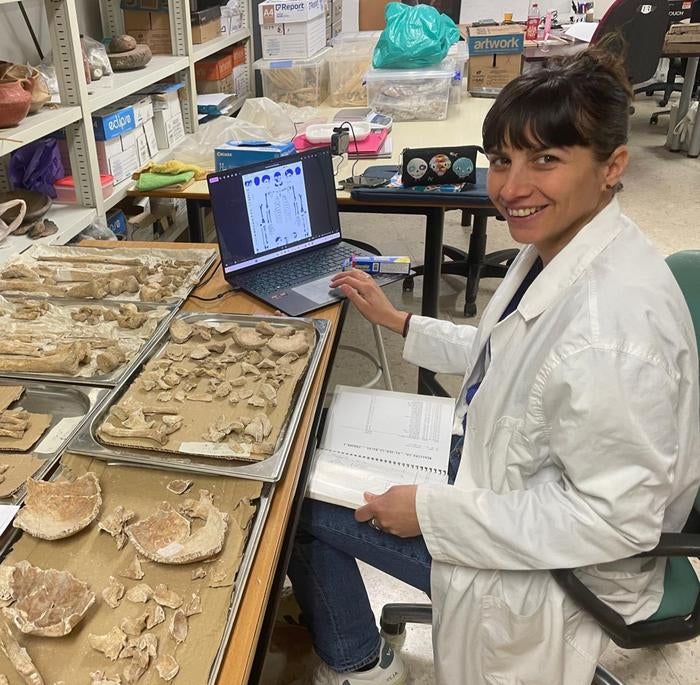
Zita Laffranchi, researcher of the Universyity of Cordoba. The Novilara necropolis isotope study reveals gendered diets, limited seafood consumption, mobility, and complex burial status. (CREDIT: Zita Laffranchi, University of Cordoba)
- Scientists studied bones from 148 people buried nearly 2,700 years ago in an Italian cemetery to see what they ate and where they came from.
- People buried with fancy items like amber jewelry or weapons didn’t actually eat better than people buried more plainly, and men generally had more meat in their diet than women.
- A small number of people, mostly men, appear to have moved to the area from elsewhere, showing this ancient community had contact with distant regions.
In grave 57 at an ancient Italian cemetery lies a teenage girl buried with a bone and amber brooch, a rare piece that closely matches jewelry found hundreds of kilometers to the north. Yet the chemical signature locked inside her bones points somewhere else entirely: southern Italy. Her grave goods and her own body are telling two different stories, and that mismatch sits at the heart of a new study into daily life 2,700 years ago
The girl was one of 148 people whose remains were examined as part of an international project led by the Universities of Córdoba and Pisa. Researchers used isotopic analysis, a technique that reads chemical traces left behind in bone, to reconstruct diet, movement and social patterns at the Novilara necropolis, one of the largest burial grounds of the Picene culture. The Picenes were a pre-Roman people in central Italy, active around the same time as the Tartessian societies on the Iberian Peninsula.
Novilara sits near the Adriatic coast in the Marche region, and excavations there, spanning more than a century, have uncovered hundreds of graves dating to the 8th and 7th centuries BCE. Burials varied widely in what they contained, from simple pits with little more than pottery to graves filled with weapons, brooches, necklaces and amber earrings. The new study combined that funerary evidence with bioarchaeological and isotopic analysis of the skeletons themselves
Chemical clues stored in bone
Bones and teeth slowly build themselves out of whatever a person eats and drinks. That process leaves behind measurable ratios of carbon, nitrogen and sulfur, sometimes called chemical footprints, which can survive for thousands of years
“As they form, bones and teeth absorb the isotopic composition of the food and water consumed. As a result, analyzing them can provide information about diet, mobility, and the environment in which people lived,” explained Zita Laffranchi, a researcher in the Prehistory Department at the University of Córdoba
Carbon and nitrogen levels reveal what people ate. Sulfur levels shift with geography, which makes them useful for tracking where a person actually grew up
Men ate better than women
The isotope results showed a clear split by sex. Men had greater access to animal protein than women did, a pattern that held even though the overall community relied mainly on cereals and meat rather than fish
That last detail is notable given the community’s location. The Adriatic Sea sat just 6 kilometers away, yet fish appears to have played little part in the diet. Meat and grain, not seafood, were the staples
Men’s isotope values were also more varied than women’s, hinting at a wider range of diets and environments among males. Researchers linked this pattern to greater mobility among men, who may have traveled and interacted with more diverse settings over their lifetimes
A cemetery with visitors from afar
Isotopic data also pointed to outsiders. Between 1.4 percent and 6.4 percent of the people buried at Novilara appear to have come from elsewhere, evidence of contact and movement between communities, some of them far away
Estimates based on the chemical signatures suggest possible origins in the Po Plain or the Balkan region for some individuals, and in southern Italy, Sardinia or Corsica for others. Most of the people identified as likely outsiders were men
The teenage girl from grave 57 fits into this picture, though with a twist. Her isotopic profile points to southern Italy, while her rare brooch closely resembles items from a Villanovan cemetery in the north, a completely different direction. Researchers found no clear pattern linking grave goods to a person’s likely place of origin
Rich in death, ordinary in life
Perhaps the most striking finding involves the graves themselves. Some burials at Novilara contained valuable items such as amber ornaments or weapons, objects that would normally suggest wealth or high status. But people buried with these items showed no isotopic evidence of having eaten better than those buried far more modestly
“The study shows that social inequality cannot be interpreted solely based on the objects placed in graves,” Laffranchi explained
In other words, an impressive grave did not necessarily mean an easier life. Researchers suggest the social status conveyed by a burial was, at least in part, a symbolic construct, shaped by the decisions and traditions of the people who buried the dead rather than a direct reflection of how the deceased actually lived
The study, published in the Journal of Archaeological Science, adds new detail to a period of major cultural change in Iron Age Italy, when distinct groups such as the Picenes were taking shape
“The study demonstrates the potential of bioarchaeological approaches to understand how people experienced identity, mobility, and social differences in the past,” said Marco Milella, a researcher at the University of Pisa
Practical implications of the research
The findings offer a caution for how archaeologists read burial sites more broadly. Grave goods alone, the research suggests, cannot be treated as a reliable stand-in for how well someone actually lived, since prestige items and everyday diet did not move together at Novilara
The isotopic approach used here also gives researchers a template for revisiting other Iron Age cemeteries where funerary wealth has been assumed to reflect social or dietary inequality. Applying the same carbon, nitrogen and sulfur analysis elsewhere could test whether the pattern seen at Novilara, symbolic status disconnected from lived conditions, appears in other pre-Roman communities
The team also plans additional testing, including strontium and oxygen isotope analysis of tooth enamel, to refine estimates of where individual outsiders originally came from. That follow-up work could sharpen the picture of how far, and how often, people at Novilara traveled during their lives
Research findings are available online in the Journal of Archaeological Science
The original story “2,700 year-old Italian cemetery reveals how status, gender, and diet impacted people’s lives” is published in The Brighter Side of News
- Roman gladiator vs lion: Surprising discovery in York cemetery
- Plague was killing hunter-gatherers 5,500 years ago, long before cities
- Rich medieval Danes bought graves ‘closer to God’, study finds
Like these kind of feel good stories? Get The Brighter Side of News’ newsletter
ancient dietancient mobilitybioarchaeologycarbon isotopesfunerary archaeologyIron Age Italyisotopic analysisNew Discoveriesnitrogen isotopesNovilara necropolisPicene culturepre-Roman ItalyResearchSciencesocial status archaeologysulfur isotopesUniversity of CórdobaUniversity of Pisa
Rebecca ShavitReporter
Based in Los Angeles, Rebecca Shavit is a dedicated science and technology journalist who writes for The Brighter Side of News, an online publication committed to highlighting positive and transformative stories from around the world. Having published articles on MSN, AOL News, and Yahoo News, Rebecca’s reporting spans a wide range of topics, from cutting-edge medical breakthroughs to historical discoveries and innovations. With a keen ability to translate complex concepts into engaging and accessible stories, she makes science and innovation relatable to a broad audience.
Latest Stories
 InnovationsMIT engineers create a stretchy yarn designed to be melted down and recycledShy Cohen
 DiscoveriesDust from the Chicxulub asteroid baked dinosaurs alive within hours of impactJoseph Shavit
 SpaceAstronomers find four Barnard’s Star planets to be small, uninhabitable, with years lasting only daysJoseph Shavit
