


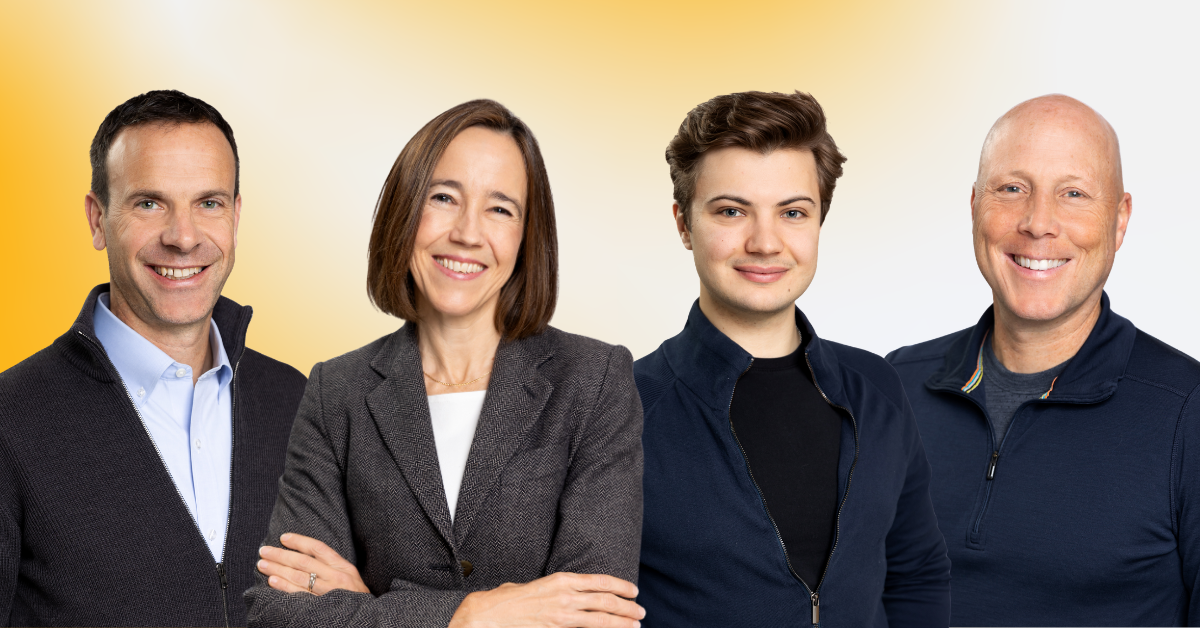
Experts in healthcare economics, computational health, biostatistics, and behavioral design from across the Haas School of Business and UC Berkeley came together to build a new kind of healthcare AI—trained on how doctors actually practice medicine
Professor Jonathan Kolstad knew the signals were buried deep within the data. He just didn’t yet have the precise tools to unlock them
For years, the UC Berkeley Haas healthcare economist had been sitting on a massive data set—the audit logs of hundreds of thousands of electronic medical records, each a millisecond-by-millisecond account of every action taken by the doctors, nurses, and care teams who treated those patients. Kolstad’s conviction, drawn from decades studying how healthcare systems work, was simple: when a doctor makes a decision, they are revealing what’s in their brain. That behavioral record contains a form of clinical intelligence that exists nowhere else. Not in textbooks. Not in journals. Not in any artificial intelligence models built to that point.
Then in October of 2023, he sat down at a campus café with a new doctoral student named Jonas Knecht, who was studying how computational methods map onto human decision-making. Within minutes, the two were riffing off Kolstad’s economic framework for human decision-making and the possibilities opened by the computational toolkit that Knecht was working with. After six years making little headway, they saw a path to making sense of the records
A new breed of AI
Less than three years later, Kolstad and Knecht—along with co-founders Ted Robertson and Dr. Maya Petersen, a professor at UC Berkeley Public Health—launched Knit Health, a healthcare AI company that is developing the world’s first large clinical behavior model (LCBM). Through this new breed of AI that learns not from medical literature but from how clinicians actually make decisions in the real world, Knit aims to inject “clinical intelligence” into healthcare systems so they can better guide patients to the right care, at the right time, with the right information.
Knit Health went live in May with $11.6 million in seed funding co-led by Uncork Capital and Frist Cressey Ventures (a pre-seed round was led by Moxxie Ventures, with participation from Coalition Operators). This summer, Knit’s model will continue to be trained on the anonymized electronic health records of more than 130 million patients across 30 major U.S. health systems, roughly a third of the American population
While many healthcare AI startups are focused on back-office tasks and a few are experimenting with clinical care—mostly by pulling from medical literature
“This form of intelligence is a fundamentally different way to build AI,” said Kolstad, who serves as CEO of Knit Health. “What we are saying is that if a clinician or provider team knew everything about a patient up to this point, what might they do next? The goal is to help clinicians focus on what they’re really good at, by giving them more of the patients that are the right ones for them at the right time.”
This form of intelligence is a fundamentally different way to build AI
—Professor Jonathan Kolstad, CEO & Co-founder, Knit Health
A product of UC Berkeley
Knit Health is uniquely a University of California product—born from UC Berkeley’s fertile innovation ecosystem with the help of a foundational data partnership with UC San Francisco. It drew on a founding team assembled from across Berkeley’s schools and programs and was incubated in the Center for Healthcare Marketplace Innovation (CHMI), a joint center spanning Haas and the UC Berkeley College of Computing, Data Science, and Society, built as a runway from research to real-world impact. Knit is the first startup to emerge from CHMI. It is the kind of company that can only be brought to life when a university actively dissolves the boundaries between its disciplines rather than reinforcing them.
“There are only a couple of places where you have that confluence of interdisciplinary skills,” Kolstad said, “Berkeley is one of the top.”
Learning from behavior, not textbooks
But none of that was yet on their minds in those heady first months of building
Working out of a spare room on the fourth floor of the Haas Faculty Building, Kolstad and Knecht met every couple of days, filling whiteboards with diagrams of what the model’s architecture might look like. Where most AI researchers were training models on text—feeding them medical literature, clinical guidelines, everything medicine had written down—they were building something that learned from what doctors actually did
“This is a human decision-making and human behavior problem. It’s not just something you read and regurgitate,” said Robertson, Knit COO and co-founder and executive director at CHMI. “That is why we went looking for that solution.”
Knecht set up the computational infrastructure to run the UCSF audit log data. Then they waited to see what the model would learn
Mostly, at first, it generated patterns that made no clinical sense. Then one case jumped out. A woman who looked like she was having a heart attack underwent a chest CT scan, followed by a brain scan. The moment the second scan entered the model, the model began pushing up the probabilities of everything associated with stroke. It was, Kolstad said, a breakthrough moment—the model had picked up an important clinical signal and demonstrated it was learning from human decision making
“That was the first aha moment. The model was really working,” said Kolstad
A brewpub epiphany
The next breakthrough came not in the lab but at a serendipitous meeting in a Berkeley brew pub, where Kolstad ran into Dr. Maya Petersen, an MD/PhD professor of epidemiology and biostatistics at UC Berkeley Public Health and one of the world’s leading experts in causal inference. Kolstad told her about the model they were building and her response stopped him cold: learning how every doctor practiced, she said, was not the same as knowing what was right
Petersen’s insight pointed toward a solution—a model trained on clinical behavior at scale could, in theory, be used to replicate a doctor’s decision-making for any patient at any step, and then ask causally what the best hospital in the country would have done differently. That is the research direction Petersen’s causal AI expertise unlocked, and she became a Knit Health co-founder and chief scientist. The model became something deeper—not just a record of what clinicians do, but a lens for identifying what the best ones do differently.
The pieces come together
Rounding out the team as chief operating officer was Robertson, whose role has been focused on turning Knit Health into a company a healthcare system would actually trust and use. His background in behavioral economics, product design, and organization building completed the founding team that reads, in retrospect, like it had been purpose-built: a health economist, a computational architect, a causal inference expert, and a behavioral designer. But it had been assembled piece by piece, due to the density of talent that Berkeley brings together and the infrastructure designed to take world-class research and push it into the real world.
“Knit is a proof point,” Robertson said, “that there is groundbreaking research at Cal that can and should make the world better.”
Knit is a proof point that there is groundbreaking research at Cal that can and should make the world better
Ted Robertson, COO & Co-founder, Knit Health
Scaling the model
The team knew early on they would need far more data to train the LCBM. Drawing on a relationship Kolstad had previously cultivated, they turned to Providence Health, one of the largest health systems in the U.S. The results were striking. Running the model on Providence’s emergency room data, they could predict 60% to 80% earlier in a patient’s visit whether that person would be admitted to the hospital. The model was performing at the level of the clinicians themselves—and doing it faster.
This summer, the LCBM is continuing its training at several pilot sites. At one site, the model will determine whether emergency department patients need to be admitted to the hospital or treated elsewhere, which could free beds for those who truly need them. At another pilot site, it will handle specialty referrals, identifying which patients are the right fit for which doctors and routing the rest back to primary care. The model runs invisibly inside existing workflows, asking of every patient the question Kolstad and Knecht first posed on that fourth floor: given everything known about this patient up to this moment, what should happen next?
The vision
But Knit’s founders aren’t claiming victory—the pilots are the next step in a long series of tests that will accumulate data on how the LCBM can best improve decision making, patient outcomes, and the overall functioning of hospitals and clinics. The team’s ultimate vision is a healthcare system in which the expertise of the world’s most skilled doctors is available to all patients, regardless of geography, timing, or financial considerations
“AI is already beginning to reshape healthcare delivery, but there’s also a lot of hype about applications that offer piecemeal solutions,” Kolstad said. “We have a tremendous opportunity to be at the center of that transformation by building the infrastructure layer for better healthcare.”
Read the academic paper behind the LCBM:
Deep Causal Behavioral Policy Learning: Applications to HealthcareBy Jonas Knecht, Anna Zink, Jonathan Kolstad, Maya Petersen
Faculty NewsResearch
Topics:
HealthcareInnovation & Technology
