


Download PDF
Abstract
Background
National Institutes of Health (NIH) pediatric research funding has persistently lagged behind children’s share of the US population and disease burden. This study examined trends in NIH pediatric research expenditures, funding distribution across NIH components, and classification accuracy of the NIH Research, Condition, and Disease Categorization (RCDC)’s system for identifying pediatric research
Methods
We conducted a repeated cross-sectional analysis of RCDC, NIH Office of Budget, and NIH RePORTER data from fiscal years (FY) 2015–2024. Expenditures were inflation-adjusted using the Biomedical Research and Development Price Index (BRDPI). A stratified random audit of 200 RCDC Pediatric-category projects assessed classification accuracy
Results
NIH research expenditures grew 62% nominally (FY2015: $28.5 billion; FY2024: $46.1 billion), but only 26% in inflation-adjusted dollars. Pediatric research consistently comprised approximately 13% of NIH nonadministrative expenditures, despite children <18 years-old constituting 22% of the US population. Five institutes accounted for 57% of pediatric research expenditures. The audit identified a 6% misclassification rate, clustering around maternal health studies lacking pediatric outcomes
Conclusion
NIH pediatric research funding remained proportionally stagnant, rising passively with the NIH budget rather than reflecting deliberate prioritization. Strengthening pediatric and life-course research may require more coordinated trans-NIH prioritization
Impact
In nominal dollars, pediatric research funding at the NIH rose from $3.5 billion in FY2015 to $6.2 billion in FY2024; however, adjusted for inflation, the level of funding plateaued from FY2020 to FY2024
As a proportion of NIH nonadministrative expenditures, pediatric research accounted for approximately 13% across FY2015–FY2024
Although NICHD devoted 58–60% of its research funding to pediatric studies, it accounted for just 17% of all pediatric research funding
Every NIH component funded some amount of pediatric research, but the NIH lacks a coordinated trans-NIH strategy for pediatric research prioritization and oversight
Introduction
NIH-funded pediatric research has produced landmark medical advances, including development of preventive and therapeutic interventions that transformed once-fatal childhood conditions. Yet these gains coexist with evidence that US child health has worsened over the past two decades, including mortality, chronic conditions, obesity, functional status, and symptoms, with US infants and children experiencing substantially higher mortality than peers in other high-income countries.1 Children <18 years old represent 22% of the US population, and the returns on investment in their health extend well beyond childhood: mental health conditions frequently originate in childhood or adolescence,2,3,4 and childhood obesity predicts adult cardiometabolic risk.5,6 A life-course framing underscores how investments in pediatric research yield durable benefits across the lifespan.7,8 These concerns take on heightened urgency at a moment when NIH is facing significant organizational and budgetary pressures that may alter the trajectory of federal investment in pediatric research.
Prior work suggests that NIH pediatric research funding has remained limited relative to pediatric population share and lifespan disease burden for conditions that originate in childhood. Longitudinal analyses spanning the NIH budget “doubling era” (1998–2003) and beyond describe a declining or stagnant proportional commitment to pediatric research and a vulnerability of the pediatric funding portfolio to broader federal funding dynamics.7,9,10,11,12,13 Disease-specific analyses demonstrate moderate alignment between NIH pediatric research funding and pediatric disease burden, with notable mismatches across conditions.14 Parallel work evaluating pediatric clinical trial activity identifies similar misalignment.15 Recent syntheses continue to emphasize the fragility of the pediatric research enterprise and the need for coordinated strategies to strengthen child health research and its workforce.16,17 Most recently, a 2026 National Academies of Science, Engineering, and Medicine (NASEM) consensus committee, mandated by Congress and sponsored by the NIH, conducted a comprehensive review of NIH’s pediatric research portfolio and organizational structure and issued a set of policy recommendations for strengthening pediatric and life course research at NIH.18 Translating the empirical foundation underlying that report into the peer-reviewed scientific literature provides a scientific baseline against which future changes in NIH’s pediatric research investment can be assessed and monitored over time.
This study presents an empirical analysis based on data assembled in support of the NASEM committee’s work, with several substantive extensions: an explicit and separate characterization of intramural and extramural funding streams across the full decade; a longitudinal analysis of NICHD’s structural position relative to both overall NIH spending and the NIH-wide pediatric portfolio; detailed audit methodology to support reproducibility; a formal statistical and limitations framework; and an explicit contextualization of findings within the three-decade longitudinal literature on NIH pediatric research funding. A companion peer-reviewed editorial summarizing the NASEM committee’s policy recommendations was published separately.18,19
This study’s objectives were to describe trends in NIH pediatric research funding from FY2015–2024; characterize the distribution of pediatric research funding across all 25 NIH components (i.e., Institutes, Centers, and the Office of the Director) that fund research; examine NICHD’s role as the plurality funder and its structural relationship to NIH-wide pediatric investment; and assess the classification accuracy of the ‘Pediatric’ category of the NIH Research, Condition, and Disease Categorization (RCDC) system through a structured audit of a stratified random sample of projects.
Methods
Data sources
We obtained pediatric research expenditure data from the NIH RCDC system, an NIH reporting system that uses automated text analysis to assign funded projects to spending categories for public reporting.20 Both intramural and extramural research expenditures were included. Intramural research is conducted by NIH-employed investigators within NIH laboratories and at the NIH Clinical Center and is funded through direct congressional appropriations rather than the extramural grants process; both funding streams are captured in RCDC expenditure reporting. The RCDC defines the pediatric category as research related to health conditions in individuals younger than 21 years of age. For multi-component awards, subprojects were treated as separately funded projects. Total NIH research expenditures, excluding administrative costs, were obtained from the NIH Office of Budget.21 Data were accessed between May 2 and July 15, 2025. The analytic dataset included all projects assigned to the RCDC Pediatric category from FY2015 through FY2024.
Data analysis
Nominal (unadjusted for inflation) pediatric research expenditures were converted to constant 2020 dollars using the Biomedical Research and Development Price Index (BRDPI)22 to enable comparison of real funding trends across the decade. Specifically, nominal expenditures for each fiscal year were multiplied by the ratio of the 2020 annual average BRDPI to the BRDPI for the corresponding fiscal year, thereby removing the effects of biomedical price inflation. We calculated total and annual pediatric research expenditures for each of the NIH components that fund research. These included 20 Institutes, 4 Centers (Fogarty International Center, National Center for Advancing Translational Sciences, National Center for Complementary and Integrative Health, and the National Library of Medicine), and the NIH Office of the Director, for a total of 25 NIH components supporting research (throughout this manuscript, “NIH components” refers to these Institutes, Centers, and the Office of the Director collectively, consistent with NIH organizational terminology). Expenditures for research were expressed as a proportion of each component’s total research budget. To characterize variation in pediatric research commitment across the agency, we grouped components into five tiers based on what share of the aggregate pediatric expenditure each component contributed over the full study period, with Tier 1 representing the highest cumulative pediatric funding and Tier 5 the lowest. We linked RCDC records to NIH RePORTER via Application ID to obtain additional project information for portfolio characterization and audit review; for projects associated with NIH-wide initiatives and not linked to a specific component in RCDC, the funding component was obtained from RePORTER. NICHD’s annual share of total NIH nonadministrative expenditures and of total NIH pediatric research expenditures were calculated separately across FY2015–2024 to characterize its structural position within the agency-wide portfolio. This study analyzed publicly available administrative data and did not involve human subjects research; accordingly, Institutional Review Board approval was not required.
RCDC pediatric categorization audit
To evaluate classification accuracy of the RCDC Pediatric category, we conducted a systematic audit of projects assigned to that category across FY2015–2024. The audit was designed to assess whether projects classified as Pediatric by the RCDC system met publicly verifiable criteria for pediatric research; it was not designed to detect pediatric research projects that may have been assigned to non-pediatric RCDC categories. We selected 20 projects per fiscal year (N = 200) using a stratified random sampling approach to ensure representation across the years. Loan-repayment awards and training grants were excluded.
A single pediatric expert reviewer assessed each sampled project using publicly available information in NIH RePORTER, including the project title, abstract, and public health relevance statement. Audit data were recorded in REDCap using a structured abstraction form. Each project was assessed for three criteria: (1) evidence of pediatric relevance, defined as an explicit focus on health conditions affecting individuals <21 years old; (2) presence of a basic-science component, defined as research not involving direct human-subjects data collection; and (3) specific health condition(s) addressed in public-facing materials. Misclassification was defined as the lack of any documented evidence in publicly available materials that the project represented pediatric research, regardless of any unpublished study details. Audit findings were summarized descriptively as the proportion of sampled projects meeting each criterion and the proportion meeting the misclassification definition.
Results
Pediatric research funding trends, FY2015–2024
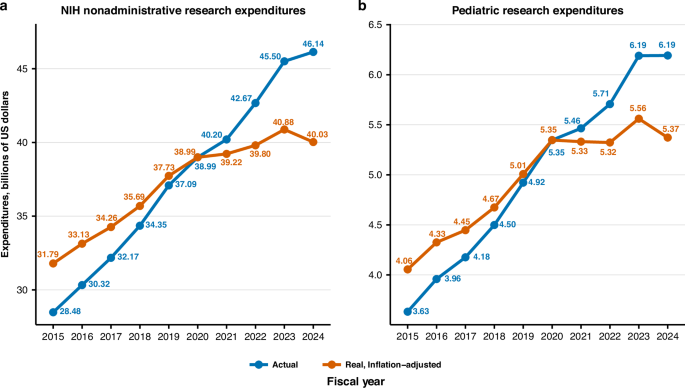
NIH research expenditures, excluding administrative costs, increased 62% in nominal terms from FY2015 ($28.5 billion) to FY2024 ($46.1 billion), but only 26% in inflation-adjusted dollars, and real spending largely plateaued after FY2020 (Fig. 1). Pediatric research expenditures also increased, growing 70% in nominal terms ($3.5–$6.2 billion) and 32% in real terms, with similar plateauing after FY2020. The number of NIH-funded pediatric research projects grew from 9079 in FY2015 to 12,527 in FY2024, a 38% increase. Inflation-adjusted funding per pediatric research project declined from $455,000 in FY2020 to $429,000 in FY2024.
a Shows trends in total NIH research expenditures excluding administrative costs from fiscal year (FY) 2015 through FY2024, using data from the NIH Office of Budget. b Displays total NIH pediatric research expenditures over the same period, based on data from the Research, Condition, and Disease Categorization (RCDC) system. In both panels, blue lines represent actual (nominal) annual expenditures, and orange lines represent inflation-adjusted expenditures calculated using the NIH Biomedical Research and Development Price Index (BRDPI).
Over the study period, pediatric research consistently accounted for approximately 13% of NIH nonadministrative expenditures (Fig. 2), even as children and adolescents <18 years old comprised roughly 22% of the US population. In FY2024, total NIH pediatric research expenditures represented approximately $87 per child under 18 years of age in the United States. Intramural research accounted for 9–11% of total NIH pediatric research expenditures over this period, with extramural grants and contracts comprising the remaining 89–91%.
The trend line illustrates pediatric research expenditures as a percentage of total NIH research expenditures excluding administrative costs for FY2015 through FY2024. Annual proportions were calculated by dividing total pediatric research expenditures (from the NIH Research, Condition, and Disease Categorization [RCDC] system) by total NIH nonadministrative research expenditures (from the NIH Office of Budget)
Distribution of pediatric research across NIH
All 25 NIH components that support research funded pediatric research during the study period. Funding was concentrated among five Institutes—NICHD (17%), NCI (11%), NHLBI (10%), NIMH (10%), and NIAID (9%)—which collectively accounted for 57% of total pediatric research expenditures from FY2015 through FY2024 (Fig. 3). No major pediatric health condition category was funded exclusively by a single component, reflecting the cross-cutting nature of the pediatric research portfolio across NIH. The proportion of each component’s overall research budget devoted to pediatric research varied widely. NICHD allocated the largest share (60%), substantially exceeding all other components; the next highest allocations were from the NIMH (26%), NIDCR (26%), NIAAA (25%), and NIMHD (21%).
Bars (left y-axis) represent total pediatric research expenditures in US dollars aggregated across FY2015–2024. Points (right y-axis) indicate pediatric research spending as a percentage of each component’s total budget over the same period. Pediatric expenditure data were obtained from the RCDC system, and total budget data were obtained from the NIH Office of Budget. Components are grouped into five tiers based on total pediatric research funding across the study period, with Tier 1 representing the highest cumulative funding and Tier 5 the lowest. Tier 1 (teal) represents NICHD; Tier 2 (orange) includes the next largest pediatric funders; Tier 3 (purple), Tier 4 (pink), and Tier 5 (green) reflect progressively smaller contributors to pediatric research from FY2015–2024.
NICHD’s role
Despite consistently devoting 58–60% of its annual budget to pediatric research—the highest proportion of any component—NICHD accounted for only 17% of total NIH pediatric research expenditures and 4% of overall NIH nonadministrative spending (Fig. 4). In FY2024, NICHD’s pediatric portfolio totaled $998 million, the largest of any component, yet its share of NIH-wide pediatric funding remained stable across the decade
The pink line represents the percentage of total NIH nonadministrative research expenditures funded by the NICHD from FY2015–2024. The green line depicts NICHD’s share of total NIH pediatric research spending over the same period. Pediatric research expenditure data were obtained from the RCDC system, and total NIH nonadministrative research expenditure data were obtained from the NIH Office of Budget
RCDC pediatric category audit findings
In the stratified random audit of 200 NIH projects classified in the RCDC Pediatric category across FY2015–2024, 12 projects (6%) lacked publicly available evidence of pediatric research based on their title, abstract, and public health relevance statement in NIH RePORTER. These apparently misclassified projects clustered around maternal health studies conducted during pregnancy in which descriptions did not indicate assessment of fetal, infant, child, adolescent, or young adult outcomes. This low discordance rate suggests that the RCDC pediatric category has acceptable validity for NIH-wide portfolio reporting.
Among the 188 projects with evidence of pediatric relevance, 83 (44%) had a basic-science component, defined as research not involving direct human participants data collection, such as studies in animal models or cell lines, and 94 (50%) explicitly indicated enrollment of participants ≤21 years old. The remaining projects addressed pediatric health through approaches not clearly described as enrolling pediatric participants, such as studies focused on maternal health during or after pregnancy, interventions targeting emerging adults ages 18–25, or research where pediatric relevance was not evident from the study description.
Discussion
This study provides an empirical assessment of NIH pediatric research funding, spanning a decade of expenditure data across the full complement of NIH research-funding components and including a formal audit of the RCDC classification system used for public reporting. The central finding is one of structural stability rather than deliberate investment: pediatric research has comprised approximately 13% of NIH nonadministrative spending throughout FY2015–2024, a proportion that has persisted even as NIH nominal expenditures grew by 62% and even as accumulating evidence has documented worsening child health trends and clear long-term societal returns of early investment. In addition, pediatric research investments adjusted for inflation stagnated after FY2020. Because the number of pediatric research projects is increasing, the purchasing power of each project has decreased over the last 5 years.
The gap between the share of children in the US population (22%) and the research investment (13%) has endured across a decade of substantial NIH budget growth. Prior evidence indicates that this gap dates back to at least 1992,10,11,12,13 suggesting that this reflects an entrenched structural pattern rather than a transient funding anomaly—one unlikely to close through overall NIH budget growth alone. That this pattern persists at a moment of organizational and budgetary uncertainty at NIH makes the empirical baseline established here even more critical for future monitoring.
These findings are difficult to reconcile with the scientific rationale for prioritizing pediatric research. A substantial body of evidence establishes that the origins of many adult chronic conditions lie in early life, when environmental exposures shape developing metabolic, immune, cardiovascular, and neurological systems in ways that persist across the lifespan.8 Pediatric research is not just an investment in children, although that is critically important, it is also an investment in the entire population across the lifespan. Returns from this research accrue to the 22% of current children and 100% of all future adults, who will have benefited from the work. A paucity of investment during childhood, when development of biobehavioral systems is most rapid, forfeits the best opportunity we have for preventing disease, intervening at its origins rather than just managing its consequences in adulthood.
All NIH components (i.e., Institutes, Centers, and the Office of the Director) that fund research include pediatric projects, indicative of a broad engagement in child health research. However, the marked variation in pediatric funding across components indicates a highly distributed portfolio without a clearly coordinated NIH-wide strategy.18 The wide variation in the proportion of each component’s budget devoted to pediatric research—from 60% at NICHD to single digits at many institutes—reflects individual mission priorities rather than a shared trans-NIH framework for advancing child health.18 This pattern is not inherently problematic: NIH components appropriately support pediatric research that aligns with their scientific missions, including pediatric cancer research at NCI and pediatric mental health research at NIMH. No major pediatric health condition category is funded exclusively by any single component, underscoring both the cross-cutting nature of the portfolio and the limitations of relying on individual institute or center priorities to ensure comprehensive, non-duplicative coverage across the full spectrum of child health needs. Our findings, however, suggest that these distributed investments are not currently organized through a comparably visible trans-NIH framework to identify gaps, reduce unnecessary duplication, and align priorities across the full spectrum of pediatric health needs.
This absence is particularly consequential for life course science. Because the developmental origins of adult disease link early life and later health as a continuum, research that spans the continuum does not fit neatly within a research portfolio organized around organ systems, diseases, or discrete life stages. The Environmental influences on Child Health Outcomes (ECHO) Program is a notable counterexample. Launched by the NIH Office of the Director in 2016, ECHO has harmonized about 70 existing cohorts into a single national resource that follows children from fetal life forward, which demonstrates that NIH can indeed mount developmentally framed research at scale.23 ECHO is a research program, however, not a coordinating mechanism. Its endpoints remain pediatric rather than extending into adult disease, and it carries no mandate to align priorities across components or to ensure that other large-scale initiatives incorporate a life course perspective. Its continuity depends on periodic re-competition rather than a standing institutional commitment. That ECHO is housed in the Office of the Director does, however, establish a useful precedent for where such a mechanism could reside. No NIH component currently holds responsibility for the life course developmental continuum itself, and the agency therefore lacks a durable means of ensuring that the developmental origins of adult health shape how NIH sets priorities and structures large-scale initiatives.
NIH has established coordination models for other cross-cutting research priorities—HIV/AIDS, cancer, and the BRAIN Initiative among them. A comparably resourced trans-NIH mechanism for pediatric research is clearly precedented. The NIH Pediatric Research Consortium (N-PeRC), created in 2018 for precisely this purpose, currently functions on volunteer effort without dedicated resources. The NASEM committee (Recommendation 4-2) calls specifically for elevating N-PeRC to the NIH Office of the Director, with representation from senior leaders in each component holding pediatric health and life course expertise, dedicated infrastructure funding and personnel, and a mandate to coordinate pediatric research across trans-NIH initiatives and ensure that large-scale programs integrate pediatric and life-course perspectives from the outset.18 This recommendation is both specific and immediately actionable, and its implementation would provide the institutional infrastructure that coordinated pediatric research currently lacks.
NICHD occupies a distinctive position in the NIH pediatric research enterprise. It devotes a larger share of its budget to pediatric research than any other component—consistently 58%–60% across the decade—and functions as the de facto institutional home for pediatric scientific expertise at NIH. Because NICHD’s total appropriation represents only 4% of NIH nonadministrative spending, even its maximal commitment cannot materially move the agency-wide proportion devoted to pediatric research. This structural arithmetic is underscored by the per-project funding trend: even as NICHD and other components increased nominal pediatric expenditures, real funding per project declined 6% over four years as the number of funded projects grew faster than inflation-adjusted budgets. The implication is that distributing more projects across a nominally growing but real-dollar-stagnant portfolio may not be equivalent to building research capacity. Strengthening NIH pediatric research investment may require both sustained support for NICHD and greater pediatric research commitment across larger NIH components with greater influence on the agency-wide portfolio.16
The RCDC audit suggests that the pediatric category is reasonably accurate for NIH-wide portfolio reporting, and a 6% misclassification rate is unlikely to materially change decade-scale trend estimates. The pattern of misclassification, however, was also informative: apparent errors clustered around maternal health studies in which public-facing descriptions did not document assessment of fetal, infant, or child outcomes, highlighting a boundary problem at the maternal-perinatal interface. This finding points to a broader limitation of the current classification approach: without a more explicit agency-wide definition of pediatric research, NIH may have difficulty consistently tracking the full pediatric portfolio and distinguishing among basic, translational, clinical, and life-course research domains.19 This boundary problem is addressable. The NASEM committee (Recommendation 3-2) also calls for NIH to evaluate the validity of the RCDC Pediatric category, improve its transparency and specificity, add developmental-stage subcategories, and publish a reference document describing the classification methodology in sufficient detail to support external replication.18 A practical near-term step toward resolving the maternal-perinatal misclassification pattern would be to require that projects assigned to the RCDC Pediatric category include explicit documentation of pediatric outcomes or pediatric relevance in their public-facing descriptions—a change that would also improve the reliability of pediatric portfolio tracking across basic, translational, and clinical domains.
A few study limitations are worth noting. First, this analysis relied on the NIH RCDC system as the primary classification approach, which reflects NIH public reporting conventions, rather than investigator self-classification or independent portfolio review. Second, the study period ended with FY2024 and did not capture subsequent budgetary changes or organizational developments at NIH. Third, the descriptive analyses were intended to characterize funding patterns and portfolio structure and cannot determine whether observed levels or distributions of pediatric research funding were appropriate relative to scientific opportunity, disease burden, or public health need. Fourth, although the audit demonstrated generally reasonable accuracy, ambiguity persisted in borderline cases, particularly at the maternal–perinatal interface, precluding definitive classification. Fifth, the audit relied on publicly available NIH RePORTER records, so some apparent misclassification may reflect incomplete public-facing project descriptions rather than true classification error. Sixth, the audit was designed to assess the classification accuracy of projects assigned to the RCDC Pediatric category—that is, to detect non-pediatric projects that may have been incorrectly included. It was not designed to identify pediatric research projects that may have been assigned to non-pediatric RCDC categories and therefore excluded from the Pediatric category. The extent of any such under-classification remains unknown, and the true scope of NIH-funded pediatric research may be broader than RCDC reporting captures. Last, the audit was conducted by a single pediatric expert reviewer without a second reviewer to document coding validity through analysis of inter-rater reliability.
Conclusion
Pediatric research consistently accounted for about 13% of NIH spending from FY2015 through FY2024, extending a pattern of proportional stagnation described in prior work since 1992, and of under-investment in relation to the approximately 22% of Americans who are children. These findings suggest that recent growth in NIH spending has not been accompanied by an increase in the share devoted to pediatric research, and that the pediatric portfolio remains structurally distributed across NIH components. These results support consideration of more deliberate NIH-wide coordination, clearer pediatric accountability across Institutes and Centers, and improved portfolio measurement to better track pediatric research across basic, translational, and clinical domains. The NASEM committee’s recommendations18 provide a specific policy framework for near-term action, and the present study offers a peer-reviewed empirical baseline against which future change can be assessed.
Data availability
The datasets analyzed during the current study are drawn from publicly available. The linked analytic dataset is available from the corresponding author on reasonable request
References
Forrest, C. B., Koenigsberg, L. J., Eddy Harvey, F., Maltenfort, M. G. & Halfon, N. Trends in US children’s mortality, chronic conditions, obesity, functional status, and symptoms. JAMA334, 509–516 (2025)
Kessler, R. C. et al. Age of onset of mental disorders: a review of recent literature. Curr. Opin. Psychiatry20, 359–364 (2007)
McGrath, J. J. et al. Age of onset and cumulative risk of mental disorders: a cross-national analysis of population surveys from 29 countries. Lancet Psychiatry10, 668–681 (2023)
Merikangas, K. R. et al. Lifetime prevalence of mental disorders in U.S. adolescents: results from the national comorbidity survey replication–adolescent supplement (Ncs-a). J. Am. Acad. Child Adolesc. Psychiatry49, 980–989 (2010)
Llewellyn, A., Simmonds, M., Owen, C. G. & Woolacott, N. Childhood obesity as a predictor of morbidity in adulthood: a systematic review and meta-analysis. Obes. Rev.17, 56–67 (2016)
Umer, A. et al. Childhood obesity and adult cardiovascular disease risk factors: a systematic review with meta-analysis. BMC Public Health17, 683 (2017)
Gitterman, D. P., Hay, W. W. Jr. & Langford, W. S. Making the case for pediatric research: a life-cycle approach and the return on investment. Pediatr. Res. 93, 797–800 (2023)
Halfon, N. & Forrest, C. B. In Handbook of Life Course Health Development (Halfon, N., Forrest, C. B., Lerner, R. M. & Faustman, E. M. eds) 19–43 (Springer, 2018)
Flores, G. & Lesley, B. Children and U.S. federal policy on health and health care: seen but not heard. JAMA Pediatr.168, 1155–1163 (2014)
Gitterman, D. P. & Hay, W. W. Jr. That sinking feeling, again? The state of national institutes of health pediatric research funding, fiscal year 1992-2010. Pediatr. Res.64, 462–469 (2008)
Gitterman, D. P., Langford, W. S. & Hay, W. W. Jr. The uncertain fate of the National Institutes of Health (NIH) Pediatric Research Portfolio. Pediatr. Res.84, 328–332 (2018)
Gitterman, D. P., Langford, W. S. & Hay, W. W. Jr. The fragile state of the National Institutes of Health Pediatric Research Portfolio, 1992-2015: doing more with less?JAMA Pediatr.172, 287–293 (2018)
Hay, W. W. Jr. et al. Child Health Research Funding and policy: imperatives and investments for a healthier world. Pediatrics125, 1259–1265 (2010)
Rees, C. A., Monuteaux, M. C., Herdell, V., Fleegler, E. W. & Bourgeois, F. T. Correlation between National Institutes of Health Funding for Pediatric Research and Pediatric Disease Burden in the US. JAMA Pediatr.175, 1236–1243 (2021)
Bourgeois, F. T., Olson, K. L., Ioannidis, J. P. & Mandl, K. D. Association between pediatric clinical trials and global burden of disease. Pediatrics133, 78–87 (2014)
Boat, T. F. & Whitsett, J. A. How can the pediatric community enhance funding for child health research? JAMA Pediatr.175, 1212–1214 (2021)
Speer, E. M. et al. The state and future of pediatric research-an introductory overview: the state and future of pediatric research series. Pediatr. Res. 24, 1–5 (2023)
Committee on Strategies to Enhance Pediatric Health Research Funded by NIH. Strategies to Enhance NIH-Funded Pediatric Research: Optimizing Child Health (2026)
Forrest, C. B., Jeste, J. S. & Shah, S. K. NIH-Funded Pediatric Research. JAMA Pediatr.180, 817–818 (2026)
NIH RePORT: Research Portfolio Online Reporting Tools. Rcdc: Categorization Process, https://report.nih.gov/funding/categorical-spending/rcdc-process
National Institutes of Health. Office of Budget, https://officeofbudget.od.nih.gov/
National Institutes of Health Office of Budget. Brdpi Projection Memo Fy 2025 to Fy 2030, https://officeofbudget.od.nih.gov/pdfs/FY26/gbiPrice/BRDPI%20Projection%20Memo%20FY%202025%20to%20FY%202030%20March%202025.pdf (2025)
Blaisdell, C. J. et al. The NIH ECHO program: investigating how early environmental influences affect child health. Pediatr. Res.92, 1215–1216 (2022)
Acknowledgements
We thank the members of the consensus committee who authored the NASEM report, community members who provided their input at various stages of the process, and the NASEM staff
Funding
Analysis of the data in this manuscript was supported by institutional funds from the Children’s Hospital of Philadelphia. The funder for the data analysis portion of this work had no role in the design, conduct, analysis, or dissemination of the work reported in this manuscript
Author information
Authors and Affiliations
Department of Pediatrics, Children’s Hospital of Philadelphia, Philadelphia, PA, USA
Christopher B. Forrest & Lauren J. Koenigsberg
Office of the Vice President for Research, The University of Iowa, Iowa City, IA, USA
David C. Schwebel
Stead Family Department of Pediatrics, The University of Iowa, Iowa City, IA, USA
Alexander G. Bassuk
Department of Pediatrics, The Warren Alpert Medical School of Brown University, Providence, RI, USA
Phyllis A. Dennery
Department of Pediatrics, University of Miami Miller School of Medicine, Miami, FL, USA
Glenn Flores
Department of Pediatrics, Emory University School of Medicine and Children’s Healthcare of Atlanta, Atlanta, GA, USA
Kristy O. Murray
Center for Health, People, and Places, National Academies of Sciences, Engineering, and Medicine, Washington, DC, USA
Udara Perera
Department of Pediatrics, University of Washington and Seattle Children’s Research Institute, Seattle, WA, USA
Frederick P. Rivara
Department of Pediatrics, Cincinnati Children’s Hospital Medical Center, Cincinnati, OH, USA
Leah C. Kottyan
Authors
- Christopher B. ForrestView author publications
Search author on:PubMed Google Scholar
- Lauren J. KoenigsbergView author publications
Search author on:PubMed Google Scholar
- David C. SchwebelView author publications
Search author on:PubMed Google Scholar
- Alexander G. BassukView author publications
Search author on:PubMed Google Scholar
- Phyllis A. DenneryView author publications
Search author on:PubMed Google Scholar
- Glenn FloresView author publications
Search author on:PubMed Google Scholar
- Kristy O. MurrayView author publications
Search author on:PubMed Google Scholar
- Udara PereraView author publications
Search author on:PubMed Google Scholar
- Frederick P. RivaraView author publications
Search author on:PubMed Google Scholar
- Leah C. KottyanView author publications
Search author on:PubMed Google Scholar
Contributions
C.B.F. was responsible for study conception and design, acquisition, analysis, and interpretation of data, drafting of the manuscript, statistical analysis, and supervision of the project. L.J.K. contributed to data acquisition, analysis, and interpretation, statistical support, and drafting and critical revision of the manuscript. D.C.S. contributed to study design, interpretation of data, and critical revision of the manuscript. A.G.B. contributed to interpretation of data and critical revision of the manuscript. P.A.D. contributed to study design, interpretation of data, and critical revision of the manuscript. G.F. contributed to interpretation of data and critical revision of the manuscript. K.O.M. contributed to acquisition and interpretation of data and critical revision of the manuscript. U.P. contributed to acquisition and interpretation of data and administrative and technical support, and critical revision of the manuscript. F.P.R. contributed to interpretation of data, supervision, and critical revision of the manuscript. L.C.K. contributed to study design, data analysis, interpretation of data, and critical revision of the manuscript. C.B.F. had full access to all data in the study and takes responsibility for the integrity of the data and accuracy of the analysis. Data analyses were conducted by C.B.F. and L.J.K. (Children’s Hospital of Philadelphia). All authors approved the final manuscript and agreed to be accountable for all aspects of the work.
Ethics declarations
Competing interests
The authors declare no competing interests
Ethical approval
This study utilized publicly available NIH expenditure data. As the study did not involve human participants and all data were anonymized prior to analysis, Institutional Review Board approval was not required
Additional information
Publisher’s note Springer Nature remains neutral with regard to jurisdictional claims in published maps and institutional affiliations
Rights and permissions
Open Access This article is licensed under a Creative Commons Attribution 4.0 International License, which permits use, sharing, adaptation, distribution and reproduction in any medium or format, as long as you give appropriate credit to the original author(s) and the source, provide a link to the Creative Commons licence, and indicate if changes were made. The images or other third party material in this article are included in the article’s Creative Commons licence, unless indicated otherwise in a credit line to the material. If material is not included in the article’s Creative Commons licence and your intended use is not permitted by statutory regulation or exceeds the permitted use, you will need to obtain permission directly from the copyright holder. To view a copy of this licence, visit http://creativecommons.org/licenses/by/4.0/.
About this article
Cite this article
Forrest, C.B., Koenigsberg, L.J., Schwebel, D.C. et al. Recent trends and structural patterns in NIH pediatric research funding, 2015–2024.
Pediatr Res (2026). https://doi.org/10.1038/s41390-026-05379-5
Received:26 May 2026
Revised:17 July 2026
Accepted:24 July 2026
Published:13 August 2026
Version of record:13 August 2026
DOI
:https://doi.org/10.1038/s41390-026-05379-5
