


Abstract
Background
Despite the effectiveness of lifestyle multidisciplinary (LMD) weight loss interventions in pediatric obesity, outcomes remain variable between individuals. Machine learning (ML), capable of capturing complex relationships between variables, offer a promising avenue to better understand and predict this variability
Methods
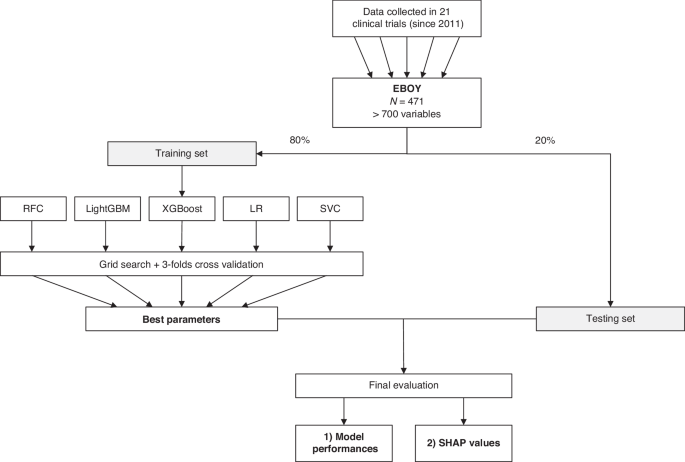
This study aimed to identify baseline predictors of 9-month LMD success in adolescents with obesity. A pooled database of 471 adolescents (42.9% males, 13.6 ± 1.4 years, BMI z-score 3.06 ± 0.51) from 21 clinical trials was used. Five ML models (Random Forest (RFC), XGBoost, LightGBM, Logistic Regression, and Support Vector Machine) were developed and evaluated to predict treatment response using both binary and multiclass classification
Results
Mean BMI z-score reduction at 9 months was −0.53 ± 0.34. For binary classification, RFC achieved the highest performance (accuracy = 0.97; AUC-ROC = 0.97). For multiclass prediction, XGBoost performed best (accuracy = 0.80; AUC-ROC = 0.90)
Conclusion
The most influential predictors consistently belonged to two main domains: (1) functional aptitudes, (e.g. forced vital capacity, maximal aerobic power, vertical jump height, resting VO2) and (2) dietary profiles (e.g. total energy intake, protein intake, hunger/fullness scores). Metabolic markers (eg. Insulin, cholesterol) also contributed to multiclass prediction. ML shows promise for personalizing adolescent weight loss strategies and deserves further study
Impact
While many fields of healthcare utilize artificial intelligence-based (AI) methods to achieve personalized and patient-centered care, these methods remain underexplored in the field of pediatric obesity
Identifying baseline predictors of lifestyle multidisciplinary weight loss interventions (LMD) would further improve the effectiveness of such interventions, currently hindered by inter-individual variability in response to treatment
Machine learning models were successful in predicting LMD’s success in adolescents with obesity with high accuracy, and uncovered a novel, promising dietary factors
Machine learning is a promising tool for personalization of weight management strategies in the field of pediatric obesity
This is a preview of subscription content, access
Access options
Access through your institution
- Purchase on SpringerLink
- Instant access to the full article PDF.
39,95 €
Prices may be subject to local taxes which are calculated during checkout
Data availability
The datasets generated and analyzed during the current study and analytical code are available from the corresponding author on reasonable request
References
Phelps, N. H. et al. Worldwide trends in underweight and obesity from 1990 to 2022: a pooled analysis of 3663 population-representative studies with 222 million children, adolescents, and adults. Lancet403, 1027–1050 (2024)
Herman, K. M., Craig, C. L., Gauvin, L. & Katzmarzyk, P. T. Tracking of obesity and physical activity from childhood to adulthood: the physical activity longitudinal study. Int. J. Pediatr. Obes.4, 281–288 (2009)
Lindberg, L., Danielsson, P., Persson, M., Marcus, C. & Hagman, E. Association of childhood obesity with risk of early all-cause and cause-specific mortality: a Swedish prospective cohort study. PLOS Med.17, e1003078 (2020)
Maffeis, C. et al. The treatment of obesity in children and adolescents: consensus position statement of the Italian society of pediatric endocrinology and diabetology, Italian Society of Pediatrics and Italian Society of Pediatric Surgery. Ital. J. Pediatr. 49, 69 (2023)
Kushner, R. F. Weight loss strategies for treatment of obesity: lifestyle management and pharmacotherapy. Prog. Cardiovasc. Dis.61, 246–252 (2018)
Jung, H. W. Current options in obesity pharmacotherapy for children and adolescents. Precis. Future Med.8, 38–49 (2024)
Fay, C. et al. Keys to achieving clinically important weight loss: perceptions of responders and nonresponders in the clinic and community approaches to healthy weight trial. Child. Obes.19, 507–514 (2023)
Wei, C., Candler, T., Crowne, E. & Hamilton-Shield, J. P. Interval outcomes of a lifestyle weight-loss intervention in early adolescence. Children5, 77 (2018)
Zoh, R. S. et al. Design, analysis, and interpretation of treatment response heterogeneity in personalized nutrition and obesity treatment research. Obes. Rev. 24, e13635 (2023)
Bini, S. A. Artificial intelligence, machine learning, deep learning, and cognitive computing: what do these terms mean and how will they impact health care? J. Arthroplasty33, 2358–2361 (2018)
Li, P., Stuart, E. A. & Allison, D. B. Multiple imputation: a flexible tool for handling missing data. JAMA314, 1966 (2015)
Poalelungi, D. G. et al. Advancing patient care: how artificial intelligence is transforming healthcare. J. Pers. Med.13, 1214 (2023)
Glasbrenner, C. et al. Prediction of individual weight loss using supervised learning: findings from the CALERIETM 2 study. Am. J. Clin. Nutr.120, 1233–1244 (2024)
Dinov, I. D. Volume and value of big healthcare data. J. Med. Stat. Inform.4, 3 (2016)
Liu, X. et al. Reporting guidelines for clinical trial reports for interventions involving artificial intelligence: the CONSORT-AI extension. Nat. Med.26, 1364–1374 (2020)
Moore, H. et al. The association between obesity severity and food reward in adolescents with obesity: a one-stage individual participant data meta-analysis. Eur. J. Nutr.63, 1241–1255 (2024)
Zhang, Z. Multiple imputation with multivariate imputation by chained equation (MICE) package. Ann. Transl. Med.4, 30 (2016)
Junaid, K. P., Kiran, T., Gupta, M., Kishore, K. & Siwatch, S. How much missing data is too much to impute for longitudinal health indicators? A preliminary guideline for the choice of the extent of missing proportion to impute with multiple imputation by chained equations. Popul. Health Metr. 23, 2 (2025)
Biering, K., Hjollund, N. H. & Frydenberg, M. Using multiple imputation to deal with missing data and attrition in longitudinal studies with repeated measures of patient-reported outcomes. Clin. Epidemiol. 91, https://doi.org/10.2147/CLEP.S72247 (2015)
Mühlig, Y., Wabitsch, M., Moss, A. & Hebebrand, J. Weight Loss in Children and Adolescents. Dtsch. Ärztebl. Int. (2014) https://doi.org/10.3238/arztebl.2014.0818
Cox, D. R. The regression analysis of binary sequences. J. R. Stat. Soc. Ser. B Stat. Methodol.20, 215–232 (1958)
Ho, T. K. Random decision forests. in Proc. 3rd International Conference on Document Analysis and Recognition vol. 1 278–282 (IEEE Comput. Soc. Press, 1995)
Ke, G. et al. LightGBM: a highly efficient gradient boosting decision tree. in Advances in Neural Information Processing Systems (eds Guyon, I. et al.) vol. 30 (Curran Associates, Inc., 2017)
Chen, T. & Guestrin, C. XGBoost: a scalable tree boosting system. In Proc. 22nd ACM SIGKDD International Conference on Knowledge Discovery and Data Mining 785–794 (ACM, 2016)
Cortes, C. & Vapnik, V. Support-vector networks. Mach. Learn.20, 273–297 (1995)
Lundberg, S. M. & Lee, S.-I. A Unified Approach to Interpreting Model Predictions. in Advances in Neural Information Processing Systems (eds Guyon, I. et al.) vol. 30 (Curran Associates, Inc., 2017)
Pedregosa, F. et al. Scikit-learn: Machine Learning in Python. J. Mach. Learn. Res. 12, 2825–2830 (2011)
Alowais, S. A. et al. Revolutionizing healthcare: the role of artificial intelligence in clinical practice. BMC Med. Educ.23, 689 (2023)
Kuhlemeier, A. et al. Personalized predictions to identify individuals most likely to achieve 10% weight loss with a lifestyle intervention. Obesity33, 861–869 (2025)
Yang, H.-W. et al. Uncovering key factors in weight loss effectiveness through machine learning. Int. J. Obes.49, 1189–1199 (2025)
Colmenarejo, G. Machine learning models to predict childhood and adolescent obesity: a review. Nutrients12, 2466 (2020)
Triantafyllidis, A. et al. Computerized decision support and machine learning applications for the prevention and treatment of childhood obesity: A systematic review of the literature. Artif. Intell. Med.104, 101844 (2020)
Öksüz, N., Kowatsch, T. & Shcherbatyi, I. A. Data-analytical system to predict therapy success for obese children. German Research Center for Artificial Intelligence (2018)
Tsiros, M. D. et al. Obesity, the new childhood disability? An umbrella review on the association between adiposity and physical function. Obes. Rev.21, e13121 (2020)
Allali, B. et al. The effectiveness of multidisciplinary weight loss interventions is associated with initial cardiorespiratory fitness in adolescents with obesity. Pediatr. Obes.19, e13147 (2024)
Cowley, J. C., McCaw, S. T., Laurson, K. R. & Torry, M. R. Children who are overweight display altered vertical jump kinematics and kinetics from children who are not overweight. Pediatr. Exerc. Sci.32, 2–8 (2020)
O’Malley, G. C., Shultz, S. P., Thivel, D. & Tsiros, M. D. Neuromusculoskeletal health in pediatric obesity: incorporating evidence into clinical examination. Curr. Obes. Rep.10, 467–477 (2021)
Fillon, A. et al. Usefulness of the satiety quotient in a clinical pediatric obesity context. Eur. J. Clin. Nutr.74, 930–937 (2020)
Miguet, M. et al. Cognitive restriction accentuates the increased energy intake response to a 10-month multidisciplinary weight loss program in adolescents with obesity. Appetite134, 125–134 (2019)
Casanova, N., Beaulieu, K., Finlayson, G. & Hopkins, M. Metabolic adaptations during negative energy balance and their potential impact on appetite and food intake. Proc. Nutr. Soc.78, 279–289 (2019)
Hughes, C. M. L., Zhang, Y., Pourhossein, A. & Jurasova, T. A comparative analysis of binary and multi-class classification machine learning algorithms to detect current frailty status using the English longitudinal study of ageing (ELSA). Front. Aging6, 1501168 (2025)
Ibrahim, S. A. & Pronovost, P. J. Diagnostic errors, health disparities, and artificial intelligence: a combination for health or harm? JAMA Health Forum2, e212430 (2021)
Kambach, S. et al. Consequences of multiple imputation of missing standard de9–11712 (2020)
Alves Junior, C. A., Mocellin, M. C., Gonçalves, E. C. A., Silva, D. A. & Trindade, E. B. Anthropometric indicators as body fat discriminators in children and adolescents: a systematic review and meta-analysis. Adv. Nutr.8, 718–727 (2017)
Ross, R. & Bradshaw, A. J. The future of obesity reduction: beyond weight loss. Nat. Rev. Endocrinol.5, 319–325 (2009)
Sherifali, D. et al. Missing the target: a scoping review of the use of percent weight loss for obesity management. Obes. Rev. e13960 https://doi.org/10.1111/obr.13960 (2025)
Acknowledgements
The authors want to thank the participants who completed the study and the CMI Romagnat and SSR Tzanou pediatric clinics for their contribution
Funding
This research has been supported through the Clermont Auvergne University I-SITE CIR-3 grant
Author information
Authors and Affiliations
Laboratory of the Metabolic Adaptations to Exercise under Physiological and Pathological Conditions (AME2P), Centre de Recherche en Nutrition Humaine, Clermont Auvergne University, Clermont-Ferrand, France
Andrea Gaucherot, Duane Beraud, Paul Lonjou, Laurie Isacco & David Thivel
Academic Center of Vitoria, Federal University of Pernambuco, Vitoria de Santo Antao, Brazil
Virgínia Carol Leandro Góis
CHU Clermont-Ferrand, 63000 Clermont-Ferrand, France; Department of Sport Medicine, functional and respiratory rehabilitation, CHU Clermont-Ferrand, Clermont-Ferrand, France
Valérie Julian & Martine Duclos
CRNH, INRAE, Unité de Nutrition Humaine, Clermont Auvergne University, Auvergne, Clermont-Ferrand, France
Valérie Julian, Martine Duclos & Yves Boirie
International Research Chair Health in Motion, Clermont Auvergne University Foundation, Clermont-Ferrand, France
Martine Duclos, Christelle Guillet, Laurie Isacco & David Thivel
Department of Human Nutrition, CHU Clermont-Ferrand, Clermont-Ferrand, France
Yves Boirie
Biostatistics Unit, DRCI, CHU Clermont-Ferrand, Clermont-Ferrand, France
Bruno Pereira
Authors
- Andrea GaucherotView author publications
Search author on:PubMed Google Scholar
- Duane BeraudView author publications
Search author on:PubMed Google Scholar
- Paul LonjouView author publications
Search author on:PubMed Google Scholar
- Virgínia Carol Leandro GóisView author publications
Search author on:PubMed Google Scholar
- Valérie JulianView author publications
Search author on:PubMed Google Scholar
- Martine DuclosView author publications
Search author on:PubMed Google Scholar
- Christelle GuilletView author publications
Search author on:PubMed Google Scholar
- Yves BoirieView author publications
Search author on:PubMed Google Scholar
- Laurie IsaccoView author publications
Search author on:PubMed Google Scholar
- Bruno PereiraView author publications
Search author on:PubMed Google Scholar
- David ThivelView author publications
Search author on:PubMed Google Scholar
Contributions
T.D. and B.P. designed the study; P.L., A.G., and D.B. managed the database and data quality process; A.G., B.P., and T.d. analyzed the data; T.D., I.L., M.D., Y.B., and B.P. are investigators of the database; A.G. and T.D. edited the first draft; V.J., C.G.L., I.S., G.C., and D.M. reviewed the results and the manuscript. All authors significantly contributed to the realization of this work
Ethics declarations
Competing interests
The authors declare no competing interests
Consent for publication
Patients’ consent was collected during each intervention they participated in
Additional information
Publisher’s note Springer Nature remains neutral with regard to jurisdictional claims in published maps and institutional affiliations
Supplementary information
Supplementary information (download PDF )
Supplementary Table S1 (download XLSX )
Supplementary Table S3 (download XLSX )
Rights and permissions
Springer Nature or its licensor (e.g. a society or other partner) holds exclusive rights to this article under a publishing agreement with the author(s) or other rightsholder(s); author self-archiving of the accepted manuscript version of this article is solely governed by the terms of such publishing agreement and applicable law
About this article
Cite this article
Gaucherot, A., Beraud, D., Lonjou, P. et al. Identification of weight loss predictors using machine learning approaches in adolescents with obesity.
Pediatr Res (2026). https://doi.org/10.1038/s41390-026-05359-9
Received:29 September 2025
Revised:18 March 2026
Accepted:07 July 2026
Published:13 August 2026
Version of record:13 August 2026
DOI
:https://doi.org/10.1038/s41390-026-05359-9
