


Abstract
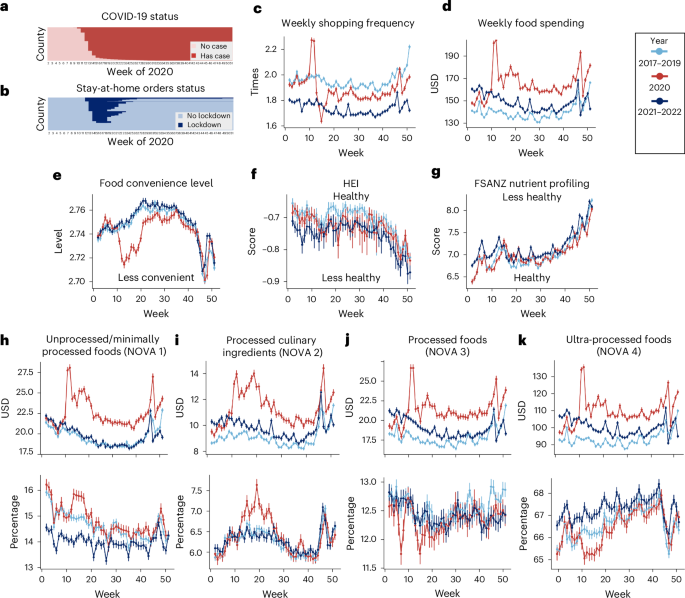
The coronavirus 2019 pandemic disrupted food purchasing behaviours, triggering both short- and long-term nutritional shifts. Here, analysing 9,367,550 weekly shopping baskets from over 30,000 US households (2017–2022), combined with county-specific policies and artificial intelligence-enhanced nutrition profiling, we document distinct changes in household food baskets. During the pandemic and lockdowns, households increased spending on less processed foods, but by the post-pandemic period, spending on ultraprocessed foods rose above pre-pandemic levels. This divergence appeared strongly in processing-based measures (NOVA) but less in nutrient-based profiles (Healthy Eating Index and Food Standards Australia New Zealand), underscoring their complementary perspectives on diet quality. The spending gap between socioeconomic groups widened in 2020 but converged post-pandemic, while a new nutrition gap emerged as higher-income households increased spending on less nutritious foods. Categories such as prepared and frozen foods and carbonated beverages showed persistant effects. These findings highlight the pandemic’s uneven, lasting influence on dietary behaviour and the need for policies promoting healthier, more resilient food systems.
This is a preview of subscription content, access
Access options
Access through your institution
- Purchase on SpringerLink
- Instant access to the full article PDF.
39,95 €
Prices may be subject to local taxes which are calculated during checkout
Subjects
- Nutrition
- Social policy
Data availability
Publicly available data sources used in this study are listed in the References, including COVID-19 case data, county- and state-level policy data, census population data, Consumer Price Index data and public food composition databases. The primary household purchase data used in this study are restricted-use NielsenIQ Consumer Panel data accessed through the NielsenIQ Datasets at the Kilts Center for Marketing Data at the University of Chicago Booth School of Business. These third-party data are not publicly available from the authors and cannot be redistributed because they are subject to NielsenIQ/Kilts Center licensing and data-use restrictions. Qualified researchers may request access directly from the Kilts Center for Marketing Data, subject to its application, approval and data-use requirements. The FLIP-Canada food composition data used to train and validate the nutritional quality and NOVA classification models are third-party data maintained by the University of Toronto’s Food Label Information and Price Program/L’Abbé Laboratory. These data are not publicly available from the authors and cannot be redistributed because they are subject to third-party data-use restrictions. Researchers may request access through the FLIP Program/L’Abbé Laboratory access process, subject to approval and applicable data-use requirements. The minimum dataset necessary to interpret and verify the results consists of the restricted NielsenIQ household purchase data, the FLIP-Canada training data, the linked public datasets described above and the derived analytic variables generated from these sources. Because the NielsenIQ and FLIP data are subject to third-party data-use restrictions, the authors are not permitted to redistribute the underlying data or derived datasets containing restricted information. To support transparency, we provide detailed variable definitions, data-construction procedures and analysis code in the Code availability section. Publicly available input datasets are listed in the References. No additional source data are provided with this paper because the reported results are derived from restricted third-party datasets. List of datasets used and links: (1) NielsenIQ Consumer Panel Datasets, 2017–2022—restricted-use household UPC-level food purchase data available via the Kilts Center for Marketing Data at the University of Chicago Booth School of Business at https://www.chicagobooth.edu/research/kilts/research-data/nielseniq, (2) US Bureau of Labor Statistics/FRED—Consumer Price Index for All Urban Consumers: Food and Beverages in US City Average was used for inflation adjustment and available via FRED at https://fred.stlouisfed.org/series/CPIFABNS, (3) USDA FoodData Central/USDA Global BFPDB—branded food composition, nutrition and ingredient data linked to purchases by UPC is available via FDC at https://fdc.nal.usda.gov/, (4) FLIP-Canada 2017 and FLIP-Canada 2020—University of Toronto Food Label Information and Price Program/L’Abbé Laboratory food composition data used to train and validate NOVA and FSANZ prediction models available via the University of Toronto at https://labbelab.utoronto.ca/projects/food-label-information-price-flip/, (5) The New York Times Coronavirus (COVID-19) Data in the USA—county-level COVID-19 case data available via GitHub at https://github.com/nytimes/covid-19-data, (6) Hikma Health COVID-19 County-Level Policy Data—county-level stay-at-home and reopening policy data available via GitHub at https://github.com/hikmahealth/covid19countymap, (7) COVID-19 State Policies Data available via State Policies at https://statepolicies.com/ and (8) US Census County Population Totals, 2010–2019—county population data used to construct per-capita COVID severity measures available via the United States Census Bureau at https://www.census.gov/programs-surveys/popest.html.
Code availability
Custom code used to construct the analytic datasets, implement the nutrition quality and food-processing classification pipeline, conduct the statistical analyses and generate the tables and figures will be made publicly available via GitHub at https://github.com/guanlanhu/covid-food. The repository will include documentation describing the computational environment, package versions, workflow and instructions for reproducing the analyses. Because the NielsenIQ Consumer Panel data and FLIP-Canada data are restricted third-party datasets, the code repository will not include these underlying data; access to those data is governed by the data-use agreements described in the Data availability statement.
References
WHO Director-General’s Opening Remarks at the Media Briefing on COVID-19 (WHO, 2020)
Declaring a National Emergency Concerning the Novel Coronavirus Disease (COVID-19) Outbreak (Office of the Federal Register, 2020)
Elenev, V., Quintero, L. E., Rebucci, A. & Simeonova, E. Direct and Spillover Effects from Staggered Adoption of Health Policies: Evidence from COVID-19 Stay-at-Home Orders (National Bureau of Economic Research, 2021)
Afshin, A. et al. Health effects of dietary risks in 195 countries, 1990–2017: a systematic analysis for the Global Burden of Disease Study 2017. Lancet393, 1958–1972 (2019)
Wolfson, J. A. & Leung, C. W. Food insecurity and COVID-19: disparities in early effects for US adults. Nutrients12, 1648 (2020)
Wolfson, J. A. & Leung, C. W. Food insecurity during COVID-19: an acute crisis with long-term health implications. Am. J. Public Health110, 1763–1765 (2020)
Mignogna, C. et al. Impact of nationwide lockdowns resulting from the first wave of the COVID-19 pandemic on food intake, eating behaviors, and diet quality: a systematic review. Adv. Nutr.13, 388–423 (2022)
Murphy, B. et al. Changes in consumers’ food practices during the COVID-19 lockdown, implications for diet quality and the food system: a cross-continental comparison. Nutrients13, 20 (2021)
Nielsen, D. E., Karamanoglu, I., Yang Han, H., Labonté, K. & Paquet, C. Food values, food purchasing, and eating-related outcomes among a sample of Quebec adults during the COVID-19 pandemic. Can. J. Diet. Pract. Res.84.2, 69–76 (2022)
Nielsen, D. E. et al. Longitudinal patterns of food procurement over the course of the COVID-19 pandemic: findings from a Canadian online household survey. Front. Public Health9, 752204 (2022)
Ellison, B., McFadden, B., Rickard, B. J. & Wilson, N. L. Examining food purchase behavior and food values during the COVID-19 pandemic. Appl. Econ. Perspect. Policy43, 58–72 (2021)
Mendes, L. L. et al. Food environments and the COVID-19 pandemic in Brazil: analysis of changes observed in 2020. Public Health Nutr.25, 32–35 (2022)
Zeballos, E., Sinclair, W. & Park, T. Understanding the components of US food expenditures during recessionary and non-recessionary periods. Economic Research Report No. 301 (U.S. Department of Agriculture, Economic Research Service, 2021); https://doi.org/10.22004/ag.econ.316348
Janssen, M. et al. Changes in food consumption during the COVID-19 pandemic: analysis of consumer survey data from the first lockdown period in Denmark, Germany, and Slovenia. Front. Nutr.8, 635859 (2021)
Gligorić, K., Chiolero, A., Kıcıman, E., White, R. W. & West, R. Population-scale dietary interests during the COVID-19 pandemic. Nat. Commun.13, 1–14 (2022)
Monroe-Lord, L. et al. Changes in food consumption trends among American adults since the COVID-19 pandemic. Nutrients15, 1769 (2023)
McLaughlin, P. W. et al. National trends in food retail sales during the COVID-19 pandemic: findings from Information Re retail-based scanner data. COVID-19 Working Paper AP-108 (U.S. Department of Agriculture, Economic Research Service, 2022)
Ogundijo, D. A., Tas, A. A. & Onarinde, B. A. Exploring the impact of COVID-19 pandemic on eating and purchasing behaviours of people living in England. Nutrients13, 1499 (2021)
Zeballos, E. & Sinclair, W. US consumers spent more on food in 2022 than ever before, even after adjusting for inflation. Amber Waveshttps://www.ers.usda.gov/amber-waves/2023/september/u-s-consumers-spent-more-on-food-in-2022-than-ever-before-even-after-adjusting-for-inflation (USDA, 2023)
Marchesi, K. & McLaughlin, P. W. Food spending shifted in response to pandemic changes for food away from home continued through 2022. in Amber Waves: The Economics of Food, Farming, Natural Re; https://doi.org/10.22004/ag.econ.341261
Nilson, E. A. et al. Premature mortality attributable to ultraprocessed food consumption in 8 countries. Am. J. Prev. Med.68.6, 10911099 (2025)
Cordova, R. et al. Consumption of ultra-processed foods and risk of multimorbidity of cancer and cardiometabolic diseases: a multinational cohort study. Lancet Reg. Health Eur.35, 100771 (2023)
Juul, F., Vaidean, G. & Parekh, N. Ultra-processed foods and cardiovascular diseases: potential mechanisms of action. Adv. Nutr.12, 1673–1680 (2021)
Touvier, M. et al. Ultra-processed foods and cardiometabolic health: public health policies to reduce consumption cannot wait. BJM383, e075294 (2023)
CAS
Google ScholarValicente, V. M. et al. Ultra-processed foods and obesity risk: a critical review of reported mechanisms. Adv. Nutr.https://doi.org/10.1016/j.advnut.2023.04.006 (2023)
Monteiro, C. A., Moubarac, J. C., Cannon, G., Ng, S. W. & Popkin, B. Ultra-processed products are becoming dominant in the global food system. Obesity Rev.14, 21–28 (2013)
Lane, M. M. et al. Ultraprocessed food and chronic noncommunicable diseases: a systematic review and meta-analysis of 43 observational studies. Obesity Rev.22, e13146 (2021)
Hall, K. D. et al. Ultra-processed diets cause excess calorie intake and weight gain: an inpatient randomized controlled trial of ad libitum food intake. Cell Metab.30, 67–77 (2019)
Barrero, J. M., Bloom, N. & Davis, S. J. The evolution of working from home. J. Econ. Perspect.37.4, 23–50 (2023)
Gignoux, J. & Menéndez, M. Benefit in the wake of disaster: long-run effects of earthquakes on welfare in rural Indonesia. J. Dev. Econ118, 26–44 (2016)
Chen, R., Li, T. & Li, Y. Analyzing the impact of COVID-19 on consumption behaviors through recession and recovery patterns. Sci Rep.14, 1678 (2024)
French, S. A., Tangney, C. C., Crane, M. M., Wang, Y. & Appelhans, B. M. Nutrition quality of food purchases varies by household income: the SHoPPER study. BMC Public Health19, 1–7 (2019)
Leung, C. W. et al. Food insecurity and ultra-processed food consumption: the modifying role of participation in the Supplemental Nutrition Assistance Program (SNAP). Am. J. Clin. Nutr.116, 197–205 (2022)
Elizabeth, L., Machado, P., Zinöcker, M., Baker, P. & Lawrence, M. Ultra-processed foods and health outcomes: a narrative review. Nutrients12, 1955 (2020)
Askari, M., Heshmati, J., Shahinfar, H., Tripathi, N. & Daneshzad, E. Ultra-processed food and the risk of overweight and obesity: a systematic review and meta-analysis of observational studies. Int. J. Obesity44, 2080–2091 (2020)
Monteiro, C. A. et al. Ultra-processed foods: what they are and how to identify them. Public Health Nutr.22, 936–941 (2019)
Allcott, H. et al. Food deserts and the causes of nutritional inequality. Q. J. Econ.134, 1793–1844 (2019)
Han, J., Meyer, B. D. & Sullivan, J. X. Income and Poverty in the COVID-19 Pandemic (National Bureau of Economic Research, 2020)
Raphael, S. & Schneider, D. Introduction: the socioeconomic impacts of COVID-19. RSF J. Soc. Sci.9, 1–30 (2023)
U.S. Bureau of Labor Statistics, Consumer Price Index for All Urban Consumers: Food and Beverages in U.S. City Average (Federal Reserve Bank of St. Louis, 2023)
FoodData Central: USDA Global Branded Food Products Database (USDA Agricultural Research Service, 2021)
Kretser, A., Murphy, D. & Starke-Reed, P. A partnership for public health: USDA branded food products database. J. Food Compos. Anal.64, 10–12 (2017)
Labonté, M. -È et al. Nutrient profile models with applications in government-led nutrition policies aimed at health promotion and noncommunicable disease prevention: a systematic review. Adv. Nutr.9, 741–788 (2018)
Kaur, A. et al. The nutritional quality of foods carrying health-related claims in Germany, the Netherlands, Spain, Slovenia and the United Kingdom. Eur. J. Clin. Nutr.70, 1388–1395 (2016)
Australia New Zealand Food Standards Code – Standard 1.2.7 – Nutrition, Health and Related Claims F2018C00942 (C06) (Australian Government, 2018)
Food Standards Australia New Zealand: Short Guide for Industry to the Nutrient Profiling Scoring Criterion in Standard 1.2.7 – Nutrition, Health and Related Claimshttps://www.foodstandards.gov.au/business/labelling/Short-guide-for-industry-to-the-NPSC (Australian Government, 2016)
Food Standards Australia New Zealand: Nutrient Profiling Scoring Criterion (Australian Government, 2023)
Poon, T. et al. Comparison of nutrient profiling models for assessing the nutritional quality of foods: a validation study. Br. J. Nutr.120, 567–582 (2018)
Pereira, R. C., Souza Carneiro, J.dD. & de Angelis Pereira, M. C. Evaluating nutrition quality of packaged foods carrying claims and marketing techniques in Brazil using four nutrient profile models. J. Food Sci. Technol.59, 1520–1528 (2022)
Hersey, J. E. et al. Policy research for front of package nutrition labeling: environmental scan and literature review. ASPEhttp://aspe.hhs.gov/sp/reports/2011/FOPNutritionLabelingLitRev/ (2011)
Martinez-Steele, E. et al. Best practices for applying the Nova food classification system. Nat. Food4, 445–448 (2023)
Monteiro, C. A. et al. The UN Decade of Nutrition, the NOVA food classification and the trouble with ultra-processing. Public Health Nutr.21, 5–17 (2018)
Peltner, J. & Thiele, S. Convenience-based food purchase patterns: identification and associations with dietary quality, sociodemographic factors and attitudes. Public Health Nutr.21, 558–570 (2018)
Hu, G., Flexner, N., Tiscornia, M. V. & L’Abbé, M. R. Accelerating the classification of NOVA food processing levels using a fine-tuned language model: a multi-country study. Nutrients15, 4167 (2023)
Hu, G., Ahmed, M. & L’Abbé, M. R. Natural language processing and machine learning approaches for food categorization and nutrition quality prediction compared with traditional methods. Am. J. Clin. Nutr.117, 553–563 (2023)
Coronavirus (COVID-19) Data in the United States (The New York Times, 2021)
Noah, C. et al. Covid-19 County Level Policy Data (Hikma Health, 2020)
Ebrahim, S. et al. Reduction of COVID-19 incidence and nonpharmacologic interventions: analysis using a US county-level policy data set. J. Med. Internet Res.22, e24614 (2020)
Baker, S. R., Farrokhnia, R. A., Meyer, S., Pagel, M. & Yannelis, C. How does household spending respond to an epidemic? Consumption during the 2020 COVID-19 pandemic. Rev. Asset Pricing Stud.10, 834–862 (2020)
Glaeser, E. L., Jin, G. Z., Leyden, B. T. & Luca, M. Learning from deregulation: the asymmetric impact of lockdown and reopening on risky behavior during COVID-19. J. Reg. Sci.61, 696–709 (2021)
U.S. Census, County Population Totals: 2010–2019 (US Census, 2019)
Wang, D. D. et al. Trends in dietary quality among adults in the United States, 1999 through 2010. JAMA Intern. Med.174, 1587–1595 (2014)
U.S. Federal Poverty Guidelines 1983–2023 (US Government, 2023)
Aikens, N. L. & Barbarin, O. Socioeconomic differences in reading trajectories: the contribution of family, neighborhood, and school contexts. J. Educ. Psychol.100, 235 (2008)
Harding, M., Leibtag, E. & Lovenheim, M. F. The heterogeneous geographic and socioeconomic incidence of cigarette taxes: evidence from Nielsen homescan data. Am. Econ. J. Econ. Policy4, 169–198 (2012)
Jones, K. The impact of the rapid expansion of SNAP’s online purchasing pilot on food purchasing behavior. Kilts Center at Chicago Booth Marketing Data Center Paper https://doi.org/10.2139/ssrn.4948210 (2024)
Crucini, M. J. & O’Flaherty, O. Stay-at-Home Orders in a Fiscal Union (National Bureau of Economic Research, 2020)
Dave, D., Friedson, A. I., Matsuzawa, K. & Sabia, J. J. When do shelter-in-place orders fight COVID-19 best? Policy heterogeneity across states and adoption time. Econ. Inq.59, 29–52 (2021)
Jones, K., Leschewski, A., Jones, J. & Melo, G. The Supplemental Nutrition Assistance Program online purchasing pilot’s impact on food insufficiency. Food Policy121, 102538 (2023)
Jones, K. Evaluating the Early Impacts of the SNAP Online Purchasing Pilot (University of Kentucky, 2024)
De Chaisemartin, C. & d’Haultfoeuille, X. Two-way fixed effects and differences-in-differences with heterogeneous treatment effects: a survey. Econom. J.26, C1–C30 (2023)
Liu, L., Wang, Y. & Xu, Y. A practical guide to counterfactual estimators for causal inference with time-series cross-sectional data. Am. J. Pol. Sci.68, 160–176 (2024)
Acknowledgements
The researcher(s)’ own analyses were calculated (or derived) based in part on data from Nielsen Consumer LLC and marketing databases provided through the NielsenIQ Datasets at the Kilts Center for Marketing Data Center at The University of Chicago Booth School of Business. The conclusions drawn from the NielsenIQ data are those of the researcher(s) and do not reflect the views of NielsenIQ. NielsenIQ is not responsible for, had no role in, and was not involved in analysing and preparing the results reported herein.
Funding
M.L. and D.S. disclose support for the research of this work from the Canadian Institutes of Health Research (CIHR) (grant nos. PJT-165858 and PJT-152979). G.H. discloses support for the research of this work from the Canadian Institutes of Health Research Implementing Smart Cities Interventions to Build Healthy Cities (SMART) Training Platform (2022–2023). W.L. declares no relevant funding. The funders had no role in study design, data collection and analysis, decision to publish or preparation of the manuscript.
Author information
Authors and Affiliations
Department of Nutritional Sciences, Temerty Faculty of Medicine, University of Toronto, Toronto, Ontario, Canada
Guanlan Hu & Mary R. L’Abbé
Data Science Institute, Columbia University, New York, NY, USA
Guanlan Hu
Zicklin School of Business, Baruch College, City University of New York, New York, NY, USA
Wei Lu
Rotman School of Management, University of Toronto, Toronto, Ontario, Canada
Wei Lu & David Soberman
Authors
- Guanlan HuView author publications
Search author on:PubMed Google Scholar
- Wei LuView author publications
Search author on:PubMed Google Scholar
- David SobermanView author publications
Search author on:PubMed Google Scholar
- Mary R. L’AbbéView author publications
Search author on:PubMed Google Scholar
Contributions
G.H., W.L., D.S. and M.R.L. designed research. G.H., W.L. and D.S. performed research and wrote the manuscript. G.H. analysed data. W.L. contributed methodology. All authors reviewed and approved the final manuscript
Ethics declarations
Competing interests
The authors declare no competing interests
Peer review
Peer review information
Nature Human Behaviour thanks Tirtha Dhar and the other, anonymous, reviewer(s) for their contribution to the peer review of this work
Additional information
Publisher’s note Springer Nature remains neutral with regard to jurisdictional claims in published maps and institutional affiliations
Supplementary information
Supplementary Information (download PDF )
Supplementary Figs. 1–7 and Tables 1–10
Reporting Summary (download PDF )
Rights and permissions
Springer Nature or its licensor (e.g. a society or other partner) holds exclusive rights to this article under a publishing agreement with the author(s) or other rightsholder(s); author self-archiving of the accepted manuscript version of this article is solely governed by the terms of such publishing agreement and applicable law
About this article
Cite this article
Hu, G., Lu, W., Soberman, D. et al. Short- and long-term shifts in food purchasing behaviours and nutrition disparities in the USA during and after the COVID-19 pandemic.
Nat Hum Behav (2026). https://doi.org/10.1038/s41562-026-02547-9
Received:31 October 2024
Accepted:09 July 2026
Published:14 August 2026
Version of record:14 August 2026
DOI
:https://doi.org/10.1038/s41562-026-02547-9
