


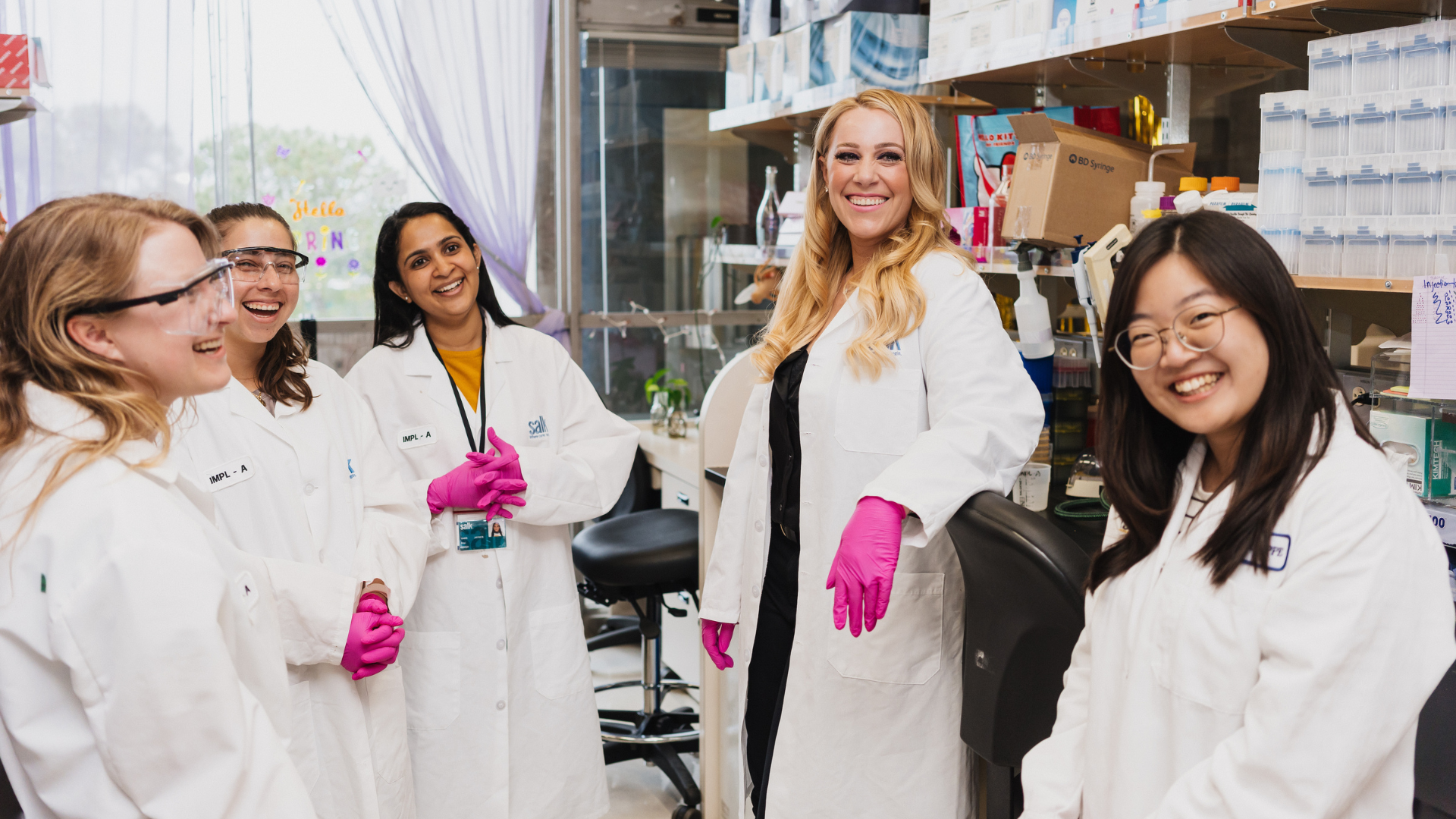
HHMI Investigator Janelle Ayres studies how the body can survive infections by cooperating with pathogens rather than killing them — findings that could transform development of new infectious disease treatments.
Investigator, Salk Institute for Biological Studies
HHMI Investigator Janelle Ayres studies how the body can survive infections by cooperating with pathogens rather than killing them — findings that could transform development of new infectious disease treatments.
KEY TAKEAWAYS
- HHMI Investigator Janelle Ayres studies why even genetically identical animals can react differently to the same infection. She found that the outcome isn’t based on bacterial load, but differences in how their bodies adapt to the pathogen, a response researchers call disease tolerance.
- A simple dietary intervention — iron supplements — improved survival in mice against otherwise lethal doses of a gut pathogen, without killing a single bacterium.
- The genes that protect young mice from sepsis-induced heart damage actively cause it in older mice — a finding that suggests a need for age-specific treatment for infectious diseases.
- Ayres believes that even though there are countless infectious diseases, they ultimately damage the body in only a handful of ways. Her lab is working to identify those common patterns — a first step toward treatments that could work across many of them.
Two identical mice experience the same deadly infection. One survives, while the other dies. Why?
Scientists long thought the answer lay in the pathogen burden — the amount of harmful bacteria present in the body. They assumed that in the mice that died, the pathogen burden had become insurmountable, overpowering the immune system.
But when HHMI InvestigatorJanelle Ayres tested this idea, that’s not what she found. Something else was driving the outcome — and Ayres was determined to find it
An Alternate Strategy to Address Infections
The assumption about pathogen burden stems from how infection defense has traditionally been understood. In the standard paradigm, a person is infected, the body mounts an immune response that kills the pathogen, and the person survives.
Though this scenario is common, it’s not universal. Sometimes the immune system does clear the pathogen, but the individual still dies or experiences long-lasting symptoms. Other times, the pathogen persists, but the individual remains perfectly healthy as an asymptomatic carrier. Ayres first documentedexternal link, opens in a new tab this kind of tolerance as a graduate student, working with fruit flies, and has spent the two decades since trying to understand how it works in mammals. She calls it disease tolerance: hosts survive by limiting the physiological damage that a pathogen causes rather than destroying it — as antibiotics are designed to do.
“Antibiotics are an essential tool for treating infections, but they shouldn’t be the only tool,” Ayres says. “That lens is driving the arms race between us and pathogens, and it’s why we’re now facing antibiotic resistance.”
Taming a Pathogen
Ayres and her lab at the Salk Instituteexternal link, opens in a new tab focused their studies on a gut-dwelling pathogen called Citrobacter rodentium. At the infectious dose they used, roughly half the mice would normally die and half would survive. Once they’d established that the pathogen burdens were the sameexternal link, opens in a new tab in the mice that lived and the mice that died, they began searching for differences between the two groups
A clue emerged from the liver: the surviving mice were processing iron differently. When Ayres’ team administered an iron supplement alongside the Citrobacter infection, 100 percent survived, instead of the usual 50 percent. Not only that, but the protection held even when mice were given 10, 100, or even 1,000 times the amount of bacteria that was normally fatal
Most importantly, the iron protected the mice without reducing their pathogen burden. The iron wasn’t killing the bacteria; rather, it initiated a series of metabolic changes in the mice that increased the availability of glucose to the bacteria — its preferred food
Sensing that abundance, the bacteria dialed down their own virulence. Over time, under those conditions of peaceful coexistence, the pathogen evolved mutations that permanently deleted its disease-causing genes. “A small dietary intervention in the host drove the bacteria toward commensalism, where it persists in the host without harming it,” Ayres explains.
When Survival Genes Become Lethal
The Citrobacter findings raised a bigger question: if the body’s response to infection — not the pathogen itself — determines survival, what else shapes that response? Ayres turned to one obvious candidate: age.
Her lab applied two strains of bacteria that commonly cause sepsis to both young and old mice. The dose was the same for both young and old mice, as was the pathogen burden. But how they survived, and died, looked completely differentexternal link, opens in a new tab.
When the young mice died, their hearts were enlarged. Conversely, the old mice that died had shrunken, atrophied hearts.
Survival was also a story of opposites. The young mice that survived never seemed visibly ill, while the aged mice that survived became sick for a day or two. When those older mice did recover, it was with an enlarged heart — the same cardiac pattern that killed young mice.
To find out why, Ayres’s team looked at gene activity in the mice’s hearts. She found that two genes — Foxo1 and Trim63 — protected the young survivors from the cardiac growth and organ damage that killed their peers. But in older mice, those same genes drove illness and death.
The idea that a beneficial trait can become a liability with aging is called antagonistic pleiotropy, and it is already a mainstay of cancer medicine. This finding suggests it is also relevant to infectious disease treatments. If the mechanism holds in humans, a drug targeting these genes could theoretically save a young sepsis patient but kill an elderly one experiencing the same infection. That suggests that age should potentially factor into infectious disease treatments.
“There are so many different infectious diseases, which makes the problem seem intimidating. But there are only so many ways that they end up killing,” explains Ayres. “We’re interested in finding the commonalities — the strategies that they share, and the common effects that they have on our physiologies. We are working to understand those shared mechanisms of disease tolerance, so we can begin to develop treatments that work across many infectious diseases and that should not drive drug resistance.”
Media Contact: Halea Kerr-Layton, Media Relations Manager [email protected]
Media Contact: Halea Kerr-Layton, Media Relations Manager [email protected]
