



Science is supposed to be self-correcting. But what happens when the journals entrusted to uphold this principle become its gatekeepers? We have collaborated for almost a decade in an effort to correct the fraud permeating throughout the most influential depression study ever conducted. And what our efforts reveal is that the mechanisms for accountability in medical research are broken
While the risk of fraud in pharmaceutical company-funded psychiatric research is now widely acknowledged,1-4 this fraud occurred in a taxpayer-funded study presumed to be trustworthy. This assumption made the fraud harder to challenge—and has allowed its flawed findings to be widely accepted and embedded into everyday medical practice
We have collaborated on writing this piece. However, the first part of this effort to correct the STAR*D record stretches back two decades, when one of us—Ed—first discovered irregularities in the reported results from the STAR*D study. As such, this blog toggles between an initial “I” part and a subsequent “we” part to reflect this history
Background
The Sequenced Treatment Alternatives to Relieve Depression (STAR*D) study is the largest, longest, and most expensive antidepressant trial ever conducted. Costing American taxpayers 35 million dollars, STAR*D was designed to identify the best next-step treatment for the many depressed patients who fail to respond adequately to their first and/or subsequent antidepressant medication trial
In order to mirror real-world clinical practice, STAR*D used an open-label research design (ie, patients knew what drug(s) they were taking), enrolled patients seeking routine medical or psychiatric care, and included individuals with comorbid medical and psychiatric conditions, thereby maximizing the generalizability and clinical relevance of STAR*D’s findings
STAR*D enrolled 4,041 patients who screened positive for depression and then started on Celexa, a selective serotonin reuptake inhibitor (SSRI). Patients who did not respond to Celexa in step-1 of the trial selected acceptable treatment options for randomization in steps 2 through 4, to “empower patients, strengthen the therapeutic alliance, optimize treatment adherence, and improve outcome.”5,p.483 Cognitive therapy was also offered as an option in step-2; however, too few patients chose it, and it was therefore excluded from the major step-2 articles published in The New England Journal of Medicine (NEJM).6,7
Besides allowing patient choice of treatment options in steps 2-4, STAR*D implemented several other measures designed to optimize clinical outcomes. These included a rigorous visit-by-visit symptom monitoring system (SMS) to guide aggressive medication management to “ensure that the likelihood of achieving remission was maximized and that those who did not reach remission were truly resistant to the medication.”8,p.31
Patients and family members also received education during each visit based on the neurochemical imbalance theory of depression. This included “a glossy visual representation of the brain and neurotransmitters” and “the mechanism of action” of each patient’s current medication and emphasized that “depression is a disease, like diabetes or high blood pressure…The educator should emphasize that depression can be treated as effectively as other illnesses.”9,p.6-8
In 2006, The American Journal of Psychiatry (AJP) and NEJM published STAR*D’s seven primary articles. Two decades later, these high-impact articles continue to profoundly influence antidepressant medication treatment guidelines worldwide. The summary article reported that 67% of the depressed patients achieved a complete remission after up to four sequential medication trials,10 a figure that continues to shape clinical guidelines and expectations among clinicians and the public regarding the likelihood of treatment success.
But, as I (Ed) soon discovered, this was all a lie
My Inner Columbo Triggered…
Intrigued after reading a front-page Washington Post story on STAR*D, I downloaded the step-1 Celexa article in the spring of 2006.8 Careful reading revealed tells of research fraud inflating Celexa’s remission rate
The first tell was the novel research design for assessing antidepressant effectiveness. I coined it the tag-you-are-healed design.11 Using STAR*D’s SMS algorithm, many patients were declared remitted after just 4 to 6 weeks on Celexa and promptly removed from the step-1 Celexa subject pool and shifted into the 1-year follow-up care subject pool—even though the acute phase of Celexa treatment lasted for up to 14 weeks
This sleight-of-hand ensured that Celexa remitters could never un-remit, thereby exploiting the well-known fact that depression ebbs and flows for the vast majority of sufferers. To discover STAR*D’s true remission rate, I would have to wait for the 12-month follow-up care data to be published
The second tell was STAR*D excluding from data analysis 234 patients who quit their Celexa therapy during the first 2 weeks, even though the protocol specified that such patients should be counted as treatment failures. The STAR*D investigators never disclosed that these patients were taking Celexa when they dropped out. This sleight-of-hand alone increased Celexa’s reported remission rate from 25.4% to 28%
We later learned that this trickery served an additional, more troubling purpose. In their step-1 article, the STAR*D investigators asserted that, “There were no suicides in the 2,876 participants in this acute-phase Celexa study.”8,p.33 This assertion though was true only by excluding from analysis the 234 early-dropout Celexa patients when they were most at risk for becoming suicidal
In 2009, the STAR*D investigators published an analysis of emergent suicidality during Celexa treatment.12 They reported that 7% of patients who were not suicidal at baseline reported emergent suicidality during their first two weeks of Celexa treatment. The investigators then go on to acknowledge that “One of the participants who did not return after baseline was reported as a likely suicide secondary to falling off his apartment complex roof 10 days after Celexa was prescribed.”12,p.69
How clever on the STAR*D PIs’ part. This protocol violation was a twofer. It inflated the remission rate while covering up a suicide
Then the fog horn blared . . . Troubled, I downloaded STAR*D’s 2004 Research Design article and discovered that the second measure used to report Celexa’s remission rate was specifically excluded from being used as such because it was non-blinded and central to STAR*D’s SMS-algorithm guiding treatment.13 This protocol violation bumped up Celexa’s remission rate further to 33%
I was now hooked waiting for each new article to drop…
The fog thickened…In March 2006, I downloaded STAR*D’s step‑2 drug‑switch and Celexa‑augmentation articles from NEJM.6,7 These two comparative-effectiveness studies were STAR*D’s raison d’être and the justification for publication in America’s preeminent medical journal. Yet the two NEJM articles obscured the number of STAR*D patients progressing from step‑1 to step‑2 treatment
STAR*D enrolled 4,041 patients. However, only 3,110 met the depression severity criteria for major depressive disorder (MDD) when assessed by expert raters blind to patients’ study status (entry, exit, or follow-up), and therefore met STAR*D’s inclusion criteria for data analysis.8 Figure 1 The remaining 931 patients stayed in STAR*D because the investigators did not learn patients’ depression severity scores at entry into the study until after the 12-month follow-up care phase ended and the study’s blind broken.
The step-1 Celexa flowchart reports that 1,201 eligible depressed patients advanced to step‑2 treatment.8 Figure 1 But when combining the step‑2 treatment groups reported in NEJM and AJP the total is 1,439. This means that without clear public disclosure, the STAR*D investigators included 238 patients in their analyses who failed to meet inclusion criteria due to insufficient depression severity when first enrolled into the study
Darkest before dawn…In November 2006, I downloaded STAR*D’s summary article, which reported remission rates for steps 1–4 treatments and the 12-month follow-up care data using survival-analysis.10
The key survival analysis figure was nearly impossible to interpret (see below)
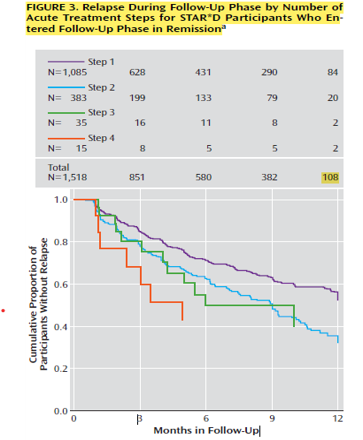
Like most readers, I tried to decipher from the graph how many remitted patients survived follow-up care without relapsing and/or dropping out. After weeks pondering the squiggly lines, I realized the answer was in plain sight—just not in the graph—but the table above it.
The failure of STAR*D’s treatment model—sequential trials of increasingly aggressive antidepressants and their combinations—was hiding in plain sight. The investigators simply never drew attention to the abysmally low stay-well rate. Instead, they promoted a 67% cumulative remission rate—a false claim that collapses under scrutiny yet has been repeated countless times in medical journals, the media, and during patient consultations for the past 20 years—and sustained by the silence of the two journals that gave STAR*D global credibility.
Tilting at Windmills…
With colleagues in 2008, I submitted our first STAR*D reanalysis to NEJM. This manuscript received a form-letter rejection despite documenting that only 108 of STAR*D’s 4,041 patients had a sustained remission without relapsing and/or dropping out.14
In April 2009, I submitted our deconstruction of STAR*D’s findings toAJP documenting numerous protocol violations, each one inflating further STAR*D’s reported success rates
This submission included a letter to Dr. Freedman, AJP’s Editor-in-Chief, highlighting how an unbiased presentation of STAR*D’s findings discredits the American Psychiatric Association’s guidelines for treating depression.15 I informed Dr. Freedman that “only 108 of STAR*D’s 4,041 patients (2.7%) who were initially started on Celexa in step-1 had a remission (after up to four treatment trials) and during follow-up neither dropped out nor relapsed.”
I offered to send Dr. Freedman my email exchanges with Dr. Wisniewski, STAR*D’s chief biostatistician, confirming the accuracy of our analyses.16,17 Dr. Freedman never requested the emails and our submission received another form-letter rejection without peer review
In July 2009, my colleagues and I submitted our manuscript titled “Efficacy and Effectiveness of Antidepressants: Current Status of Research” to Psychotherapy and Psychosomatics(PPS). The first section reviewed prior placebo-controlled antidepressant studies, and the second deconstructed STAR*D’s findings. It was published in July 2010, and became PPS’s most frequently downloaded article for 22 consecutive months.18
Eureka: STAR*D’s Patient-Level Dataset
Soon after the PPS publication, I started collaborating with University of Connecticut researchers who had obtained STAR*D’s patient-level dataset from NIMH
In June 2012, we submitted to NEJM a reanalysis of the dataset adhering to the NIMH-approved protocol I obtained through one of three Freedom of Information Act (FOIA) requests.19The cover letter stated:
“Our paper warrants publication in NEJM because it reanalyzes the STAR*D dataset according to its research protocol. This analysis documents that the reported benefits of antidepressant treatment in the first step have been greatly exaggerated…Furthermore, our analyses found STAR*D’s researchers violated the protocol inclusion and exclusion criteria, resulting in patients who were not depressed at the start of the study being included in subsequent phases.”20
Once again, NEJM rejected our submission without peer review
Finding a Kindred Spirit
In 2018, I teamed up with Dr. Jay Amsterdam, Emeritus Professor of Psychiatry at the University of Pennsylvania, Perelman School of Medicine, who had directed its Depression Research Unit for more than two decades, starting in 1980
Jay had an illustrious career at Penn in research psychiatry. Despite gradually losing his eyesight, he published more than 285 peer-reviewed articles and 6 textbooks on treatment resistant depression.21-26 Jay’s research includes prospective and retrospective studies consistently showing a 20% to 30% increase in drug tolerance (ie, loss of antidepressant effectiveness) with each increase in the number of prior antidepressant treatments taken by the patient.27-34
Jay’s provocative findings, published over a 25-year period, were mirrored in the progressive loss of effectiveness during the STAR*D study when patients were exposed to repeated—and increasingly aggressive—antidepressant medication trials in steps 1-4. What Jay’s research, among others,35-37 suggests is that the repetitive administration of antidepressant medications over time often results in an iatrogenic (ie, doctor-induced) treatment-resistant depression
This concept—that a medication once helpful can become iatrogenic—is not foreign to medicine. Antibiotics lose effectiveness with overuse. Benzodiazepines and stimulants lose potency as tolerance kicks in. Antidepressants appear to follow the same trajectory.35-40 What begins as treatment over time becomes part of the problem—transforming episodic depression into a chronic, treatment-resistant illness. And when the response to that loss of effectiveness is simply more medication, the cycle far too often becomes self-perpetuating.
In March 2019, we posted a “Call to action: RIAT reanalysis of the sequenced treatment alternatives to relieve depression (STAR*D) study” in The British Medical Journal (BMJ).41 In addition to documenting the STAR*D investigators’ numerous protocol violations, we found a jaw-dropping new one:
STAR*D included in data analysis 117 patients who were in protocol-defined remission before starting their step-2 treatment
This shameless deception violated both the protocol—and common sense—to double-count remitted patients. We only discovered this flagrant protocol violation because we now had STAR*D’s patient-level dataset—and bothered to look
As part of our Restoring Invisible and Abandoned Trials (RIAT) grant application,42 we notified the STAR*D PIs of our Call to Action, documented their protocol violations, and announced our intention to reanalyze the dataset with fidelity to the original NIMH-approved protocol. We invited the PIs to conduct the reanalysis themselves but they declined
Let the RIAT Begin
With RIAT funding, we hired two Penn graduate students (now Drs. Colin Xu and Thomas Kim) to analyze the dataset. Along with Dr. Irving Kirsch, Associate Director of the Program in Placebo Studies at Harvard University, we published in BMJ Open the article titled, “What are the treatment remission, response and extent of improvement rates after up to four trials of antidepressant therapies in real-world depressed patients? A reanalysis of the STAR*D study’s patient-level data with fidelity to the original research protocol.”43
Prior to publication, the BMJ Open editor invited the STAR*D PIs to respond publicly to our reanalysis and documentation of their protocol violations. Again, they declined to do so.44 In contrast to the STAR*D investigators’ claim of a 67% cumulative remission rate, we found it was only 35% when adhering to the protocol—and this was before assessing how many of those who remitted actually stayed well
The importance of our BMJ Open article was quickly recognized by the editors of Nature Mental Health and Psychiatric Times. Two months after its publication, Nature Mental Health’s Editor-in-Chief wrote:
“Some of the bedrock of clinical wisdom in psychiatry has begun to erode…Recent work has challenged long-held and widely accepted statistics about the efficacy of antidepressants. A reanalysis of the patient-level dataset from the STAR*D study demonstrated that, in contrast to the previously reported cumulative remission rate of 67%, after examination of key methodological deviations from the research protocol and related publications, the actual rate of remission was only 35.0% of participants — a precipitous drop in what has become a benchmark estimate for antidepressant efficacy.”45
This was followed by the Editor-in-Chief of Psychiatric Times, writing in a cover story titled, “STAR*D Dethroned?”:
“Recently, a provocative and well-researched publication in the BMJ reanalyzed the original raw data obtained from the NIMH and challenged the conclusions of the STAR*D publications…For us in psychiatry, if the BMJ authors are correct, this is a huge set back, as all of the publications and policy decisions based on the STAR*D findings that became clinical dogma since 2006 will need to be reviewed, revisited, and possibly retracted.”46
Soon thereafter, Drs Nicolas Badre and Jason Compton published an article in Psychiatric Times titled, “STAR*D: It is Time to Atone and Retract.”47 The article was written in response to an exchange in Psychiatric Times detailing our allegations of protocol violations48 and the STAR*D PIs’ response.49Drs. Badre and Compton’s conclusion echoed their title. If our analyses were correct, the time had come for the American Psychiatric Association’s marquee journal to Atone and Retract STAR*D.
Step Two
Next, we reanalyzed STAR*D’s drug-switch and Celexa-augmentation articles NEJM published and posted our RIAT re-analyses on the medRxiv preprint server. Drs. Martin Plöderl50 and Kevin Kennedy51 added their expertise to our efforts. Each preprint included the statistical code used to analyze the dataset thereby allowing researchers worldwide to confirm or challenge our findings
Our February 2025 drug-switch reanalysis, submitted to NEJM, found:52
- 44 patients (6.1% of enrolled subjects) met the protocol definition of remission before starting drug-switch treatment with either Wellbutrin, Zoloft, or Effexor;
- There were four times more incidents of severe suicidal behavior reported by the treating clinicians than reported in the original NEJM article;
- There was a significant 43% increase in treatment-emergent suicidal ideation (TESI) during drug-switch therapy with Wellbutrin (12.7%), Zoloft (11.2%), and Effexor (15.0%) compared with step-1 Celexa (9.0%) using the same TESI assessment methodology the STAR*D investigators used;53 and
- On average, drug-switch patients were 4.2 times more likely to experience emergent suicidality than remit and stay-well during 12 months of follow-up care.
Our October 2025 NEJM submission reanalyzing STAR*D’s Celexa-augmentation article found:54
- 54 patients (9.6% of enrolled subjects) met the protocol definition of remission before starting Celexa-augmentation treatment with either Wellbutrin or Buspar;
- There was a highly significant fourfold difference in TESI rates between Wellbutrin (3.6%) and Buspar (13.9%) Celexa-augmentation;
- Wellbutrin’s stay-well rate during follow-up care was only 5.1% while Buspar’s rate was 4.9%; and
- STAR*D patients prescribed Buspar were three times more likely to experience emergent suicidality than to have a remission and stay well.
Both of our 2025 RIAT reanalysis submissions were accompanied by letters to Dr. Eric Rubin, NEJM’s current Editor-in-Chief.55,56 Key points in the letters were:
- We included the statistical code used to analyze STAR*D’s dataset, making it easy for NEJM’s statistical consultant to confirm or disprove our findings; and
- We informed Dr. Rubin that despite notifying the STAR*D PIs three times that they had included many remitted-before-treated patients in their NEJM articles, the PIs failed to correct this error, and instead advanced a misleading defense alleging we created “rules to define post hoc which participants to include.”49,57
A Call to Retract
The STAR*D trial is the most influential depression treatment study ever conducted and continues to shape clinical practice guidelines worldwide. Yet its core findings are unreliable due to systematic protocol violations. The Committee on Publication Ethics (COPE) guidelines state that retraction is warranted in cases of pervasive error and/or research misconduct that render findings invalid and misleading.58 Both apply here:
- The inclusion of remitted-before-treated patients in outcome analyses invalidates the trial’s findings.
- The refusal by the STAR*D PIs to correct this protocol violation, among others, despite being notified three times, constitutes research misconduct.
- The misrepresentation of our correction as a post hoc criterion change is false. We simply applied STAR*D’s prespecified rules for inclusion in data analysis. It was the STAR*D investigators who changed these rules post hoc—and did so without public disclosure.
Given our correspondence, Dr. Rubin has now twice made grave, ethically-flawed editorial decisions: first, by refusing to send our RIAT re-analyses for peer review, and second, by refusing to retract the articles NEJM published despite compelling evidence that their conclusions are invalid. The question now is not whether STAR*D’s central claims are invalid, but whether the journals that gave them global authority will do what integrity demands: Atone and Retract
NEJM’s incompetent peer review 20 years ago led to a two-decade long delay in the public learning that (1) outcomes from both drug-switch and Celexa-augmentation treatments were far worse than claimed, and (2) patients were far more likely to become suicidal than remit and stay well
I (and others),59-62 figured out that STAR*D was riddled with scientific mischief when first published.NEJM’s editors and peer reviewers would have seen the same problems I did, had they simply read STAR*D’s 2004 Research Design article15 and compared it to the STAR*D investigators’ two submissions. NEJM had the power to demand answers regarding the STAR*D protocol violations two decades ago—but failed to do so
Dr. Rubin faced a choice when confronted with our 2025 submissions: expose NEJM’s editorial failures starting in 2006—including its rejection without peer review our 2008, 2012, and now both 2025 submissions—or bet that this fraudulent scheme NEJM became party to would remain largely hidden, as it has for 20 years
Regrettably, Dr. Rubin chose the latter, effectively deciding that the NEJM-enabled fraud would stay buried—patient welfare be damned. Dr. Rubin knew that as NEJM’s Editor-in-Chief, his decision was final with no avenues for appeal
Change Is Needed
The Hippocratic Oath emphasizes that medicine’s first duty is to do no harm, and fulfilling this duty requires honesty in medical research. Until the scientific publishing and editorial process permits independent correction of the scientific record—no matter how uncomfortable the truth may be—medical science will continue to protect its academic and corporate institutions at the expense of its integrity and the public’s safety
For these reasons, we recommend the establishment of an independent, financially-unconflicted ombudsman to evaluate allegations of research misconduct. Patient safety and the advancement of evidence-based medicine requires a neutral arbiter, free of institutional and financial conflicts of interest, with the authority to investigate misconduct and mandate corrections or retractions when warranted
In the meantime, NEJM should be shamed into cleaning up the mess they made. NEJM’s prestige—and its worldwide platform—were used to legitimize and disseminate a profoundly flawed and misleading narrative about antidepressant medications
This same platform should now be used to inform clinicians and the public about these drugs’ true risks and their low likelihood of sustained benefit, as documented by our RIAT re-analyses. Failure to do so—despite nearly two decades of repeated notification that NEJM’s STAR*D publications contain demonstrably false and clinically-consequential claims—should expose the journal to legal consequences for knowingly allowing these claims to remain uncorrected
To Whom Much is Given
For better or worse, high-impact medical journals are the gatekeepers of evidence-based medicine, where science is presumed to reign supreme. In practice, these journals supply the certified, high-strength concrete foundation of America’s 5.3 trillion dollar healthcare industry—accounting for approximately 18% of U.S. gross domestic product in 2024. What they publish determines which treatments are deemed legitimate, and therefore reimbursed by private insurers, Medicare, and Medicaid
Yet from these institutions to whom we have entrusted such extraordinary influence, as a society, we demand remarkably little…
Like the president in the Supreme Court’s Trump v. United States decision, medical journals have broad legal immunity for official acts. They are essentially untouchable because the law treats them as protected speakers exercising editorial discretion, not as institutions whose publications are relied upon in clinical decision-making. Even after repeated, well-documented proof of research fraud, journals have no duty to investigate or correct the scientific record
Even the First Amendment though does not protect yelling fire in a crowded theater and then, after learning the claim is false, choosing silence as people experience ongoing harm
Medical journals do exactly that when they refuse to investigate and correct fraudulent research despite clear notice—converting editorial discretion into a mechanism for perpetuating harm and failing in their societal mission to provide a level platform for scientific inquiry and debate
We would be far further ahead today in treating depression if STAR*D’s findings had been reported truthfully when first published two decades ago. While our preprints have not yet been certified by peer review, if verified they suggest very different evidence-based guidance for treating depression than that promoted by the STAR*D investigators
Given the increased risk of emergent suicidality—and the low likelihood of sustained benefit—following a failed SSRI trial, the more responsible course is to stop and reconsider versus follow STAR*D’s try-and-try-again ad infinitum model of care with ever more aggressive antidepressant medications and their combinations
When these findings are finally confirmed, the greatest failure will not be STAR*D’s flawed science, but the decisions by AJP and NEJM’s Editor-in-Chiefs to let its claims continue shaping clinical practice long after their validity was called into question
It’s crazy. As a society, we’ve allowed an industry which is vital to America’s health to be legally immune from the adverse consequences of their actions. Legal reforms—such as a post-notification duty to respond, a recklessness standard for willful inaction, and injunctive relief to compel corrections—are needed to restore accountability without compromising scientific inquiry and debate
For nearly two decades, AJP and NEJM have refused to correct the fraudulent STAR*D record and patients continue to be collateral damage
When medical journals choose silence over truth, patients pay the price—and the law calls it editorial freedom. It is long past-time to end this practice. Only then will we as a society get what we expect and deserve from our investments in medical science
*****
Postscript from Ed Pigott
My co-PI and dear friend, Jay Amsterdam, died suddenly on July 28th as we waited to learn the fate of our appeal to BMJ Open. On May 14th, BMJ Open rejected our group’s reanalysis of STAR*D’s medication-switch study published in NEJM.Even worse, the editor did so without allowing us the opportunity to respond to the 5 peer reviewers’ criticisms
This was devastating news. We first submitted the manuscript on March 25, 2025 and 14 months later, we learned it was rejected without the opportunity to respond. So, Jay and I got to read the criticisms—and learn the names of each reviewer—but not respond? What’s OPEN with that?
By December 31, 2025, the editor had received all 5 reviews—one of which was written by Dr. Maurizio Fava, a STAR*D PI. So the editor had Maurizio’s review, and we had to wait almost 6 months to read it…and then not respond?
On August 10th, the editor emailed me stating: “I appreciate your patience and am sorry for the wait you’ve experienced…we expect to provide you with a formal update within the next few days.” And 12 days later, I am still waiting…
Jay and I were very different. He was a true Renaissance man who quoted Latin while in essence, I dropped out of high school in 10th grade to join the work release program. What we shared was a commitment to integrity . . . and justice. Fortis Fortuna Adiuvat—fortune favors the brave—Jay would often say, when bolstering my nerve to press send
Jay’s sudden passing has given me a measure of the courage he showed unto the very end. Carpe diem. Seize the day, we press on
***
References & Links
- Turner EH et al. Selective Publication of Antidepressant Trials and Its Influence on Apparent Efficacy.N Engl J Med See: Selective Publication of Antidepressant Trials and Its Influence on Apparent Efficacy | New England Journal of Medicine
- Jureidini J et al. Restoring Study 329: Efficacy and harms of paroxetine and imipramine in treatment of major depression in adolescence. BMJ See: Restoring Study 329: efficacy and harms of paroxetine and imipramine in treatment of major depression in adolescence | The BMJ
- Harris G. Drug Makers Hid Evidence on Risks of Antipsychotics, Study Finds. NYT 2008. See: Lilly Said to Be Near $1.4 Billion U.S. Settlement – The New York Times
- Goldacre B. Bad Pharma. The Guardian 2012. See: Bad Pharma by Ben Goldacre – review | Health, mind and body books | The Guardian
- Fava M, Rush AJ, Trivedi MH, et al. Background and rationale for the Sequenced Treatment Alternatives to Relieve Depression (STAR*D) study. Psychiatr Clin North Am. 2003;26:457–494.
- Rush AJ, Trivedi MH, Wisniewski SR, et al. Bupropion- SR, sertraline, or venlafaxine- XR after failure of SSRIs for depression. N Engl J Med 2006;354:1231–42.
- Trivedi MH, Fava M, Wisniewski SR, et al. Medication augmentation after the failure of SSRIs for depression. N Engl J Med 2006;354:1243–52.
- Trivedi MH, Rush AJ, Wisniewski SR, et al. Evaluation of outcomes with citalopram for depression using measurement- based care in STAR*D: implications for clinical practice. Am J Psychiatry 2006;163:28–40.
- See STAR*D Patient Education Manual: Microsoft Word – STAR_D Patient Education Plan Manual.doc
- Rush AJ, Trivedi MH, Wisniewski SR, et al. Acute and longer- term outcomes in depressed outpatients requiring one or several treatment steps: a STAR*D report. Am J Psychiatry 2006;163:1905–17. See: Acute and Longer-Term Outcomes in Depressed Outpatients Requiring One or Several Treatment Steps: A STAR*D Report | American Journal of Psychiatry
- See 2010 Medscape article: Broad Review of FDA Trials Suggests Antidepressants Only Marginally Better than Placebo
- Zisook S, Trivedi MH, Warden D, Lebowitz B, Thase M, Stewart JW, Moutier M, Fava M, Wisniewski SR, Luther J, Rush AJ. Clinical correlates of the worsening or emergence of suicidal ideation during SSRI treatment of depression: An examination of citalopram in the STAR*D study. J Affective Dis 2009;117:63–73.
- Rush AJ, Fava M, Wisniewski SR, et al. Sequenced treatment alternatives to relieve depression (STAR*D): rationale and design. Control Clin Trials 2004;25:119–42.
- Link to 2008 NEJM submission: NEJM-PDF-submission.pdf
- Link to Dr. Freedman letter: Microsoft Word – Letter to AJP__FINAL v2.2.doc
- Link to Wisniewski email exchange re: survival analysis on MIA website: Microsoft Word – First Wisniewski Email confirming interpretation of survival analysis tables.doc
- Link to Wisniewski email exchange re: all patients starting on Celexa in their baseline visit on MIA website: Microsoft Word – Second Wisniewski Email confirming that all pts were started on Celexa in baseline visit.doc
- Pigott, H.E., Leventhal, A.M., Alter, G.S. & Boren, J.J. (2010). Efficacy and effectiveness of antidepressants: Current status of research. Psychotherapy and Psychosomatics, 79, 267–279.
- Link to STAR*D: A Tale and Trail of Bias: STAR-D__A-Tale-and-Trail-of-Bias__with-Highlights.pdf
- Link to NEJM 2012 submission letter: NEJM-Letter-to-the-Editor.doc
- Psychobiology of Affective Disorders. J. Mendels, J.D. Amsterdam (eds.). New York, S. Karger, 1980, pp. 1-220.
- Pharmacotherapy of Depression: Applications for the Outpatient Practitioner. J. Amsterdam (ed.) New York, Marcel Dekker, Inc. 1990, pp 1-496.
- Refractory Depression. J. Amsterdam (ed.). New York, Raven Press 1991, pp 1-241. (Translated into Spanish and polish).
- Refractory Depression. Nolan, W., Zohar, J., Roose, S., Amsterdam, J.D. (eds.). Chichester, John Wiley & Sons, 1994, pp 1-256.
- Treatment-resistant Depression. Hornig-Rohan, M., Amsterdam, J.D. (eds.). “Psychiatric Clinics of North America”, Philadelphia, W.B. Saunders, 1996, 19:1-412.
- Treatment Resistant Mood Disorders – Advances in Research and Treatment. Amsterdam, J.D., Hornig-Rohan, M., Nierenberg, A. (eds.), Cambridge & New York, Cambridge University Press, 2001, pp 1-516.
- Amsterdam JD, Maislin G, Potter L. Fluoxetine efficacy in treatment resistant depression. Prog Neuropsychopharmacol Biol Psychiatry1994;18:243–61.
- Amsterdam JD, Shults J. MAOI safety and efficacy in advanced treatment-resistant depression: a retrospective analysis. J AffectDisord 2005;89:183–8.
- Amsterdam JD, Williams D, Michelson D, et al. Tachyphylaxis after repeated antidepressant drug exposures in patients with recurrent major depressive disorder. Neuropsychobiology 2009;59:227–33.
- Leykin Y, Amsterdam JD, DeRubeis RJ, et al. Progressive resistance to SSRI therapy but not to cognitive therapy in the treatment of major depression. J Consulting & Clinical Psychology 2007;75:267–76.
- Amsterdam JD, Lorenzo-Luaces L, DeRubeis RJ. Step-wise loss of antidepressant effectiveness after repeated antidepressant trials in bipolar II depression. Bipolar Disord2016;18:563–70.
- Amsterdam JD, Lorenzo-Luaces L. Increase in pharmacodynamic tolerance after repeated antidepressant trials in treatment-responsive bipolar I depressed subjects: an exploratory study. Psychiatr Pol 2018;52:957–69.
- Amsterdam JD, Kim TT. Increased risk of depressive relapse during maintenance therapy after repeated antidepressant trials in treatment-responsive subjects. J Clinical Psychopharmacology 2019;39:344–50.
- Andrews P, Amsterdam J. A Hormetic approach to understanding antidepressant effectiveness and the development of antidepressant tolerance – A conceptual view. Psychiatr Pol2020;54:1067–90.
- Fava GA, Offidani E. The mechanisms of tolerance in antidepressant action. Progress inNeuro-Psychopharmacology & Biological Psychiatry. 2011;35:1593-602.
- Baldessarini RJ, Tondo L, Vázquez GH. Treatment-resistant depression: mechanisms and implications. Psychother Psychosom. 2015;84(4):231-241.doi:10.1159/000431060
- Rothschild AJ. Tachyphylaxis in antidepressant treatment. J Clin Psychiatry. 2003;64(suppl 18):20-23.
- Fava GA. Can long-term treatment with antidepressant drugs worsen the course of depression? J Clin Psychiatry. 2003;64(2):123-133. doi:10.4088/JCP.v64n0204.
- Fava GA. The concept of behavioral toxicity of psychotropic drugs. Int J Risk Saf Med. 1998;10(1):1-3. doi:10.3233/JRS-1998-10101.
- Baldessarini RJ, Tondo L, Hennen J. Treatment-latency and previous episodes: relationships to response to antidepressants in major depressive disorder. J Clin Psychiatry. 1999;60(3):191-199.
- BMJ Call to Action: https://www.bmj.com/content/346/bmj.f2865/rr-10
- Link to RIAT Initiative Support Center: RIAT Support Center – Tackling bias in the way research is published
- Link to BMJ Open article: BMJ-Open-Publication.pdf
- Link to BMJ Open’s editor comment: What are the treatment remission, response and extent of improvement rates after up to four trials of antidepressant therapies in real-world depressed patients? A reanalysis of the STAR*D study’s patient-level data with fidelity to the original research … | BMJ Open
- Link to Nature Mental Health editorial: The right treatment for each patient: unlocking the potential of personalized psychiatry | Nature Mental Health
- Link to STAR*D Dethroned cover story: STAR*D Dethroned? | Psychiatric Times
- Badre N, Compton J. STAR*D: It is time to atone and retract. Psychiatric Times. March 2024: STAR*D: It’s Time to Atone and Retract | Psychiatric Times
- Pigott HE, Kim T, Xu C, Kirsch I, Amsterdam, JD. What was STAR*D’s cumulative remission rate and why does it still matter? Reply to John Miller. Psychiatric Times. 2024;41(3). STAR*D’s Cumulative Remission Rate and Why It Still Matters (psychiatrictimes.com)
- Rush AJ, Trivedi MH, Fava M, Thase ME, Wisniewski SR Rejecting the accusation of a violated STAR*D protocol. Psychiatric Times. 2024;41(3). Rejecting the Accusation of a Violated STAR*D Protocol (psychiatrictimes.com)
- Amendola A, Plöderl M & Hengartner MP. Suicide rates and prescription of antidepressants: Trends in the United States, 1999–2020, by sex and race/ethnicity. Crisis:The Journal of Crisis Intervention and Suicide Prevention 2024;45(3). Doi:https://doi.org/10.1027/0227-5910/a000941
- Link to Kevin’s “What if STAR*D had a placebo article: Kennedy KP, Heldt JP, Oslin DW. What if STAR*D had been placebo-controlled? A critical reexamination of a foundational study in depression treatment. J Clin Psychopharmacol 2025; DOI: 10.1097/JCP.0000000000002025.90990.
- Link to drug-switch preprint: Restoring STAR*D: A RIAT Reanalysis of Medication Augmentation Therapy After Failed SSRI Treatment Using Patient-Level Data with Fidelity to the Original Research Protocol
- Perlis RH, Purcell S, Fava M, et al. Association between treatment-emergent suicidal ideation with citalopram and polymorphisms near cyclic adenosine monophosphate response element binding protein in the STAR*D study. Arch Gen Psychiatry 2007;64:689-697.
- Link to Celexa-augmentation preprint: Restoring STAR*D: A RIAT Reanalysis of Medication Augmentation Therapy After Failed SSRI Treatment Using Patient-Level Data with Fidelity to the Original Research Protocol
- Link to drug-switch letter to NEJM’s Editor-in-Chief: Letter-to-NEJM-editor__FINAL.pdf
- Link to Celexa-augmentation letter to NEJM’s Editor-in-Chief: Letter-to-NEJM-Editor__Augmentation.pdf
- Rush AJ, Trivedi MH, Fava M, Thase ME, Wisniewski SR. The STAR*D data remain strong: Reply to Pigott et al. Am J Psychiatry 2023; 180:919–920; doi: 10.1176/appi.ajp.20230869
- COPE Ethics Retraction Guidelines: Retraction guidelines | COPE: Committee on Publication Ethics
- Nelson, JC. The STAR*D Study: A Four-Course Meal That Leaves Us Wanting More. Am J Psychiatry 163:11, November 2006
- Link to: Fact Checking the New Yorker – Mad In America
- Link to: Fact Checking the New Yorker, Part Two – Mad In America
- Link to: The STAR*D Scandal: A New Paper Sums It All Up – Mad In America
