


South Sudan’s nutrition crisis: Holding the line between hunger and hope – Eye Radio

South Sudan’s nutrition crisis: Holding the line between hunger and hope
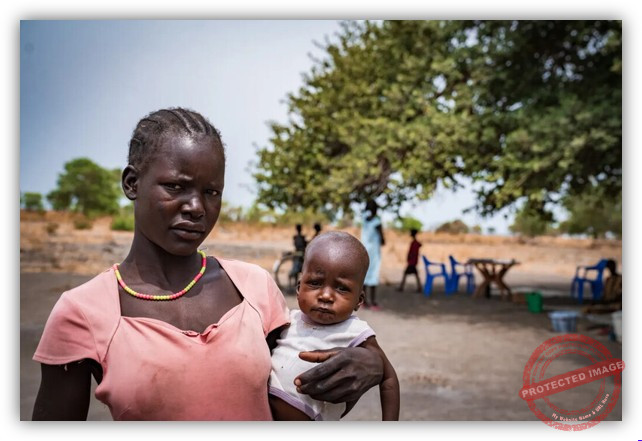
Mother Wut Akol with her eight-month-old daughter, Abuoch Jiel Bak, at an outreach site in Machar, Tonj, Warrap State, South Sudan
Under the shade of a tree in Machar Ayuel village in Tonj, Warrap State, mothers sit with their children, waiting to be screened
There is no health centre building here. No consultation rooms or pharmacy
Instead, a temporary nutrition outreach run by Amref Health Africa has become a lifeline for families who would otherwise have to walk for hours to access care
Among the mothers is Wut Akol, whose nine-month-old daughter, Abuoch Bak, was recently diagnosed with severe acute malnutrition
Before coming to the outreach, Wut would make the long journey to Pawel health clinic, about three hours away on a good day
When her daughter became ill, she suffered from vomiting, diarrhoea, fever and cough. As the illness continued, Wut feared something beyond her understanding was happening
“When it started, I thought she was bewitched,” Wut says
At the outreach, health workers screened Abuoch, enrolled her in the nutrition programme and provided the nutritional support she needed
Now on her sixth visit, Wut says she has seen a major improvement in her daughter’s health
“There is a big difference. Now it has changed her body, and she is better.”
Wut’s story is one example of a much wider nutrition crisis affecting South Sudan
A crisis measured in millions
Between April and July 2026, an estimated 7.8 million people—56 percent of the analysed population—are expected to face Crisis-level food insecurity or worse, according to the Integrated Food Security Phase Classification (IPC)
The nutrition situation is also alarming. More than 2 million children under five are expected to require treatment for acute malnutrition, alongside more than one million pregnant and breastfeeding women
Behind these figures are families facing several challenges at the same time. These include conflict and displacement, rising food and fuel prices, disrupted markets, disease outbreaks, flooding, poor access to clean water and sanitation, and reduced humanitarian access
For communities such as Machar Ayuel, these challenges can turn an ordinary illness into a life-threatening emergency
During the rainy season, roads can become impassable. Health facilities are far away, medicines and supplies are limited, and families may not be able to reach treatment when they need it
For 19-year-old Yom Akol, who is pregnant and was found to be malnourished, distance and flooding are constant concerns
“Travelling to a health facility is a challenge. During rainy season, we are cut off… There is nowhere to pass because of floods.”
Yom learnt about the nutrition outreach through Amref’s community nutrition volunteers, who move from household to household screening families and referring those who need care
After being assessed, Yom received a ration card and nutrition supplements
But her needs go beyond nutrition
“We also need medicine. People are sick. People need to be treated.”
Her words highlight the wider challenges behind South Sudan’s nutrition crisis
Hunger does not happen in isolation. Malaria, diarrhoea, respiratory infections and other illnesses can worsen malnutrition, while shortages of medicines and limited access to health services can make recovery more difficult
For Amref Nutrition Assistant Peter Mabior, bringing services closer to communities is essential
Without the outreach, mothers and children in Machar Ayuel may have to walk three to five hours to reach health and nutrition services
“That is why we brought the services closer to the community,” Peter explains
Across Warrap State, Amref is supporting care for children and mothers affected by malnutrition
Community volunteers screen children and pregnant women, while outreach teams identify cases early and connect families to treatment
With support from WFP and Unicef along with supplementary funding from Amref USA & Amref Italy through their external donors the programme aims to maintain 23 Outpatient Therapeutic Programme and Targeted Supplementary Feeding Programme sites, alongside eight mobile outreach sites, helping bring care closer to hard-to-reach communities
For children who are severely malnourished and have medical complications, outpatient care is not enough
At the Thiet Stabilisation Centre, supported by Amref, critically ill children can receive inpatient treatment and specialised nutrition care
Once they stabilise, they are discharged with therapeutic food and referred back to outpatient services for continued follow-up
Bringing services closer to communities can make the difference between a family accessing care and being forced to undertake another long and difficult journey
From emergency treatment to stronger food systems
Treating malnutrition is only part of the solution
Amref is also supporting communities to improve household food security through women-led kitchen gardens
For mothers such as Rebecca Nyalok Aru, the gardens provide more than vegetables
They give families access to nutritious food while creating opportunities to earn income from surplus produce
The income can help families pay school fees, seek medical care and support one another during difficult periods
In communities where families struggle to access enough nutritious food, the gardens provide an important layer of protection and help families move beyond simply surviving the next hunger season
Back under the tree in Machar Ayuel, mothers continue to wait
Children are screened. Nutrition supplies are distributed. Health workers provide advice and follow up with families who need continued support
For Wut, returning to the outreach means more than collecting nutrition supplies. It means watching her daughter recover
For Yom, it means receiving support during a vulnerable pregnancy while living in a community where healthcare remains difficult to access
And for health workers like Peter, it means continuing to bring care to communities that are far from formal health facilities
But resilience alone cannot solve a crisis of this scale
A mother’s determination cannot replace medicine. Resilience cannot fill a stock-out. And courage cannot shorten a three-hour journey through flooded roads
South Sudan’s nutrition crisis is a test of whether lifesaving services can reach families before hunger and illness push children and mothers beyond the reach of care
For now, in places like Machar Ayuel, that fragile line is still holding
Mothers are still bringing their children
Health workers are still screening
Children are still receiving treatment
And there is still hope
Previous PostKornelio Kon declares 2026 presidential bid, challenging Kiir
Next PostFormer Lainya County commissioner Eresto Taban Luate dies
Support Eye Radio, the first independent radio broadcaster of news, information & entertainment in South Sudan
Make a monthly or a one off contribution
Copyright 2026. All rights reserved. Eye Radio is a product of Eye Media Limited
Cookie Consent
We use cookies to improve your experience on our site. By using our site, you consent to cookies
Powered by(opens in a new window)
Manage your cookie preferences below:
Essential cookies enable basic functions and are necessary for the proper function of the website
Cookie Preferences
This cookie is used to store the user’s cookie consent preferences.
30 days
These cookies are used for managing login functionality on this website
wordpress_logged_in
Used to store logged-in users.
Persistent
wordpress_sec
Used to track the user across multiple sessions.
15 days
wordpress_test_cookie
Used to determine if cookies are enabled.
Session
Statistics cookies collect information anonymously. This information helps us understand how visitors use our website
Google Analytics is a powerful tool that tracks and analyzes website traffic for informed marketing decisions
Service URL: policies.google.com(opens in a new window)
_gac_
Contains information related to marketing campaigns of the user. These are shared with Google AdWords / Google Ads when the Google Ads and Google Analytics accounts are linked together.
90 days
__utma
ID used to identify users and sessions
2 years after last activity
__utmt
Used to monitor number of Google Analytics server requests
10 minutes
__utmb
Used to distinguish new sessions and visits. This cookie is set when the GA.js javascript library is loaded and there is no existing __utmb cookie. The cookie is updated every time data is sent to the Google Analytics server.
30 minutes after last activity
__utmc
Used only with old Urchin versions of Google Analytics and not with GA.js. Was used to distinguish between new sessions and visits at the end of a session.
End of session (browser)
__utmz
Contains information about the traffic source or campaign that directed user to the website. The cookie is set when the GA.js javascript is loaded and updated when data is sent to the Google Anaytics server
6 months after last activity
__utmv
Contains custom information set by the web developer via the _setCustomVar method in Google Analytics. This cookie is updated every time new data is sent to the Google Analytics server.
2 years after last activity
__utmx
Used to determine whether a user is included in an A / B or Multivariate test.
18 months
_ga
ID used to identify users
2 years
_gali
Used by Google Analytics to determine which links on a page are being clicked
30 seconds
_ga_
ID used to identify users
2 years
_gid
ID used to identify users for 24 hours after last activity
24 hours
_gat
Used to monitor number of Google Analytics server requests when using Google Tag Manager
1 minute
You can find more information in our Cookie Policy and Privacy Policy
Powered by(opens in a new window)
