


Add Us On GoogleAdd as a preferred source on Google
S.D. (KOTA) – As falling crop prices and rising expenses squeeze farm budgets, a research team at South Dakota Mines is developing drone technology designed to help farmers make more precise decisions about where and how to apply nutrients
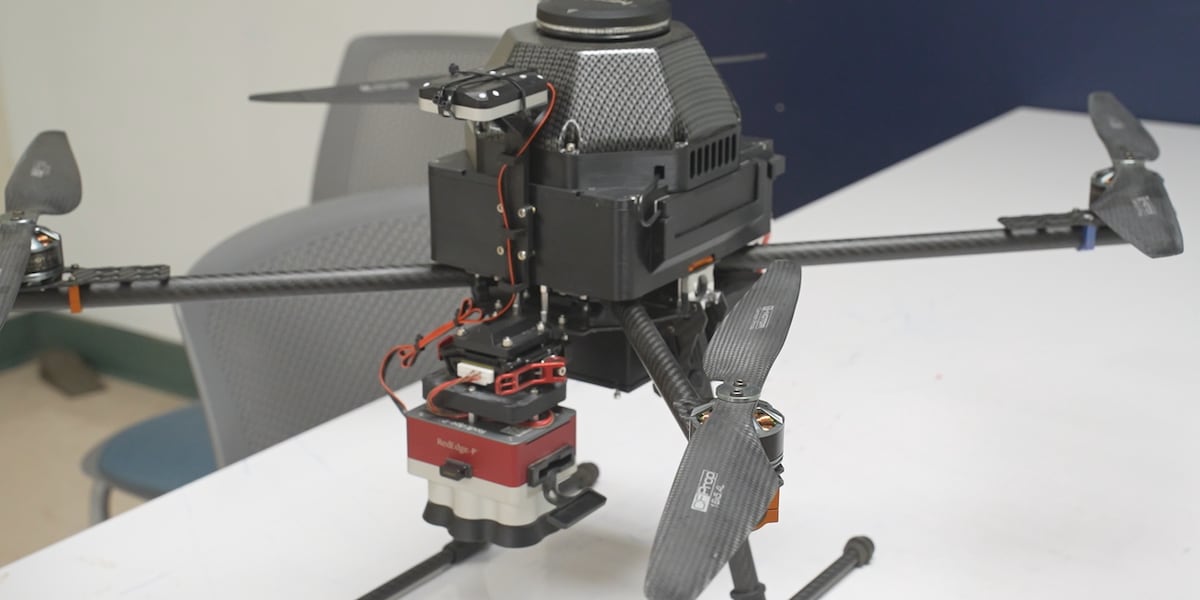
The team — which includes doctoral candidate Zach Karg, senior engineering students Carson Daly and Stirling Wallace, and faculty advisor Prasoon Diwakar — is building custom drones equipped with multispectral cameras that analyze light to assess crop and soil health
The drones capture data about light reflected from crops, which researchers then analyze to identify nutrient deficiencies, water stress and early signs of disease before they are visible to the human eye. The team is also incorporating cavity ring-down spectroscopy to detect and measure trace gases in the soil
“The core of this project is precision agriculture,” Diwakar said. “If we can help farmers know exactly which parts of a field need attention, farmers can reduce fertilizer use, lower costs and minimize the adverse effects on the soil.”
The project is part of the Advancement of Microbial Technologies for Sustainable Agriculture, known as AMiTSA — a $4 million, National Science Foundation-funded collaboration led by South Dakota State University now in its third year. North Dakota State University and Sitting Bull College are also part of the effort
The broader AMiTSA project explores microbial-based fertilizers that use naturally occurring bacteria to make nutrients more available to plants. Mines professors Rajesh Sani and Tanvi Govil are working on developing the microbial consortia that would be introduced to test fields
“We want to have a complete picture of the ecosystem — the plant health from the drone, the soil respiration as well as the ground truth detection, what is actually in the soil,” Karg said
Both Karg, who grew up on a family farm near Sterling, Colo., and Daly, who grew up near Philip, S.D., bring agricultural backgrounds to the project. Diwakar said that connection is important to the research’s real-world value
“We can do things in the lab, but unless we go out and talk to the farmers and see whether the technologies are useful, the research is insignificant,” Diwakar said. “Carson and Zach help bridge the gap because they understand both the technology and the farming community.”
Karg said the financial pressures facing producers are part of what drives his work
“My dad has been farming since he was 18,” Karg said. “Fertilizer costs continue to rise while market prices don’t necessarily keep pace. We’re working on tools that can help producers apply nutrients more efficiently and get more value from what’s already in their soil.”
For Wallace, the fieldwork reinforces the purpose behind the lab research
“It’s easy to get lost in the weeds, so to speak, so going out and seeing what we’re actually doing — that there’s actually test plots and what we’re doing is actually going to be helping the world of agriculture is a great feeling,” Wallace said
The team is spending the summer validating their models and sensors and establishing a baseline before introducing microbes to test fields next summer
See a spelling or grammatical error in our story? Pleaseclick hereto report it
Do you have a photo or video of a breaking news story?Send it to us herewith a brief description
Copyright 2026 KOTA. All rights reserved
