


Credit: Zain bin Awais / Mashable / Getty Images
Table of Contents
I’m someone who smashes TikTok’s “Not Interested” button like I’m getting paid per click.
Content about losing weight, eating clean, or glow-ups have become an easy target for my lightning quick thumbs. Post about how healing your gut microbiome also made you lose 20 pounds? Not interested. The latest Serena Williams Ro ad? Certainly not interested! Vlog about packing a palm-sized, crumb-filled “snack” tin? What did I say? Not. Interested!!
I believed in that precious button. I thought it was a tool in the fight against companies hawking GLP-1s or weight loss apps and creators platforming unhealthy body transformations while disguising unhealthy eating habits as trends
You May Also Like
More than 30 million Americans will have an eating disorder in their lifetime — and every 52 minutes a person dies as a direct consequence of an eating disorder, according to the Strategic Training Initiative for the Prevention of Eating Disorders (STRIPED). Meanwhile, our federal government is funneling taxpayer money into ads that call people in larger bodies “nasty,” all while slashing at affordable food programs, healthcare, and federal food regulation.
I’ve worked hard to keep that messaging out of my life, but I’ve noticed that weight loss influencers still frequently infiltrate my daily scroll. About every third ad is for a weight loss service. I’m seeing GLP-1 influencers more than my friends. What’s going on, “Not Interested” button?
If you are like me, shouting disinterest to the TikTok algorithm gods, I have horrible news. It doesn’t appear to do anything.
TikTok’s “Not Interested” button isn’t what you think
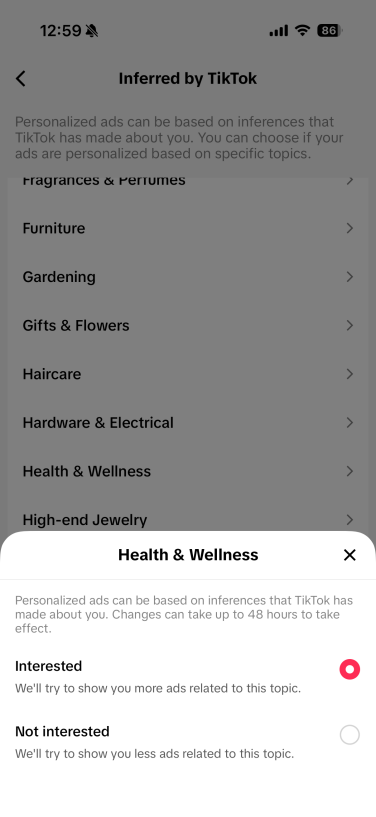
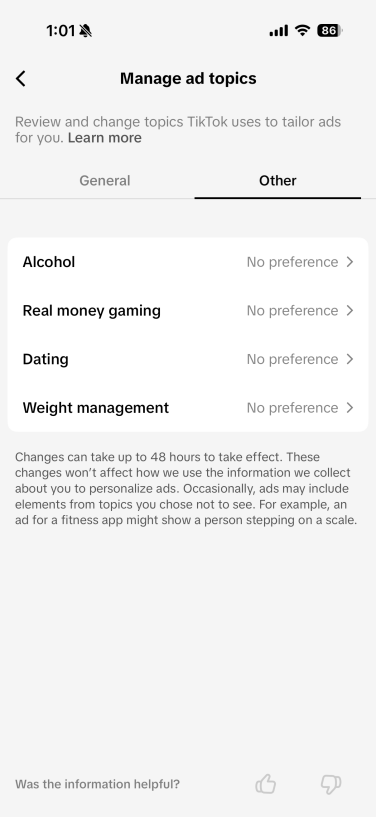
After what I would estimate was years of trying to curate my FYP, check out what my advertising settings looked like when I went over them last month:
Credit: Mashable screenshot / TikTok
Credit: Mashable screenshot / TikTok
Health & Wellness: Interested. Weight management: No preference
Well. I thought I had made my preferences and interests pretty clear, actually
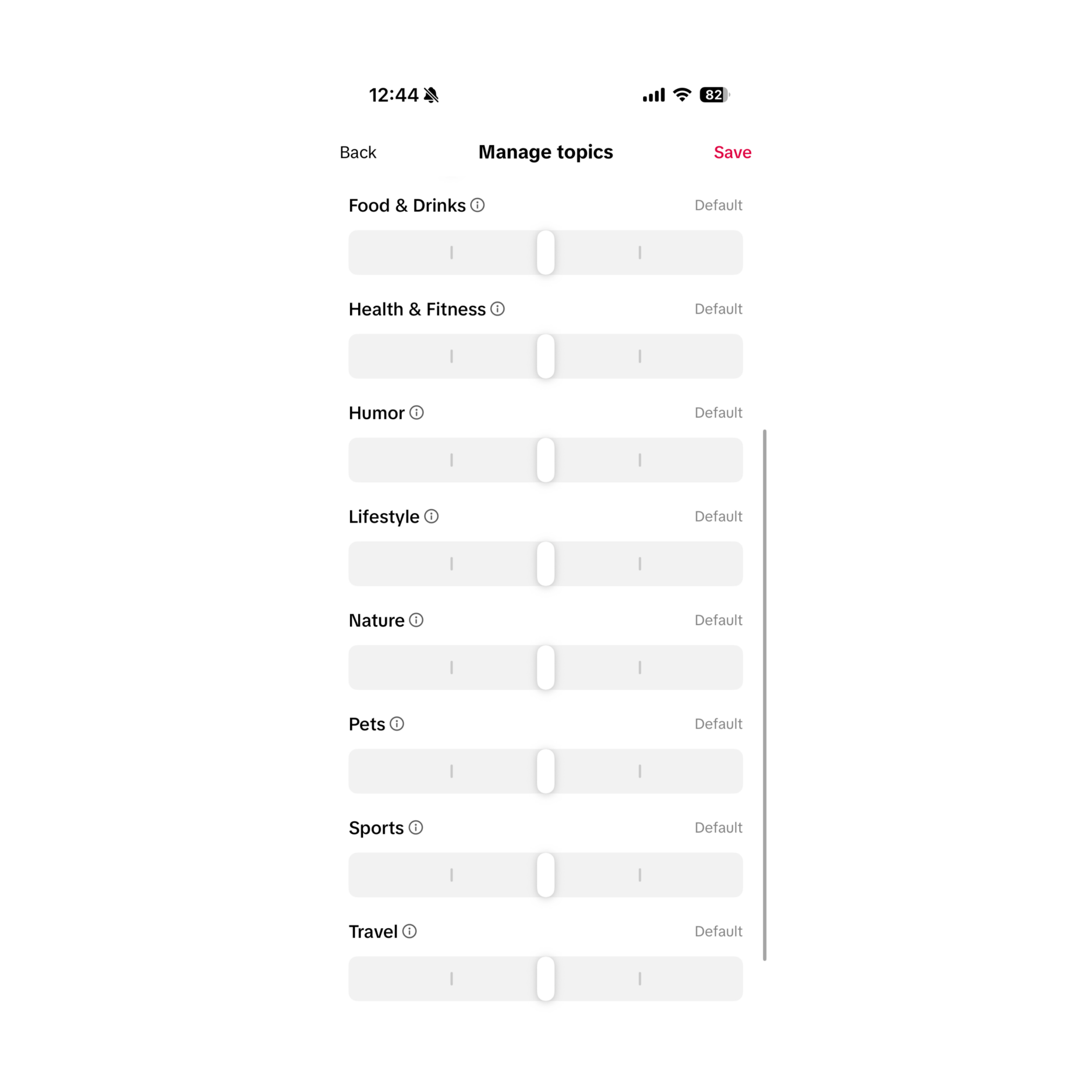
I also looked at my content topic preferences, which users can edit using a sliding scale from “See More” to “See Less.” They were all still set to the default, including “Health and Fitness.” This is the closest to weight-related settings on this page, since there isn’t a specific sliding scale for weight loss or body-focused content.
Credit: Mashable screenshot / TikTok
TikTok’s own advertising guidelines prohibit “exaggerated or harmful weight loss or muscle gain claims” and products such as fat burning pills, appetite suppressants, and weight loss or detox foods. The app’s community guidelines ban content that promotes disordered eating and risky weight management behaviors, including sponsored content from creators. The company says its “goal is to foster a body-positive and inclusive environment” and the platform hosts a large community of body positive creators, several I follow.
And yet
I had incorrectly assumed that by smashing “Not Interested,” TikTok was also automatically changing my account settings. It’s not. Instead, “Not Interested” is more like a thumbs down, adjusting how the algorithm is categorizing me and my interests in a much more simple manner. If I hit “Not Interested” on one GLP-1 creator, or even go as far as blocking their page, it would continue to show me others. It’s not registering that I don’t want to see any content like that, just that I didn’t enjoy scrolling by that one.
To be fair to the billion dollar company, the button wasn’t designed or advertised to act the way I and others users think it does. But research has found that it may not be effective at its intended purpose, limiting specific content, either.
A recent Northeastern study used hundreds of bot accounts to test the impact of the tool — which researchers still called “the most effective explicit” signal to the algorithm — on user agency. It found that video topics can reappear mere minutes after hitting the button under these conditions
“Worse, we find that once accounts cease to indicate disinterest in a topic, many find their feeds dominated by such content again,” the study authors write. TikTok declined to comment on the research.
Content settings: Solution or part of the problem?
That’s not to say you shouldn’t user TikTok’s “Not Interested” button. It’s also not the end all be all of personal content moderation on the platform. In fact, there’s a plethora of settings users may not know exist. Specific content control tools and ad preferences — included ones related to weight loss and nutrition — are embedded deep in profile settings
Mashable Trend Report
By clicking Sign Me Up, you confirm you are 16+ and agree to our Terms of Use and Privacy Policy.
What I changed in my TikTok settings
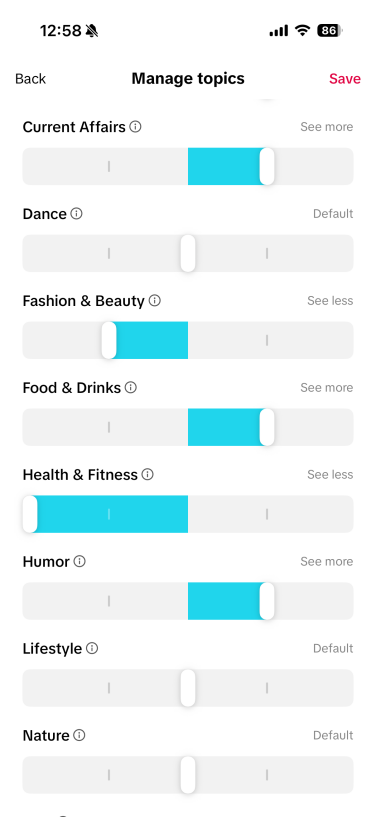
For content preferences (at the top of your settings), I moved “Health and Fitness” all the way to “see less” and adjusted “Fashion & Beauty” as well, just to be safe
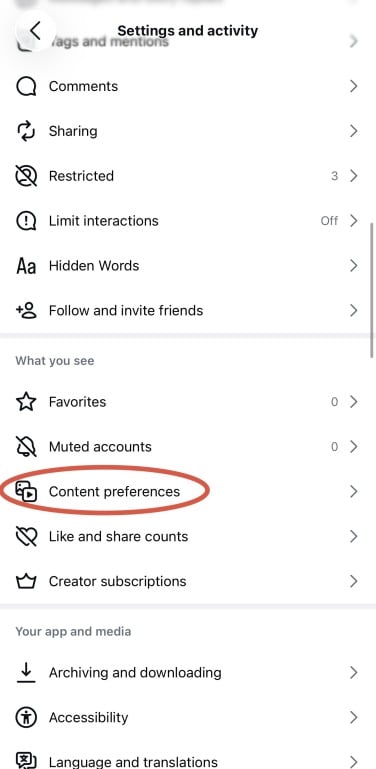
Then, I scrolled to the bottom of my settings to find ad controls. I clicked “manage ad topics” to adjust specific types of content and “mute advertisers” to hide accounts. I adjusted every related setting to the equivalent of “Not Interested,” including removing any personal user details that could potentially indicate my interest (like my gender and age) under “edit personal details.” To find settings for “weight management,” I had to select “Other” under “manage ad topics.”
I cleaned out TikTok’s “inferred” preferences, too. Yes, you can see what assumptions TikTok has made of you. I recommend you take a look.
Credit: Mashable screenshot / TikTok
Credit: Mashable screenshot / TikTok
The app gave me notice: I may have to wait 48 hours to see any changes. Finally, I thought, these may actually do something
I gave the app the full two days, waiting to see a change… and I kept waiting. In fact, I am still waiting, months later.
Not long after I changed my settings and began testing the “Not Interested” button more intentionally, the ads seemed to only get worse, just like the Northeastern researchers posited. I started screenshotting every ad I got just out of pure incredulity. Here’s a sampling:
May 9: Two Wegovy semaglutide injection ads.
May 14: A sponsored vlog from an account named “Lily Nurse&Lifestyle” with the caption “Unrecognizable ✨ #tryeden #glp1community #fyp”
May 27: One ad for TrimRX. One for Hers’ Wegovy subscription. A vlog of a woman who “mysteriously” lost half her body weight.
May 30: A Ro ad, featuring images of semaglutide injection pens and the Wegovy pill. An ad from BitePal: Food Calorie Tracker showing possibly AI-generated women wearing anatomical onesies with fat pads attached. A vlog from a GLP-1 influencer with the caption “How to get started on a GLP-1 🤍”
Nearly two months after first reporting this story, I am still inundated with ads
I blocked Ro. And yet there the brand was…Credit: Mashable
Instagram and weight loss content: What to know
I recognize it’s not just a problem for TikTok, so I also explored Instagram’s tools to personalize content and reconfigure user preference profiles
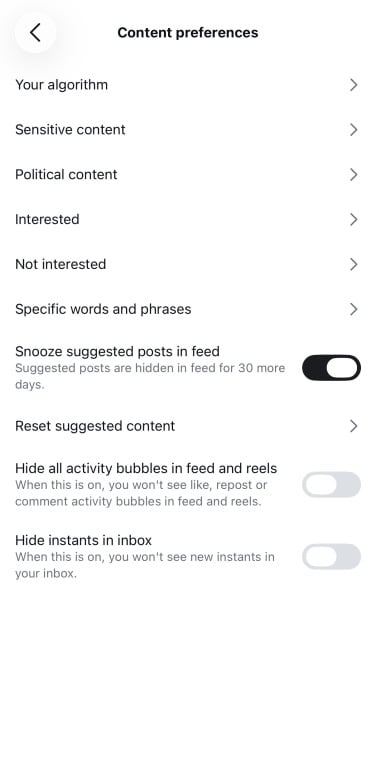
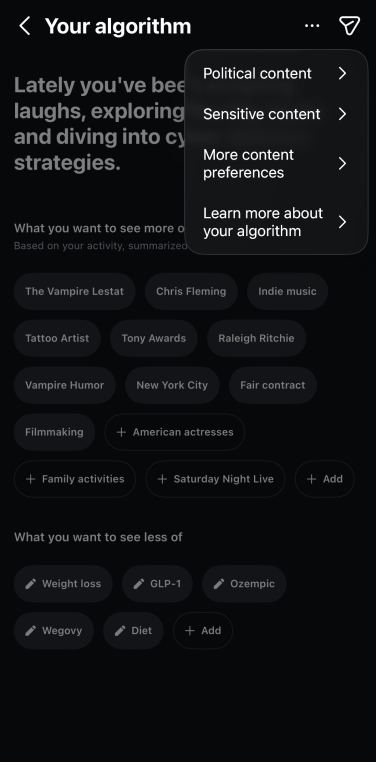
Under content preferences, users can see and edit their own algorithm, including things you want to encounter less. Unlike TikTok, users can also “snooze” suggested content from profiles you don’t follow for 30 days at a time. (Do that.)
Credit: Mashable screenshot
What Instagram knows about me right now.Credit: Mashable screenshot
But here is the real difference between the two platforms, experts told me: Unlike TikTok, Instagram’s main feed is not designed to show you a never ending flow of content from people you don’t follow
Yes, you can go to the app’s explore page. Yes, the app can inject suggested content into your scroll. But you can also avoid those things much easier than on TikTok (who actually uses the “Following” tab over there?), and stick with only the accounts you have carefully chosen to pay attention to.
I checked my settings, which are linked across Meta platforms like Facebook, and adjusted them only marginally. As long as I stick to my main feed, I haven’t had as much of a problem
This isn’t to say Instagram is perfect. In fact, parent company Meta was recently found liable for misleading consumers about the safety of its platforms when it came to mental health and content tools. But I feel a bit better over there. For now
In the midst of a growing frustration with my feeds — that I have still not solved
I asked Jessica Scheer, CEO of the National Eating Disorders Association, why it’s so difficult to protect our feeds, and why GLP-1 ads have seemed to skirt the tools above.
“Because of the political construct we’re in right now,” Scheer said, “we’re seeing much more of a laissez-faire approach to any type of active content moderation on either accounts or algorithm programming.”
“It’s really, really tough, because everybody’s competing for the views, the clicks, the likes,” said Dr. Elizabeth Wassenaar, regional medical director of the Eating Recovery Center. “The algorithms are designed in favor of the creators, not in favor of the consumers.”
And even when platforms have robust controls, weight loss content can very easily slip through the cracks, explains Dr. Blair Burnette, a Michigan State University assistant professor and principal investigator of the ARISE Lab. Videos featuring disordered eating, body checking, and anti-fat sentiment are not easily caught by algorithms trained to scan captions, comment sections, and audio for explicit words and phrases.
Not only are brands still creeping up, but so-called “GLP-1 influencers.”Credit: Mashable
How to clean your feeds, the best you can
If I can offer you one takeaway, it is this: Continuously update your profile settings. Not once, not twice, but consistently.
Scheer says NEDA is still figuring out best practices for being online in this landscape, working alongside clinicians, caregivers, and people with lived experience to determine which tools work, which ones don’t, and how tech companies can step up. But in the meantime, routine (or even clinician-supported) audits of your feeds are crucial. “Algorithms re-train slowly so repetition is key,” the organization writes.
“Oftentimes, these fixes are only temporary,” said Scheer. “It only really helps you, maybe, for a few sessions, and then you might have to recalibrate yet again.”
Burnette told me she is also still figuring out the best advice for patients who want to stay online while in recovery. But there are ways to regain some control.
She recommends her patients utilize device screen time limits and additional time-limiting apps like Roots. She suggests following new forms of content and purging your following list regularly. You have to be intentional in who you choose to follow, Burnette advises, like creators who are specifically anti-diet or accounts that never post images of their bodies.
This advice works just as effectively for those who aren’t in active recovery. If your feed isn’t working anymore, scrap it. If something feels off about accounts you’ve followed for years, block them. If your phone is causing more anxiety than joy, put it down. Don’t be precious about it, either. That’s how Big Tech (and its sneaky older sibling Big Pharma) want you to feel.
If you feel like you’d like to talk to someone about your eating behavior, text “NEDA” to the Crisis Text Line at 741-741 to be connected with a trained volunteer or visit the National Eating Disorder Association websitefor more information
TopicsHealthInstagramMental HealthSocial GoodTikTok
Social Good Reporter
Chase joined Mashable’s Social Good team in 2020, covering online stories about digital activism, climate justice, accessibility, and media representation. Her work also captures how these conversations manifest in politics, popular culture, and fandom. Sometimes she’s very funny
