


Download PDF
Abstract
Artificial intelligence is reshaping population medicine and public health, yet the same systems that generate insight can amplify misleading content and blur where evidence ends and AI fabrication begins. This perspective offers a four-level harm-reduction framework, comprising responsible population selection, data governance, public engagement, and transparent dissemination, illustrated through six case strategies. The aim is operationalizing responsible AI in population health research without slowing the innovation the field needs.
Subjects
- Health care
- Medical research
- Scientific community
Introduction
Population medicine and public health are being remade by artificial intelligence (AI). Federated learning is being tested against the data-silo problem that has long constrained pandemic surveillance1. Foundation models trained on multi-source data are improving early warning for infectious disease2. Edge computing is moving inference into resource-constrained settings where bandwidth, not capability, has been the bottleneck. Yet the same systems that generate insight can generate harm. Large language models (LLMs) and generative tools can produce convincing inaccuracies that undermine both public understanding and confidence in science, with consequences that fall hardest on already-marginalized populations3.
In population health research specifically, the dominant threat is not intentional disinformation by researchers. The more plausible scenario looks like this: a team rushing a rapid-response preprint during an emerging outbreak uses an LLM to summarize prior literature, and a fabricated citation slips through review and into public discourse, where it is cited downstream as evidence4
False content of this kind functions as a public health hazard. AI chatbots have been shown to present false medical claims with confidence, reproduce demographic biases, and personalize misleading content in ways that make it more persuasive5. At the individual level, false content misleads people about symptoms and prevention. At the community level, it weakens trust and widens disparities. Coordinated bot campaigns on social media have cast doubt on election integrity, and claims that certain racial groups experience pain differently continue to circulate online, contributing to the dismissal of symptoms in already marginalized patients6,7. At the societal level, false content fuels policy resistance and vaccine hesitancy8. During the 2025 U.S. government shutdown, AI-generated videos pushing racist narratives about SNAP recipients drew millions of views, with measurable implications for public opinion about food assistance9.
AI-generated misinformation is a clear illustration of risk, but it is one of several harms that arise when AI is integrated into public health research without safeguards. Others include participant burden, privacy and re-identification failures10, opaque automation in evidence synthesis11, and inequitable access to AI infrastructure12. Preventing them requires more than technical fixes; it requires ethical research design. The methods featured in this collection of articles on AI for Population Medicine and Public Health will translate into improved population health only if harm reduction is built in from the start.
The framework that follows is grounded in a public health staple: harm reduction. Six case strategies, drawn from the author’s program of work and the broader literature, are organized into four levels that researchers can enter at different points depending on study design and risk. The framework’s main objective is to anticipate AI-related harm rather than correct it after the fact. It works by placing safeguards at each point where AI risk can turn into public health harm, through responsible population selection, data governance, public engagement, and transparent dissemination.
Strategies to consider
Testing multi-modal large language models in low-risk educational environments
Using student populations as test groups for AI-based health tools allows new multimodal large language models (MLLMs) to be evaluated for feasibility before they reach patients or caregivers. In our work, health sciences students role-played as family caregivers within a structured research design, completing ecological momentary assessment (EMA) prompts while MLLMs analyzed the data for emotional content and unmet need13. Embedded in coursework, the design supports both pedagogical growth and model validation, and it builds AI literacy in a workforce that will inherit these tools14. Simulation-based study designs have a long history in the health professions for exactly this reason; they let learners and researchers stress-test a system without exposing real patients to the cost of getting it wrong15.
Using publicly available online data
Publicly accessible datasets such as online caregiver forums and open social media posts allow LLM-based methods to be evaluated without imposing new data-collection burdens. In our analysis of brain tumor patient and caregiver discussions, natural-language processing surfaced emotional themes and support-seeking behaviors that would have been costly and intrusive to elicit through recruitment16. A word of caution is warranted: “publicly available” does not mean “ethically neutral.” Some online communities have explicitly asserted agency over how their content is used, and contextual integrity matters as much as access17. Ethical oversight in our studies included institutional ethics review, removal of direct and indirect identifiers, exclusion of unverifiable medical claims, and iterative screening for re-identification risk. Ethics is only half the work, while quality control is the other half. We verified the provenance of each source, screened for duplicated or manipulated posts, and checked whether the sampled communities reflected the populations we meant to describe before drawing inferences.
Machine learning on secondary datasets offers an adjacent approach. Our analysis of county-level U.S. cancer death rates used random-forest models against publicly available national datasets18. Reusing well-documentedibility. That transparency matters for AI specifically: subgroup analyses and audit metrics can surface bias and drift earlier than is possible in opaque or proprietary settings19
Integrating AI-related questions into systematic reviews
Systematic reviews offer a controlled context for examining how AI shapes evidence synthesis. In a recent systematic review of noncommunicable diseases using satellite imagery, our team assessed whether included studies relied on AI to process or interpret image-derived data20. AI was not the review’s primary focus, but the question revealed emerging patterns in automation, interpretation, and reproducibility that would otherwise have been invisible. Explicitly asking how AI shaped each included study reduces epistemic harm from opaque automation, improves transparency in synthesis, and helps prevent downstream misinterpretation in policy and practice11. The same question can guard against epistemic injustice. When automated tools underrepresent or misread data from already marginalized groups, asking where AI entered the evidence helps reviewers see whose knowledge was discounted before those gaps harden into policy21. In this way, systematic reviews can function as checkpoints, not only summaries.
Securing safe testing environments through vendor partnerships
Academic–industry collaboration is increasingly necessary to ensure that AI research occurs within secure digital environments. Our team has negotiated with technology vendors for temporary credits on HIPAA-compliant AI testing platforms, allowing data workflows to be piloted without compromising institutional governance. Such arrangements also democratize access; smaller institutions and early-career researchers can explore AI methods without prohibitive cost22. The principle is shared accountability. In our work, the research team controlled the data access, de-identification, and analytic decisions, while vendors maintained the platform-level safeguards such as audit logs, access controls, and security monitoring. Protocols and anticipated risk scenarios were reviewed jointly before deployment, and any unexpected system behavior was documented in both directions. Vendors gained safety and usability feedback; researchers retained ethical control over data handling. These arrangements also make the safeguards trustworthy, because they can be checked rather than taken on faith. In this way, every data action is logged, and one party stays answerable when something looks wrong23.
Using synthetic data to protect privacy and reduce risk
Synthetic data, defined as data generated by a purpose-built mathematical model or algorithm to support a defined data-science task24, offers another route to privacy protection. Because synthetic records do not map one-to-one to real individuals, they reduce re-identification risk while preserving useful correlation structures25. The approach aligns directly with the privacy-preserving methods at the center of this collection’s call; federated learning, differential privacy, and synthetic-data generation are complementary tools for population-scale research that does not require pooling identifiable records1.
Caveats matter, however. When a generative model overfits or inherits distortions from its training data, synthetic records can amplify those biases25,26. Audit metrics and explainable-AI methods help researchers detect this drift before AI-derived findings reach decision-makers26. With those safeguards, synthetic data lowers participant burden and re-identification risk
Engaging communities through transparent communication
Perhaps the most overlooked harm-reduction strategy is early, authentic engagement with the public. The author and a colleague recently presented at a TED Talk-style event at our university, explaining how AI and caregiving science come together in our research27. The talk gave community members an opportunity to question, push back, and share perspectives; the recording allowed later asynchronous reach. Engagement of this kind functions as a “social audit” for AI research, helping to detect potential misinterpretation before it spreads. It is not a substitute for technical safeguards such as red-teaming or preference fine-tuning, which sit largely outside the scope of public health research teams. Rather, social audits address a complementary risk: how AI outputs may be misinterpreted or overextended as they move from research into the wider public conversation. Authentic engagement asks for more than a single talk. A presentation that invites questions is a starting point, not the same as the sustained, two-way dialogue in which community members can actually shape how a tool is built; what matters is whether the conversation continues and whether community input changes the work.
Community engagement also gives historically underserved populations a voice in AI-enabled public health research. The National Institutes of Health’s AIM-AHEAD (Artificial Intelligence/Machine Learning Consortium to Advance Health Equity and Researcher Diversity) Coordinating Center, for example, ran listening sessions whose dominant themes included a need for researchers to translate AI concepts into vignettes and a desire for open-science data access28. Listening sessions of this kind come closer to genuine engagement when they are paired with meaningful follow-up rather than treated as a one-time consultation.
A framework for anticipating and reducing harm
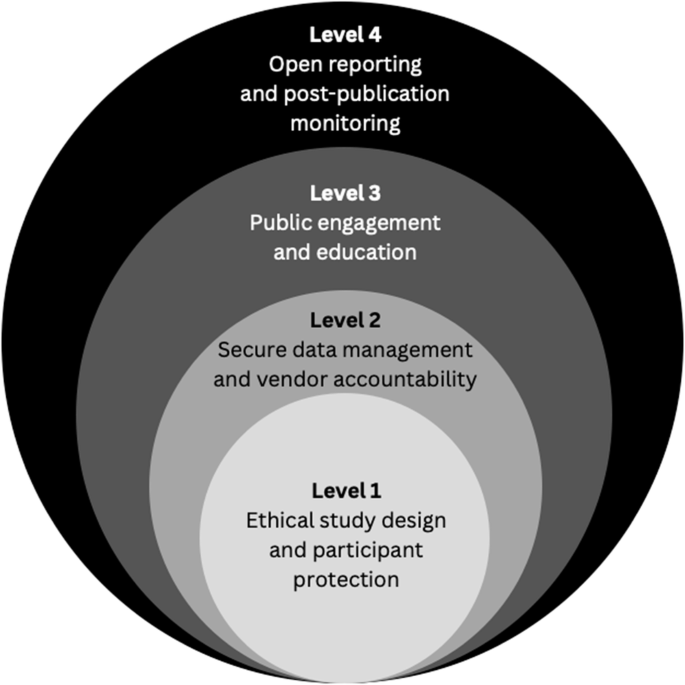
Each strategy above corresponds to a distinct intervention point along the pathway from AI risk to public health harm, summarized in Table 1 and conceptualized in Fig. 1. In this framework, “exposure” means encountering AI-generated content before its underlying model and workflow have been adequately vetted — content that may mislead, stigmatize, or violate privacy. Some strategies (population selection, synthetic data, vendor partnerships) operate upstream to limit exposure to technical risks. Others (community engagement, transparent dissemination) operate downstream to detect and correct interpretive and communicative failures.
This conceptual framework depicts four concentric levels representing strategies to reduce the risks of false or misleading content in AI-enabled public health research
Figure 1 organizes the strategies into four levels. At Level 1, responsible population selection — through student simulations or secondary data — keeps early AI testing in low-risk settings. This protects vulnerable individuals from bearing the cost of methodological refinement. Level 2 addresses data governance through secure environments and vendor oversight, reducing risks of unauthorized reuse, re-identification, and unvetted secondary analysis. Level 3 emphasizes public engagement and education to counteract misperception. Level 4 embeds transparency into dissemination through method documentation, AI-use disclosure, and invited replication.
The layered structure mirrors public-health prevention models: primary prevention (avoiding harm), secondary prevention (detecting early incidents), and tertiary prevention (reducing impact). Applied to AI, the tiers create a system that anticipates harm rather than reacting to it. The framework is intentionally adaptable across study designs, institutional contexts, and stages of AI integration; researchers can enter at the level that matches their risk and goals
How the framework operates depends on context. The same strategy looks different in a large hospital system and a rural health department, so the levels mark where to intervene rather than prescribe a fixed procedure. The framework is also meant to learn from its own use. Each application leaves something worth keeping: a social audit shows how a finding was misread, an audit log flags an unexpected data flow, an ethics board raises a question no one anticipated. Feeding those lessons into the next study turns a static checklist into a practice that grows richer as the field gains experience with AI.
Discussion and future directions
Responsible AI in population health is as much a cultural transformation as a technical one. The strategies described here suggest that prevention begins inside the research process itself, through population ethics, data stewardship, and open communication. Several priorities follow
First, reporting guidelines for AI use in population health manuscripts should be standardized, building on existing CONSORT-AI29 and PRISMA-AI11 extensions. Emerging efforts such as TRIPOD-LLM30 and GUIDE-LLM31 offer additional structure specific to large language models. Second, AI ethics training should be embedded into public-health and medical curricula to produce a workforce fluent in both data science and community values14,32. Third, interdisciplinary partnerships should include computer scientists, ethicists, and community leaders from project inception33,34. Fourth, early-warning systems for AI-generated false content should pair machine learning with human fact-checking networks35,36.
Barriers remain. Many institutions lack secure AI infrastructure, regulatory expectations are still evolving, and IRB experience with AI is uneven. None of these is intractable. Collective governance can address them, particularly when funding agencies and journals reward transparency and harm-reduction design22,37. For non-technical public health researchers, the entry points are practical: pilot AI tools in simulated settings, then pair AI outputs with human review before scaling
Conclusion
Preventing AI-related harm in population medicine and public health requires moving from reactive correction to proactive ethics. The strategies presented here illustrate how researchers can operationalize harm reduction in practice, transforming potential risks into educational and methodological safeguards. Transparent, inclusive research strengthens public trust, and in both health communication and AI work, trust is what keeps findings useful in practice. Built in from the start, this kind of practice is what lets AI’s contributions to public health hold up over time.
Data availability
No datasets were generated or analysed during the current study
References
Rieke, N. et al. The future of digital health with federated learning. npj Digit Med3, 119 (2020)
Moor, M. et al. Foundation models for generalist medical artificial intelligence. Nature616, 259–265 (2023)
Rodrigues, F. et al. The social media infodemic of health-related misinformation and technical solutions. Health Policy Technol.13, 100846 (2024)
Walters, W. H. & Wilder, E. I. Fabrication and errors in the bibliographic citations generated by ChatGPT. Sci. Rep.13, 14045 (2023)
Meyrowitsch, D. W., Jensen, A. K., Sørensen, J. B. & Varga, T. V. AI chatbots and (mis)information in public health: impact on vulnerable communities. Front Public Health11, 1226776 (2023)
Adams, Z., Osman, M., Bechlivanidis, C. & Meder, B. Why) is misinformation a problem? Perspect. Psychol. Sci.18, 1436–1463 (2023)
Hoffman, K. M., Trawalter, S., Axt, J. R. & Oliver, M. N. Racial bias in pain assessment and treatment recommendations, and false beliefs about biological differences between blacks and whites. Proc. Natl. Acad. Sci. USA113, 4296–4301 (2016)
American Psychological Association. Misinformation vs. disinformation. 2025. https://www.apa.org/topics/journalism-facts/misinformation-disinformation
Kaiser Family Foundation. Fake AI-generated videos perpetuate stereotypes about SNAP recipients, and new KFF poll looks at belief in the false claim that undocumented immigrants are eligible for ACA coveragehttps://www.kff.org/health-information-trust/fake-ai-generated-videos-perpetuate-stereotypes-about-snap-recipients-and-new-kff-poll-looks-at-belief-in-the-false-claim-that-undocumented-immigrants-are-eligible-for-aca-coverage/ (2026). Published March 2025. Accessed January 4
Rocher, L., Hendrickx, J. M. & de Montjoye, Y. A. Estimating the success of re-identifications in incomplete datasets using generative models. Nat. Commun.10, 3069 (2019)
Cacciamani, G. E. et al. PRISMA AI reporting guidelines for systematic reviews and meta-analyses on AI in healthcare. Nat. Med29, 14–15 (2023)
Ibrahim, H., Liu, X., Zariffa, N., Morris, A. D. & Denniston, A. K. Health data poverty: an assailable barrier to equitable digital health care. Lancet Digit Health3, e260–e265 (2021)
Muasher-Kerwin C., Hughes M. C., Sanatizadeh A., Mayer J. F., Alhoori H. Harnessing multimodal large language models to interpret ecological momentary assessment-generated caregiving photographs. Discov Artif Intell. 2026;6. https://doi.org/10.1007/s44163-026-00879-z
Acosta, J. A. Perspective: advancing public health education by embedding AI literacy. Front Digit Health7, 1584883 (2025)
Cook, D. A. et al. Technology-enhanced simulation for health professions education: a systematic review and meta-analysis. JAMA306, 978–988 (2011)
Muasher-Kerwin C., Hughes M. C., Foster M. L., Al Azher I., Alhoori H. Exploring large language models for summarizing and interpreting an online brain tumor support forum. Digit Health. 2025. https://doi.org/10.1177/20552076251337345
Nissenbaum H. Privacy in Context: Technology, Policy, and the Integrity of Social Life. Stanford University Press; 2010
Guo L. R., Hughes M. C., Wright M. E., Harris A. H., Osias M. C. Geospatial hotspots and coldspots in US cancer disparities and associated risk factors, 2004-2008 to 2014-2018. Prev Chronic Dis. 2024
Rajkomar, A., Hardt, M., Howell, M. D., Corrado, G. & Chin, M. H. Ensuring fairness in machine learning to advance health equity. Ann. Intern. Med.169, 866–872 (2018). Dec 18
Folkmann, E., Hughes, M. C., Khan, U. & Vaezi, M. Examining noncommunicable diseases using satellite imagery: a systematic review. BMC Public Health24, 2774 (2024)
Pozzi, G. Testimonial injustice in medical machine learning. J. Med Ethics49, 536–540 (2023)
Wagner, J. K., Doerr, M. & Schmit, C. D. AI governance: a challenge for public health. JMIR Public Health Surveill.10, e58358 (2024)
Jordon J., et al. Synthetic data—what, why and how? arXiv preprint arXiv:2205.03257. Published May 6, 2022
Reddy, S., Allan, S., Coghlan, S. & Cooper, P. A governance model for the application of AI in health care. J. Am. Med Inf. Assoc.27, 491–497 (2020)
Giuffrè, M. & Shung, D. L. Harnessing the power of synthetic data in healthcare: innovation, application, and privacy. npj Digit Med6, 186 (2023)
Hao S., et al. Synthetic data in AI: challenges, applications, and ethical implications. arXiv preprint arXiv:2401.01629. Published January 3, 2024
Hughes M. C., Muasher-Kerwin C. Caring with code: the role of AI in caregiving. Huskie Trek Talks. DeKalb, IL; 2025. https://www.youtube.com/watch?v=2SHNnKQX9e8
Vishwanatha, J. K. et al. Community perspectives on AI/ML and health equity: AIM-AHEAD nationwide stakeholder listening sessions. PLOS Digit Health2, e0000288 (2023)
Ibrahim, H. et al. Reporting guidelines for clinical trials of artificial intelligence interventions: the SPIRIT-AI and CONSORT-AI guidelines. Trials22, 11 (2021)
Gallifant, J. et al. The TRIPOD-LLM reporting guideline for studies using large language models. Nat. Med31, 60–69 (2025). Jan
GUIDE-LLM. Reporting checklist for studies using large language models. https://llm-checklist.com/ Accessed May 2026. Peer-review status pending
Syeda, L. H., Batool, Z., Hayder, Z. & Ali, S. Medical undergraduate students’ awareness and perspectives on artificial intelligence: a developing nation’s context. BMC Med Educ.25, 1060 (2025)
Ammeling, J. et al. An interdisciplinary perspective on AI-supported decision making in medicine. Technol. Soc.81, 102791 (2025)
Gisselbaek, M. et al. Bridging the gap between scientists and clinicians: addressing collaboration challenges in clinical AI integration. BMC Anesthesiol.25, 269 (2025)
Park P. S., Goldstein S., O’Gara A., Chen M., Hendrycks D. AI deception: a survey of examples, risks, and potential solutions. Patterns. 2024;5
Feher, D., Khered, A., Zhang, H., Batista-Navarro, R. & Schlegel, V. Learning to generate and evaluate fact-checking explanations with transformers. Eng. Appl Artif. Intell.139, 109492 (2025)
Wendelborn, C., Anger, M. & Schickhardt, C. Promoting data sharing: the moral obligations of public funding agencies. Sci. Eng. Ethics30, 35 (2024)
Funding
This study received no funding
Author information
Authors and Affiliations
Professor and Interim Associate Dean for Research and Administration, College of Health and Human Sciences, Northern Illinois University, DeKalb, IL, USA
M. Courtney Hughes
Authors
- M. Courtney HughesView author publications
Search author on:PubMed Google Scholar
Contributions
M.C.H. conceived the framework, drafted the manuscript, and approved the final version for submission
Ethics declarations
Competing interests
The author declares no competing interests
Additional information
Publisher’s note Springer Nature remains neutral with regard to jurisdictional claims in published maps and institutional affiliations
Rights and permissions
Open Access This article is licensed under a Creative Commons Attribution 4.0 International License, which permits use, sharing, adaptation, distribution and reproduction in any medium or format, as long as you give appropriate credit to the original author(s) and the source, provide a link to the Creative Commons licence, and indicate if changes were made. The images or other third party material in this article are included in the article’s Creative Commons licence, unless indicated otherwise in a credit line to the material. If material is not included in the article’s Creative Commons licence and your intended use is not permitted by statutory regulation or exceeds the permitted use, you will need to obtain permission directly from the copyright holder. To view a copy of this licence, visit http://creativecommons.org/licenses/by/4.0/.
About this article
Cite this article
Hughes, M.C. A harm-reduction framework for responsible AI in public health research.
npj Digit. Public Health1, 24 (2026). https://doi.org/10.1038/s44482-026-00031-9
Received:15 May 2026
Accepted:23 June 2026
Published:04 August 2026
Version of record:04 August 2026
DOI
:https://doi.org/10.1038/s44482-026-00031-9
