


Abstract
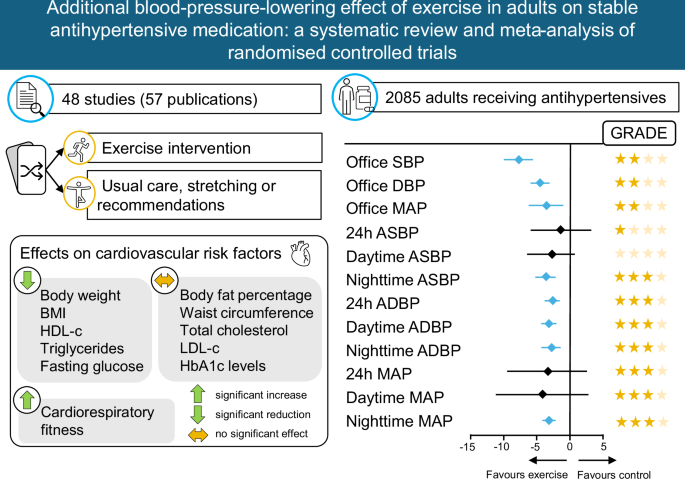
Physical exercise and antihypertensive medications are routinely co-prescribed for treating hypertension. Contemporary international guidelines separately establish the expected effects of pharmacological and exercise interventions. However, meta-analytical evidence assessing the additional effect of exercise on antihypertensive medication is lacking. We conducted a systematic review and meta-analysis of randomised controlled trials evaluating the effects of exercise interventions in adults receiving stable antihypertensive medication. The outcomes included blood pressure parameters, body composition, lipid profiles, glycaemic markers, and cardiorespiratory fitness. Mean differences (MDs) with 95% CIs were pooled using random-effects models, and the risk of bias of the studies was assessed using the RoB2 tool. This systematic review with meta-analysis was registered in PROSPERO (CRD420261277175). Forty-eight studies (2085 participants across 57 publications) fulfilled the inclusion criteria. Compared with usual care on a background of stable medication, exercise reduced office SBP (MD −7.9 mmHg; 95% CI −10.3 to −5.6; I² = 78%) and office DBP (−4.4; −5.8 to −3.1; I² = 64%). The magnitude of these reductions is comparable to that expected from adding a further antihypertensive agent, although the certainty of evidence was low and the prediction intervals were wide. Beyond these effects, significant improvements were observed across multiple outcomes, including office mean blood pressure (MAP), 24 h ambulatory DBP, daytime DBP, nighttime ambulatory blood pressure, body weight, BMI, HDL-c, triglycerides, fasting glucose, and cardiorespiratory fitness. In contrast, no significant between-group differences were observed for changes in 24 h ambulatory SBP, daytime SBP, 24 h MAP, daytime MAP, body fat percentage, waist circumference, total cholesterol, LDL-c, and HbA1c levels. Evidence quality ranged from low to very low for ambulatory SBP, whereas it was moderate for diastolic and nocturnal measurements. No exercise modality (aerobic, resistance, combined, high-intensity interval, or isometric training) was significantly superior to another for any outcome. Adding structured exercise to stable antihypertensive therapy was associated with further reductions in office blood pressure and several ambulatory blood-pressure indices, and with improvements in cardiovascular risk factors; however, given the heterogeneity and risk of bias, the certainty was low to moderate for most estimates, and trials testing exercise-guided medication adjustment are warranted.
This is a preview of subscription content, access
Access options
Access through your institution
- Purchase on SpringerLink
- Instant access to the full article PDF.
39,95 €
Prices may be subject to local taxes which are calculated during checkout
References
McEvoy JW, McCarthy CP, Bruno RM, Brouwers S, Canavan MD, Ceconi C, et al. 2024 ESC Guidelines for the management of elevated blood pressure and hypertension. Eur Heart J. 2024;45:3912–4018. https://doi.org/10.1093/eurheartj/ehae178c
Mills KT, Stefanescu A, He J. The global epidemiology of hypertension. Nat Rev Nephrol. 2020;16:223–37. https://doi.org/10.1038/s41581-019-0244-2
Zhou B, Carrillo-Larco RM, Danaei G, Riley LM, Paciorek CJ, Stevens GA, et al. Worldwide trends in hypertension prevalence and progress in treatment and control from 1990 to 2019: a pooled analysis of 1201 population-representative studies with 104 million participants. Lancet. 2021;398:957–80. https://doi.org/10.1016/S0140-6736(21)01330-1
Brouwers S, Sudano I, Kokubo Y, Sulaica EM. Arterial hypertension. Lancet. 2021;398:249–61. https://doi.org/10.1016/S0140-6736(21)00221-X
Forouzanfar MH, Liu P, Roth GA, Ng M, Biryukov S, Marczak L, et al. Global burden of hypertension and systolic blood pressure of at least 110 to 115 mm Hg, 1990-2015. JAMA. 2017;317:165. https://doi.org/10.1001/jama.2016.19043
Zhou B, Perel P, Mensah GA, Ezzati M. Global epidemiology, health burden and effective interventions for elevated blood pressure and hypertension. Nat Rev Cardiol. 2021;18:785–802. https://doi.org/10.1038/s41569-021-00559-8
Laurent S. Antihypertensive drugs. Pharm Res. 2017;124:116–25. https://doi.org/10.1016/j.phrs.2017.07.026
Correia RR, Veras ASC, Tebar WR, Rufino JC, Batista VRG, Teixeira GR. Strength training for arterial hypertension treatment: a systematic review and meta-analysis of randomized clinical trials. Sci Rep. 2023;13:201. https://doi.org/10.1038/s41598-022-26583-3
Morita H, Abe M, Suematsu Y. Resistance exercise has an antihypertensive effect comparable to that of aerobic exercise in hypertensive patients: a meta-analysis of randomized controlled trials. Hypertens Res. 2025;48:733–43. https://doi.org/10.1038/s41440-024-01998-9
Mancia G, Rosei EA, Azizi M, Burnier M, Clement DL, Coca A, et al. 2018 ESC/ESH Guidelines for the management of arterial hypertension. Eur Heart J. 2018;39:3021–104. https://doi.org/10.1093/eurheartj/ehy339
Baffour-Awuah B, Man M, Goessler KF, Cornelissen VA, Dieberg G, Smart NA, et al. Effect of exercise training on the renin–angiotensin–aldosterone system: a meta–analysis. J Hum Hypertens. 2023;38:89–101. https://doi.org/10.1038/s41371-023-00872-4
Writing Committee Members, Jones DW, Ferdinand KC, Taler SJ, Johnson HM, Shimbo D, et al. 2025 AHA/ACC/AANP/AAPA/ABC/ACCP/ACPM/AGS/AMA/ASPC/NMA/PCNA/SGIM guideline for the prevention, detection, evaluation and management of high blood pressure in adults: a report of the American College of Cardiology/American Heart Association Joint Committee on Clinical Practice Guidelines. Hypertension. 2025;82. https://doi.org/10.1161/HYP.0000000000000249
Law MR, Wald NJ, Morris JK, Jordan RE. Value of low dose combination treatment with blood pressure lowering drugs: analysis of 354 randomised trials. BMJ. 2003;326:1427. https://doi.org/10.1136/bmj.326.7404.1427
Canoy D, Copland E, Nazarzadeh M, Ramakrishnan R, Pinho-Gomes AC, Salam A, et al. Antihypertensive drug effects on long-term blood pressure: an individual-level data meta-analysis of randomised clinical trials. Heart. 2022;108:1281–9. https://doi.org/10.1136/heartjnl-2021-320171
Schneider VM, Domingues LB, Umpierre D, Tanaka H, Ferrari R. Exercise characteristics and blood pressure reduction after combined aerobic and resistance training: a systematic review with meta-analysis and meta-regression. J Hypertens. 2023;41:1068–76. https://doi.org/10.1097/HJH.0000000000003455
Noone C, Leahy J, Morrissey EC, Newell J, Newell M, Dwyer CP, et al. Comparative efficacy of exercise and anti-hypertensive pharmacological interventions in reducing blood pressure in people with hypertension: a network meta-analysis. Eur J Prev Cardiol. 2020;27:247–55. https://doi.org/10.1177/2047487319879786
Edwards JJ, Deenmamode AHP, Griffiths M, Arnold O, Cooper NJ, Wiles JD, et al. Exercise training and resting blood pressure: a large-scale pairwise and network meta-analysis of randomised controlled trials. Br J Sports Med. 2023;57:1317–26. https://doi.org/10.1136/bjsports-2022-106503
Naci H, Salcher-Konrad M, Dias S, Blum MR, Sahoo SA, Nunan D, et al. How does exercise treatment compare with antihypertensive medications? A network meta-analysis of 391 randomised controlled trials assessing exercise and medication effects on systolic blood pressure. Br J Sports Med. 2019;53:859–69. https://doi.org/10.1136/bjsports-2018-099921
Hanssen H, Boardman H, Deiseroth A, Moholdt T, Simonenko M, Kränkel N, et al. Personalized exercise prescription in the prevention and treatment of arterial hypertension: a Consensus Document from the European Association of Preventive Cardiology (EAPC) and the ESC Council on Hypertension. Eur J Prev Cardiol. 2022;29:205–15. https://doi.org/10.1093/eurjpc/zwaa141
Cornelissen VA, Smart NA. Exercise training for blood pressure: a systematic review and meta-analysis. J Am Heart Assoc. 2013;2:e004473. https://doi.org/10.1161/JAHA.112.004473
Pescatello LS, Wu Y, Gao S, Livingston J, Sheppard BB, Chen MH. Do the combined blood pressure effects of exercise and antihypertensive medications add up to the sum of their parts? A systematic meta-review. BMJ Open Sport Exerc Med. 2021;7:e000895. https://doi.org/10.1136/bmjsem-2020-000895
Higgins J, Thomas J, Chandler J, Cumpston M, Li T, Page M, et al. Cochrane handbook for systematic reviews of interventions. Cochrane; 2024. www.cochrane.org/handbook
Page MJ, McKenzie JE, Bossuyt PM, Boutron I, Hoffmann TC, Mulrow CD, et al. The PRISMA 2020 statement: an updated guideline for reporting systematic reviews. BMJ. 2021;n71. https://doi.org/10.1136/bmj.n71
Methley AM, Campbell S, Chew-Graham C, McNally R, Cheraghi-Sohi S. PICO, PICOS and SPIDER: a comparison study of specificity and sensitivity in three search tools for qualitative systematic reviews. BMC Health Serv Res. 2014;14:579. https://doi.org/10.1186/s12913-014-0579-0
Sterne JAC, Savović J, Page MJ, Elbers RG, Blencowe NS, Boutron I, et al. RoB 2: a revised tool for assessing risk of bias in randomised trials. BMJ. 2019;l4898. https://doi.org/10.1136/bmj.l4898
Neumann I, Schünemann H. The GRADE Book version 1.0. The GRADE Working Group; 2024. https://book.gradepro.org
Higgins JPT, Thompson SG, Deeks JJ, Altman DG. Measuring inconsistency in meta-analyses. BMJ. 2003;327:557–60. https://doi.org/10.1136/bmj.327.7414.557
Elwahaab HAA, Hagag AA, Rahmy AF, Fares HM, Fouad SA. Effect of aerobic exercises on blood coagulation and fibrinolysis factors in elderly hypertensive patients. J Adv Pharm Edu Res. 2019;9:44–8
Abrahin O, Abrahin RP, De Sousa EC, Cortinhas-Alves EA, Nascimento DDC, Guerreiro JF. Inter-individual variations in response to aerobic and resistance training in hypertensive older adults. J Hypertens. 2022;40:1090–8. https://doi.org/10.1097/HJH.0000000000003139
Abrahin O, Abrahin RP, Guimarães M, De Holanda VBT, Figueiredo F,e training in the hypertensive older adult: a randomized controlled study. Blood Press Monit. 2024;29:71–81. https://doi.org/10.1097/MBP.0000000000000690
Almeida IDS, Andrade LDS, Sousa AMMD, Junior GC, Catai AM, Mota YL, et al. Is the combination of aerobic exercise with mat pilates better than mat pilates training alone on autonomic modulation related to functional outcomes in hypertensive women? Secondary analysis of a randomized controlled trial. Int J Environ Res <a href="https://healthylife7.com/west-nile-virus-detected-in-mosquitos-near-clayton-park-public-health-schedules-spraying/” title=”West Nile Virus detected in mosquitos near Clayton park; Public Health schedules spraying”>Public Health. 2022;19:10577 https://doi.org/10.3390/ijerph191710577
Da Silva Almeida I, De Souza Andrade L, De Sousa AMM, Junior GC, Turri-Silva N, Cunha Nascimento DD, et al. The effect of mat pilates training combined with aerobic exercise versus mat pilates training alone on blood pressure in women with hypertension: a randomized controlled trial. Phys Ther. 2022;102:pzab258. https://doi.org/10.1093/ptj/pzab258
Alzahrani AA, Alqahtani AS, Vennu V, Bindawas SM. Feasibility and efficacy of low-to-moderate intensity aerobic exercise training in reducing resting blood pressure in sedentary older saudis with hypertension living in social home care: a pilot randomized controlled trial. Medicine. 2023;59:1171 https://doi.org/10.3390/medicina59061171
Ammar T. Effects of aerobic exercise on blood pressure and lipids in overweight hypertensive postmenopausal women. J Exerc Rehabil. 2015;11:145–50. https://doi.org/10.12965/jer.150204
Arazi H, Asadi R, Taati B. Exercise training in thermo-mineral spring water has beneficial effects on hemodynamic and health-related factors in young-older hypertensive women: a randomized control trial. J Women Aging. 2020;32:279–91. https://doi.org/10.1080/08952841.2018.1547003
Arca EA, Martinelli B, Martin LC, Waisberg CB, Franco RJDS. Aquatic exercise is as effective as dry land training to blood pressure reduction in postmenopausal hypertensive women. Physiother Res Int. 2014;19:93–8. https://doi.org/10.1002/pri.1565
Azevêdo LM, Da Silva Junior ND, De Oliveira GF, Marin TC, Albino SAA, Costa LAR, et al. Aerobic training conducted at different times of day in elderly patients with hypertension: a controlled trial. GeroScience. 2025. https://doi.org/10.1007/s11357-025-02000-1
Aghaei Bahmanbeglou N, Ebrahim K, Maleki M, Nikpajouh A, Ahmadizad S. Short-duration high-intensity interval exercise training is more effective than long duration for blood pressure and arterial stiffness but not for inflammatory markers and lipid profiles in patients with stage 1 hypertension. J Cardiopulm Rehabil Prev. 2019;39:50–5. https://doi.org/10.1097/HCR.0000000000000377
Bartol C, Kenno K, McGowan CL. Post-exercise hypotension: effects of acute and chronic isometric handgrip in well-controlled hypertensives. Crit Rev Phys Rehabil Med. 2012;24:137–45. https://doi.org/10.1615/CritRevPhysRehabilMed.2013007153
Baruki SBS, De Lima Montebello MI, Pazzianotto-Forti EM. Physical training in outdoor fitness gym improves blood pressure, physical fitness, and quality of life of hypertensive patients: a randomized controlled trial. J Sports Med Phys Fitness. 2022;62. https://doi.org/10.23736/S0022-4707.21.10942-9
Bertani RF, Campos GO, Perseguin DM, Bonardi JMT, Ferriolli E, Moriguti JC, et al. Resistance exercise training is more effective than interval aerobic training in reducing blood pressure during sleep in hypertensive elderly patients. J Strength Cond Res. 2018;32:2085–90. https://doi.org/10.1519/JSC.0000000000002354
Boeno FP, Ramis TR, Munhoz SV, Farinha JB, Moritz CEJ, Leal-Menezes R, et al. Effect of aerobic and resistance exercise training on inflammation, endothelial function and ambulatory blood pressure in middle-aged hypertensive patients. J Hypertens. 2020;38:2501–9. https://doi.org/10.1097/HJH.0000000000002581
Brito LC, Peçanha T, Fecchio RY, Rezende RA, Sousa P, Da Silva-Júnior N, et al. Morning versus evening aerobic training effects on blood pressure in treated hypertension. Med Sci Sports Exerc. 2019;51:653–62. https://doi.org/10.1249/MSS.0000000000001852
Brito LC, Peçanha T, Fecchio RY, Pio-Abreu A, Silva G, Mion-Junior D, et al. Comparison of morning versus evening aerobic-exercise training on heart rate recovery in treated hypertensive men: a randomized controlled trial. Blood Press Monit. 2021;26:388–92. https://doi.org/10.1097/MBP.0000000000000545
Cahu Rodrigues SL, Farah BQ, Silva G, Correia M, Pedrosa R,g in hypertensives. Clin Exp Hypertens. 2020;42:24–30. https://doi.org/10.1080/10641963.2018.1557683
Cardoso GA, Silva AS, Araújo De Souza A, Pereira Dos Santos MA, Brito Da Silva RS, Mateus De Lacerda L, et al. Influence of resistance training on blood pressure in patients with metabolic syndrome and menopause. J Hum Kinet. 2014;43:87–95. https://doi.org/10.2478/hukin-2014-0093
Cezar MA, De Sá CA, Corralo VDS, Copatti SL, Santos GAGD, Grigoletto MEDS. Effects of exercise training with blood flow restriction on blood pressure in medicated hypertensive patients. Mot Rev Educ FíSci. 2016;22:9–17. https://doi.org/10.1590/S1980-6574201600020002
Cruz LGDB, Bocchi EA, Grassi G, Guimaraes GV. Neurohumoral and endothelial responses to heated water-based exercise in resistant hypertensive patients. Circ J. 2017;81:339–45. https://doi.org/10.1253/circj.CJ-16-0870
Dai̇Mo M, Mandal S, Mahmud M, Mathivanan D. Effect of aerobic exercise on blood pressure in men with hypertension: a randomized controlled study. Turk J Kinesiol. 2020;6:32–9. https://doi.org/10.31459/turkjkin.686578
De Oliveira SN, Pereira Moro AR, Polito MD, Helena De Jesus J, De Souza Bezerra E. Effects of concurrent training with elastic tubes in hypertensive patients: a blind controlled randomized clinical trial. Exp Aging Res. 2020;46:68–82. https://doi.org/10.1080/0361073X.2019.1693030
Dimeo F, Pagonas N, Seibert F, Arndt R, Zidek W, Westhoff TH. Aerobic exercise reduces blood pressure in resistant hypertension. Hypertension. 2012;60:653–8. https://doi.org/10.1161/HYPERTENSIONAHA.112.197780
Santos RZD, Bundchen DC, Amboni R, Santos MBD, Ghisi GLDM, Herdy AH, et al. Treinamento aeróbio intenso promove redução da pressão arterial em hipertensos. Rev Bras Med Esport. 2015;21:292–6. https://doi.org/10.1590/1517-869220152104139357
Farah BQ, Rodrigues SLC, Silva GO, Pedrosa RP, Correia MA, Barros MVG, et al. Supervised, but not home-based, isometric training improves brachial and central blood pressure in medicated hypertensive patients: a randomized controlled trial. Front Physiol. 2018;9:961. https://doi.org/10.3389/fphys.2018.00961
Fecchio RY, De Sousa JCS, Oliveira-Silva L, Da Silva Junior ND, Pio-Abreu A, Da Silva GV, et al. Effects of dynamic, isometric and combined resistance training on blood pressure and its mechanisms in hypertensive men. Hypertens Res. 2023;46:1031–43. https://doi.org/10.1038/s41440-023-01202-4
Ferreira MLV, Castro A, De Oliveira Nunes SG, Dos Santos MVMA, Cavaglieri CR, Tanaka H, et al. Hypotensive effects of exercise training: are postmenopausal women with hypertension non-responders or responders? Hypertens Res. 2024;47:2172–82. https://doi.org/10.1038/s41440-024-01721-8
Ghardashi-Afousi A, Pescatello LS, Asvadi Fard M, Sabouri A. Salusin-β, arterial stiffness, and heart rate variability influence the blood pressure response to high-intensity interval training among older adults with hypertension: a randomized control trial. Health Sci Rep. 2025;8:e71329. https://doi.org/10.1002/hsr2.71329
Guimarães GV, Ciolac EG, Carvalho VO, D’Avila VM, Bortolotto LA, Bocchi EA. Effects of continuous vs. interval exercise training on blood pressure and arterial stiffness in treated hypertension. Hypertens Res. 2010;33:627–32. https://doi.org/10.1038/hr.2010.42
He L, Wei WR, Can Z. Effects of 12-week brisk walking training on exercise blood pressure in elderly patients with essential hypertension: a pilot study. Clin Exp Hypertens. 2018;40:673–9. https://doi.org/10.1080/10641963.2018.1425416
Izadi MR, Ghardashi Afousi A, Asvadi Fard M, Babaee Bigi MA. High-intensity interval training lowers blood pressure and improves apelin and NOx plasma levels in older treated hypertensive individuals. J Physiol Biochem. 2018;74:47–55. https://doi.org/10.1007/s13105-017-0602-0
Janmoon S. Effect of exercise with the ball on blood pressure andfunctional performance in female hypertensive patients. Chulalongkorn Med J. 2020;64:395–402. https://doi.org/10.58837/CHULA.CMJ.64.4.6
Jo EA, Wu SS, Han HR, Park JJ, Heo JH. Synergistic effects of drug and aerobic exercise on endothelial function and epicardial fat thickness in patients with hypertension and dyslipidemia. Kosin Med J. 2025;40:31–40. https://doi.org/10.7180/kmj.24.137
Kumar A, Jangra MK, Saxena A, Anchal, Kumari S, Kumari A. Comparing the effectiveness of aerobic training, isometric handgrip exercise and yoga therapy to manage primary hypertension: a randomised controlled trial. J Clin Diagn Res. 2025. https://doi.org/10.7860/JCDR/2025/74283.20858
Lima LG, Bonardi JMT, Campos GO, Bertani RF, Scher LML, Louzada-Junior P, et al. Effect of aerobic training and aerobic and resistance training on the inflammatory status of hypertensive older adults. Aging Clin Exp Res. 2015;27:483–9. https://doi.org/10.1007/s40520-014-0307-y
Lima LG, Bonardi JTM, Campos GO, Bertani RF, Scher LML, Moriguti JC, et al. Combined aerobic and resistance training: are there additional benefits for older hypertensive adults? Clinics. 2017;72:363–9. https://doi.org/10.6061/clinics/2017(06)06
Lopes S, Mesquita-Bastos J, Garcia C, Bertoquini S, Ribau V, Teixeira M, et al. Effect of exercise training on ambulatory blood pressure among patients with resistant hypertension: a randomized clinical trial. JAMA Cardiol. 2021;6:1317. https://doi.org/10.1001/jamacardio.2021.2735
Lopes S, Mesquita-Bastos J, Garcia C, Leitão C, Ribau V, Teixeira M, et al. Aerobic exercise improves central blood pressure and blood pressure variability among patients with resistant hypertension: results of the EnRicH trial. Hypertens Res. 2023;46:1547–57. https://doi.org/10.1038/s41440-023-01229-7
Lu Q, Lu J, Li C, Huang P, Jiang F, Zhao X, et al. Cardiopulmonary exercise testing-guided exercise therapy in hypertensive patients: a single center study. Cardiovasc Ther. 2024;2024:8476971. https://doi.org/10.1155/2024/8476971
Masoudi M, Saghebjoo M, Kazemi T, Hedayati M. The effect of a gym- and home-based training on plasma TXNIP level, insulin sensitivity, and lipid profile in hypertensive men: a randomized controlled trial. Middle East J Rehabil Health Stud. 2022;9. https://doi.org/10.5812/mejrh-129041
Mengzhen G, Yang Z, Wenli Z, Lina W, Rui C, Jiayue F. A study on the efficacy of individualized exercise prescriptions for treating hypertension in the elderly. Chin J Geriatr. 2021;12:1102–6
Müller C, Hauser C, Carrard J, Gugleta K, Hinrichs T, Schmidt-Trucksäss A, et al. Effects of high-intensity interval training on retinal vessel diameters and oxygen saturation in patients with hypertension: a cross-sectional and randomized controlled trial. Microvasc Res. 2024;151:104616. https://doi.org/10.1016/j.mvr.2023.104616
Pagonas N, Dimeo F, Bauer F, Seibert F, Kiziler F, Zidek W, et al. The impact of aerobic exercise on blood pressure variability. J Hum Hypertens. 2014;28:367–71. https://doi.org/10.1038/jhh.2013.121
Palmeira AC, Farah BQ, Silva GOD, Moreira SR, Barros MVGD, Correia MDA, et al. Effects of isometric handgrip training on blood pressure among hypertensive patients seen within public primary healthcare: a randomized controlled trial. Sao Paulo Med J. 2021;139:648–56. https://doi.org/10.1590/1516-3180.2020.0796.r1.22042021
Pinheiro JK, Bezerra MAA, Santos BRS, Resende-Neto AGD, Wichi RB. The effects of functional training on the ambulatory blood pressure and physical fitness of resistant hypertensive elderly people: a randomized clinical rehearsal with preliminary results. Int J Environ Res Public Health. 2024;21:1015. https://doi.org/10.3390/ijerph21081015
Polito MD, Papst R, Goessler K. Twelve weeks of resistance training performed with different number of sets: Effects on maximal strength and resting blood pressure of individuals with hypertension. Clin Exp Hypertens. 2021;43:164–8. https://doi.org/10.1080/10641963.2020.1833024
Saini P, Malhotra N. Effectiveness of interval versus continuous training on blood pressure among hypertensive postmenopausal women. Int J Physiother. 2025;12. https://doi.org/10.15621/ijphy/2025/v12i1s/1619
Silva De Sousa JC, Fecchio RY, Oliveira-Silva L, Pio-Abreu A, Da Silva GV, Drager LF, et al. Effects of dynamic, isometric, and combined resistance training on ambulatory blood pressure in treated men with hypertension: a randomized controlled trial. J Hum Hypertens. 2024;38:796–805. https://doi.org/10.1038/s41371-024-00954-x
Sócrates J, Browne RAV, Macêdo GAD, Araújo MBF, Paulo-Pereira R, Cabral LLP, et al. Short-term effect of self-selected training intensity on ambulatory blood pressure in hypertensive older women: a randomized controlled trial. Clin Inter Aging. 2020;15:1449–60. https://doi.org/10.2147/CIA.S260134
Stiller-Moldovan C, Kenno K, McGowan CL. Effects of isometric handgrip training on blood pressure (resting and 24 h ambulatory) and heart rate variability in medicated hypertensive patients. Blood Press Monit. 2012;17:55–61. https://doi.org/10.1097/MBP.0b013e32835136fa
Taha MM, Aneis YM, Hasanin ME, Felaya EE, Aldhahi MI, Abdeen HAA. Effect of high intensity interval training on arterial stiffness in obese hypertensive women: a randomized controlled trial. Eur Rev Med Pharm Sci. 2023;27:4069–79. https://doi.org/10.26355/eurrev_202305_32314
Thompson S, Wiebe N, Stickland MK, Gyenes GT, Davies R, Vallance J, et al. Physical activity in renal disease and the effect on hypertension: a randomized controlled trial. Kidney Blood Press Res. 2022;47:475–85. https://doi.org/10.1159/000524518
Twerenbold S, Hauser C, Gander J, Carrard J, Gugleta K, Hinrichs T, et al. Short-term high-intensity interval training improves micro- but not macrovascular function in hypertensive patients. Scand J Med Sci Sports. 2023;33:1231–41. https://doi.org/10.1111/sms.14343
Westhoff TH, Franke N, Schmidt S, Vallbracht-Israng K, Zidek W, Dimeo F, et al. Beta-blockers do not impair the cardiovascular benefits of endurance training in hypertensives. J Hum Hypertens. 2007;21:486–93. https://doi.org/10.1038/sj.jhh.1002173
Westhoff TH, Franke N, Schmidt S, Vallbracht-Israng K, Meissner R, Yildirim H, et al. Too old to benefit from sports? The cardiovascular effects of exercise training in elderly subjects treated for isolated systolic hypertension. Kidney Blood Press Res. 2007;30:240–7. https://doi.org/10.1159/000104093
Yakasai AM, Maharaj SS, Nuhu JM, Danazumi MS. Moderate intensity endurance exercise: a beneficial intervention for relative cardiovascular parameters of primary and secondary hypertensive patients. Randomised controlled trial. Eur J Physiother. 2021;23:259–65. https://doi.org/10.1080/21679169.2020.1720800
Ettehad D, Emdin CA, Kiran A, Anderson SG, Callender T, Emberson J, et al. Blood pressure lowering for prevention of cardiovascular disease and death: a systematic review and meta-analysis. Lancet. 2016;387:957–67. https://doi.org/10.1016/S0140-6736(15)01225-8
Bundy JD, Li C, Stuchlik P, Bu X, Kelly TN, Mills KT, et al. Systolic blood pressure reduction and risk of cardiovascular disease and mortality: a systematic review and network meta-analysis. JAMA Cardiol. 2017;2:775. https://doi.org/10.1001/jamacardio.2017.1421
Nazarzadeh M, Bidel Z, Canoy D, Copland E, Bennett DA, Dehghan A, et al. Blood pressure-lowering treatment for prevention of major cardiovascular diseases in people with and without type 2 diabetes: an individual participant-level data meta-analysis. Lancet Diab Endocrinol. 2022;10:645–54. https://doi.org/10.1016/S2213-8587(22)00172-3
Wang N, Salam A, Pant R, Kota V, Dhurjati R, Kumar A, et al. Blood pressure lowering efficacy of antihypertensive drugs and their combinations: a systematic review and meta-analysis of 500 randomised, double-blind placebo-controlled trials. Eur Heart J. 2024;45:ehae666.2594. https://doi.org/10.1093/eurheartj/ehae666.2594
Yusuf S, Hawken S, Ôunpuu S, Dans T, Avezum A, Lanas F, et al. Effect of potentially modifiable risk factors associated with myocardial infarction in 52 countries (the INTERHEART study): case-control study. Lancet. 2004;364:937–52
Clausen JSR, Marott JL, Holtermann A, Gyntelberg F, Jensen MT. Midlife cardiorespiratory fitness and the long-term risk of mortality. J Am Coll Cardiol. 2018;72:987–95. https://doi.org/10.1016/j.jacc.2018.06.045
Ross R, Blair SN, Arena R, Church TS, Després JP, Franklin BA, et al. Importance of assessing cardiorespiratory fitness in clinical practice: a case for fitness as a clinical vital sign: a scientific statement from the American Heart Association. Circulation. 2016;134. https://doi.org/10.1161/CIR.0000000000000461
Cao L, Li X, Yan P, Wang X, Li M, Li R, et al. The effectiveness of aerobic exercise for hypertensive population: a systematic review and meta-analysis. J Clin Hypertens. 2019;21:868–76. https://doi.org/10.1111/jch.13583
Mallmann Schneider V, Klarmann Ziegelmann P, Muniz Pereira D, Ferrari R. Effects of different exercise training modalities on 24-hour ambulatory blood pressure in adults with hypertension: a network meta-analysis of randomised controlled trials. Br J Sports Med. 2026;bjsports-2025-111474. https://doi.org/10.1136/bjsports-2025-111474
Saco-Ledo G, Valenzuela PL, Ruiz-Hurtado G, Ruilope LM, Lucia A. Exercise reduces ambulatory blood pressure in patients with hypertension: a systematic review and meta-analysis of randomized controlled trials. J Am Heart Assoc. 2020;9:e018487. https://doi.org/10.1161/JAHA.120.018487
Zoccoli G, Amici R. Sleep and autonomic nervous system. Curr Opin Physiol. 2020;15:128–33. https://doi.org/10.1016/j.cophys.2020.01.002
Laterza MC, De Matos LDNJ, Trombetta IC, Braga AMW, Roveda F, Alves MJNN, et al. Exercise training restores baroreflex sensitivity in never-treated hypertensive patients. Hypertension. 2007;49:1298–306. https://doi.org/10.1161/HYPERTENSIONAHA.106.085548
Wang JF, Mao SJ, Xia F, Li X. lin. Effects of aerobic and resistance exercise on patients with hypertension: a systematic review and meta-analysis focusing on the sympathetic nervous system. Front Cardiovasc Med. 2025;12:1569638. https://doi.org/10.3389/fcvm.2025.1569638
Anyfanti P, Malliora A, Chionidou A, Mastrogiannis K, Lazaridis A, Gkaliagkousi E. Clinical significance of nocturnal hypertension and nighttime blood pressure dipping in hypertension. Curr Hypertens Rep. 2024;26:69–80. https://doi.org/10.1007/s11906-023-01277-x
O’Brien E, Parati G, Stergiou G, Asmar R, Beilin L, Bilo G, et al. European society of hypertension position paper on ambulatory blood pressure monitoring. J Hypertens. 2013;31:1731–68. https://doi.org/10.1097/HJH.0b013e328363e964
Morelli A, De Backer D. The ten principles behind arterial pressure. Intensive Care Med. 2018;44:911–4. https://doi.org/10.1007/s00134-017-4888-8
Phillips SA, Mahmoud AM, Brown MD, Haus JM. Exercise interventions and peripheral arterial function: implications for cardio-metabolic disease. Prog Cardiovasc Dis. 2015;57:521–34. https://doi.org/10.1016/j.pcad.2014.12.005
Sardeli AV, Griffth GJ, Dos Santos MVMA, Ito MSR, Chacon-Mikahil MPT. The effects of exercise training on hypertensive older adults: an umbrella meta-analysis. Hypertens Res. 2021;44:1434–43. https://doi.org/10.1038/s41440-021-00715-0
Mierina K, Millere E. The effect of exercise dose on blood lipid in hypertensive patients based on ACSM recommendations: a meta-analysis. Angiol. 2024;12:476. https://doi.org/10.35841/2329-9495.24.12.476
Jia Y, Zhang S, Liu J. Exploring BMI’s mediating influence on cardiovascular risk correlations with the triglyceride-glucose index: using NHANES and CHARLS cohorts. Front Cardiovasc Med. 2025;12:1593413. https://doi.org/10.3389/fcvm.2025.1593413
Ganjeh BJ, Zeraattalab-Motlagh S, Jayedi A, Daneshvar M, Dezfuli ZG, Norouziasl R. Effects of aerobic exercise on blood pressure in patients with hypertension: a systematic review and dose-response meta-analysis of randomized trials. Hypertens Res. 2024;47:385–98
Moralez G, Jouett NP, Tian J, Zimmerman MC, Bhella P, Raven PB. Effect of centrally acting angiotensin converting enzyme inhibitor on the exercise-induced increases in muscle sympathetic nerve activity. J Physiol. 2018;596:2315–32. https://doi.org/10.1113/JP274697
Chant B, Bakali M, Hinton T, Burchell AE, Nightingale AK, Paton JFR, et al. Antihypertensive treatment fails to control blood pressure during exercise. Hypertension. 2018;72:102–9. https://doi.org/10.1161/HYPERTENSIONAHA.118.11076
Author information
Authors and Affiliations
Navarrabiomed, Universidad Pública de Navarra (UPNA), Pamplona, Spain
Paula Etayo-Urtasun, Mikel L. Sáez de Asteasu & Mikel Izquierdo
CIBER of Frailty and Healthy Aging (CIBERFES), Instituto de Salud Carlos III, Madrid, Spain
Mikel L. Sáez de Asteasu & Mikel Izquierdo
Authors
- Paula Etayo-UrtasunView author publications
Search author on:PubMed Google Scholar
- Mikel L. Sáez de AsteasuView author publications
Search author on:PubMed Google Scholar
- Mikel IzquierdoView author publications
Search author on:PubMed Google Scholar
Ethics declarations
Conflict of interest
The authors declare no competing interests
Additional information
Publisher’s note Springer Nature remains neutral with regard to jurisdictional claims in published maps and institutional affiliations
Supplementary information
Supplementary material (download DOCX )
List of Abbreviations (download DOCX )
Rights and permissions
Springer Nature or its licensor (e.g. a society or other partner) holds exclusive rights to this article under a publishing agreement with the author(s) or other rightsholder(s); author self-archiving of the accepted manuscript version of this article is solely governed by the terms of such publishing agreement and applicable law
About this article
Cite this article
Etayo-Urtasun, P., Sáez de Asteasu, M.L. & Izquierdo, M. Additional blood-pressure-lowering effect of exercise in adults on stable antihypertensive medication: a systematic review and meta-analysis of randomised controlled trials.
Hypertens Res (2026). https://doi.org/10.1038/s41440-026-02784-5
Received:08 July 2026
Revised:29 July 2026
Accepted:09 August 2026
Published:25 August 2026
Version of record:25 August 2026
DOI
:https://doi.org/10.1038/s41440-026-02784-5
