


Can This Group Get Organic Food to 6 Million California Kids? | Civil Eats
Can This Group Get Organic Food to 6 Million California Kids? | Civil Eats
Conscious Kitchen Wants to Bring Organic Food to 6 Million California Schoolchildren
The nonprofit seeks to transform the school food supply chain by connecting districts directly to farms and giving schools greater buying power to drive down costs.
July 21, 2026
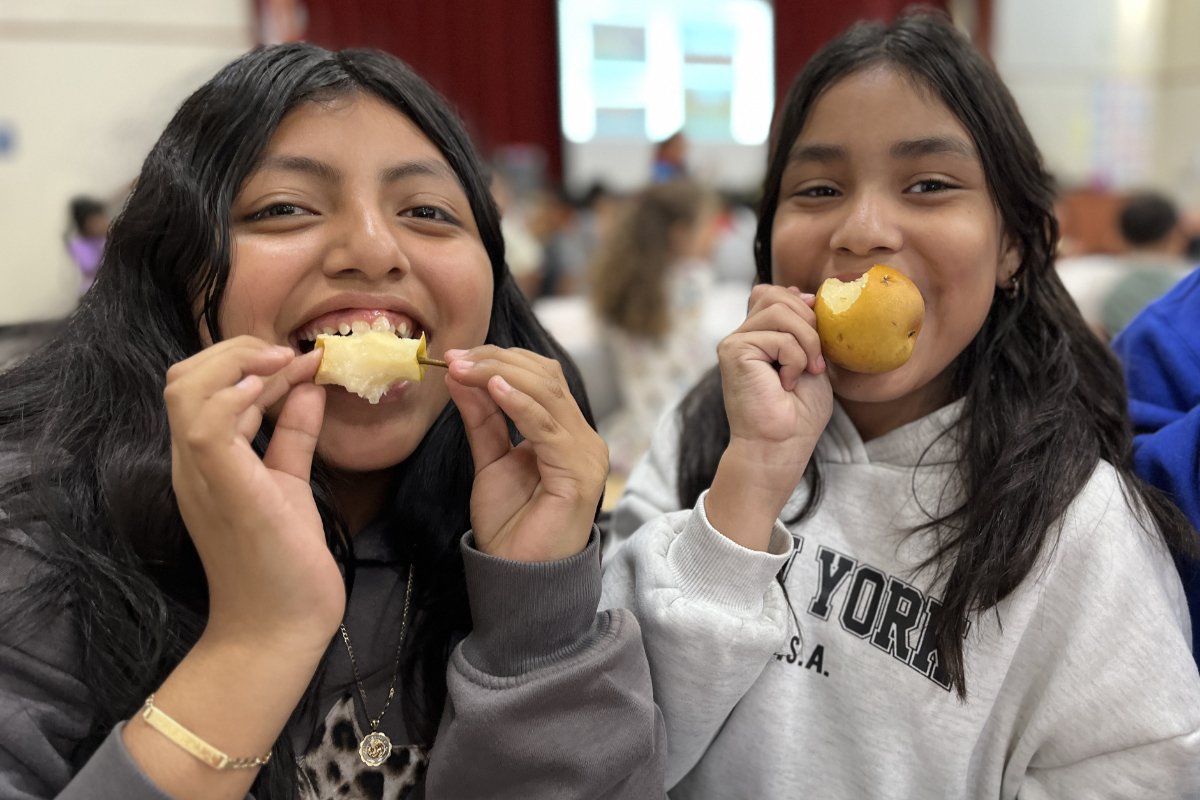
Two students at Meadow Homes Elementary School in Concord, California, eat Asian pears from Brentwood’s Frog Hollow Farm,alifornia Crunch Day, when school kids across the state take a bite of local fruits or vegetables all at the same time to celebrate local farms and healthy eating. (Photo courtesy of Conscious Kitchen)
Conscious Kitchen has spent more than a decade developing new ways to get organically grown food onto students’ plates by connecting school leaders directly to local farmers
Unlock the Full Story with a Civil Eats Membership
Expand your understanding of food systems as a Civil Eats member. Enjoy unlimited access to our groundbreaking reporting, engage with experts, and connect with a community of changemakers
Based in Sausalito, California, the organization now touts over 50 farms in its network and says it has worked with more than 100 school districts statewide as its partners. Its guiding conviction: With the right infrastructure and relationships, organic food can become a much larger part of the school-food supply chain
And Conscious Kitchen is just getting started. This spring, the nonprofit won a nomination for this year’s Food Planet Prize, which recognizes an organization’s potential to create positive environmental change through food. Conscious Kitchen was one of four finalists out of more than 1,000 applicants worldwide
Although Conscious Kitchen wasn’t the ultimate winner of the coveted environmental prize—the top award went to a region-wide agroecology movement in South India—the nomination earned it a significant award of $150,000 and served as validation of Conscious Kitchen’s potential to reduce the environmental impact of the way we eat
Conscious Kitchen’s new goal: to feed 6 million schoolchildren across California with organic local food and potentially serve as a model for school districts in other parts of the country
To do this, it is chipping away at every facet of a deeply entrenched school food distribution system that has traditionally favored long supply chains over local relationships, bulk ordering over seasonal produce, and readymade simplicity over the flexibility and diversity of scratch cooking
In addition to linking small and mid-size organic farms with local school districts, Conscious Kitchen has worked with manufacturers of organic pantry foods like cereals and bulk foods like milk to design organic products that meet schools’ needs
It has helped organize districts to leverage their buying power through cooperative purchasing, while making organic products more economicallyanic produce in the catalogs they offer to school districts
Conscious Kitchen is not alone in its quest to make school meals healthier and upend the food distribution system, though it is uniquely diverse in its approach
About three-fourths of districts surveyed by the School Nutrition Association last year reported trying to integrate local food into their menus, though food service leaders overwhelmingly cited cost and funding as top concerns. Conscious Kitchen is attempting to solve these hurdles with its all-hands-on-deck approach
“It’s a very interesting, intricate, nuanced, incredible puzzle, and I think we’re getting to the other end, which is so fun,” said Judi Shils, founder and executive director of Conscious Kitchen. “Just knowing what levers we can pull to help everybody realize what they can do together and then doing it—not waiting, not thinking about it, but just diving in.”
Conscious Kitchen chefs teach students at Dr. Martin Luther King Jr. Academy in Sausalito, California, about organic produce. (Photo courtesy of Conscious Kitchen)
Shils and her team are convinced that seasonal, organic purchasing can be as simple and straightforward as the current conventional-food pathway
“The ambition and coherence of Conscious Kitchen’s systems-level approach stood out from the start,” Lina Engler, the general manager of the Food Planet Prize, wrote Civil Eats in an email. “Rather than solving one piece of the puzzle, CK works across the entire chain that spans farm to school.”
In addition to providing a financial boost, the Food Planet Prize nomination serves as key proof of the nonprofit’s concept and a foothold for its expansion mission. Despite a constantly shifting political landscape and a host of other obstacles, Conscious Kitchen believes its model is both durable and replicable, with the potential to work anywhere
The Seeds of a System Change
In 2013, Shils and her team founded Conscious Kitchen at Bayside Elementary in Marin City, California, an underserved community where 95 percent of students qualified for free and reduced meals. Their goal was to help the school shift from ultraprocessed, prepackaged meals to local, organically grown food
The organization’s work took off during the COVID-19 pandemic, which disrupted deeply ingrained supply chains and offered an opportunity for change. School districts were granted a temporary reprieve from the tight shackles of the government-funded and controlled food procurement system, and ensured government reimbursement even if they didn’t adhere to previous standards
Conscious Kitchen had made an initial foray into a much larger school district—West Contra Costa Unified, in San Francisco’s East Bay. When the pandemic hit, the district’s food service director, Barbara Jellison, quickly tapped the group to locate organic produce for each of 23,000 student meal boxes
“I called her and said, ‘Is this real?’” Shils recalled. “She goes, ‘Yeah, it’s real. If you build the supply chain, I’ll buy it.’”
Over the next nine months, Conscious Kitchen helped funnel 10.7 million pounds of organic food grown by local farmers into 18.7 million boxed to-go meals for West Contra Costa students, totaling $17 million in purchases. What started with produce quickly expanded to a full box of organic dairy, protein, cereals, and grains
As the pandemic revealed the fragility of long supply chains, Conscious Kitchen demonstrated the value of a direct link between farmers and the schools that use their food. Rather than let its pandemic momentum fade, the nonprofit used it as a launching pad
“I knew that I couldn’t not keep blowing this up,” Shils explained
Creating a Solution for Every Problem
The group’s primary challenge is just getting a foot in the door with school district food-service leaders and small- to mid-size organic farmers to ask for help in rebuilding the supply chain. The farmers don’t lack the will to change, Shils said, but often have no idea where to start
In 2025, Conscious Kitchen hosted 13 farm-to-school workshops where farmers and school district officials could not only learn about its model, but also meet one another and establish direct relationships. It has continued the dialogue in 2026, with the most recent workshop held in April
For farmers, opening up a new, large customer base like schools can be invaluable. Small farms are struggling nationwide, with about 15,000 closing or consolidating in the last year, according to the U.S. Department of Agriculture(USDA)
Conscious Kitchen’s liaison with schools has been a boon to family growers like Full Belly Farm, a venerated multigenerational organic farm in the Capay Valley. California schools are the largest client Full Belly has had in 50 years of farming, Shils said
“For a farmer to say that about school-supported agriculture is unheard of,” Shils said
For school district leaders, there are several major concerns about buying organic foods: the cost, the complexity of ordering food and planning meals in volume, kitchen configuration and capacity (most are only set up for heating food, not cooking it, which also requires more space), and staff training to cook meals from scratch in vast quantities. Also, schools must rise to these challenges while abiding by strict government regulations
“There’s a lot of strategy involved in all of this,” explained Kristin Hilleman, director of food and nutrition services at the Capistrano Unified School District outside Los Angeles, which produces about 25,000 meals a day
Conscious Kitchen student ambassadors help serve a 100 percent organic, scratch-cooked meal at Michelle Obama School in Richmond, California, in January. (Photo courtesy of Conscious Kitchen)
To help with staff training, Conscious Kitchen offers sessions on scratch cooking, and the nonprofit is launching a database in August that will allow districts to share recipes. But its most powerful levers for change are its innovations in food purchasing, product development, and distribution
The Conscious Kitchen Purchasing Cooperative
One key way in which Conscious Kitchen helps schools tackle food costs is through its new purchasing cooperatives, bringing together multiple school districts to issue joint RFPs (requests for proposals) on which organic producers can bid. Higher volume purchasing can increase the schools’ leverage and unlock lower organic food prices. It can also make organic and sustainable purchasing simpler
The Mt. Diablo Unified School District, just east of San Francisco, is the lead district of 16 in a pilot purchasing cooperative spearheaded by Conscious Kitchen. The district serves about 29,000 students and purchases from 30 vendors ranging from major distributors like Sysco to Mimi’s Organic Farm in Salinas, roughly 100 miles away
A cooperative that manages multiple contracts on behalf of many districts has the power to be “pretty transformational,” said Alex Emmott, the district’s director of food and nutrition services. “It just makes it easier, more accessible, and then hopefully helps to drive down costs for items.”
The co-op “hits the supply and demand, operational side of things” for the Tahoe Truckee Unified School District, said Kat Soltanmorad, its director of food and nutrition services
“If I’m looking for organic string cheese, and now there’s 20-plus school districts ordering the same thing, I’m going to get a much better bid price compared to maybe even the conventional,” Soltanmorad said
Working With Vendors
Conscious Kitchen wants to make organic purchasing work not only for buyers, but also for sellers. It can encourage food vendors to repackage their products in bulk—a 1-pound package of dry goods doesn’t go very far in a school kitchen—or reformulate them to meet federal nutritional standards
Conscious Kitchen worked with Nature’s Path in 2024 to reformulate its organic cereal to ensure the first two ingredients were whole grains, thus meeting the standards
“Part of the ability to leverage purchasing is to figure out what the needs are, and then make the products with companies that are already really outstanding in those areas,” Shils explained
We’ll bring the news to you
Get the weekly Civil Eats newsletter, delivered to your inbox
Sign up today
Sign up today
Hilleman, of the Capistrano Unified School District, said Shils is “amazing” at asking organic food producers to sell in bulk rather than retail packaging. She did this with refried beans, said Hilleman, making them far more versatile
“Then you’ve got organic refried beans that you can use in a burrito, a bowl, as a side item, or whatever it might be, because it’s not really feasible for your employees to be unpacking millions of tiny packages of something at the scale they’re cooking,” Hilleman said
Distribution: Creating Opportunities Within the System
In 2024, Conscious Kitchen found a new pathway to getting more organic food to schools by tapping into the longstanding conventional school-food deliveries organized by the Department of Defense (DoD)
The DoD’s Fresh Fruit and Vegetable Program, which began in 1993, leverages the large-scale procurement and delivery system that already existed for the military. Every school district receives an annual “entitlement” from the USDA based on the number of reimbursable meals it serves students. Districts can allocate some of that funding to buy fresh produce through the DoD’s fruit and vegetable program
Conscious Kitchen convinced the program’s two California distributors that there would be demand for organic produce were they to offer it
“All the school districts that we work with that want organic produce started pulling their money out of the DoD [program] because they wanted to buy direct and they wanted to buy organic,” Shils explained. “And so we started working with . . . the two distributors in our state and we asked them to bring in some of the smaller farmers and see if that worked.”
Now, more than 30 organic products, from small to midsize organic farms, grace the DoD Fresh Fruit and Vegetable Program buyer’s list
Seeing organic options from the DoD Fresh distributor leaves Soltanmorad, of Tahoe Truckee Unified, almost incredulous
“What universe are we in? I love it,” Soltanmorad said. “Here I’m ordering thousands of pounds of peaches and nectarines—organic.”
Growing vs. Scaling
Conscious Kitchen believes its model can scale—a term Shils dislikes, preferring “grow”—because everything it builds exists independently of the nonprofit
How you grow “is through heart, through relationships, through believing in people that don’t even believe in themselves,” Shils said. “To have school food-service directors that honor the farmers because they know them.” To that end, the group puts time and energy toward bringing people together and building those relationships
Conscious Kitchen began connecting Mt. Diablo to many of the farmers in its ever-expanding network in the 2023 school year
“[It’s] just a really cool nonprofit, a small-but-mighty team who are really boots on the ground, and not afraid to get their hands dirty and kind of get in it with you and help you out,” Emmott said
The Critical Role of Government
Mt. Diablo’s dollars stretch further thanks to California’s seismic state investment in school meals, dubbed Universal Meals, a program adopted in 2021 that ensures every schoolchild can receive a free meal, regardless of family income
Universal free meals have increased meal participation by 20 percent in the last three years at Mt. Diablo. That has increased reimbursement for the district—creating a bigger budget for nutritious organic food
“With California Universal Meals, the funding structure just makes a lot more sense,” Emmott said. “It’s easier to do higher-quality procurement, essentially, because we’re feeding more kids.”
The larger reimbursement can also pay for the labor and equipment required to prepare meals from scratch, like blast chillers and a vacuum sealer for the district’s central kitchen. Mt. Diablo has increased its payroll by $2 million, expanded hours for some employees, and added 20 new positions with full benefits
The Universal Meals program “changed the conversation” around school food, Shils said
“California schools now serve millions of meals every day, and at that scale, every purchasing decision matters,” Shils said. “The food schools choose influences not only children’s health, but also what farmers grow, how food is produced, where public dollars flow, and the future of regional food systems.”
Other types of government support have also been critical to the continued transformation of the California school food system, she noted
For example, California Governor Gavin Newsom supported investments in rebuilding school kitchens and retraining their employees to allow them to scratch-cook meals
California State Superintendent of Public Instruction Tony Thurmond launched “Mission Possible: Go Organic” with Conscious Kitchen in 2024, an initiative that encourages school districts to pledge to increase their purchases of organic foods
But both Newsom and Thurmond will leave office in early 2027, and there’s no guarantee that the next wave of leaders will share their interest
On the federal level, the USDA under the Biden administration in 2022-23 allocated $24 million in funding to California under the Local Food for Schools program, which encouraged districts to buy locally. The program—and another $660 million in funding nationally—was halted shortly after President Donald Trump took office
The Trump administration has expressed interest in feeding schoolchildren healthier meals, but the USDA has yet to release school nutrition guidelines based on the new Dietary Guidelines for Americans. Advocates and school officials have warned it will be impossible to meet higher nutritional standards without robust funding
In response to the demands of a growing coalition of school nutrition advocates, a bipartisan proposal introduced in the U.S. House of Representatives in June would mandate that $200 million be allocated to the Local Food for Schools program annually
For Shils, political motives don’t need to align to find common ground, as long as the desired goal is healthier meals for children. Different administrations have different priorities that can, each in their own way, provide an entry point for a conversation, she says
“Under different administrations, different aspects of our work have resonated,” Shils said. “Sometimes the focus is school meal quality. Sometimes it’s climate. Today, there is increasing attention on children’s health.”
Conscious Kitchen is starting to work with people in states beyond California. There are people and institutions ready to embrace change, Shils said, and “there are all sorts of levers that make this opportunity scalable.”
“There’s a will,” Shils said. “And people aren’t saying, ‘What if’ or ‘but,’ but ‘Let’s just roll our sleeves up and try to make this work.’”
More from
School Food
How Do You Convince a First Grader to Like Peas? Teach Them
By Rebekah Alvey
May 20, 2026
School Nutrition Experts Wary as Government Considers New Policies
By Rebekah Alvey
March 13, 2026
Public Health Groups Challenge Trump Administration Dietary Guidelines
By Rebekah Alvey
January 9, 2026

What’s at Stake for School Food-Literacy Programs
By Hannah Wallace
September 17, 2025
Featured
New Rule Ties Potential Green Card Approval to SNAP Benefits
By Rebekah Alvey
July 20, 2026
Food advocates say the new rule could discourage eligible recipients in mixed status households from applying
New Rule Ties Potential Green Card Approval to SNAP Benefits
By Rebekah Alvey
July 20, 2026
Why US Farms Increasingly Rely on Guestworker Programs
By Lisa Held
July 20, 2026
‘My Shelves Are Very Empty’: How a Year of SNAP Cuts Is Pressuring the Food System
By Rebekah Alvey
July 16, 2026
‘It Isn’t Only About Who Gets Seen. It’s About Who Gets to Feel Safe Being Seen’
By Gaby Pereyra and Karen Washington
July 16, 2026
Popular
Trump Administration Proposes Grant Overhaul That Could Upend Farm Funding
By Lisa Held
July 16, 2026
Federal Officials Have Yet to Identify
By Rebekah Alvey
July 15, 2026
Once Touted as a Solution to CAFO Manure, Biodigesters Face an Uncertain Future
By Kari Lydersen
July 15, 2026
Should You Compost Bioplastics in Your Backyard?
By Meg Wilcox
July 14, 2026
‘;
userWithoutSessionInfo.classList.add(‘wk-user-update-info’);
userWithoutSessionInfo.insertAdjacentHTML(‘beforeend’, infoBlock);
authForm.parentNode.insertBefore(userWithoutSessionInfo, authForm);
authForm.style.display = ‘none’;
document.addEventListener(‘click’, hideUserWithoutSessionInfo);
}
signInSubmitSpinner.style.display = ‘none’;
return true;
}); window.wk.events.subscribe(“success-auth”, function ({register}) {
let userWithoutSessionInfo = document.querySelector(‘.wk-user-update-info’);
if(userWithoutSessionInfo) {
hideUserWithoutSessionText();
}
if (register) {
subscribeSignUpNewsletters();
const extra_groups = [];
/** Location data */
extra_groups.push({
group_key: “signup-info”,
field_key: “signup-location”,
field_value: window.location.href
});
/** UTM data */
let utm_data = getUTMdata();
if (utm_data.length>0) {
utm_data.forEach(item => {
extra_groups.push({
group_key: “signup-info”,
field_key: item[0],
field_value: item[1]
});
})
}
/** saving data: */
window.wk.sdk.methods.client.put({
path: ‘/user/extra/data’,
data: {
extra_groups: extra_groups
}
}).catch(error => {
console.log(error.response.error, ‘error’);
});
}
});
async function subscribeSignUpNewsletters() {
let tags = {
598: true
}
await window.wk.sdk.methods.client.put({
path: ‘/integrations/activecampaign/user/tags’,
data: {
tags: tags
}
}).then(function (response) {
console.log(‘SUBSCRIPTION SUCCESS’, response);
}).catch(function () {
console.log(‘SUBSCRIPTION ERROR’);
});
}
function getUTMdata() {
let query = window.location.search.substring(1);
let vars = query.split(‘&’);
let utm_data = [];
for (let i = 0; i < vars.length; i++) {
let pair = vars[i].split(‘=’);
pair.forEach((item, index) => {
try {
pair[index] = decodeURIComponent(item);
} catch (e) {
}
});
if (pair[0] === ‘utm’ || pair[0].startsWith(‘utm_’)) {
utm_data.push(pair);
}
}
return utm_data;
}
window.wk.events.subscribe(‘wk-event-checkout-success’, function (value) {
const extra_groups = [];
/** Location data */
extra_groups.push({
group_key: “payment-info”,
field_key: “payment-location”,
field_value: window.location.href
});
/** UTM data */
let utm_data = getUTMdata();
if (utm_data.length>0) {
utm_data.forEach(item => {
extra_groups.push({
group_key: “payment-info”,
field_key: item[0],
field_value: item[1]
});
})
}
/** saving data: */
window.wk.sdk.methods.client.put({
path: ‘/user/extra/data’,
data: {
extra_groups: extra_groups
}
}).catch(error => {
console.log(error.response.error, ‘error’);
});
});
}
});
function hideUserWithoutSessionInfo(e) {
switch(e.target.id) {
case ‘auth-signup-link’:
case ‘auth-modal-close-btn’:
case ‘auth-modal-wrapper’:
case ‘auth-password-link’:
hideUserWithoutSessionText();
break;
}
if(e.target.classList.contains(‘wk-form-button’)) {
hideUserWithoutSessionText();
}
}
function hideUserWithoutSessionText() {
let userWithoutSessionInfo = document.querySelector(‘.wk-user-update-info’);
let authForm = document.querySelector(‘#wk-email-auth-form’);
document.removeEventListener(‘click’, hideUserWithoutSessionInfo);
userWithoutSessionInfo.remove();
authForm.style.display = ‘block’;
let authFormHeaderError = document.querySelector(‘#wk-email-auth-form .wk-form .wk-form-header .wk-form__error’);
if(authFormHeaderError) {
authFormHeaderError.style.display = ”;
}
} function wkSignInButtonModify() {
let menuSignInButtons = document.querySelectorAll(‘.wkwp-user-my-account-button’);
if (menuSignInButtons.length > 0) {
menuSignInButtons.forEach(element => {
element.classList.remove(‘wkwp-user-my-account-button’, ‘wk-call’, ‘wk–sign-in’);
element.classList.add(‘custom-wkwp-user-my-account-button’);
});
}
document.addEventListener(‘click’, (e) => {
if (e.target.classList.contains(‘wallkit-sign-in-cta’) || e.target.classList.contains(‘custom-wkwp-user-my-account-button’)) {
e.preventDefault();
if (typeof window.wk.authentication !== ‘undefined’ && window.wk.authentication.isAuthenticated()) {
// user authenticated
} else {
window.wk.authentication.show(‘sign-in’);
}
}
});
}
function wkShowUserStatus() {
let wkSettings = window[“wallkitSettings”] || {};
let wkCallClass = wkSettings.integration.call.classForHandleClick || ‘wk-call’;
let wkTranslations = window[“wallkitTranslations”] || {};
const accountStatusSpanEls = document.querySelectorAll(‘.custom-wkwp-user-my-account-button’);
if (!accountStatusSpanEls.length) {
return;
}
if (window.wk.authentication.isAuthenticated()) {
if (accountStatusSpanEls.length > 0) {
accountStatusSpanEls.forEach(element => {
element.innerHTML = wkTranslations.my_account || ‘My Account’;
element.classList.add(wkCallClass, ‘wk–account-settings’);
element.style.display = ‘block’;
});
}
} else {
if (accountStatusSpanEls.length > 0) {
accountStatusSpanEls.forEach(element => {
element.classList.remove(wkCallClass, ‘wk–account-settings’);
element.innerHTML = wkTranslations.sign_in || ‘Sign in’;
element.style.display = ‘block’;
});
}
}
let topSignIn = document.querySelector(‘header nav .wrapper-menu-buttons .custom-wkwp-user-my-account-button’);
if(topSignIn) {
topSignIn.style.display = ‘inline-block’;
}
}
async function updateUserInfo() {
if (window.wk.authentication.isAuthenticated()) {
if (!window.wk.sdk.methods.user.email) {
await window.wk.sdk.methods.client.get({
path: ‘/user’
})
.then((responce) => {
if (responce.id > 0 && responce.id === window.wk.sdk.methods.user.id) {
window.wk.sdk.methods.user = responce;
}
}, (error) => {
console.log(‘ERROR:’, error);
});
}
}
}
async function setWisepopsArgs() {
if (window.wk.authentication.isAuthenticated()) {
wisepops(“properties”, {
firstName: window.wk.sdk.methods.user.first_name,
lastName: window.wk.sdk.methods.user.last_name,
authentication: true,
plan: window.wk.sdk.methods.user.subscriptions[0].plan.title,
priceTier: window.wk.sdk.methods.user.subscriptions[0].title
});
}
}
function wkCheckPostAccess() {
if (typeof window.wallkitPostData.config !== “undefined”
&& typeof window.wallkitPostData.data.type !== “undefined”
&& window.wallkitPostData.data.type === ‘post’
&& typeof window.wallkitPostData.data !== “undefined”
&& typeof window.wallkitPostData.data.id !== “undefined”
&& window.wallkitPostData.data.id !== ”
) {
const postInfo = window.wallkitPostData.data;
const wkPost = new window.wk.content(postInfo);
const postContentWrapper = document.querySelectorAll(“.wrapper-content-story .row > *”);
let topElement = document.querySelector(“#pico .wrapper-content”);
let paragraphs = topElement.querySelectorAll(‘.wrapper-content-story .post-single-left p’);
// let wkContentAfterEls = document.querySelectorAll(“.wrapper-content-story .row .post-single-left .post-simple”);
if (!topElement || !paragraphs.length) {
return;
}
wkPost.checkAccess().then((response) => {
if (!response.allowed) {
let showParagraphs = paragraphs.length > 2 ? 2 : paragraphs.length – 1;
var paragraphsHTML = ”;
for (var i = 0; i <= showParagraphs; i++) {
paragraphsHTML += `
` + paragraphs[i].innerHTML + `
`;
}
showWKPaywall(topElement, paragraphsHTML);
if (postContentWrapper.length) {
postContentWrapper.forEach((e) => {
if (!e.classList.contains(‘sidebar-right’)) {
e.classList.add(‘wk-content-paywall’);
}
});
}
let paywallBlockLoginLink = document.querySelector(‘.wallkit-paywall-block__login_plans’);
if (paywallBlockLoginLink) {
if (window.wk.authentication.isAuthenticated()) {
paywallBlockLoginLink.style = “display:none;”;
} else {
paywallBlockLoginLink.style = “display:block;”;
}
}
} else {
if (postContentWrapper.length) {
postContentWrapper.forEach((e) => {
if (!e.classList.contains(‘sidebar-right’)) {
e.classList.remove(‘wk-content-paywall’);
}
});
}
let wkPaywallBlock = document.querySelector(“.wkwp-paywall-block-wrapper”);
if (wkPaywallBlock) {
wkPaywallBlock.parentNode.removeChild(wkPaywallBlock);
}
}
if (postContentWrapper) {
postContentWrapper.forEach((e) => {
if (!e.classList.contains(‘sidebar-right’)) {
e.classList.add(‘wk-content-active’);
}
});
}
}).catch((error) => {
console.log(‘!! wkPost ERROR’, error);
});
}
}
function showWKPaywall(contentNode, paragraphsHTML) {
let wkSettings = window[“wallkitSettings”] || {};
let paywallBlockContent = document.querySelector(“.wkwp-paywall-block-wrapper”);
if (!paywallBlockContent) {
paywallBlockContent = document.createElement(‘div’);
paywallBlockContent.classList.add(‘wkwp-paywall-block-wrapper’, ‘wrapper-content’, ‘wrapper-content-story’);
paywallBlockContent.insertAdjacentHTML(‘beforeend’, `${paragraphsHTML} ${wkSettings.config.paywall.content}
`);
contentNode.parentNode.insertBefore(paywallBlockContent, contentNode);
}
}
})();
var bl_wkuser = window?.Wallkit?.user;
var wisepopsProperties = {};
if (bl_wkuser) {
wisepopsProperties = {
WKemail: bl_wkuser.email,
WKactive: bl_wkuser.active,
WKFirstName: bl_wkuser.first_name,
WKLastName: bl_wkuser.last_name,
WKSubscription: bl_wkuser.subscriptions.length
};
}
wisepops(“properties”, wisepopsProperties);
