


https://p.dw.com/p/5Io4L
The Ebola epidemic in the eastern part of the Democratic Republic of the Congo has now spread to a sixth province in the country. Concerns are growing that the life-threatening infectious disease could reach the capital, Kinshasa, which is home to 19 million people
Facilities for isolating patients are ready for the event that a public health alert should hit the capital, said Jean-Jacques Muyembe, head of Congo’s National Institute for Biomedical Research (INRB)
“If there is a suspected case, the epidemiological services and the INRB laboratory are ready to quickly identify and confirm cases,” he told DW
“The Ministry of Health has set up the Cinquantenaire Hospital so that it can admit and fully isolate patients if necessary. We are prepared. We can quickly contain an Ebola outbreak here in Kinshasa.”
Health crisis still in the making
However, the virus has been spreading faster than health authorities can contain it. This Ebola outbreak is driven by the rare Bundibugyo strain of the virus, for which no vaccine or treatment has yet been approved
According to Tedros Adhanom Ghebreyesus, director-general of the World Health Organization, the outbreak, given its rapid rise, could surpass the West African Ebola outbreak of 2014–2016
Some 11,000 people died at the time. The current health crisis has claimed 2,000 lives so far, with more than 4,300 cases recorded to date. Authorities officially announced the outbreak on May 15; three months later, the country remains on edge
The WHO, meanwhile, expects the current outbreak to only peak in six months
The initial infections can be traced back to as early as February, according to reports. The epicenter of the outbreak was identified as the northeastern province of Ituri, which has been plagued by insecurity for years, and is home to a large number of internally displaced persons
Many other cases have also been reported in the provinces of North and South Kivu, where the security situation is an even bigger problem. Authorities have effectively lost control over entire areas in their yearslong conflict with M23 rebels and affiliated groups
Fear among Kinshasa’s huge population
Fear among the population of contracting the virus is also growing every day. A week ago, the threat came close to the capital when a boat was stopped at the port of Maluku, about 65 kilometers (about 40 miles) upstream from Kinshasa
One of the passengers had previously disembarked in Mongala Province to seek medical help, presenting with typical Ebola symptoms such as fever and diarrhea
The patient died shortly thereafter, and more than 200 passengers from the vessel were placed in isolation. Teams from the Ministry of Health and the WHO tested them using a mobile laboratory — but the results came back negative
But with its population of millions, this did not mean the all-clear for Kinshasa. Every day people come and go between cities and provinces, leaving potentially lethal traces behind
In fact, the rapid spread of the current outbreak has been positively attributed to large-scale population movements as well as ongoing violence in main affected areas
Not enough beds for worst-case scenario
Beyond the diagnosis of the disease and isolation of patients, capacity remains one of the biggest challenges for Kinshasa if the virus were to make its way there
However, the Center for Public Health Emergency Response has said it plans to further expand its capacity to be able to meet the onset of any outbreak
Emergency preparations have already been taken at Cinquantenaire Hospital: “We have set up 20 beds for this purpose. However, this capacity is flexible and can be expanded to 200 or 250 beds,” Christian Ngandu, the hospital’s coordinator, told DW.
However, according to the WHO, several thousand beds would need to be ready in the worst-case scenario
“We are currently exploring the possibility of providing additional beds. We have trained more than 120 people from various facilities, including the Vijana, Sino-Congolais, Kinkole, Kintambo and Cinquantenaire hospitals. These professionals are capable of treating any potential Ebola case,” said Ngandu
DR Congo launches Ebola trial for high-risk contacts
Is enough being done?
According to Carlos Mupili, president of the Supreme Council of Civil Society, current capacities are insufficient.
“Twenty beds are insignificant in this city, and a single hospital is not enough. Several health facilities should have been mobilized to prevent the outbreak effectively,” he told DW
Mupili has called on authorities to provide more rewiftly and provide the necessary reecisions.”
WHO Director-General Tedros cautioned that an unexpected surge in infections could occur anywhere, as contact-tracing of infected individuals has been slow. He expressed “concern” about the fact that many people dying from the virus have not been registered on the official Ebola contact lists before being buried
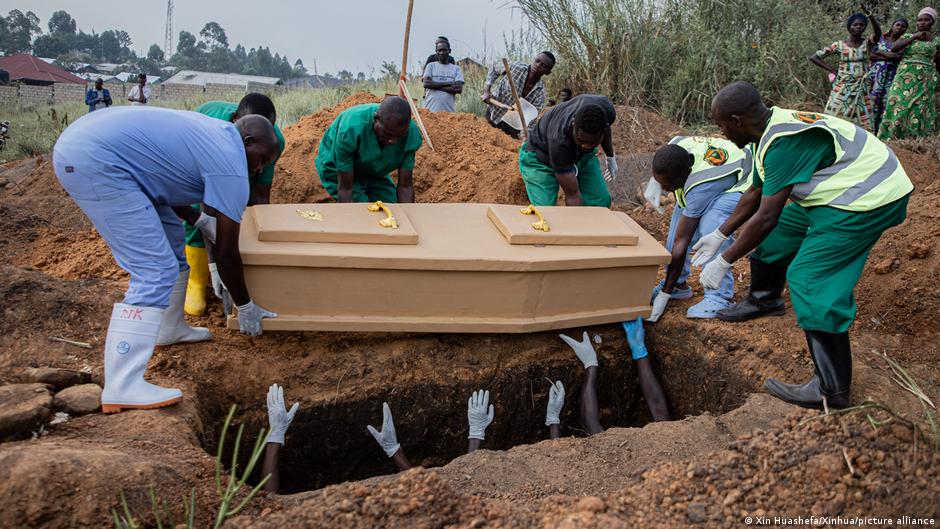
Furthermore, he stressed that many infections originate from from funerals
Ngandu, meanwhile, emphasized the fact that there has not been a single case of Ebola in Kinshasa so far, and that the primary strategy is to keep things that way
To break the fast-moving chains of transmission, 95% of all contacts must be tracked; currently, that rate is believe to be around only 80%
Scientists meanwhile are scrambling to find a cure: Clinical trials of two antiviral treatments are underway, and work on vaccines is also in progress. The results — so far — look promising
To date, there have been no mutations of the virus observed in the current outbreak, said Sylvie Briand, the WHO’s chief scientist, which has been a smalld be highly dangerous, with the potential of becoming more lethal or increasing the transmission rate, thus jumping across borders faster
