


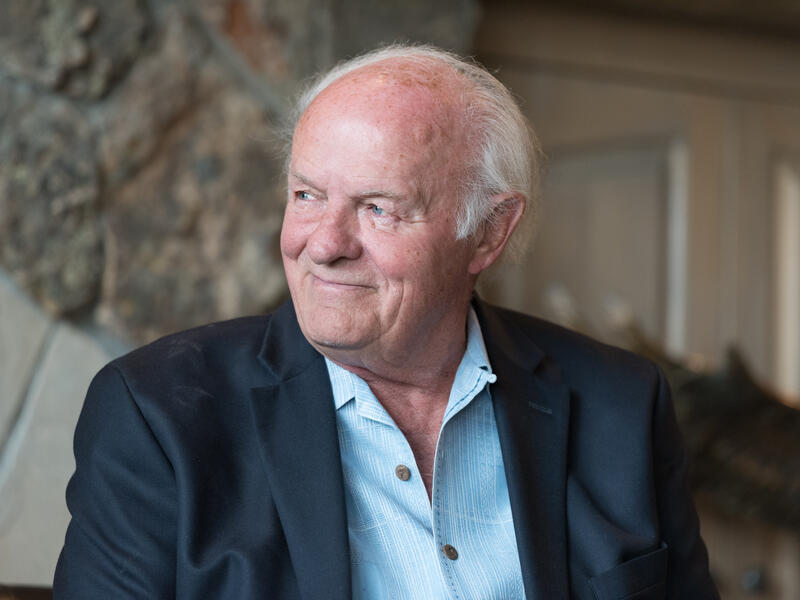
T. Denny Sanford’s philanthropy was heartfelt and impactful in ways that will endure for generations. This has always been the genius of Sanford’s generosity. His efforts on behalf of healthcare came with a beginning, but no end
His oft-repeated motto, “Aspire to inspire before you expire,” does not actually come with an expiration date. Sanford’s gifts to the world will maintain their usefulness
It was similar to the way Sanford himself saw his role in life, particularly at that stage where philanthropy became his focus. Make yourself useful
This personal commitment was at the core of a legacy in healthcare that trampled both geographic and scientific boundaries
During an interview with Miles Beacom, Chairman and CEO of PREMIER Bankcard, for Sanford’s induction into the South Dakota Hall of Fame, Beacom asked Sanford about his motivation for giving. The philanthropist’s response was typically down-to-earth
“We are on earth to provide for other people, not just ourselves and our families,” Sanford told Beacom. “We all have the opportunity to work a little bit harder and help someone else, not just ourselves.”
From the rural towns of the Upper Midwest to the villages of Ghana, Africa, Sanford’s efforts to provide for other people have played an indispensable role in helping overcome the persistent challenges associated with bringing healthcare to those in need of it
His unprecedented philanthropy went well beyond providing dollars to aid in the conventional bedside delivery of healthcare, though that would have been plenty enough to establish an indelible legacy
In addition to the nearly $2 billion donated to Sanford Health, he was a committed champion to other healthcare and research institutions, children’s causes and education initiatives
Within the region, this giving manifested itself in providing the renique blend of large-scale projects. Sports arenas, new healthcare facilities, research centers and playing fields began appearing on the landscape
“What we always said is that at the end of every single decision we make is a patient,” said Bill Gassen, president and CEO of Sanford Health. “And for Denny, at the end of every gift is a patient.”
These efforts have established Sanford Health as a force in modern medicine, empowering clinicians and researchers to think big and pursue bold, innovative endeavors at a pace not otherwise possible
“He made a comment a few years ago that he’d rather live a life of significance than a life of success,” Beacom said. “I said, ‘Denny what’s the difference?’ He said, ‘A lot of people are successful, but a lot of people, they don’t share those things and make the world a better place. If you’re able to do that, you live a life of significance.’ And I thought, ‘Wow, that’s pretty impressive.’”
Sanford was often reminded that his generosity made the transformation to significance. The big-scale projects he helped bring about were ultimately going to make people’s lives better, one person at a time
In one instance a young woman who was expecting a baby spotted him and approached with her father
“She introduces herself, introduces her father to me,” Sanford remembered. “And she said, ‘You saved my life. You saved my baby’s life. We were diagnosed as having incurable problems in this pregnancy and we’re likely to both die and we moved over to Sanford Health and you saved our life.’ And the tears were flowing – our tears were flowing down. That’s significant.”
Jaxon and Jeren
Jaxon and Jeren Scheff both live with the effects of a rare genetic disorder. For Jaxon, the disorder has caused breathing complications and vision impairment. For Jeren, it’s been more severe. He was born blind and struggled to breathe. They were close to losing him a few times. He still has chronic respiratory issues that have led to 31 surgeries
“When Jaren was born, he clearly had difficulty significantly breathing through his nose and had a rare condition that we call pyriform aperture stenosis,” said Patrick Munson, M.D., a pediatric ear, nose and throat specialist at Sanford. “Basically it’s a squished up nose. You can’t breathe through it. And in a young infant that’s really important.”
When Jaxon was born with breathing issues, the equipment needed to care for him didn’t exist in the area. When Jeren came along, it did – thanks to the Sanford Children’s Castle of Care
“They didn’t have pediatric specialists when Jaxon was born,” said their mother, Jennifer Scheff. “When Jeren was born, we had this – we had the Castle, we had pediatric specialists and pediatric ENTs who knew exactly what to do in a timely manner.”
Before the existence of Sanford Children’s, the Scheff family would not have been able to care for their sons locally. An incredibly challenging part of their lives would have been significantly more daunting
“When you are going through that specialized care, you need your family,” Jennifer said. “You need that support here. They become more than just the providers. They become a part of your family and they also become big advocates for your kids.”
When interviewed for a segment on Sanford Children’s, Jeren and Jaxon were asked to talk about their care at Sanford. Before getting to that, however, Jeren had something he needed to say
“Hey, guess what? Fun little fact,” he said. “When I was young, I thought Denny Sanford lived in the Sanford Castle. I thought since it was a castle, I used to think that he was the king.”
The History of Denny Sanford’s Philanthropy
It all began in 2004 with a contribution of $16 million to Sioux Valley Hospital. In the decades since then, Sanford continued to share his fortune with the health system that bears his name
A look at the timeline of his major contributions:
2025: Sanford Black Hills Medical Center – $300 million
To help establish the Sanford Black Hills Medical Center campus in Rapid City, South Dakota, a new state-of-the-art medical center campus to expand access to specialty care and services including an emergency department, ICU, oncology center, comprehensive women’s health including a labor and delivery unit, and children’s services
2021: Sanford Virtual Care Center – $350 million
To create one of the world’s leading virtual care centers, with a focus on providing more accessible care in rural and underserved areas of the Midwest. The initiative aims to transform rural care delivery, improving access to affordable, high-quality healthcare for generations to come
2021: Graduate Medical Education & Community Health – $300 million
The $300 million initiative includes a significant expansion of graduate medical education. Working with its academic partners, Sanford Health is creating eight new graduate medical residencies and fellowships in critical specialty areas. The gift includes the addition of 18 outdoor turf fields – an area covering 173 acres — at the Sanford Sports Complex in Sioux Falls
2019: Enhancing Health Care for Veterans – $25 million
$25 million in 2019 to support PHASER (pharmacogenomic testing for veterans), a program created by Sanford Health in partnership with the U.S. Department of Veterans Affairs, that offers free pharmacogenetic (PGx) testing to all veterans through the VA’s healthcare system and Sanford Health
2018: Sanford Health Hospice Care – $1 million
To support an endowment for Ava’s House by Sanford, a multigenerational hospice facility that offers one of only four inpatient hospice programs for children and young adults
2014: Sanford Imagenetics – $125 million
To launch Sanford Imagenetics, the first program of its kind in the nation to fully integrate genetics and genomic medicine into primary care for adults
2011: Edith Sanford Breast Center – $100 million
To launch the Edith Sanford Breast Center initiative dedicated to unlocking each woman’s genetic code to advance prevention and treatment of breast cancer. The gift also allowed for the construction of the Edith Sanford Breast Center in Sioux Falls, integrating the initiative’s research into patient care
2007: Transformational Gift: Sanford Health – $400 million
To open a chain of clinics around the world (today known as Sanford World Clinic) from Costa Rica to New Zealand partnering with communities to advance research and education and build a sustainable infrastructure in areas of need. This gift also helped launch The Sanford Project, a research effort to cure type 1 diabetes, and spurred growth in all areas of Sanford Research
2006: University of South Dakota Sanford School of Medicine – $20 million
To enhance the scope, reputation, re fostering the further growth and development of the pediatrics department
2004: Sioux Valley Hospitals & Health System – $16 million
To build a state-of-the-art, stand-alone children’s hospital in Sioux Falls
“As much as he has transformed healthcare through his decision to continue to give and invest in Sanford Health, I think in that way and more he’s transformed what philanthropy means in the healthcare space,” Gassen said. “I believe he’s transformed what philanthropy means in the community of Sioux Falls, South Dakota, and far beyond.”
A kiss and a hug
Kendra Gottsleben has a disease known as mucopolysaccharidosis, Type VI (MPS VI). She was diagnosed with this rare disease at age 4. Because there is no cure, weekly infusions will likely be a reality for her entire life. When she was younger, she had to go to the Twin Cities for treatment
“Sioux Falls and Sanford have become a bigger and bigger rare disease spot,” Gottsleben said. “They are filling a void. It is amazing and phenomenal.”
There was a day when Laura Davis-Keppen, M.D., who has treated Gottsleben, was the only geneticist and the only pediatric endocrinologist in the state
“People like Kendra, if she had not been able to get her enzyme therapy, would not be able to live here,” Dr. Davis-Keppen said. “Now she has blossomed before our eyes when she started getting the enzyme therapy. It’s exciting to see that there are therapies like this that change the course of somebody’s life. She’s just an incredible advocate for rare disease. She’s really an amazing example of medicine and how we can treat rare disease that we couldn’t have done 20 years ago. To see someone benefit from this is awesome.”
Gottsleben is a national spokesperson for rare diseases and a published author. She has also been part of the clinical trial for Naglazyme, the enzyme that keeps her going
Her message to Sanford researchers: “You need to know that the patients, if they could, would give you a big kiss and a hug, because when you’re in the rare disease space, anybody that is taking years and years trying to find a treatment for one rare disease is unbelievable. What you’re doing is good. It’s helping us. It’s making us live as a life as best we can.”
Humble start
Given Sanford’s humble beginnings, thinking outside what at the time was a very small box was a necessity to get ahead in life
His home as a youngster was a 700-square-foot apartment in working-class east St. Paul, Minnesota. His mother, Edith, died of breast cancer when he was 4 and his father, William, raised him and his older brother
Over the years Sanford often told a story – which has since then been frequently repeated by others – about how he ended up attending the University of Minnesota, where he graduated with a degree in psychology in 1958
His original intent after graduating from St. Paul Central High School – where he’d been an indifferent student more concerned with his part-time jobs than his grades – was to join the Navy
He went to a going-away party for a friend about that time, however, and got in a fight involving several others. It likely would have been handled much differently today, but in the early 1950s in St. Paul the brawling earned him a 90-day jail sentence
He later unveiled a proposal to the judge who put him in there in the first place
“It turned out to be one of the best things in my life,” Sanford said. “I said, ‘Judge, you gave me the best wake-up call I could ever have. If you let me out, I’ll go to college.’ I had no intention of going to college before getting in trouble. And he said, ‘If you can get into the University of Minnesota or some other college, I’ll think about it.’ So I applied. My high school grades were not very good so I had to start on scholastic probation – and I made it through four-plus years and got a degree in psychology.”
When Denny was 20 and in college, his father died of heart disease. Though gone from his life far too early, the elder Sanford provided an inspiring example that Denny never forgot
“He was the most caring person I ever met,” Sanford told the Horatio Alger Society. “He never graduated high school because he had to help support his family. He was very giving, and I think my ideas about philanthropy, which is such an important part of my life today, came from him.”
After graduating from Minnesota, Sanford took a sales job for Armstrong Cork Co., and quickly became one of the company’s best and brightest. When he didn’t get a $50-a-month pay raise he felt he’d earned, however, he went out on his own
In the 1960s he established Contech Inc., a national company based in Minneapolis that manufactured sealants, coatings and adhesives. In 1972 he took the company public at $5 a share. In 10 years he sold it at $35 a share and became a multimillionaire
With two sons in college, he made a futile attempt at retirement at age 47 but was back in the Twin Cities a few years later, establishing a venture capital company, Threshold Ventures, that provided financing to young entrepreneurs
In 1986, he bought a struggling bank in Sioux Falls as a favor to a friend. He changed the name to First Premier Bank and eventually added Premier Bankcard
The success of these companies allowed Sanford to begin contemplating more transformational donations to causes he held dear. Ultimately this led first to a $16 million donation to what is now known as Sanford Children’s Castle of Care in Sioux Falls, but it was just a beginning
In 2007, Sanford pledged an unprecedented $400 million – then the largest gift to a healthcare system in U.S. history – to help transform what was Sioux Valley Hospitals, a small regional provider at the time, into what Sanford Health is today
Sanford Health now has 55,000 employees and serves more than two million patients and nearly 415,000 health plan members across the upper Midwest including South Dakota, North Dakota, Minnesota, Wyoming, Iowa, Wisconsin and the Upper Peninsula of Michigan. The integrated health system has a network of 58 hospitals, 289 clinic locations, 145 senior care communities, 4,500 physicians and advanced practice providers and 1,100 active clinical trials and studies. The organization’s transformational virtual care initiative brings patients closer to care with access to nearly 80 specialties. More than 400 residents and fellows are trained each year through graduate medical education with Sanford Health fully funding and supporting 29 of the 40 available programs. Sanford Health also includes 92 retail pharmacies, including Sanford and Lewis Drug pharmacies with locations in 6 states, and more than 300 pharmacists.
“With Denny’s gift, it transformed our worldview and our expectations of ourselves,” said Becky Nelson, an RN and retired senior vice president and COO of Sanford Health. “We were going to be sure that we were doing things that were beyond what a community health system could do. It transformed our whole culture with the attitude that ‘we can.’”
Running to the Castle
Melissa Olivier is a breast cancer survivor who remembers pulling up to the Edith Sanford Breast Center and thinking she should not be there at her age. She was 33 and a mom whose daughter Lena was born 10 weeks early with complete heart block – a congenital disorder that keeps her heart from pumping blood normally
Keely Hack, M.D., an oncologist for Sanford Health, was there on the front line with Olivier, who needed treatment but also assurance that she’d be OK for her children
“Melissa isn’t just a breast cancer patient,” Dr. Hack said. “She is a person with a whole life and a family who depends on her. What can we do to get rid of this cancer and also keep you as healthy as you can be, to continue to do the things that you need to do in your daily life with and for your family?”
At Sanford Children’s with her daughter, and for her own cancer treatment, Olivier gained insight into the commitment of her family’s providers and the level of care she and her family received
“Our story is not done,” she said. “We have a purpose and we are here to share that purpose. I’ve become very passionate about Sanford Hospital and about everything that Sanford has really provided us. It makes me want to tear up just thinking about it. They truly deep-down care. I can’t even describe the care we’ve gotten.”
For the Oliviers, Sanford Health has become a safe and trusted part of their lives
“Now we have little girls that dress up in princess dresses and crowns when they come to the Castle,” Hack said. “When a child runs into the Castle instead of running away from it, I’d say ‘Yeah, we’re in the right place.’”
Sanford’s legacy
In those spaces where progress arrives only with great human effort, long-term insight and considerable financial might, Sanford was a loyal companion who listened closely to those who have a vivid picture of the future of healthcare in the region and the unique challenges that will come with it
As with so many other Sanford gifts over the decades, the rural healthcare initiative is a patient-focused attempt to solve a difficult problem
“Near and dear to my heart is the gift that he made to this organization for virtual care to enable us to move forward to a new frontier of medicine,” Gassen said. “This is going to allow us to make good on a commitment that will be able to deliver world-class care everywhere.”
The rural healthcare initiative would be just one example of Sanford establishing confidence in those around him. It was a necessary core value in securing his wild level of success in business and even more so in building Sanford Health
“It’s important to be a person whom others trust and respect,” he told the Horatio Alger Society. “The better we are at creating a reputation for trust and respect, the better off we are.”
Sustaining that culture will be part of a future made more inspiring by Sanford’s willingness to devote his time, energy and fortune to healthcare. The nearly $2 billion he has gifted has come with an encouragement to think big and trust others’ commitment to a shared vision
The result is a future where Sanford’s legacy encourages others to continue to aspire to inspire before they expire
“Most physicians can only dream of what it would be like to practice not only on the cutting edge of medical advancement but also working to fundamentally change how patients are treated,” said Eric Larson, M.D., a Sanford Health physician. “The creation of this environment does not occur spontaneously. It requires great leadership and generosity and a level not previously seen.”
Note to journalists: You can find more information, including photos and videos, on our website
…
Posted In
Company News, Foundation
