


Double standards on supermarket shelves: How food MNCs sell inferior products in India
HomeLive TV
Sections
WorldEntertainmentExplainersCricketSportsOpinionIndiaTechAutoLifestyleHealthBusinessVideosImpact ShortsWeb Stories
Shows
VantageFirstpost AmericaFirstpost AfricaFirst SportsSpotlightLive TV
Events
FIFA World CupUnion BudgetIndependence DayDelhi Elections 2025
Double standards on supermarket shelves: How food MNCs sell inferior products in India
The same multinational food brands can contain different ingredients across markets, raising questions about nutrition, regulation and consumer transparency in India
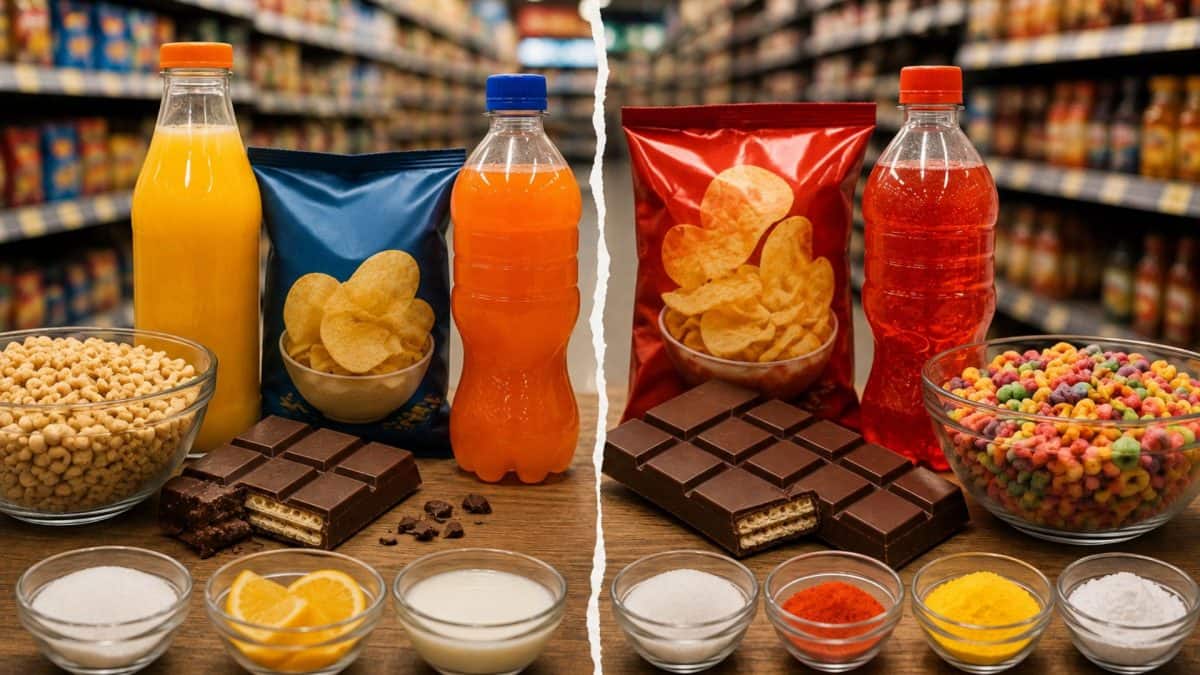
A box of infant cereal sold in Switzerland. A bottle of orange soda sold in France. A chocolate bar sold in Australia. You will find all these products stuffed in supermarket shelves in India, but with a vital difference. Flip the pack over, and the ingredient list is often radically different.
The cereal in India has more added sugar, the orange soda contains barely any oranges, but has more harmful colour, the popular chocolate has less milk and milk products compared with those sold in the West
For years, consumer groups and public health experts in India have questioned the brazen pratice of multinational food companies marketing products under the same brand names after modifying ingredients and diluting the quality. The issue hogged global headlines in 2024 when Swiss investigative organisation Public Eye and the International Baby Food Action Network (IBFAN) found that Nestle’s Cerelac baby cereals sold in India and several other low- and middle-income countries, mostly in Africa and Asia, contained added sugar. Comparable products sold for infants in big European markets did not.
Advertisement
The controversy put a harsh spotlight on multinational companies allegedly applying different nutritional standards depending on where consumers live
In India, the issue has gathered attention after health reform advocate Revant Himatsingka, popularly known as @FoodPharmer, documented the differences in formulations across several multinational brands. In a recent video, he compared Coca-Cola’s Fanta sold in France with the one sold in India
French Fanta a Wharton University graduate who launched the consumer awareness campaign Label Padhega India, contains around 4 teaspoons of sugar compared with 10 teaspoons in India. The French version has real oranges, no artificial colour and is low in calories; the Indian version has `orange flavour” and a harmful artificial colour
Packaged foods on supermarket shelves as consumers face growing questions over ingredients, nutritional content and labelling standards. Image Courtesy/ Pexels
The difference in the quality of food products is especially important for India, which is witnessing an unprecedented rise in obesity, diabetes and other diet-related diseases. Experts say the debate over multinational food companies selling different formulations across countries is ultimately about transparency—and consumers’ right to know
“Numerous international studies have linked diets high in sugar, salt and saturated fats with obesity, hypertension, heart disease and type 2 diabetes. It doesn’t stop there; these have been linked to hormonal imbalances, hair and skin issues as well,’” said Ishi Khosla, leading nutritionist and author
India’s growing nutrition crisis
India has more than 101 million people living with diabetes, according to the Indian Council of Medical Research-India Diabetes (ICMR-INDIAB) study published in The Lancet Diabetes & Endocrinology in 2023. Another 136 million people are estimated to have pre-diabetes, placing them at high risk of developing the disease
Advertisement
The same study estimated that 254 million Indians have generalised obesity, while 351 million have abdominal obesity — a major risk factor for diabetes and cardiovascular disease
Increasing consumption of packaged and ultra-processed foods, coupled with sedentary lifestyles, is a growing concern. “Industrial additives and emulsifiers, and the breakdown of natural food matrices, adversely alter gut microbiota composition, inducing inflammation. These can be more harmful if consumed regularly,” said Khosla
Different country, different ingredients
The Cerelac controversy highlighted by Himatsingka may have become the most visible example, but it is hardly the only one
The same is true of Pepsi. According to PepsiCo products fact US, Pepsi is sweetened with high-fructose corn syrup in the U.S. The US ingredient list explicitly ranks High Fructose Corn Syrup as the second ingredient right after carbonated water
In contrast, in several European countries and the United Kingdom, according to the company website, Pepsico has reduced sugar content and is using artificial sweeteners such as sucralose and acesulfame-K
In India, however, Pepsi formulations continue to depend more heavily on sugar as the sweetening agent. The mandatory nutritional information labels printed on every bottle and can lists high carbohydrate and total sugar content (roughly 10.9g of sugar per 100ml), alongside local supply chain and agricultural reports confirming the use of domestic cane sugar rather than high-fructose corn syrup
Advertisement
Nestle, Pepsi and Coca-Cola declined comment
Himatsingka said he compared products such as Cerelac, KitKat, Lays and Fanta sold in India with versions available overseas. “There are three broad reasons this happens: pricing, regulation and consumer awareness.”
According to Himatsingka, India remains one of the world’s most price-sensitive consumer markets. “If a product sells for ₹10 or ₹20, manufacturers have very limited room to use more expensive ingredients. If they double the price, many consumers won’t buy it. So they rely on cheaper, more harmful ingredients here.”
Regulation, or lack of it, is another reason
“Countries such as France require front-of-pack nutrition ratings. Such measures push companies to improve their formulations,” he adds
Where as other countries such as Chile, Mexico and Israel shows that simple warning labels are easier to understand across education and income groups and encourage both healthier consumer choices and product reformulation by food companies
India has debated similar regulations for years, but implementation has repeatedly been delayed. In an affidavit in court, regulator Food Safety and Standards Authority of India (FSSAI), proposed a nutritional information board on the front of packaged food instead of warning labels
FSSAI declined comment
Dr Arun Gupta, pediatrician and convenor of Nutrition Advocacy in Public Interest (NAPi), said whatever is in the product should be clearly displayed on the front of the pack so people immediately know how much sugar, salt or unhealthy fat it contains. “Front-of-pack labelling focuses on nutrients of concern—high sugar, saturated fat and sodium—because these have a well-established link with cardiovascular disease and other non-communicable diseases.”
The third factor is consumer behaviour
“Even if a company decides to make its product healthier, how many consumers will notice it or be willing to pay more? Most people still buy based on taste, price and marketing claims rather than by reading ingredient labels,” said Himatsingka
Transparency, not bans
Dr Gupta believes the solution is not to dictate recipes but to ensure consumers know exactly what they are buying
“I don’t think governments can dictate to companies what they should put in their products,” he says. “The important thing is that companies must declare clearly what is in the product.”
“If companies are using different standards for different countries, that is certainly something that should be highlighted.”
Public health organisations have spent years urging the FSSAI to introduce mandatory front-of-pack warning labels on foods high in sugar, salt and saturated fat. They claim that such labels are far easier for consumers to understand than detailed nutrition panels printed on the back of packages
The battle over front-of-pack labels
Countries such as Chile and Mexico require prominent warning labels on foods high in sugar, sodium or saturated fat. France uses the Nutri-Score system, grading foods from A to E according to their nutritional quality
Evidence from these countries suggests that front-of-pack warning labels not only affect purchasing decisions but also encourage companies to reformulate products to avoid receiving poor nutritional ratings. “Many companies feel Indians will take everything lying low. Maybe these companies think the health of Indians is indispensable. That is why we say FOPL with clear warnings are very important,” said Dr Sivaranjani Santosh, Pediatrician and public health advocate based in Hyderabad
Dr Gupta said India still lacks a formal definition of ultra-processed foods
“Colours and additives may also be harmful, but the strongest evidence from a public health perspective is for too much sugar, salt and unhealthy fats.”
A global debate with local consequences
Following the Cerelac investigation, Nestle claimed its products comply with Indian regulations and international Codex standards and that it has reduced added sugar in its infant cereal portfolio in recent years. Nestle declined comment
But the controversy highlighted a wider issue that goes beyond one company. Across social media, consumer groups and researchers have compared ingredient lists of chocolates, breakfast cereals, chips and beverages sold in India with those sold overseas, asking why identical brands should have different formulations
The European Union has itself dealt with similar concerns over “dual quality” products, particularly in Central and Eastern European countries, which felt they were getting inferior goods compared to the rest of Europe. After this, the EU strengthened consumer protection rules against misleading practices where products are marketed as identical despite significant differences in composition
“The solution is greater transparency,” said Dr Gupta. “If a product contains high amounts of sugar, salt or certain additives, consumers should be able to see that at a glance.”
By Toufiq Rashid
Toufiq Rashid is a journalist with over 25 years of experience in print and digital media. She covers health and lifestyle
First Published:Aug 13, 2026, 11:42:30 IST
Advertisement
Advertisement
Trending Stories

Why are your 30s leaving you so burnt out? Experts explain
Career pressure, family responsibilities and the inability to switch off can make your 30s exhausting. Experts explain why burnout creeps in.
6 min read
Shruti Haasan rehomes cat after severe allergy: Doctors explain what to know before adopting a pet
Shruti Haasan’s severe cat allergy highlights why prospective pet owners should understand allergy risks before adopting a cat or dog.
9 min read
Swine flu surge in Delhi: Why H1N1 cases are rising this season and how to avoid the virus
Delhi has recorded 1,344 H1N1 cases in 2026, up from 229 during the same period last year, with doctors urging caution as the virus continues to circulate
3 min read
Joe Biden’s prostate cancer has spread to bones: What bone metastasis means
Joe Biden’s prostate cancer has spread to bones. Experts explain bone metastasis, symptoms, risks like spinal cord compression, and modern treatment options
2 min read
What is Sperm Freezing, who should opt for it and why age matters | Doctors explain
Sperm freezing can preserve male fertility before cancer treatment, certain surgeries or delayed fatherhood. Doctors explain who should consider it and what to know.
7 min read
Advertisement
Advertisement
Up Next
