


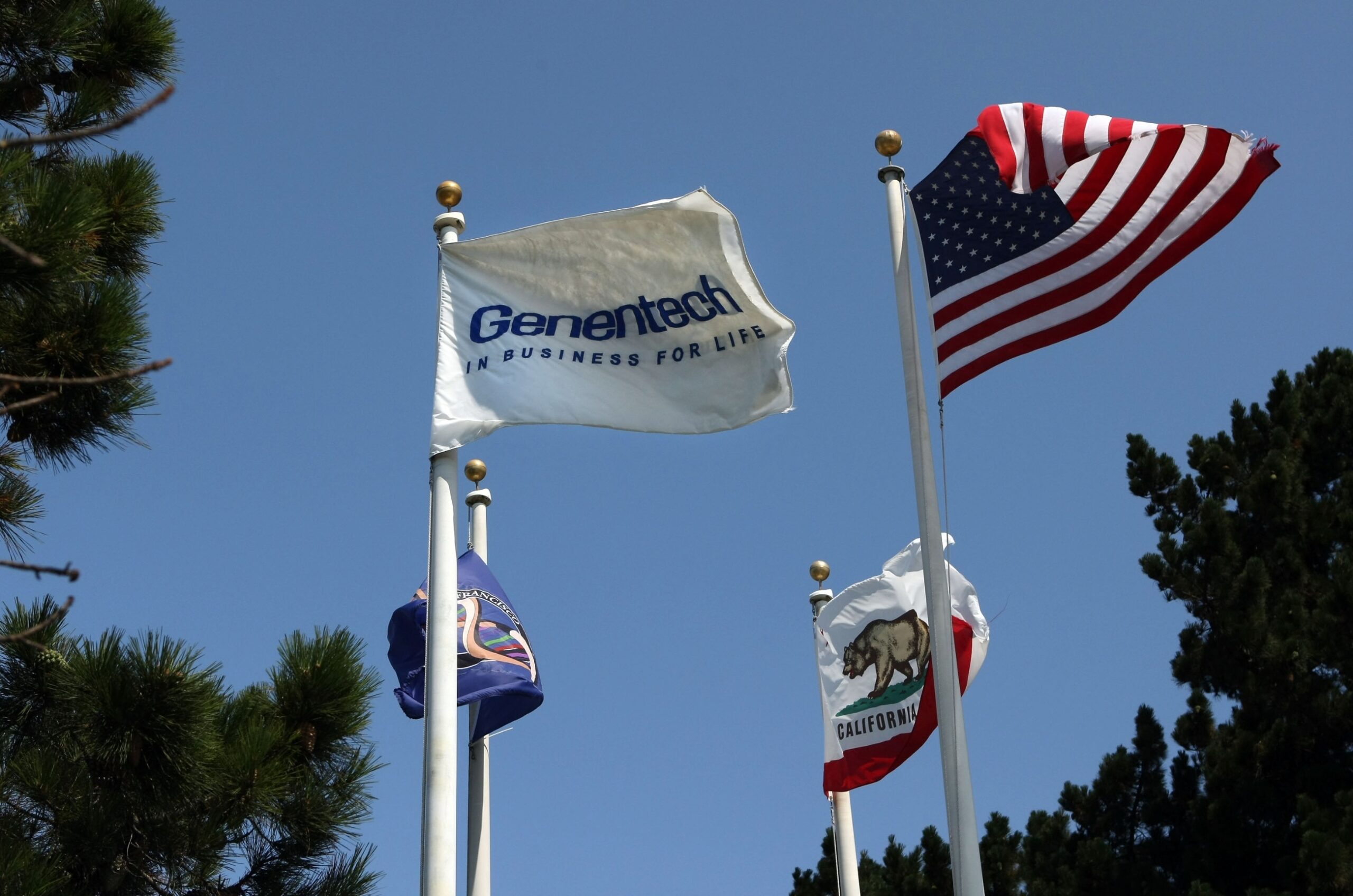
South Korea’s Hanmi Pharmaceutical signed an exclusive global licensing agreement Monday with Genentech, a Roche subsidiary, for HM17321 — an experimental obesity drug designed to selectively burn fat while simultaneously building muscle, attacking the single biggest clinical complaint about the blockbuster GLP-1 drug class: the lean mass patients lose alongside the weight. The deal is worth up to $2.3 billion in total, with Genentech paying $190 million upfront before a single human efficacy data point exists, a price that amounts to an industry vote of confidence in a biological mechanism no approved drug has ever successfully engaged.
HM17321 is a proprietary analog of urocortin-2 (UCN2), a naturally occurring signaling peptide that belongs to the corticotropin-releasing factor family. Where GLP-1 receptor agonists like semaglutide and tirzepatide work primarily through receptors in the gut and brain to suppress appetite and slow gastric emptying, HM17321 works through a receptor called CRHR2 that is highly expressed in skeletal muscle
When CRHR2 is activated in skeletal muscle, it triggers a cascade that includes the mTOR protein synthesis pathway — one of the primary intracellular switches controlling muscle protein synthesis and hypertrophy. In parallel, UCN2 induces lipolysis (fat breakdown) in adipose tissue and suppresses lipogenesis (fat storage), creating the dual action that makes the molecule scientifically interesting: more muscle, less fat, simultaneously. No GLP-1 drug engages this pathway. The two mechanisms are orthogonal, which is what makes combination therapy theoretically attractive — and why the press release notes HM17321’s potential for use in fixed-dose combination products alongside incretin-based drugs.
What HM17321 Actually Does Inside the Body
Hanmi discovered the molecule using HARP, its proprietary AI-driven research platform, then validated it across multiple preclinical species. The data presented at the 2025 European Association for the Study of Diabetes confirmed fat-selective reduction with preserved lean mass in Rhesus monkeys — an important translational step, given that primate physiology is a meaningful predictor of human response. At the 2025 American Diabetes Association Scientific Sessions, Hanmi presented further data showing HM17321 produced body-composition improvements across animal models that improved further when the drug was combined with semaglutide.
Because HM17321 is a peptide, it can be administered as a subcutaneous injection — the same delivery route as GLP-1 drugs and, crucially, more practical for chronic use than the intravenous antibody-based muscle-preserving approaches (such as myostatin inhibitors) that require infusion and have historically struggled with tolerability
Why Muscle Loss From GLP-1 Drugs Has Become a Clinical Problem
The GLP-1 drugs — semaglutide (Wegovy, Ozempic) and tirzepatide (Zepbound, Mounjaro) — have produced genuine breakthroughs in obesity medicine, achieving 15 to 25 percent weight loss over 12 to 24 months in clinical trials. But that weight loss is not all fat. Published data show that lean body mass accounts for roughly 25 to 39 percent of total weight lost on GLP-1 therapies, a range that remains actively debated
The debate was on full display at the ADA 2026 Scientific Sessions in New Orleans, where two leading obesity researchers publicly disagreed about its clinical significance. Dr. Samuel Klein, director of the Weight Management Program at Washington University School of Medicine, argued that lean mass loss on GLP-1 drugs is proportional to total weight loss — the same pattern seen with any caloric restriction — and that no current evidence links it to frailty or clinically defined sarcopenia. Dr. Eric Ravussin of Louisiana State University‘s Pennington-Louisiana Nutrition Obesity Research Center countered that while the absolute risk may be low in otherwise healthy individuals, older patients with low muscle reserves face real clinical exposure.
That disagreement is precisely the market Hanmi and Roche are targeting. Among all patients on GLP-1 therapies achieving more than 15 percent body weight loss, the lean mass contribution to total weight loss has ranged from about 25 percent with tirzepatide to about 39 percent with semaglutide. For the approximately 40 percent of GLP-1 users who are over 60 — a population with lower baseline muscle mass and higher frailty risk — even proportional muscle loss can cross into clinically meaningful territory. Separately, adherence to GLP-1 therapy is poor: published data indicate up to two-thirds of patients discontinue treatment within a year, and weight regain typically follows quickly, often including the muscle that was lost. A drug that actively rebuilds or maintains muscle would change the risk calculus of that stop-start pattern.
Read more:Biweekly GLP-1 Drug Clears First Human Test via Dual Fatty Acid Engineering
What Do GLP-1 Drugs Actually Do to Muscle?
The mechanism matters. GLP-1 drugs suppress appetite and reduce caloric intake, producing a sustained negative energy balance. That energy deficit draws on both fat and lean tissue. The clinical implication is not that GLP-1 drugs are uniquely destructive to muscle — they are not — but that achieving very large amounts of weight loss without simultaneously stimulating muscle anabolism means the body naturally catabolizes some lean mass for fuel. HM17321’s design is to interrupt that catabolism at the receptor level, not by further manipulating appetite or caloric intake, but by flipping the muscle’s own growth machinery on.
The Race for the Muscle-Sparing Frontier
Hanmi is not alone in pursuing this pathway, and the timing of Monday’s deal carries strategic significance. Denmark’s Gubra initiated its own Phase 1/2 clinical trial of a competing UCN2 analog, GUB-UCN2, in July 2026. Gubra’s trial will enroll approximately 188 participants, including healthy volunteers and people with obesity — designed to evaluate safety, tolerability, pharmacokinetics, and preliminary efficacy with specific attention to muscle volume and function endpoints. Hanmi’s IND clearance arrived in November 2025, giving the Hanmi/Genentech program approximately an eight-month head start; according to BioPharma Dive, Hanmi could complete Phase 1 and hand development to Genentech more than a year and a half before Gubra finishes its early human studies.
Pfizer has also previously explored UCN2 as a potential metabolic target, publishing mechanistic research, but has not advanced a candidate to clinical trials. If HM17321 or GUB-UCN2 can demonstrate safety in Phase 1 and even preliminary efficacy signals in Phase 2, the UCN2/CRHR2 pathway will likely attract a wave of competitive entries — making Roche’s early-stage acquisition a potentially defining positioning move
What Genentech Gets, and Why It Fits
For Roche and Genentech, HM17321 does not duplicate what they already have in development. Enicepatide, Genentech’s leading obesity candidate, is a cAMP signal-biased dual GLP-1/GIP receptor agonist that the company moved into Phase 3 clinical trials earlier in 2026. Petrelintide is an amylin analog — a different mechanism aimed at improving satiety signals — also advancing to Phase 3. Roche announced a Phase 2 multi-arm trial evaluating fixed-dose combinations of enicepatide and petrelintide in mid-2026.
HM17321 is the missing piece that none of those agents provides: a non-incretin mechanism that could be layered into fixed-dose combination regimens specifically to address body composition. It does not compete with enicepatide or petrelintide; it extends what either drug can do. That is likely why Roche’s Boris L. Zaïtra described the deal as pursuing “a differentiated approach to selectively reduce fat mass while improving both muscle mass and muscle function” — the language of portfolio construction, not head-to-head replacement.
Under the agreement, Hanmi will complete the ongoing Phase 1 trial, which is currently evaluating safety, tolerability, pharmacokinetics, and pharmacodynamics in healthy volunteers and individuals with obesity. Genentech takes over for Phase 2 and beyond. Hanmi retains all rights in South Korea. The Phase 1 trial is registered as NCT07219589 on ClinicalTrials.gov
Hanmi’s Accelerating Deal Record
The Genentech agreement caps a twelve-month stretch that has transformed Hanmi’s international dealmaking profile. On June 1, 2026, Hanmi announced a licensing agreement with Eli Lilly for sonefpeglutide — a GLP-2 analog built on Hanmi’s proprietary LAPSCOVERY long-acting platform — worth up to $1.26 billion, including a $75 million upfront payment. The Genentech deal, more than double the headline value with a $190 million upfront, sets a new single-asset record for the company
HM17321 sits within Hanmi’s HOP (Hanmi Obesity Pipeline) program, a six-pipeline obesity strategy the company initiated in 2023 that extends beyond simple weight loss to address medication adherence, post-loss weight maintenance, and relapse prevention
Hanmi Senior Executive Vice President and R&D head In-Young Choi framed the deal as confirmation of a deliberate long-term bet: the company has spent years arguing that effective obesity treatment means improving body composition — not just reducing body weight on a scale — and that the GLP-1 era has created a clear clinical gap that non-incretin mechanisms are positioned to fill
What Still Has to Be Proven
HM17321 remains early-stage, and the bar ahead is steep. No drug targeting the UCN2/CRHR2 pathway has ever reached regulatory approval. The Phase 1 trial currently underway measures only safety, tolerability, and biological markers — it is not designed to tell anyone whether HM17321 actually causes meaningful fat loss and muscle preservation in humans at therapeutic doses. The primate data is promising, but animal-to-human translation in metabolic medicine has a complicated record
The $190 million Genentech committed before seeing a single human efficacy data point reflects genuine conviction in the biological hypothesis — and Roche’s interest in securing the UCN2 space before a competitor does. It does not guarantee the drug works. Proof of that awaits Phase 2 results, which will be Genentech’s responsibility to generate and which are, at minimum, several years away
Frequently Asked Questions
Do GLP-1 drugs actually destroy muscle?
Not selectively, but they do cause lean mass loss alongside fat loss. Clinical data show that roughly 25 to 39 percent of total weight lost on GLP-1 therapies comes from lean body mass — including muscle — depending on the specific drug and dose. This is largely proportional to any major caloric-restriction-induced weight loss, rather than a unique destructive effect of GLP-1 drugs. Whether that loss is clinically harmful depends heavily on the patient: older adults and those with pre-existing low muscle mass face the highest risk of crossing into the territory of sarcopenia — the medically recognized syndrome of reduced muscle mass and impaired function.
What makes UCN2 drugs different from other muscle-preserving strategies being tried with GLP-1 therapy?
Several approaches exist: myostatin inhibitors (antibody-based, typically IV-delivered), selective androgen receptor modulators (SARMs), and caloric-restriction-plus-resistance-training protocols. UCN2 analogs like HM17321 are distinct because they act directly on a receptor naturally expressed in skeletal muscle — essentially mimicking an endogenous signal for muscle growth and fat metabolism simultaneously — and can be delivered subcutaneously like GLP-1 drugs, making them practical for chronic use. No UCN2 analog has yet demonstrated this effect in human clinical trials; all efficacy data so far is preclinical.
What happens to the drug if Phase 1 shows safety problems?
If the Phase 1 trial reveals unacceptable safety signals, Genentech is under no obligation to continue development — and the milestone payments that make up the bulk of the $2.3 billion headline figure would not be triggered. The $190 million upfront is the committed, non-refundable payment; everything else is contingent on clinical success. Hanmi would retain global rights outside of any territory carved out by the agreement (Hanmi keeps South Korea) and could presumably seek a new partner, though at a weaker negotiating position.
Is there any drug that burns fat without losing muscle approved today?
No pharmacological agent combining fat loss with muscle preservation is currently approved for obesity specifically. Resistance training combined with adequate protein intake is the standard clinical recommendation for preserving lean mass during any weight-loss regimen, including GLP-1 therapy. The UCN2 drug class — if HM17321 or Gubra’s GUB-UCN2 proves safe and effective in humans — would be the first dedicated pharmacological approach if it reaches approval, which would be, at minimum, several years from now.
ⓒ 2026 TECHTIMES.com All rights reserved. Do not reproduce without permission
Tags:GenentechObesity
