


Goat Milk Products Market Set for Strong Expansion as Health, Nutrition and Premium Dairy Demand Rise
Goat Milk Products Market Set for Strong Expansion as Health, Nutrition and Premium Dairy Demand Rise
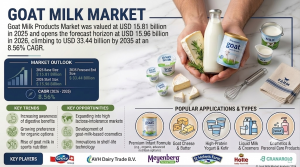
Goat Milk Products Market is expanding as consumers seek nutritious, digestible, and natural dairy alternatives, supported by rising health awareness
Growing health awareness and demand for natural dairy alternatives are creating new opportunities for goat milk products worldwide.”— Market Research Future (MRFR)
NEW YORK, NY, UNITED STATES, August 31, 2026 /EINPresswire.com/ — The global Goat Milk Products Market is entering a period of sustained expansion as consumers increasingly seek nutritious dairy options, distinctive flavors, functional food choices, and alternatives to conventional cow’s milk. Growing awareness of goat milk’s nutritional characteristics, increasing interest in specialty dairy products, and wider availability through modern retail and digital commerce are creating new opportunities for producers across developed and emerging economies.
According to the provided market assessment, the global Goat Milk Products Market is valued at approximately USD 15.81 billion in 2025 and is expected to reach USD 15.96 billion in 2026, before expanding to USD 33.44 billion by 2035. The industry is projected to register a CAGR of 8.56% between 2026 and 2035. The study covers the global caprine dairy industry across product type, packaging, distribution channel, and geography, with historical analysis spanning 2021–2024, 2025 serving as the base year, and forecasts extending through 2035.
Consumer Awareness Strengthens Demand:
One of the most important factors influencing the Goat Milk Products Market is the growing emphasis on health-conscious food consumption. Consumers are becoming more interested in foods that can fit into balanced diets and support broader wellness goals. Goat milk has gained attention because it contains important nutrients such as calcium, protein, phosphorus, and several vitamins. Its composition and characteristics have also encouraged consumers to consider goat milk products when exploring alternatives to conventional dairy.
This trend is particularly relevant among households that are experimenting with different types of dairy products. Instead of relying exclusively on standard cow’s milk, consumers are increasingly exploring goat milk, goat cheese, yogurt, kefir, milk powders, and other specialty formulations. This diversification is expanding the addressable consumer base for goat dairy manufacturers.
However, the growing popularity of goat milk should not be interpreted as meaning that it is suitable for everyone with dairy intolerance or allergy. Goat milk remains a dairy product and can contain proteins that cause allergic reactions in some individuals. The industry’s growth therefore depends on responsible product communication, accurate labeling, and consumer education rather than broad health claims.
Goat Milk Products Market Segmentation:
▪️By Product Type:
The Goat Milk Products Market is segmented into fluid milk, cheese, milk powder, yogurt, butter and ghee, and ice cream and desserts. Fluid milk remains a major category due to household consumption and its digestibility appeal. Cheese benefits from premium and artisanal demand, while milk powder is gaining traction through nutrition and export applications. Yogurt continues to see interest from consumers seeking probiotic and functional foods, while butter, ghee, and desserts are supported by culinary innovation and premium food trends.
▪️By Packaging:
Packaging segmentation includes Tetra Pack, glass bottles, tins, and stand-up pouches. Tetra packs remain widely used because they support convenient storage, transportation, and distribution. Glass bottles are associated with premium and artisanal products, while tins are commonly suited to powdered formats. Stand-up pouches are gaining attention due to lightweight designs, convenience, and growing interest in sustainable packaging solutions.
▪️By Distribution Channel:
The market is distributed through off-trade and on-trade channels. Off-trade channels, including supermarkets, specialty stores, and e-commerce platforms, account for a significant portion of consumer purchases due to convenience and wider product availability. On-trade channels such as cafés, restaurants, and foodservice outlets support product discovery and premium consumption experiences.
News & Developments:
▪️EFSA (March 2024): Issued a favourable opinion supporting caprine protein in infant and follow-on formulas, encouraging market investment.
▪️Ausnutria (July 2024): Expanded spray-drying capacity to increase nutrition-grade goat milk powder production.
▪️Health Canada (September 2024): Clarified requirements for caprine-based infant formula approvals.
▪️Bubs Australia (February 2025): Reported strong growth in caprine toddler nutrition and planned wider Gulf expansion.
▪️Saudi MEWA (May 2025): Introduced productivity support for small-ruminant dairy operations.
▪️Emmi Group (August 2025): Expanded its specialty cheese distribution in North America.
▪️China SAMR (October 2025): Approved additional caprine formula products for domestic retail.
Download Free Sample PDF Copy : – Access A Complimentary Copy of Our Report to Explore Its Content and Insightshttps://www.marketresearchfuture.com/sample_request/6480
Product Innovation Broadens Market Potential:
Product innovation is becoming a major competitive factor within the global Goat Milk Products Market. Historically, goat milk was often associated with fresh milk and traditional cheese. Today, manufacturers are developing a much broader portfolio designed around modern consumption habits.Fermented products are particularly important because yogurt, kefir, cultured beverages, and specialty cheeses provide manufacturers with opportunities to combine goat milk with established functional-food trends. Fermentation also creates distinctive textures and flavor profiles that appeal to consumers seeking premium or artisanal dairy experiences.
Powdered goat milk represents another important area of opportunity. Powdered formats can provide greater convenience, longer storage potential, and easier transportation compared with fresh products. These characteristics make powdered formulations relevant across household, foodservice, specialty nutrition, and ingredient applications. Manufacturers can also develop different formulations for specific culinary or nutritional requirements.
Concentrated and fat-rich products add further diversity to the product portfolio. These formats can support premium culinary applications, specialty food manufacturing, and differentiated dairy experiences. As consumers become more adventurous with food, distinctive goat milk characteristics can be positioned as an ingredient advantage rather than simply an alternative to conventional milk.
Fermented Products Maintain Strategic Importance:
The product-type landscape includes concentrated, fermented, powdered, fat-rich, and other goat milk products. Among these categories, fermented products continue to hold strong strategic importance because they connect goat dairy with several established food trends, including cultured foods, artisanal production, premium cheese, and probiotic-oriented consumption.
Goat cheese is particularly significant because its flavor profile has made it popular within gourmet cooking and specialty food markets. Restaurants, hotels, bakeries, foodservice operators, and premium grocery retailers can use goat cheese as an ingredient that adds differentiation to salads, pizzas, appetizers, sauces, desserts, and other preparations.
Yogurt and kefir also provide opportunities to introduce goat milk to consumers who may not regularly purchase fresh goat milk. These products can be flavored, portioned, packaged, and marketed for different occasions, helping manufacturers move beyond the traditional perception of goat dairy.
At the same time, powdered products are positioned for strong future development because they address convenience and distribution challenges. Shelf-stable formats can enable manufacturers to reach regions where refrigerated goat milk supply chains are less developed. This could be particularly important for international expansion and emerging markets.
Packaging Becomes a Differentiation Tool:
Packaging is another important dimension of the Goat Milk Products Market. The industry encompasses bottles, cartons, cans, tubs, and other packaging formats, with packaging choices influenced by product characteristics, storage requirements, consumer convenience, transportation needs, and brand positioning.
Bottles and cartons remain relevant for liquid goat milk and beverage products because they provide familiar formats for consumers. Clear labeling, convenient closures, portion sizes, and easy storage can influence purchase decisions, particularly among households purchasing dairy products for regular consumption.
Tubs have particular relevance for yogurt, spreads, soft cheeses, and other products requiring easy access and resealing. The format can also support premium positioning when manufacturers emphasize serving convenience and product quality.
Cans and other shelf-stable packaging formats can help address distribution and storage requirements for powdered or processed goat milk products. Such packaging can expand geographical reach and reduce dependence on highly specialized refrigerated logistics.
Sustainability is increasingly influencing packaging decisions as well. Consumers are paying closer attention to material use, recyclability, packaging weight, and waste reduction. Manufacturers that combine product quality with practical and environmentally conscious packaging can strengthen their positioning with increasingly informed consumers.
New Opportunities:
The premiumization of dairy products is another factor shaping the industry’s outlook. Consumers in many markets are increasingly willing to explore higher-value products when they perceive differences in ingredients, production practices, provenance, taste, packaging, or nutritional characteristics.
Goat milk naturally lends itself to premium positioning because it is associated with specialty dairy, traditional cheese-making, small-scale farming, and distinctive culinary experiences. Producers can build premium brands around farm origin, regional identity, animal welfare, production transparency, organic positioning, and artisanal craftsmanship where applicable.
Specialty cheese offers particularly strong opportunities. Goat cheese can be incorporated into premium restaurant menus, gourmet food baskets, specialty grocery collections, and foodservice applications. As international cuisines become more accessible, consumers are also becoming familiar with a wider range of cheese varieties and dairy traditions.
For manufacturers, the opportunity lies in converting this interest into repeat purchases. Consistent quality, attractive packaging, reliable availability, and clear product positioning are important for transforming curiosity into long-term consumer loyalty.
Sustainability Influences Production Strategies:
Sustainability is becoming increasingly relevant throughout the goat dairy value chain. Consumers are paying greater attention to where food comes from and how it is produced. This is encouraging companies to examine farming practices, animal care, resource efficiency, packaging, transportation, and supply-chain transparency.
Goat farming can be integrated into diverse agricultural environments, which gives the sector opportunities to develop region-specific production systems. However, sustainability outcomes depend on farming practices, feed systems, land management, water use, herd management, transportation, and processing efficiency. Responsible producers therefore need to evaluate sustainability across the complete value chain rather than relying on broad environmental positioning.
Supply-chain partnerships can also support sustainability goals. Working directly with farmers and cooperatives can help companies improve raw-material consistency, strengthen producer relationships, and establish clearer traceability. Such relationships can become an important component of brand storytelling when supported by verifiable sourcing practices.
Regional Expansion:
The Goat Milk Products Market has opportunities across North America, Europe, Asia-Pacific, and other international regions. Each geography presents a different combination of consumer preferences, production capabilities, retail structures, and regulatory requirements.
North America represents an important opportunity because health-oriented consumers, specialty food retailers, premium dairy categories, and established distribution systems provide a strong environment for differentiated goat milk products. Product innovation and branding can help manufacturers reach consumers interested in nutrition, specialty cheese, cultured dairy, and alternative dairy choices.
Europe remains highly relevant because goat dairy has a long association with traditional cheese-making and specialty foods. The region’s mature food culture and established premium dairy segment create opportunities for both established manufacturers and artisanal producers. Product quality, origin, sustainability, and culinary positioning can remain important purchasing considerations.
Asia-Pacific presents considerable potential because changing food preferences, rising consumer awareness, urbanization, and expanding modern retail networks can create additional demand. The region also includes countries with established goat farming traditions, providing opportunities for local production alongside international brands.
Other regions can provide emerging opportunities as urban consumers gain access to modern grocery formats and specialty dairy products. Market education, affordable packaging, reliable cold-chain infrastructure, and locally relevant product development will be important for broader penetration.
Competitive Landscape Features Diverse Suppliers:
The competitive environment includes established dairy companies, specialty goat milk brands, ingredient suppliers, and regional producers. According to the supplied report scope, 12 leading suppliers profiled in the study include
▪️Ausnutria
▪️Emmi
▪️AVH Dairy Trade
▪️Meyenberg
▪️Delamere Dairy
▪️St Helen’s Farm
▪️Bubs Australia
▪️Holle
▪️Granarolo
▪️Sanyuan
▪️Hay Dairies
▪️Australian Dairy Park.
These companies operate across different parts of the value chain and demonstrate the diversity of the goat dairy industry. Some businesses are positioned around specialty consumer products, while others have strengths in dairy ingredients, infant nutrition, processing, regional distribution, or premium dairy.
Competitive differentiation is increasingly moving beyond basic product availability. Companies can strengthen their positions through new product formats, improved packaging, supply-chain efficiency, responsible sourcing, digital commerce, premium branding, and regional expansion.
Manufacturers that understand local consumer preferences can also create an advantage by adapting flavors, formats, pack sizes, and communication strategies to individual markets. The ability to balance global production capabilities with local market relevance will become increasingly important as competition develops.
Challenges:
Despite favorable demand conditions, the Goat Milk Products Market faces several challenges. One of the most important is the availability and consistency of raw goat milk. Goat milk production can be more specialized than conventional dairy supply, making farmer relationships and procurement systems particularly important.
Processing and cold-chain requirements can also increase operational complexity for fresh products. Manufacturers expanding internationally may need to invest in logistics infrastructure, regional production partnerships, or shelf-stable formats to reach distant consumers efficiently.
Consumer awareness remains another challenge. Although goat milk products are gaining visibility, many consumers still have limited knowledge about the differences between goat dairy and other dairy categories. Brands need to communicate product attributes clearly without relying on unsupported or exaggerated health claims.
Price positioning can also influence adoption. Premium goat dairy products may carry higher prices than mainstream dairy alternatives, limiting accessibility for price-sensitive households. Manufacturers can address this through varied pack sizes, product formats, operational efficiency, and broader distribution.
Technology and Digital Commerce Shape the Next Phase:
Technology is expected to influence both production and commercialization across the industry. Manufacturers can use improved processing systems, quality-control technologies, inventory management tools, demand forecasting, and supply-chain analytics to improve operational performance.
Digital platforms are equally important on the consumer side. Online shopping allows brands to communicate product information directly, collect customer feedback, introduce subscription options, and build communities around specialty dairy products.
Data-driven marketing can help companies identify consumer preferences and develop products around specific occasions. For example, a brand may use customer insights to understand demand for small-format yogurt, specialty cheese, powdered products, or convenient family packs.
This combination of manufacturing innovation and digital engagement can help goat milk companies move from traditional dairy positioning toward more sophisticated consumer-focused strategies.
Future Outlook:
The outlook for the Goat Milk Products Market remains positive as the industry benefits from changing dietary preferences, premium food consumption, product innovation, and broader access through retail and digital channels. Based on the provided market assessment, the industry is expected to progress from USD 15.81 billion in 2025 to USD 33.44 billion by 2035, representing a CAGR of 8.56% from 2026 to 2035.
The next phase of development is likely to be characterized by greater product diversification. Fermented products, powdered formulations, specialty cheeses, concentrated products, and other value-added formats can help manufacturers reach different consumer groups and usage occasions.
Frequently Asked Questions?
What is driving the Goat Milk Products Market?
Rising interest in nutritious dairy, specialty foods, premium products, culinary innovation, and alternative dairy choices are among the major factors supporting demand for goat milk products.
Which goat milk product categories are gaining attention?
Fermented products such as yogurt, kefir, and cheese have strong consumer appeal, while powdered products are attracting interest because of convenience, storage advantages, and broader distribution possibilities.
How are consumers purchasing goat milk products?
Physical retail remains important, particularly for refrigerated dairy products. At the same time, online grocery platforms, direct-to-consumer websites, and specialty e-commerce channels are expanding access to niche goat milk products.
What is the outlook for the Goat Milk Products Market through 2035?
Based on the supplied report figures, the market is expected to increase from USD 15.81 billion in 2025 to USD 33.44 billion by 2035, with an anticipated CAGR of 8.56% during 2026–2035.
Browse More Reports:
Enriched Milk Powder Market:https://www.marketresearchfuture.com/reports/enriched-milk-powder-market-38301
Anhydrous Milk Fat Butter Oil Market: https://www.marketresearchfuture.com/reports/anhydrous-milk-fat-butter-oil-market-22991
Almond Milk Market:https://www.marketresearchfuture.com/reports/almond-milk-market-2872
Fresh Milk Market:https://www.marketresearchfuture.com/reports/fresh-milk-market-26241
Market Research Future
Market Research Future
+1 855-661-4441email us here
Legal Disclaimer:
EIN Presswire provides this news content “as is” without warranty of any kind. We do not accept any responsibility or liability
for the accuracy, content, images, videos, licenses, completeness, legality, or reliability of the information contained in this
article. If you have any complaints or copyright issues related to this article, kindly contact the author above

