


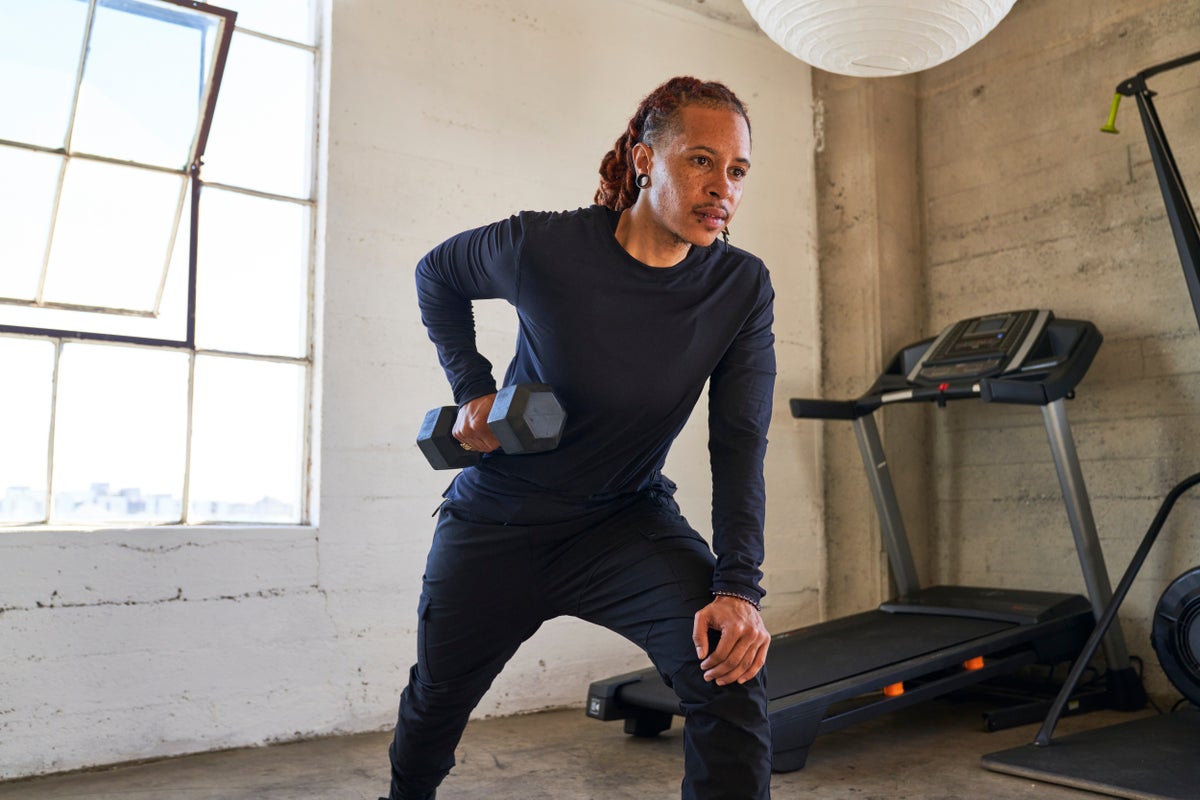
If you have a dusty pair of dumbbells hidden somewhere in your home, you have everything you need to build the fittest, healthiest bodyyou have ever occupied. And the good news for all those looking to start strength training as part of their September reset is that beginners can do so with just a 30-minute workout, done twice a week
So says Dr Brad Schoenfeld, a professor of exercise science at Lehman College in New York who has published more than 400 research papers. The vast majority are on the topic of strength trainingand, specifically, muscle growth
But to be effective, this 30-minute workout must meet certain criteria; shared by Dr Schoenfeld below. He also suggests a sample full-body dumbbell workout, the promised benefits of which are impressive
Done correctly, this twice-weekly training routine will see you build muscle, lose fat and become stronger – not just in your muscles, but also in your bones and joints. Your heart health will improve, your body will be better at managing blood sugar, and your risk of chronic diseases such as diabetes will fall dramatically
As Dr Schoenfeld puts it: “I don’t think anything gives you the bang for your buck that resistance training does on an overall health basis.”
Here is everything you need to know to get started
How to do the best beginner dumbbell workout for training your whole body
You could do this workout (written out in full below) twice a week, on non-consecutive days, for the rest of your life and stay in pretty good nick. It works all major muscle groups and moves your joints through a wide range of motion, building a strong, mobile body
All you need is a pair of dumbbells and roughly 30 minutes. There are five exercises, each targeting a different major muscle group, and two optional exercises for your arms if you have time. (These are optional as the arms have already been worked as ancillary muscles during the rows and presses, but people often enjoy giving these muscles a little extra TLC.)
You will perform each exercise for two hard sets of 8-12 repetitions, resting for 60-120 seconds between sets. Once you have performed both sets of one exercise, move on to the next movement
Dr Schoenfeld recommends using adjustable dumbbells so you can change the weight to make each exercise suitably challenging. Of the products I’ve tested, these Nordictrack adjustable dumbbells represent a quality premium option, while these cast iron spinlock dumbbells are a durable and more affordable alternative
Exercise | Sets | Repetitions | Rest between sets | |
Quadriceps and glutes | Goblet squat | 2 | 8-12 | 60-120 seconds |
Chest | Chest press (or press-up/kneeling press-up if you don’t have a weight bench) | 2 | 8-12 | 60-120 seconds |
Hamstrings | Romanian deadlift | 2 | 8-12 | 60-120 seconds |
Back | Single-arm dumbbell row | 2 | 8-12 each side | 60-120 seconds |
Shoulders | Dumbbell overhead press | 2 | 8-12 | 60-120 seconds |
Calves | Calf raise | 2 | 8-12 | 60-120 seconds |
Optional extra | ||||
Biceps | Biceps curl | 2 | 8-12 | 60-120 seconds |
Triceps | Dumbbell overhead triceps extension | 2 | 8-12 | 60-120 seconds |
Read more:The uncomfortable truth about building muscle and eight golden rules for strength training in midlife
How to ensure this workout is effective
The first few times you do this workout, you should use light weights and practice doing each exercise with good technique, Dr Schoenfeld advises
“Don’t push yourself really hard during the first few sessions because you will get really sore,” he explains. “You need to acclimate your muscles to this new training stimulus, and the body will adapt very quickly. Within a couple of sessions, you will be ready to push yourself progressively harder.”
That leads us to the two prerequisites for successful strength training: consistency and challenge
Imagine training is like a conversation with your body. If the body is not challenged, it has no need to adapt. Whereas, if you give it something challenging but achievable to tackle, it sends a clear message that it needs to be stronger in order to handle what we have in store for it
“If you’re lifting a weight, and at the end of your set you could do 10 more repetitions with the weight you’re using, you’re not really going to see much in the way of benefits,” says Dr Schoenfeld. “The last few repetitions [of each set] need to be difficult to complete.”
If you do this on a consistent basis, your request for a fitter, stronger, healthier body is reinforced, and this is what triggers the many health and fitness benefits we are after
Read more:Everyone is talking about calisthenics – here’s a 4-week strength training plan (no gym membership required)

How you can progress this workout over time
After doing this workout for a few months, weights that once felt challenging will likely start to feel fairly manageable. Given that a strength training workout needs to be challenging to be effective, this means it’s time to tweak your workout to make it more difficult, in line with your increasing strength and fitness levels. There are a few different ways to do this
Increase the weight:As your strength increases, weights that previously felt tricky to lift for eight to 12 repetitions will start to feel easier, to the point where you can hit 12 repetitions every time, no sweat. When this is the case, consider lifting slightly heavier weights for this exercise
Up the volume:“You can add more sets for each exercise, increasing the total volume of training,” Dr Schoenfeld advises. For example, instead of doing two sets of eight to 12 repetitions, you might do three or four sets of an exercise. By the end of the workout, you will have moved more weight and completed more work
Vary the rep ranges:“I would start by doing eight to 12 repetitions per set,” Dr Schoenfeld says. “But as you become more experienced, you might want to experiment with some heavier loading for a lower number of repetitions and some lighter loading for a higher number of repetitions, while still challenging yourself with each set.”
Mix up your movements:“Muscles have different attachment points [to their neighbouring bones], so there can be benefits to varying your exercises after a while,” Dr Schoenfeld explains. “For example, swapping squats for lunges [as they both focus on the quadriceps muscles].”
Read more:The easiest way to strengthen your entire body, according to this expert coach

The benefits of strength training after one day
Just one strength training session can boost your mood and help your body better regulate blood sugar levels, reducing your risk of diabetes over time. But physically, Dr Schoenfeld says, the only difference you might notice is that you feel a bit sore because your body is not used to this new challenge
However, with time, consistency and the learning of proper technique, this soreness will decrease. After a few weeks of twice-weekly workouts, you will start to see the effects
“It usually takes about four weeks to start to see the real benefits on the strength and muscle front,” Dr Schoenfeld says. “You tend to see improvements in strength more quickly, then with muscle growth it takes more like six to eight weeks to see the benefits. But that’s still quite rapid.”
After six months
“If you continue for three to six months, you can see very prominent differences in both your strength levels and muscle growth,” says Dr Schoenfeld. “It’s going to improve your body’s appearance and your ability to move heavy things.”
This is particularly true in beginners. Recent research found that people tend to enjoy “larger early gains” when they start strength training, with progress slowing as you become more experienced. In other words, simply starting is enough to supercharge your progress in most cases
“It’s also going to improve your posture and your metabolic health,” adds Dr Schoenfeld. “A very large percentage of the population has metabolic issues and doesn’t process glucose well – things like diabetes and insulin resistance. Muscle acts as a storage bin, improving your ability to store glucose.”
Strength training and the resulting muscle growth also improves the body’s inflammatory response
“Muscle secretes substances called myokines, and one of the things they do is reduce chronic inflammation,” Dr Schoenfeld explains. “Chronic inflammation has all sorts of negative health consequences
“As you start getting older, the body will generally start to increase low-grade inflammatory responses in the body. Resistance training helps to counteract those responses
“People also tend to lose bone strength as they get older. Resistance training is the primary way to offset bone loss and even to increase bone health.”
Recent research shows another benefit to strength training; improvement to mental health, brain health, mental clarity and symptoms of depression
“I know I sound like an agent for resistance training,” Dr Schoenfeld says, laughing. “But that’s because I’ve seen it and this is what the research, and a huge amount of data we have gathered, shows.”
Read more:I specialise in coaching people aged 40-plus – do these six things for immediate results
