


It’s Not Just Calories: How Fructose May Be Quietly Driving Weight Gain
Health02 September 2026ByDavid Nield
Add ScienceAlert on Google
Fructose can be found in table sugar, fruit, and vegetables.(M.A. Ortega/Moment/Getty Images)
With obesity rates increasing at alarming rates, researchers are amassing as much data as they can on the many risk factors and drivers of the condition. If we know the root causes of this health crisis, we’re better positioned to tackle it
What makes understanding obesity so challenging is the myriad variables involved, from individual genetics to chemical messengers in the body – it’s not just as simple as people overeating
But what enters our bodies through the intestine can have many knock-on effects, as a new study of the common sugar fructose shows
Led by a team from the University of California, Irvine, and published in Science Advances, the study reveals a surprising connection between fructose and fat absorption that deepens our understanding of obesity as a metabolic cascade
Fructose occurs naturally in the body and can be found in table sugar, fruit, and some vegetables
High-fructose corn syrup (HFCS), the focus of this new study and a major processed foods
Fructose has been linked to obesity before, in a 2023 study that suggested the simple sugar was the unifying factor tying together proposed hypotheses of obesity
But until now, we haven’t really known how fructose exerts effects on the body that lead to weight gain and ultimately, obesity
This new study suggests it’s not just the calories it contains – there’s something else going on too, involving the small intestine and its ruffled surface of villi, which aid absorption
“High-fructose corn syrup consumption is a risk factor for obesity and diabetes, yet the underlying mechanisms, especially at the specific organ level, are incompletely understood,” write the researchers in their published paper
“We found an unexpected role of small intestinal fructose catabolism in modulating gut microbiome, ileum-specific lacteal growth, dietary fat absorption, and eventually whole-body metabolic fitness following the consumption of high-dose HFCS.”
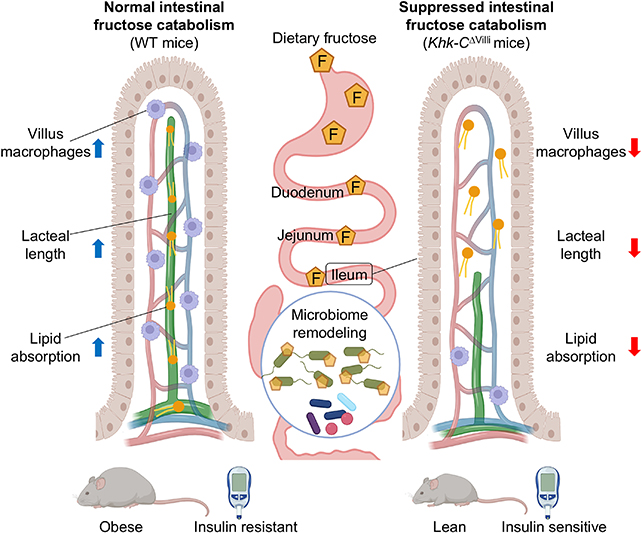
The researchers engineered mice to lack KHK-C, the main enzyme that helps metabolize fructose, in the small intestine. Then, they fed the mice a high dose of HFCS for 12 weeks
What happened next was a surprise
Compared to a control group of mice, those lacking KHK-C (and biological fructose-processing capabilities) gained less weight and had less fat mass on their bodies, as well as significant shifts in their gut microbiome
“We report that inhibition of fructose catabolism specifically in the murine small intestine unexpectedly mitigates fructose-induced obesity and insulin resistance,” write the researchers
Further analysis revealed a specific chemical chain reaction
Without intestinal fructose processing, there were fewer immune cells called macrophages in the ileum, the end section of the small intestine
That, in turn, shortened the lacteals, special carriers of dietary fat, which reduced fat absorption into the body
The process was confirmed by looking at the poop of the genetically engineered mice: It contained more fat because less had been absorbed
What’s more, when poop samples from these mice, with their altered microbiomes, were transplanted into other mice, similar effects on fat absorption were seen
“Fecal transplantation experiments revealed that the microbiome altered by blunted host intestinal fructose catabolism decreases ileal macrophages essential for lacteal growth,” write the researchers
“Thus, altered intestinal lacteal architecture likely contributes to the synergistic effects of high fat and sugar on metabolic disorders.”

All of these findings need to be analyzed and confirmed in humans, of course, but the study points to a previously undiscovered connection between fat and sugar: digesting fructose primes the small intestine to better absorb fat
This gives new meaning to our understanding of sugar as a primary driver of obesity
“While dietary fat used to be regarded as the leading culprit of public health, in recent years, researchers have found that the added sugars in the diet, mainly in the form of fructose, are primarily contributing to the prevalence of obesity, diabetes, and metabolic dysfunction–associated steatotic liver disease (MASLD),” the researchers write
If scientists are ultimately able to identify the specific bacterial strains that are causing the shift in the gut microbiome that underpins this relationship, the potential is there to develop probiotics that limit the amount of fat the body takes on board
Previously, it was thought that fructose processing in the small intestine helps protect the liver from damage, but excessive consumption overwhelms the organs
Now, we also know it affects how our bodies absorb fat
“In a contemporary society where excessive fructose and calories are widespread in processed foods, the small intestine’s role in absorbing and processing dietary nutrients becomes even more critical in determining the trajectory between health and disease,” write the researchers
The research has been published in Science Advances
This article was fact-checked by Clare Watson and edited by Clare Watson. While we pride ourselves on our process, we are only human. If you spot a mistake, please let us know
