


The California Report
Voters in This Competitive California District Say Healthcare Is the Key Issue
California’s 22nd District has high Medicaid enrollment, and redistricting has given Democrats an edge.
Sep 1, 2026
Updated 11:21 am PT
Christopher Alam
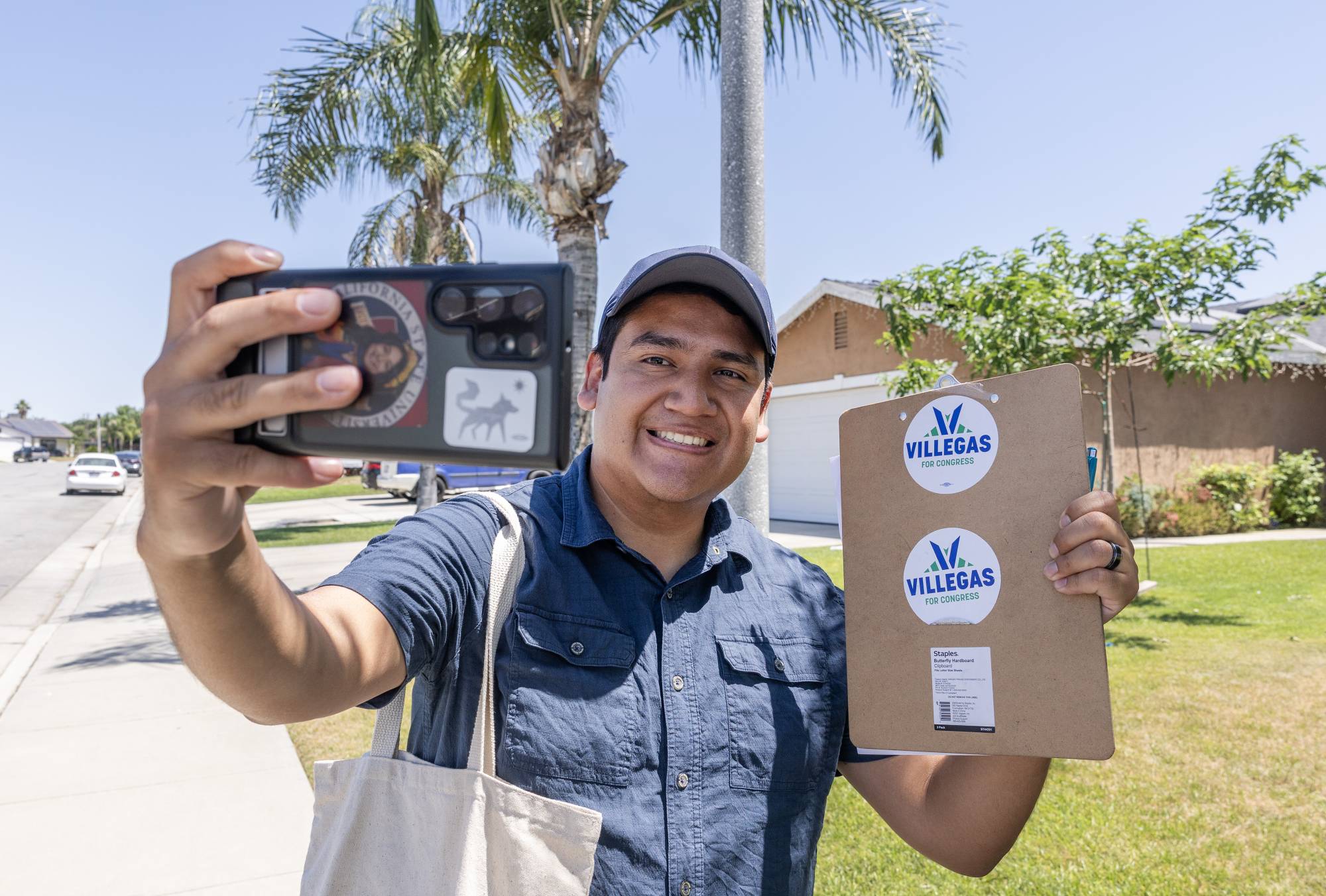
Randy Villegas, running for California’s 22nd Congressional District, said his campaign manager wants him to take frequent selfies for their social media while walking neighborhoods in Bakersfield, CA on Saturday, May 23, 2026. (Myung J. Chun / Los Angeles Times via Getty Images)
Here are the morning’s top stories on Tuesday, September 1, 2026
- As the 2026 midterm elections approach, one of the top issues for voters across the country is healthcare, following major cuts last year to Medicaid. California’s 22nd congressional district has high Medicaid enrollment, and it’s one of the most competitive seats in the country now that Democrats recently gained a voter advantage there due to redistricting. In a partnership with KFF Health News, KVPR spoke to residents in this district about how healthcare could influence their vote.
- California lawmakers are set to vote today on changes to what happens after a damaging wildfire is sparked by utility equipment.
- An Imperial County judge appears poised to strike down the county’s moratorium on data center development.
“I Expect Them to Campaign On Health Care. They’d Be Very Foolish Not To.”
For most of Carlos A.’s life, he received health insurance coverage from Medi-Cal. It’s California’s version of Medicaid, and it’s free
But when he got a raise a few years ago, he made too much money to qualify, and he spent some time without coverage at all
That’s because he has a chronic immune system condition, and he needs regular medication
“It was a panic at first,” said Carlos. “I have to be able to afford my health insurance to go to the doctor, because if not, then there’s no peace of mind.”
We agreed to withhold his diagnosis and his last name in order to protect him from repercussions related to his health
Now, the twenty-something gets insurance through his job at an Amazon warehouse in Bakersfield. But this still has meant navigating premiums, copays and deductibles. And his insurer recently told him he needed to switch to a generic version of the prescription he’s relied on for a decade
“It was a slap in the face because it’s a contract. I’m going to pay my premiums, you cover my insurance, and if there’s a copay to my medicine, I’ll pay it. So why are you playing funny business with my medication?”
And this year, he’s one of many voters weighing healthcare grievances in California’s 22nd Congressional District
This swing district has long been held by Republican David Valadao. He’s being challenged by Democrat Randy Villegas, a school board trustee in Visalia
Carlos attended a recent healthcare rally hosted by Villegas
“My name is Randy Villegas, and I’m running for Congress to fight for Medicare for all,” the candidate said
Carlos wants to hear what both candidates have to say about healthcare costs and red tape
“I do expect them to campaign on health care. They’d be very foolish not to.”
District 22 stretches from Kern County in the south to Fresno County in the north. The last time Valadao lost – in 2018 – was also a time of heated debate about healthcare. That’s partly because this district has some of the most Medicaid enrollees of any congressional district
So who will District 22 residents support this year?
Over the summer, KVPR caught up with voters as they spent time at farmers markets, fairs and rallies in this swing district. Many remain undecided
“We’re stuck between a rock and a hard place,” says Patreza Newton of Hanford. What she and others do know is they’d like to see healthcare become more affordable
Today, faced with two very different candidates, she hasn’t made up her mind
“So I want somebody that’s balanced, but I do want somebody that’s sincere about caring about the needs of everyday people.”
Matthew Depue also lives in Hanford. He says people are doing whatever they can to get the care they need
“People go from here to Mexico to get stuff done because it’s so much cheaper,” Depue says
David Valadao didn’t respond to KVPR’s request for comment. But last year, he voted for President Trump’s One Big Beautiful Bill, which included major reductions to Medicaid
Valadao has said he supports making healthcare more affordable and wants to reduce fraud and waste in the industry. He also supported a rural health program that would fund hospitals in underserved areas
Randy Villegas supports universal healthcare and has said his views were shaped by growing up on Medicaid. In a statement to KVPR, he said he’d work to reverse the cuts to Medicaid. That’s so voters don’t have to “choose between rationing their medicine and groceries.”
Newton, the voter from Hanford, says any healthcare solutions should be practical
“I’m not saying that it has to necessarily all be free because I understand that, you know, nothing in life is free. Somebody’s going to pay for it, but I do think there should be a way that people can afford it, no matter who they are.”
Voters in House District 22 have kept Valadao in office partly because he has offered middle-ground approaches to contentious issues
Villegas will soon test if he can win over voters who have yet to make up their mind – but want to see things change
Newsom and Lawmakers Reach Compromise on Fire Liability Ahead of Vote
California lawmakers are set to vote Tuesday on changes to what happens after a damaging wildfire is sparked by utility equipment
The bill, Senate Bill 492, will create a system for wildfire victims to quickly access payments from utilities, and prevent insurance companies from selling their right to sue utilities to private equity firms. That process, known as subrogation, has helped drive up the cost of electricity bills by adding massive liability costs to power companies
Peninsula Senator Josh Becker is the bill’s author. He said, “This is one of the most consequential pieces of legislation for victims and survivors of wildfires that we’ve ever done.”
Governor Gavin Newsom initially pushed to shift liability for fire damages from power companies to home insurers, but that idea met resistance from Democrats in the legislature. Wildfire survivor groups also took aim at elements of Newsom’s original proposal that would have limited some claims of noneconomic damages
At the heart of the deal is the question of who pays when utility-owned equipment sparks a damaging wildfire — costs that have ballooned into the tens of billions of dollars in recent fire disasters. The plan, which comes after months of largely closed-door negotiations, seeks to protect ratepayers by stopping hedge funds from extracting massive payouts from utilities in the wake of wildfires, while also restricting utility executives from receiving bonuses when their equipment causes a fire.
The CEOs of PG&E and Edison International criticized the bill Monday, saying the potential wildfire liability they face will keep electricity prices high
In a tentative decision last month, Imperial County superior court judge Jeffrey Jones said the county failed to identify a current and immediate threat to public health, safety or welfare that would justify an emergency measure like a moratorium
It follows the vote this summer by the Imperial County Board of Supervisors to suspend all data center development on county land until mid-2027, after months of furious public outcry over a massive proposed data center complex
Judge Jones’s decision was part of a lawsuit brought by Sebastian Rucci, a Huntington Beach-based developer who runs Imperial Valley Computer Manufacturing, an aspiring data centerdevelopment company
The developer sued the county earlier this summer after the Board of Supervisors’ vote on the moratorium
In an email to KPBS Friday, Rucci emphasized the judge’s preliminary findings. He said he would continue working with the county to respond to “legitimate concerns” and evaluate “reasonable alternatives.”
“The County’s study estimates approximately $2.95 billion in economic output over 30 years—an average of approximately $98.3 million per year,” Rucci wrote, referring to an independent economic analysis by county officials. “Each year of unnecessary delay therefore carries a substantial economic cost to the Imperial Valley.”
Data center developers are increasingly looking to rural areas like the Imperial Valley, which is also home to large renewable energys frozen all projects on county land — including Rucci’s
Across the region, hundreds of residents have raised concerns about the possible environmental and public health effects of the giant computing warehouses. Those fears have inspired people to start petitions, attend county meetings, knock on doors and hold community town halls to discuss their concerns
That outcry has inspired a number of the state’s cities to consider their own pauses or bans on data centers locally
In a statement to KPBS last week, Imperial County spokesperson Eddie Lopez said they would respect the court’s decision and were reviewing their next steps
They said the county’s broader effort to evaluate data center development will continue. The judge’s decision is not final and could still be modified, according to California’s court rules
