


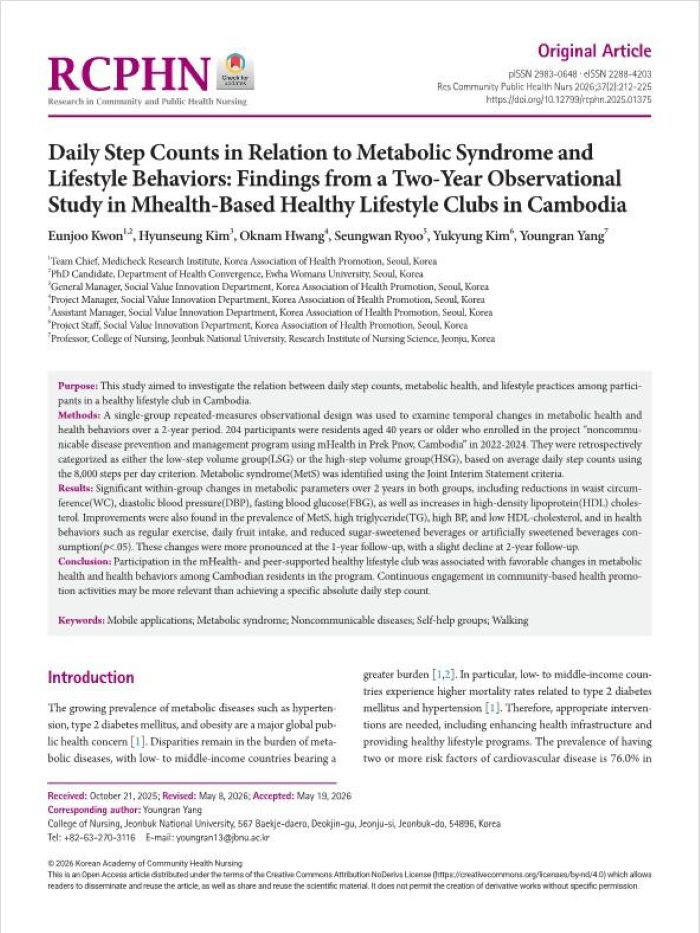
[Sportschosun Jang Jong-ho] A study on the Cambodia mHealth-based health promotion program conducted by the Korea Association of Health Promotion, chaired by Kim In-won, has been published in the international journal Research in Community and Public Health Nursing (RCPHN, Vol. 37, No. 2, 2026)
The study analyzed data from the noncommunicable disease (NCD) prevention and management project carried out in Prek Pnov, Cambodia, from 2022 to 2024 by a consortium formed by the Korea International Cooperation Agency (KOICA) and Jeonbuk National University as part of KOICA’s Civil Society Cooperation Program
Cambodia and other developing countries face major social challenges, including a lack of medical infrastructure and high mortality rates caused by noncommunicable diseases. In response, the researchers ran an integrated health promotion program for two years for 204 residents aged 40 and older who were at high risk for NCDs, combining mHealth technology with a community-based Healthy Lifestyle Club
Participants walked every day and shared their records through a mobile app. Based on their average daily step counts, the researchers divided them into a low-step group, with fewer than 8,000 steps, and a high-step group, with 8,000 steps or more, and tracked changes in metabolic health indicators and lifestyle habits
After two years of follow-up, the program showed improvements in indicators related to metabolic syndrome. The analysis found that both groups saw significant reductions over the two-year period in waist circumference, diastolic blood pressure, and fasting glucose, while HDL cholesterol increased. The prevalence of metabolic syndrome also fell significantly in both the low-step and high-step groups
Meaningful changes were also seen in lifestyle habits, including more regular exercise, higher fruit intake, and lower consumption of sugar-sweetened and artificially sweetened beverages
Notably, there was no statistically significant difference in the pattern of change over time between the high-step and low-step groups. This suggests that consistent participation in a health lifestyle program that includes walking may be more closely linked to improved metabolic health than the absolute daily step target itself
The program was carried out in Cambodian communities with limited access to medical care by combining self-management through an mHealth app, peer support, and cooperation with local medical staff and village health workers. Of the 275 initial participants, 204 remained in the program for two years without dropping out, producing a high retention rate of 74.2% and demonstrating the sustainability of a smartphone-based program
The study suggests that a health promotion model combining mHealth and a Healthy Lifestyle Club in settings with limited medical infrastructure can strengthen residents’ self-management skills and contribute to real health improvements. However, the researchers noted that the study was an observational study without a control group and should be interpreted as exploratory
Researchers at the MediCheck Research Institute said, “Through this study, we confirmed the potential of mHealth technology to help manage noncommunicable diseases among residents in developing countries. The findings could serve as evidence for applying health promotion projects that combine mHealth technology and Healthy Lifestyle Clubs in other developing or underdeveloped countries with similar conditions.”
Meanwhile, RCPHN, where the paper was published, is a reputable international journal indexed in Scopus, a global academic database. The publication carries significance because it shows that the health promotion model developed by the Korea Association of Health Promotion and Jeonbuk National University in a developing-country setting has been reviewed by experts and recognized for its academic value
Jang Jong-ho, bellho@sportschosun.com
원문보기(View Original Korean Article)
