


Attachments
- Download Report(PDF | 989.77 KB)
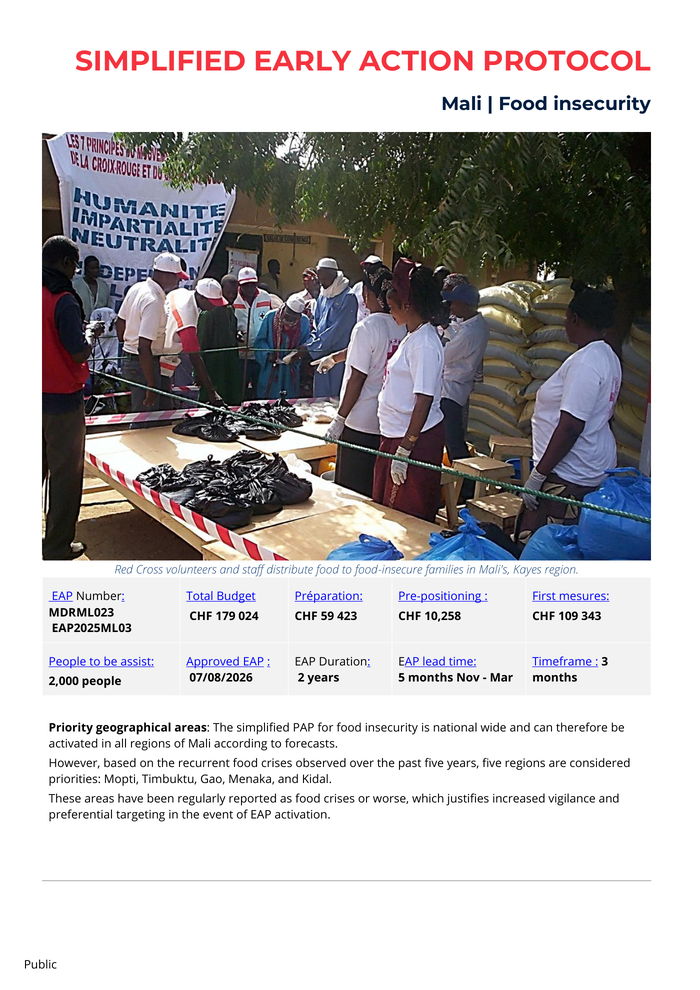
Priority geographical areas: The simplified PAP for food insecurity is national wide and can therefore be activated in all regions of Mali according to forecasts.
However, based on the recurrent food crises observed over the past five years, five regions are considered priorities: Mopti, Timbuktu, Gao, Menaka, and Kidal.
These areas have been regularly reported as food crises or worse, which justifies increased vigilance and preferential targeting in the event of EAP activation
RISK ANALYSIS AND SELECTION OF EARLY ACTIONS
Prioritization of hazards and their historical impacts
Mali, a country in the Sahel, remains particularly exposed to climatic, economic and security hazards that interact and fuel recurrent food crises
1. Hazards and Identified Triggers
The main causes of food insecurity are:
• Rainfall variability / agricultural and pastoral drought: the historical episodes of the years 1970-1980, 2005, 2010, 2018 have led to sharp declines in agricultural production. The decadal bulletins of the GTPA (Mali-Météo) now make it possible to monitor rainfall anomalies (< 75% of the average), pasture deficits (NDVI < average more than 30% of pastoral areas) and parasitic attacks (> 20% of affected crops).
• Economic shocks and market dysfunctions: sustained rise in cereal prices compared to the five-year average and the previous year, reduced supply and disruptions to local supply, deterioration in the terms of trade for livestock/cereals.
• Civil insecurity and limited humanitarian access: Armed conflict, inter-communal violence and crime disrupt supply chains, lead to the abandonment of fields and limit access to pastoral rangelands.
• Health shocks and WASH: Limited access to safe drinking water and high morbidities aggravate mal<a href="https://healthylife7.com/guest-commentary-nutrition-matters-when-buying-donating-food/” title=”Guest Commentary | Nutrition matters when buying, donating food”>nutrition, especially among children under 5 years of age and FEFA.
These factors combine to create the conditions for acute food insecurity to occur
Early actions were identified based on the analysis of historical impacts of food insecurity, the results of the Cadre Harmonisé (CH), and data collected by the CRM from communities during the food insecurity emergency appeal. These actions respond to the following logic: hazard → identified risk → early action → expected impact. This approach is a simplified theory of change :• Climatic and economic hazards are leading to a drop in production and limited access to food.• The risks identified are loss of livelihoods, malnutrition and worsening poverty.• The first selected actions are mainly based on multi-purpose cash transfers, complemented by nutrition awareness, protection and community engagement activities.
Historical data and forecasts available
According to the results of the November 2024 CH analysis, 819,092 people (3.48%) are in phase 3 or worse (October-December 2024), including 34,387 in the emergency department (phase 4+). In projection for June-August 2025, this number is expected to reach 1,470,114 people (6.25%), including 100,941 in phase 4+ (emergency)
The areas of greatest concern are Menaka, Kidal, Gao, Timbuktu and Mopti, where production deficits linked to floods, livestock losses, massive displacement (378,363 IDPs recorded in September 2024), market disruptions and persistent insecurity coexist. (source: Communication sheet CH Nov.2024) Specific vulnerabilities Poor farm households, pastoralists, IDPs and female-headed households are the most affected. Insecurity limits access to fields and markets, increasing dependence on assistance. The CRM incorporates PGI (Protection, Gender and Inclusion) considerations into its analysis and ensures that these groups are prioritized from the outset of the action.
