


The Lycra Company
Material Worldis a weekly roundup of innovations and ideas that are reshaping the materials sector. It covers the latest developments in how fashion is designed, engineered, and scaled—from emerging biomaterials and next-generation leathers to engineered fibers and sustainable alternatives
Sweat less visible
The Lycra Company is taking aim at one of performance apparel’s more visible inconveniences
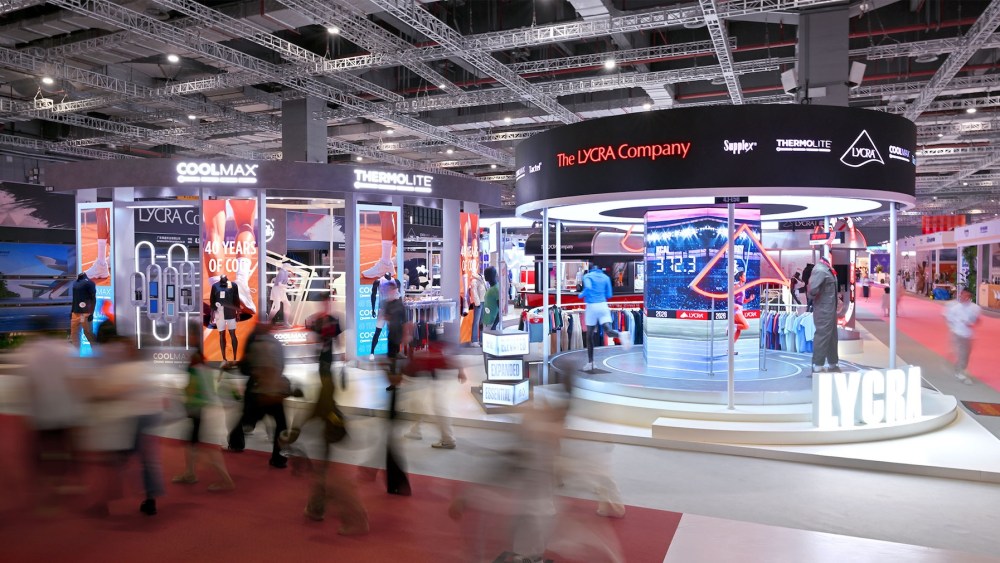
At the Intertextile Shanghai Apparel Fabrics Autumn Edition, the fiber maker introduced COOLMAX CloakFX, a recycled polyester fiber designed to mask the appearance of sweat while providing moisture management and wet and dry opacity
The technology, intended for woven fabrics, is made with 100 percent recycled PET and certified to the Global Recycled Standard, according to the company. It is being shown in commercial applications spanning performance apparel, workwear and everyday clothing
The company is also previewing woven and knitted versions of LYCRA FiT400 fiber, which provides stretch without spandex. Its refreshed knitted offering is available in three tiers—Essential, Expanded and Elevated—while the woven version is intended to give traditionally styled fabrics durable, low-to-moderate mechanical stretch
Rounding out the assortment is Renewable Lycra fiber, which contains 70 percent renewable content derived in part from field corn grown in the American Midwest. The company said the material performs like conventional Lycra fiber while helping reduce a garment’s carbon footprint
The products are being displayed inside an 895-square-meter pavilion housing 19 co-exhibitors. A smaller “Lifestyle District” brings Lycra together with Jingzili New Material, JYT Textile, Lianxingfa Knitting and Trend Textile to show how fiber technologies translate into finished fabrics and garments
“The apparel industry is built on creativity, and great ideas emerge when people with different perspectives come together,” said Jason Wang, vice president for Asia at The Lycra Company
Collectively, the launches position sustainability as one performance attribute among several—including comfort, opacity, cooling and durability—rather than as a standalone proposition
Corn and beeswax take aim at PFAS
Corn and beeswax could help textiles shed water without relying on fluorinated chemistry

Courtesy of UT Austin
A team of University of Texas at Austin students has developed Maízein Movement, a treatment that binds zein, a protein derived from corn, and beeswax to cellulose to create water- and soil-resistant fabric. According to an Aug. 24 announcement from the university, the project won the Outstanding Science Award at the 2026 Biodesign Challenge
The students are positioning the treatment as a potential alternative to PFAS-based textile finishes. The U.S. Environmental Protection Agency has identified use in textiles for water, grease and stain resistance, though moisture wicking—another performance benefit cited by UT—is a separate function from surface repellency
A project description published by the Biodesign Challenge said standardized durability testing and chemical analysis showed water resistance with minimal changes to the fabric’s appearance, hand and durability. Publicly available materials, however, do not provide numerical results, laundering data or comparisons with commercial finishes
Development is continuing as part of student Brandon Nguyen’s master’s thesis. The team plans to seek grants and industry partners, putting Maízein firmly in the promising-research category rather than the commercial PFAS-replacement column
dyeing turns down the heat
Polyester dyeing may not need to run quite so hot
Researchers at Donghua University have developed a recoverable dyeing medium that they say can color polyethylene terephthalate, or PET, at 120 degrees Celsius—10 degrees below the 130-degree benchmark commonly associated with high-temperature disperse
College of Chemistry and Chemical Engineering, Donghua University, Shanghai 201620, China
The experimental system, detailed in a study published in the journal “Sustainable Materials and Technologies,” combines water with thymol and menthol to form a hydrophobic deep eutectic solvent, a liquid mixture designed to help carry disperse dyes into polyester. The researchers reported effective coloration with fewer auxiliary chemicals and said the medium could be recovered after dyeing
That could offer a route to trimming both heat demand and chemical inputs in one of the textile industry’s most widely used—and stubbornly fossil fuel-dependent—fibers. But the work remains at the laboratory stage. A 10-degree temperature reduction does not on its own establish a net environmental benefit. Commercial relevance will depend on recovery rates, repeated reuse, solvent production and regeneration, worker safety, economics and compatibility with existing dyehouses
Wind blades get a textile second act
A retired wind turbine blade is not an obvious Research Denkendorf, or DITF, is trying to make it one
DITF
DITF is one of 13 partners from seven countries participating in Efficient Decommissioning, Repurposing and Recycling, or REWIND, a European Union-funded project developing ways to dismantle and reuse the difficult-to-recycle composite materials in wind turbine blades. According to an Aug. 17 announcement from the institute, its role is to turn recovered glass and carbon fibers into yarns and fabrics for new components and wind turbine repair kits
Researchers have produced one yarn containing roughly 40 percent recycled glass fiber and polyamide 6 for thermoplastic composite applications. They also spun a yarn containing as much as 98 percent recycled glass fiber, then wove it into a unidirectional fabric designed to concentrate reinforcement along specific load paths
A second route skips conventional fiber processing by shaving long-fiber tapes directly from cured blades, then arranging them into reinforcing fabrics. DITF is still evaluating whether those materials can meet the demands of high-performance composites
The work offers a potential outlet for a large and growing waste stream, but it remains a research project. DITF has not disclosed production yields, processing costs, energy requirements or performance over a product’s lifetime—all of which will determine whether blades can realistically become feedstock rather than simply harder-to-handle waste
Manufacturing meets recycling in Charlotte
Textile production and textile recycling will share the floor in Charlotte next spring
Events organizer AMI is launching the Textiles Manufacturing Expo alongside its existing Textiles Recycling Expo USA at the Charlotte Convention Center on April 7 and 8, 2027
The new exhibition will cover machinery and equipment, fibers and yarns, dyes and finishing chemicals, testing and inspection, automation, artificial intelligence and other digital manufacturing tools. A dedicated conference will feature keynote presentations, technical sessions and case studies
“This new expo will provide a much-needed forum for the suppliers of raw materials and production technologies to connect with textile manufacturers to discuss the innovations and applications that will move the industry forward,” said Chrissy Winegarden, exhibition sales manager at AMI
The inaugural Textiles Recycling Expo USA drew 1,858 visitors, 95 exhibitors and 52 speakers to Charlotte in April, according to the organizer. AMI said manufacturers already represented a significant portion of its audience, providing a ready-made base for the expanded event
The co-location reflects the increasingly blurred boundary between textile manufacturing and textile recycling. Decisions about fibers, dyes, finishes and fabric construction made during production can determine whether a garment can be efficiently sorted and recycled years later
AMI has not yet announced an exhibitor list or conference agenda for the manufacturing show
Fungal founders get a commercialization push
The Future is Fungi Award is expanding its support for early-stage fungal technologies beyond its annual competition
The Future is Fungi Award
On Sept. 7, the organization will begin a three-month Venture Builder program for the five leading innovators from its latest award cycle. Beginning with a two-day gathering at the Technical University of Denmark’s DTU Skylab in Copenhagen, the program will cover intellectual property, regulatory strategy, market fit, financial modeling, fundraising and corporate governance
The organization is also launching the Fungi Innovation Hub, which will offer commercialization res first sessions will include a September program with mushroom spawn producer Sylvan Biotech and an intellectual-property workshop in October
The initiative arrives as previous award participants begin moving beyond the laboratory. Visibuilt, a Danish biotechnology company developing a mycelium-based binder for paving and infrastructure, recently raised 3.34 million euros in seed funding. German startup Mycolever, whose fungal discovery platform produces surfactants and oils for cosmetics and personal care, has meanwhile joinedL’Oréal’s Green Science Incubator
Neither company is focused on apparel, but the programs address a familiar challenge for next-generation material startups: turning promising science into a company capable of navigating regulation, attracting capital and producing at commercial scale
sets date for half-year update
Spinnova will publish its financial results for the first half of 2026 on Aug. 31, offering a fresh look at the Finnish fiber innovator’s commercialization progress
CEO Janne Poranen will discuss the company’s January-through-June performance and other developments during a webcast that morning. An English-subtitled recording and presentation materials will be made available afterward
Spinnova has developed a mechanical process for producing textile fiber from wood pulp and waste inputs without dissolving the raw material or using what it describes as harmful chemicals. Its half-year report could provide further insight into the company’s production plans, partnerships, finances and progress toward bringing its technology to commercial scale
