


Abstract
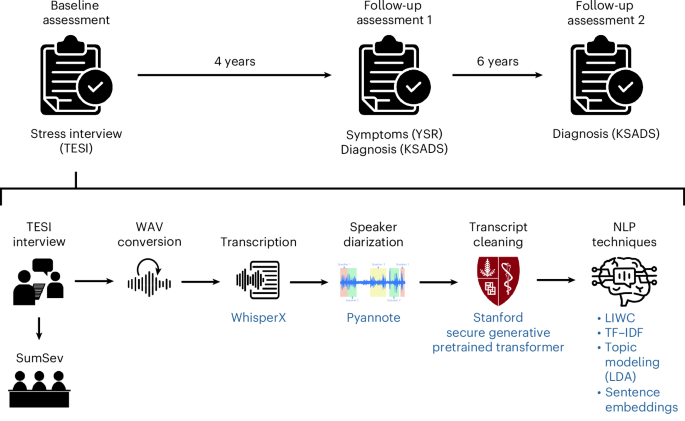
Early life stress is a significant risk factor for psychopathology; however, we lack scalable tools to identify youths who are most vulnerable. Here we tested whether the automated analysis of naturalistic speech can predict future mental health outcomes. We applied a multimodal suite of natural language processing techniques to comprehensive stress interviews with 204 youths (mean age 11.38 years, range 9–13 years; 58% female) to predict internalizing psychopathology up to 6 years later. We found that linguistic features robustly predicted future mental health, explaining more than twice the variance of traditional, human-rated risk factors. Across methods, linguistic style was more predictive than explicit emotional content. Importantly, we introduce a method to interpret transformer-based embeddings that revealed clinically intuitive themes of risk and resilience. Narratives of physical violence and social exclusion emerged as key markers of risk, whereas narratives of structured, routine activities and healthcare access were protective. Moreover, these data-driven semantic dimensions significantly predicted future diagnostic outcomes, outperforming expert ratings of cumulative stress severity. This study computationally analyzes detailed stress narratives to predict the onset of psychopathology across adolescence. Our findings establish a scalable framework to identify objective risk markers and novel intervention targets, demonstrating how artificial intelligence can enrich developmental clinical science.
This is a preview of subscription content, access
Access options
Access through your institution
- Purchase on SpringerLink
- Instant access to the full article PDF.
39,95 €
Prices may be subject to local taxes which are calculated during checkout
Subjects
- Depression
- Prognostic markers
- Risk factors
Data availability
The full dataset contains information about sensitive clinical interviews with minors assessing lifetime history of stress and trauma exposure and, therefore, includes PHI. Consequently, we cannot deidentify the data, and neither institutional review board approval nor participant consent permit public sharing of the speech-derived data
Code availability
All code used for transcription, preprocessing and analysis is publicly availableacci
References
Green, J. G. et al. Childhood adversities and adult psychopathology in the National Comorbidity Survey Replication (NCS-R) I: associations with first onset of DSM-IV disorders. Arch. Gen. Psychiatry67, 113 (2010)
Nelson, C. A. & Gabard-Durnam, L. Early adversity and critical periods: neurodevelopmental consequences of violating the expectable environment. Trends Neurosci.43, 133–143 (2020)
Wade, M., Wright, L. & Finegold, K. E. The effects of early life adversity on children’s mental health and cognitive functioning. Transl. Psychiatry12, 1–12 (2022)
Cahill, S., Hager, R. & Shryane, N. Patterns of resilient functioning in early life: identifying distinct groups and associated factors. Dev. Psychopathol.36, 1789–1809 (2024)
Masten, A. S. Ordinary magic: resilience processes in development. Am. Psychol.56, 227–238 (2001)
Amelio, P. et al. Evaluating the development and well-being assessment (DAWBA) in pediatric anxiety and depression. Child Adolesc. Psychiatry Ment. Health18, 12 (2024)
Jordans, M. J. D. & Kohrt, B. A. Scaling up mental health care and psychosocial support in low-re e189 (2020)
Pennebaker, J. W., Mehl, M. R. & Niederhoffer, K. G. Psychological aspects of natural language use: our words, our selves. Annu. Rev. Psychol.54, 547–577 (2003)
Pennebaker, J. W. & King, L. A. Linguistic styles: language use as an individual difference. J. Pers. Soc. Psychol.77, 1296–1312 (1999)
Chung, C. & Pennebaker, J. Social Communication (Psychology Press, 2007)
Rude, S., Gortner, E.-M. & Pennebaker, J. Language use of depressed and depression-vulnerable college students. Cogn. Emot.18, 1121–1133 (2004)
Argaman, O. Linguistic markers and emotional intensity. J. Psycholinguist. Res.39, 89–99 (2010)
Guntuku, S. C., Yaden, D. B., Kern, M. L., Ungar, L. H. & Eichstaedt, J. C. Detecting depression and mental illness on social media: an integrative review. Curr. Opin. Behav. Sci.18, 43–49 (2017)
Liu, T. et al. Head versus heart: social media reveals differential language of loneliness from depression. npj Ment. Health Res.1, 16 (2022)
Brockmeyer, T. et al. Me, myself, and I: self-referent word use as an indicator of self-focused attention in relation to depression and anxiety. Front. Psychol.6, 1564 (2015)
Edwards, T. & Holtzman, N. S. A meta-analysis of correlations between depression and first person singular pronoun use. J. Res. Pers.68, 63–68 (2017)
Beech, A. et al. Using natural language processing to identify patterns associated with depression, anxiety, and stress symptoms during the COVID-19 pandemic. J. Affect. Disord.376, 113–121 (2025)
Eichstaedt, J. C. et al. Facebook language predicts depression in medical records. Proc. Natl Acad. Sci. USA115, 11203–11208 (2018)
Atkins, D. C., Steyvers, M., Imel, Z. E. & Smyth, P. Scaling up the evaluation of psychotherapy: evaluating motivational interviewing fidelity
Flemotomos, N. et al. Automated quality assessment of cognitive behavioral therapy sessions through highly contextualized language representations. PLoS ONE16, e0258639 (2021)
Goldberg, S. B. et al. Machine learning and natural language processing in psychotherapy research: alliance as example use case. J. Couns. Psychol.67, 438–448 (2020)
Malins, S. et al. Developing an automated assessment of in-session patient activation for psychological therapy: codevelopment approach. JMIR Med. Inform.10, e38168 (2022)
Ewbank, M. P. et al. Quantifying the association between psychotherapy content and clinical outcomes using deep learning. JAMA Psychiatry77, 35–43 (2020)
Nook, E. C., Hull, T. D., Nock, M. K. & Somerville, L. H. Linguistic measures of psychological distance track symptom levels and treatment outcomes in a large set of psychotherapy transcripts. Proc. Natl Acad. Sci. USA119, e2114737119 (2022)
He, Q., Veldkamp, B. P., Glas, C. A. W. & de Vries, T. Automated assessment of patients’ self-narratives for posttraumatic stress disorder screening using natural language processing and text mining. Assessment24, 157–172 (2017)
Schultebraucks, K., Yadav, V., Shalev, A. Y., Bonanno, G. A. & Galatzer-Levy, I. R. Deep learning-based classification of posttraumatic stress disorder and depression following trauma utilizing visual and auditory markers of arousal and mood. Psychol. Med.52, 957–967 (2022)
Son, Y. et al. World Trade Center responders in their own words: predicting PTSD symptom trajectories with AI-based language analyses of interviews. Psychol. Med.53, 918–926 (2023)
Pestian, J. P. et al. A controlled trial using natural language processing to examine the language of suicidal adolescents in the emergency department. Suicide Life Threat. Behav.46, 154–159 (2016)
Venek, V., Scherer, S., Morency, L.-P., Rizzo, A. S. & Pestian, J. Adolescent suicidal risk assessment in clinician–patient interaction. IEEE Trans. Affect. Comput.8, 204–215 (2017)
Weintraub, M. J., Posta, F., Ichinose, M. C., Are as a predictor of depressive symptoms among youth at high risk for mood disorders. J. Affect. Disord.323, 675–678 (2023)
Asarnow, J. R., Goldstein, M. J., Tompson, M. & Guthrie, D. One-year outcomes of depressive disorders in child psychiatric in-patients: evaluation of the prognostic power of a brief measure of expressed emotion. J. Child Psychol. Psychiatry34, 129–137 (1993)
Burkhouse, K. L., Uhrlass, D. J., Stone, L. B., Knopik, V. S. & Gibb, B. E. Expressed emotion-criticism and risk of depression onset in children. J. Clin. Child Adolesc. Psychol.41, 771–777 (2012)
Levis, M., Westgate, C. L., Gui, J., Watts, B. V. & Shiner, B. Natural language processing of clinical mental health notes may add predictive value to existing suicide risk models. Psychol. Med.51, 1382–1391 (2021)
Antonacci, C. et al. Frontolimbic connectivity and threat-related psychopathology: a data-driven test of models of early adversity. Dev. Psychobiol.67, e70080 (2025)
Hou, J., Mortel, L., Popma, A., Smit, D. & van Wingen, G. Predicting the onset of mental health problems in adolescents. Psychol. Med.55, e128 (2025)
Bufano, P., Laurino, M., Said, S., Tognetti, A. & Menicucci, D. Digital phenotyping for monitoring mental disorders: systematic review. J. Med. Internet Res.25, e46778 (2023)
Kliamovich, D. et al. Leveraging distributed brain signal at rest to predict internalizing symptoms in youth. Biol. Psychiatry Cogn. Neurosci. Neuroimaging10, 58–67 (2025)
Danese, A. & Widom, C. S. Objective and subjective experiences of child maltreatment and their relationships with psychopathology. Nat. Hum. Behav.4, 811–818 (2020)
Hill, E. D. et al. Prediction of mental health risk in adolescents. Nat. Med.31, 1840–1846 (2025)
Vandewouw, M. M. et al. Using deep learning to predict internalizing problems from brain structure in youth. Transl. Psychiatry15, 326 (2025)
Chng, S. Y. et al. Ethical considerations in AI for child health and recommendations for child-centered medical AI. npj Digit. Med.8, 152 (2025)
Fusar-Poli, P. et al. Ethical considerations for precision psychiatry: a roadmap for research and clinical practice. Eur. Neuropsychopharmacol.63, 17–34 (2022)
Ribbe, D. in Measurement of Stress, Trauma, and Adaptation (ed. Stamm, B. H.) 386–387 (Sidran, 1996)
Rudolph, K. D. et al. Toward an interpersonal life-stress model of depression: the developmental context of stress generation. Dev. Psychopathol.12, 215–234 (2000)
Achenbach, T. M. & Rescorla, L. A. Manual for the ASEBA School-Age Forms and Profiles: An Integrated System of Multi-Informant Assessment (ASEBA, 2001)
Ridge, N. W., Warren, J. S., Burlingame, G. M., Wells, M. G. & Tumblin, K. M. Reliability and validity of the youth outcome questionnaire self-report. J. Clin. Psychol.65, 1115–1126 (2009)
Kaufman, J. & Schweder, A. E. in ComprehensiveHandbook of Psychological Assessment, Vol. 2: Personality Assessment 247–255 (Wiley, 2004)
Copeland, W., Shanahan, L., Costello, E. J. & Angold, A. Cumulative prevalence of psychiatric disorders by young adulthood: a prospective cohort analysis from the Great Smoky Mountains Study. J. Am. Acad. Child Adolesc. Psychiatry50, 252–261 (2011)
Radford, A. et al. Robust speech recognitionnference on Machine Learning (eds Krause, A. et al.) 28492–28518 (PMLR, 2023)
Baevski, A., Zhou, Y., Mohamed, A. & Auli, M. wav2vec 2.0: a framework for self-supervised learning of speech representations. In Advances in Neural Information Processing Systems 12449–12460 (Curran Associates, 2020)
pyannote/speaker-diarization-3.1. Hugging Facewww.huggingface.co/pyannote/speaker-diarization-3.1 (2024)
Seedat, S. et al. Cross-national associations between gender and mental disorders in the WHO World Mental Health Surveys. Arch. Gen. Psychiatry66, 785–795 (2009)
Solmi, M. et al. Age at onset of mental disorders worldwide: large-scale meta-analysis of 192 epidemiological studies. Mol. Psychiatry27, 281–295 (2022)
Boyd, R. L., Ashokkumar, A., Seraj, S. & Pennebaker, J. W. The Development and Psychometric Properties of LIWC-22 (Univ. Texas at Austin, 2022); https://doi.org/10.13140/RG.2.2.23890.43205
Salton, G. & Buckley, C. Term-weighting approaches in automatic text retrieval. Inf. Proc. Manag.24, 513–523 (1988)
Blei, D. M., Ng, A. Y. & Jordan, M. I. Latent dirichlet allocation. J. Mach. Learn. Res.3, 993–1022 (2003)
Schwartz, H. A. et al. DLATK: differential language analysis toolkit. In Proc. 2017 Conference on Empirical Methods in Natural Language Processing: System Demonstrations (eds Specia, L. et al.) 55–60 (Association for Computational Linguistics, 2017); https://doi.org/10.18653/v1/D17-2010
McCallum, A. K. MALLET a machine learning for language toolkit. Sci. Res.https://www.scirp.org/reference/referencespapers?referenceid=490739 (2002)
Eichstaedt, J. C. et al. Closed- and open-vocabulary approaches to text analysis: a review, quantitative comparison, and recommendations. Psychol. Methods26, 398–427 (2021)
Schwartz, H. A. et al. Personality, gender, and age in the language of social media: the open-vocabulary approach. PLoS ONE8, e73791 (2013)
Argamon, S., Koppel, M., Pennebaker, J. W. & Schler, J. Mining the blogosphere: age, gender and the varieties of self-expression. First Mondayhttps://doi.org/10.5210/fm.v12i9.2003 (2007)
Huertas-García, Á., Martín, A., Huertas-Tato, J. & Camacho, D. Exploring dimensionality reduction techniques in multilingual transformers. Cogn. Comput.15, 590–612 (2023)
Kern, M. L. et al. Gaining insights from social media language: methodologies and challenges. Psychol. Methods21, 507–525 (2016)
Liu, Y. et al. RoBERTa: a robustly optimized BERT pretraining approach. Preprint at https://arxiv.org/abs/1907.11692 (2019)
RoBERTa. Hugging Facehttps://huggingface.co/docs/transformers/en/model_doc/roberta (2020)
López-Otal, M. et al. Linguistic interpretability of transformer-based language models: a systematic review. Preprint at https://arxiv.org/abs/2504.08001v1 (2025)
Vaswani, A. et al. Attention is all you need. Preprint at https://arxiv.org/abs/1706.03762 (2023)
Acknowledgements
We thank the participating families and research staff for their time and effort
Funding
This work was supported by the National Institute of Mental Health (grant no. R37MH101495 to I.H.G.; grant no. F32MH135657 to J.P.U.) and the National Science Foundation (Graduate Research Fellowship Program to E.G.)
Author information
Authors and Affiliations
Department of Psychology, Stanford University, Stanford, CA, USA
Chase Antonacci, Jessica P. Uy, Kaitlyn Kwan, Eugenia Giampetruzzi, Sabrina Jones & Ian H. Gotlib
Neurosciences Interdepartmental Program, Stanford University, Stanford, CA, USA
Chase Antonacci & Sabrina Jones
Department of Psychology, University of Texas at Austin, Austin, TX, USA
James W. Pennebaker
Authors
- Chase AntonacciView author publications
Search author on:PubMed Google Scholar
- Jessica P. UyView author publications
Search author on:PubMed Google Scholar
- Kaitlyn KwanView author publications
Search author on:PubMed Google Scholar
- Eugenia GiampetruzziView author publications
Search author on:PubMed Google Scholar
- Sabrina JonesView author publications
Search author on:PubMed Google Scholar
- James W. PennebakerView author publications
Search author on:PubMed Google Scholar
- Ian H. GotlibView author publications
Search author on:PubMed Google Scholar
Contributions
Conceptualization: C.A., J.P.U., J.W.P. and I.H.G. Data curation: C.A., K.K. and E.G. Formal analysis: C.A., K.K., E.G. and S.J. Writing—original draft: C.A. and I.H.G. Writing—review and editing: C.A., J.P.U., K.K., E.G., S.J., J.W.P. and I.H.G. Funding acquisition: I.H.G., J.P.U. and E.G
Ethics declarations
Competing interests
J.W.P. developed the LIWC software used in this study and receives royalties from its sale and licensing. The other authors declare no competing interests
Peer review
Peer review information
Nature Mental Health thanks José Tomás García Molina and the other, anonymous, reviewer(s) for their contribution to the peer review of this work. Peer reviewer reports are available
Additional information
Publisher’s note Springer Nature remains neutral with regard to jurisdictional claims in published maps and institutional affiliations
Supplementary information
Supplementary Information (download PDF )
Supplementary Figs. 1–3, Tables 1–3, Methods and Results
Reporting summary (download PDF )
Peer Review File (download PDF )
Rights and permissions
Springer Nature or its licensor (e.g. a society or other partner) holds exclusive rights to this article under a publishing agreement with the author(s) or other rightsholder(s); author self-archiving of the accepted manuscript version of this article is solely governed by the terms of such publishing agreement and applicable law
About this article
Cite this article
Antonacci, C., Uy, J.P., Kwan, K. et al. Natural language processing of youth speech predicts psychopathology across adolescence.
Nat. Mental Health (2026). https://doi.org/10.1038/s44220-026-00683-9
Received:28 October 2025
Accepted:16 June 2026
Published:31 July 2026
Version of record:31 July 2026
DOI
:https://doi.org/10.1038/s44220-026-00683-9
