


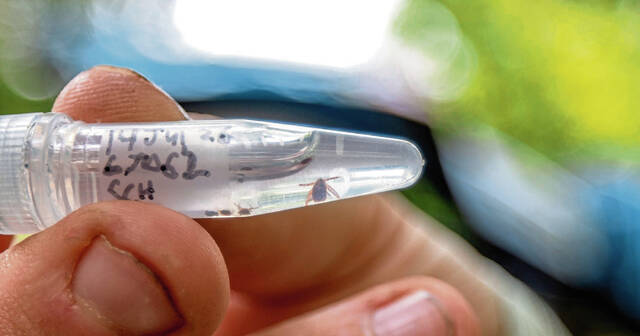
Adult Asian longhorned ticks collected in Frick Park by a group of University of Pittsburgh School of Public Health student students completing a five-year study on a variety of ticks in the area. (Louis B. Ruediger | TribLive)
University of Pittsburgh School of Public Health students gather at Frick Park to continue a study on ticks. The group dragged fabric across a section of a wooded area, then catalog the species and the maturity. (Louis B. Ruediger | TribLive)
Adult Asian longhorned ticks collected on a strip of tape that was strapped to the ankle of a student involved in the study of ticks in the area. (Louis B. Ruediger | TribLive)
Adult Asian longhorned ticks collected on a strip of tape that was strapped to the ankle of a student involved in the study of ticks in the area. (Louis B. Ruediger | TribLive)
Dog ticks (top row), deer ticks (middle) and Asian longhorned ticks are shown in various stages. (Kristina Serafini | TribLive)
Adult Asian longhorned ticks collected on a strip of tape that was strapped to the ankle of a student involved in the study of ticks in the area. (Louis B. Ruediger | TribLive)
University of Pittsburgh School of Public Health student Virgil Ong drags a cloth across a wooded area to collect ticks in Frick Park. (Louis B. Ruediger | TribLive)
With more than 1,300 cases of Lyme disease already reported in Allegheny and Westmoreland counties this year, Western Pennsylvania remains one of the most heavily impacted regions in the nation for the tick-borne illness
According to preliminary 2026 data from the Pennsylvania Department of Health, Westmoreland County has recorded 498 cases of Lyme so far this year, while neighboring Allegheny County has reported 827. The local surge follows a historic peak just last year, when statewide cases reached a 15-year high of 18,749
The recent spike is part of a massive multidecade trend. Between 2004 and 2016, the Centers for Disease Control and Prevention reported a 350% increase in vector-borne disease cases across the country
Nearly 77% of those cases were caused by tick bites — and Pennsylvania is consistently at the center of the epidemic. Indeed, CDC data shows that between 2016 and 2019, just over 29% of all Lyme disease cases in the U.S. occurred in the state
At the University of Pittsburgh School of Public Health, Danielle Tufts and a team of researchers have been studying the tick population since 2022, collecting specimens from the same locations year over year to see how the population is changing
The data Tufts’ team collected is not yet published, but she said tick numbers tend to fluctuate based on a variety of factors
“The abundance of suitable hosts, vegetation, weather — all of it plays a role in what we find,” Tufts said. “When it’s warmer for longer, for example, that’s more time for ticks to find hosts.”
A mild winter can lead not just to more ticks surviving the cold, but also emerging sooner to feed. Ticks in the larval stage often get their first blood meal from a white-footed mouse, which is where they acquire the bacteria that causes Lyme disease
Tufts said a tick can live anywhere from two to five years as it transitions from larva to nymph to adult
Contrary to popular belief, ticks do not acquire Lyme disease by feeding on deer, Tufts said
“It’s the white-footed mice,” she said. “Deer contribute to the population of the ticks, but not to pathogens.”
At the Pennsylvania Tick Research Lab, based at East Stroudsburg University, director Nicole Chinnici said her team is also in its fifth year of collecting tick specimens from six counties
“The density of ticks may fluctuate, but there hasn’t been a noticeable increase in the local tick population at the locations where we test,” Chinnici said
The general peak of tick activity is June and July, and Tufts said tick larvae in Pennsylvania are about to enter their most active stage around August
“They may find a host and take a blood meal, in which case they’ll morph into a nymph and overwinter,” she said. “But larvae that don’t find a host can also survive through the cold season. The winter will kill some, but not all of them.”
Study after study has shown not only that tick activity in the U.S. has been on the rise, but that ticks are expanding their geographic range into areas where winters were once too cold for them to survive
“All the insects and arthropods don’t regulate their body temperature, so they’re more susceptible to colder temperatures,” said Pilar Fernandez, an assistant professor at Washington State University who studies tick-borne diseases. “We just don’t understand how it affects their life cycle, their survival and how it affects the other part of the system — the hosts
“How a change in climate affects the white-footed mice will also affect the ticks, because mice are the reservoir of bacteria for most tick-borne diseases. And then we don’t know how all of that will eventually affect the transmission of diseases.”
What researchers do know, Fernandez said, is that there has been a gradual, geographic expansion into areas where ticks would have been limited by cold winter temperatures in the past
“If our winter weather doesn’t hit until later, ticks will be active longer until we start getting snowfall,” Chinnici said. “If we have warmer days in February, they’ll get more active.”
But there also is such a thing as too hot. The current heatwave the region is experiencing likely means less tick activity in the short term
“They might be active during the morning, but as the weather gets hot, they’ll tuck into leaf litter instead of being out and looking for a host,” Chinnici said. “When we get really hot days, tick activity is going to decrease. When we have cooler days with high humidity, the activity bumps up.”
More bites
When it comes to the increase in tick bites, there are a wide range of reasons why people are coming into more contact with the arachnids. Increased outdoor activity during the covid-19 pandemic brought millions more people onto hiking trails and into wooded areas
As for long-term growth, suburban housing expansion over the decades frequently backs up onto wooded treelines, making it just as likely to get a tick bite in a backyard as on a mountain hike
“In areas that had been hyper-endemic for a long time where we see most of the cases, traditionally people have been living with tick-borne diseases. Also, they’ve adapted to basically live with ticks and protect themselves more,” Fernandez said. “But what’s happening in the areas where tick-borne diseases are emerging or ticks are moving into, is people are less familiar with it, they have less knowledge, so they’re more exposed to it.”
The good news
Is there any good news about ticks? Perhaps
If you do get bitten by a tick in Pennsylvania, there is a good statistical chance that it isn’t carrying any diseases. The Pennsylvania Tick Research Lab has tested more than 141,000 ticks sent in by residents, and only 28% (about 39,500) tested positive for a vector-borne disease
There is also research being done on controlling the transmission of bacteria from white-footed mice into ticks and preventing an infected tick from passing the disease along to humans
“One that is being investigated right now, and that the USDA actually has approved for use — but I haven’t seen it in the market — is a bait that carries a vaccine, so that you can vaccinate the white-footed mouse that is the host for Lyme disease,” said Adela Oliva Chavez, a researcher at the University of Wisconsin-Madison entomology department. “The idea is that the animal will develop antibodies that kill the pathogen, so it doesn’t become infected. Not only that, when a tick that is infected bites the animal, the antibodies from the animal can kill the bacteria that is inside the tick. That is one technology that is fairly new.”
And for those terrified at the prospect of the lone star tick infecting them with the dreaded red-meat allergy, also known as alpha-gal syndrome, Tufts had some reassuring news
“In my five years of doing this, we’ve collected two,” she said. “That’s not to say they won’t become more apparent. But we’ve not seen an increase in some of the less-common tick species.”
One thing Tufts is keeping an eye on is a jump in the number of invasive longhorn ticks her team has collected. The concern in that regard is less for humans than for commercial livestock
“It can transmit a potentially very dangerous pathogen to livestock, so we’re trying hard to monitor that and work with farmers to assess that risk,” she said. “It’s been spreading to new counties every summer, so we’re really trying to map that distribution and the diseases it carries.”
The bad news, as the statistics easily bear out, is that tick bites still happen
But there is a silver lining: In most cases, a tick must be attached and feeding for 24 to 48 hours in order to transmit Lyme disease. And if you have a Tick Key or a decent set of tweezers, they are relatively simple to remove
“The idea is to grab the tick and pull the tick up vertically so you don’t leave the tick or the mouth parts behind,” said Alvaro Toledo, an associate professor at the Rutgers University entomology department in New Jersey. “Disinfect the area and watch for symptoms. In case you develop headache, fever, or anything, go to your doctor and the doctor will assess the situation and provide treatment if that’s the correct way to proceed.”
• • •
Lyme disease support
The PA Lyme Re the second Tuesday of every month at 7 p.m. at the Monroeville Public Library, 4000 Gateway Campus Blvd
For more, see PAlyme.org
About the Writer
Patrick Varine is a TribLive reporter covering Delmont, Export and Murrysville. He is a Western Pennsylvania native and joined the Trib in 2010 after working as a reporter and editor with the former Dover Post Co. in Delaware. He can be reached at pvarine@triblive.com
News Spotlight
- Pittsburgh’s Next Big Challenge Isn’t Housing. It’s Moving People.Diversity Moving Company
Partner News - Lionel Messi, defending champ Argentina set to face Spain in World Cup finalAP
- Dodgers leave Freddie Freeman in Los Angeles to rest a sore right ankle ahead of the playoffsKDKA
- What Is Holistic Beauty Therapy?ESSpa Kozmetika Organic Day Spa and Skincare Salon
Partner News
- Long Distance vs. Local Moving: What’s Different and What to ExpectDiversity Moving Company
Partner News - Oakmont Yacht Club braves wildfire smoke, threat of rain to hold annual regattaTribLive
- What Is Selling a House As-Is With Aged Mechanicals?Buys Houses
Partner News - Kecksburg UFO festival delivers other-worldly experienceTribLive
- How to Sell a House With an Old Roof OutsideBuys Houses
Partner News - Taylor Farms recalls lettuce shipped to 27 states over cyclospora riskAP
Lyme disease support
For more, see PA
lyme.org.
Push Notifications
Get news alerts first, right in your browser
Enable Notifications
